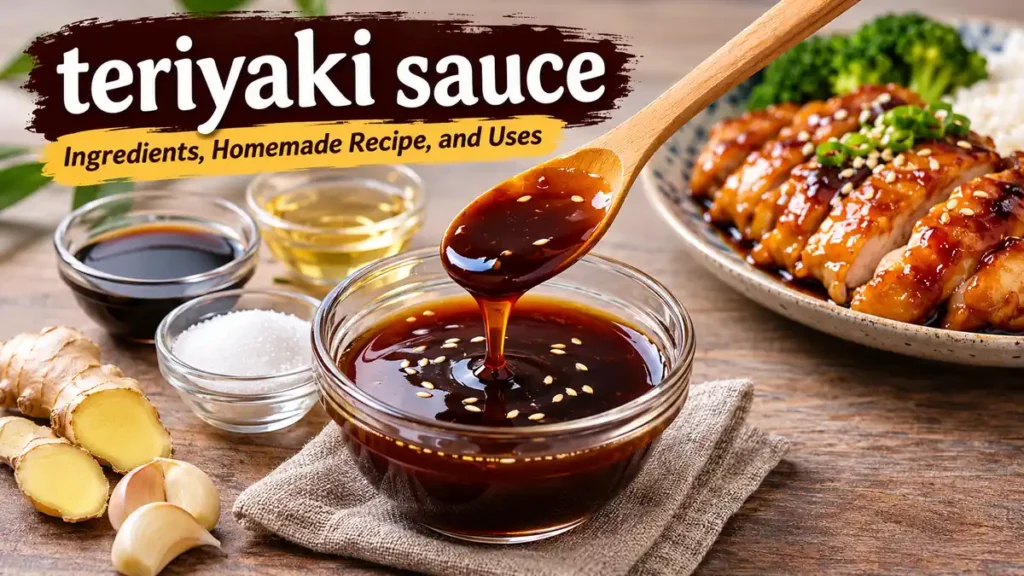
A good teriyaki sauce transforms ordinary chicken, salmon, tofu, or vegetables into a flavorful dish with a glossy, sweet-and-savory finish. But homemade versions sometimes turn out too salty, too watery, or overly sweet.
The secret is understanding how a few basic ingredients work together.
Teriyaki sauce is a Japanese-style seasoning made primarily from soy sauce, mirin, sake, and sugar. These ingredients create a balanced combination of salty, sweet, and umami flavors. Traditionally, the mixture is simmered until slightly reduced and glossy, then used to glaze cooked foods. Modern variations may include ginger, garlic, honey, or cornstarch.
Homemade teriyaki sauce is relatively simple to prepare, and you can adjust its sweetness, saltiness, and thickness to suit different dishes.
What Is Teriyaki Sauce?
Teriyaki sauce is a sweet and savory Japanese seasoning commonly used as a glaze, marinade, or finishing sauce for meat, seafood, and vegetables.
The word teriyaki combines two Japanese terms:
- Teri: Refers to the shine or glossy appearance of the finished food.
- Yaki: Refers to cooking methods involving grilling, broiling, or pan-cooking.
In traditional Japanese cuisine, teriyaki describes a cooking technique rather than simply a bottled condiment.
Foods are cooked and coated with a mixture that produces a shiny, caramelized-looking surface.
What Does Teriyaki Sauce Taste Like?
Teriyaki sauce has a distinctive combination of four flavor characteristics.
| Flavor | Main source | Effect |
|---|---|---|
| Sweet | Sugar and mirin | Balances saltiness |
| Salty | Soy sauce | Adds seasoning |
| Umami | Fermented soy sauce | Creates savory depth |
| Mildly aromatic | Mirin and sake | Adds complexity |
The result is a rich, balanced sauce that complements many proteins and vegetables.
Traditional Japanese versions are generally less heavily seasoned with garlic and ginger than some American-style recipes.
Is Teriyaki Sauce Japanese or American?
Teriyaki originated in Japan, where it developed as a cooking method using soy-based seasonings.
Over time, teriyaki became popular in Hawaii and the mainland United States, where cooks developed additional variations.
American-style versions often feature ingredients such as brown sugar, garlic, ginger, pineapple juice, and cornstarch.
Both styles share the same basic sweet-and-savory character, but their textures and flavor profiles can differ considerably.
What Is Teriyaki Sauce Made Of?
Traditional Japanese teriyaki sauce requires just four main ingredients.
Japanese-Style Teriyaki Beef Bowl
The 4-Ingredient Recipe I Use on Just About Everything
Homemade Teriyaki Sauce – The Soccer Mom Blog
8
The Four Traditional Ingredients
1. Soy sauce
Soy sauce provides the salty foundation and much of the sauce’s umami flavor.
Japanese soy sauce, commonly called shoyu, is particularly suitable.
Regular soy sauce produces a stronger salty flavor, while reduced-sodium varieties can help control the sodium content.
2. Mirin
Mirin is a sweet Japanese rice wine used extensively in Japanese cooking.
It contributes sweetness, aroma, and the glossy finish associated with teriyaki dishes.
Different products labeled mirin may contain different amounts of sugar and alcohol, so their flavors are not always interchangeable.
3. Sake
Sake is a Japanese rice wine that adds aromatic complexity and balances the overall flavor.
It also contributes subtle savory notes.
Although some alcohol evaporates during cooking, simmering does not guarantee complete alcohol removal.
4. Sugar
Sugar balances the saltiness of soy sauce and contributes to the sauce’s syrupy texture as the liquid reduces.
White granulated sugar is commonly used in traditional recipes.
Brown sugar provides a slightly deeper, molasses-like flavor.
Optional Ingredients in Modern Recipes
Many homemade teriyaki recipes include additional ingredients.
| Ingredient | Purpose |
|---|---|
| Garlic | Adds pungent, savory flavor |
| Fresh ginger | Provides warmth and freshness |
| Honey | Adds floral sweetness |
| Rice vinegar | Introduces gentle acidity |
| Cornstarch | Thickens the sauce quickly |
| Sesame oil | Adds toasted aroma |
| Pineapple juice | Adds fruity sweetness and acidity |
| Chili flakes | Creates a spicy variation |
| Sesame seeds | Adds texture as a garnish |
These additions are optional rather than essential to traditional Japanese teriyaki sauce.
How to Make Homemade Teriyaki Sauce
Making teriyaki sauce at home takes approximately 15–20 minutes, including preparation and simmering.
The following recipe uses the traditional Japanese ingredient combination and relies on reduction rather than added starch for thickening.
Easy Homemade Teriyaki Sauce Recipe
Easy
Pantry Staples Teriyaki Sauce Recipe
Prep time
5 minutes
Cook time
10–15 minutes
Yield
About 1 cup
Ingredients
Recipe quantity
½×1×2×
Soy sauce
½ cup
Mirin
½ cup
Sake
½ cup
Granulated sugar
¼ cup
Copy ingredients
Step-by-Step Instructions
Sake vs Mirin | The Complete Guide for UK Cooks — Bite Buddy
Step 1: Combine the ingredients
Add the soy sauce, mirin, sake, and sugar to a small saucepan. Stir until the sugar begins dissolving.
Step 2: Heat the mixture
Bring the mixture briefly to a boil over medium heat, stirring to dissolve the sugar completely.
Beef Tenderloin with Teriyaki Reduction Recipe | SideChef
Step 3: Simmer gently
Reduce the heat to medium-low and simmer for approximately 10–15 minutes. Stir occasionally and watch for a glossy, slightly syrupy consistency.
Traditional Teriyaki Sauce Recipe | ItsOnly.Recipes
Step 4: Check the thickness
Dip a spoon into the mixture. The sauce should lightly coat the back of the spoon rather than immediately running off like water.
Step 5: Cool and store
Remove from the heat. Allow the sauce to cool briefly before transferring it to a clean, food-safe container. Refrigerate promptly.
The sauce will thicken slightly as it cools.
This traditional four-ingredient approach is also described by Japanese cooking author Namiko Hirasawa Chen in her teriyaki sauce guide. Just One Cookbook
How to Make Teriyaki Sauce Without Mirin or Sake
Not every kitchen has Japanese rice wine available. Fortunately, you can prepare a useful alternative with common pantry ingredients.
The flavor will differ from traditional Japanese teriyaki, but the sauce can still provide a satisfying sweet-and-savory glaze.
Alcohol-Free Teriyaki-Style Sauce
For a version made without alcoholic cooking ingredients, use:
- ½ cup soy sauce
- ½ cup water
- ¼ cup brown sugar
- 1 tablespoon rice vinegar
- 1 teaspoon freshly grated ginger
- 1 small garlic clove, minced
- 1 teaspoon cornstarch mixed with 1 tablespoon cold water, optional
Combine everything except the cornstarch slurry in a saucepan.
Simmer gently for about five minutes, then stir in the slurry if a thicker consistency is desired.
Cook for another one or two minutes until glossy.
Check that your soy sauce and other packaged ingredients meet your dietary requirements if strict alcohol avoidance is necessary.
What Can Replace Mirin?
Mirin contributes both sweetness and aroma, so no single substitute perfectly reproduces its flavor.
Possible alternatives include:
| Substitute | Flavor difference |
|---|---|
| Water and sugar | Sweet but less aromatic |
| Rice vinegar and sugar | Sweeter with noticeable acidity |
| Apple juice | Fruity and mildly sweet |
| Alcohol-free mirin-style seasoning | Often closer to the intended flavor |
When substituting, begin with less sugar than you think you need and adjust after tasting.
Can You Make Teriyaki Sauce Without Soy Sauce?
Yes, although the resulting flavor will change.
Coconut aminos are sometimes used as a soy-free alternative.
They are generally sweeter and often less salty than conventional soy sauce, so additional sugar may not be necessary.
For anyone avoiding soy because of an allergy, verify that every ingredient is explicitly suitable.
How to Thicken Teriyaki Sauce
A common problem with homemade teriyaki sauce is that it remains too thin.
There are two main ways to thicken it: reducing the liquid or adding a starch slurry.
Method 1: Reduce the Sauce Naturally
Traditional Japanese teriyaki sauce usually thickens through evaporation.
As the sauce simmers, water evaporates and the remaining ingredients become more concentrated.
This produces a glossy coating without requiring cornstarch.
For best results:
- Use a wide saucepan to encourage evaporation.
- Keep the heat moderate to avoid scorching.
- Stir occasionally.
- Remove from the heat before the mixture becomes excessively thick.
Remember that reducing the sauce also concentrates its saltiness.
Method 2: Use Cornstarch
Cornstarch is useful when you want a thicker, American-style teriyaki glaze without prolonged reduction.
Mix one teaspoon of cornstarch with one tablespoon of cold water.
Slowly pour the slurry into the simmering sauce while stirring.
Continue cooking until the mixture thickens and the starch is fully cooked.
Avoid adding dry cornstarch directly to hot sauce because it can form lumps.
Which Thickening Method Is Better?
| Feature | Natural reduction | Cornstarch slurry |
|---|---|---|
| Texture | Glossy, lightly syrupy | Thick, smooth |
| Flavor | More concentrated | Less concentrated |
| Traditional Japanese style | Yes | Less typical |
| Speed | Slower | Faster |
| Best use | Pan glazes | Dipping and stir-fry sauces |
For chicken or salmon cooked in a skillet, natural reduction is particularly effective.
For noodles, rice bowls, and thicker dipping sauces, cornstarch may be more convenient.
Best Ways to Use Teriyaki Sauce
Teriyaki sauce is remarkably versatile.
It works particularly well with foods that benefit from a sweet, savory coating.
Chicken Teriyaki: Complete Nutrition Guide – SnapCalorie
Chicken teriyaki
Pan-seared chicken thighs or breasts develop a glossy coating when the sauce is added near the end of cooking. Serve with steamed rice and vegetables.
roasted TERIYAKI SALMON with HOMEMADE TERIYAKI SAUCE
Salmon teriyaki
The sauce complements salmon’s rich flavor. Brush it over cooked salmon during the final minutes of baking or pan-cooking.
Teriyaki tofu
Firm tofu absorbs the sauce’s flavor while developing a lightly caramelized exterior. Pressing the tofu first improves browning.
Beef and broccoli stir fry with bell pepper and sesame seeds served in skillet on gray background
Beef and vegetable stir-fry
Thinly sliced beef, broccoli, carrots, and bell peppers can be coated with teriyaki sauce just before serving.
Can Teriyaki Sauce Be Used as a Marinade?
Yes. Teriyaki sauce can be used as a marinade for chicken, beef, fish, or tofu.
However, a concentrated finishing glaze and a marinade are not always interchangeable.
A thick, sugary glaze may burn when exposed to high heat for too long.
For marinating, a thinner mixture generally works better.
Marinate food in the refrigerator rather than on the kitchen counter.
If a marinade has touched raw meat or poultry, do not reuse it as a finishing sauce unless it has been boiled appropriately. The safer option is to reserve a separate portion before adding raw ingredients.
When Should You Add Teriyaki Sauce While Cooking?
Teriyaki sauce is usually best added toward the end of cooking.
The sugar can scorch when exposed to intense heat for an extended period.
For example, when preparing chicken teriyaki:
- Cook the chicken until nearly done.
- Reduce the heat.
- Add the sauce.
- Turn the chicken to coat it evenly.
- Continue cooking until the chicken reaches a safe internal temperature of 165°F (74°C).
This approach produces a flavorful glaze without unnecessarily burning the sugars.
Teriyaki Sauce vs. Soy Sauce, Hoisin, and Other Sauces
Teriyaki sauce is sometimes confused with other Asian condiments because many share dark colors and savory ingredients.
However, their flavors and culinary purposes differ.
| Sauce | Main flavor | Typical consistency | Common uses |
|---|---|---|---|
| Teriyaki | Sweet, salty, umami | Thin to syrupy | Glazing, marinades |
| Soy sauce | Salty, umami | Thin | Seasoning, dipping |
| Hoisin sauce | Sweet, savory, spiced | Thick | Glazes, dipping |
| Oyster sauce | Savory, mildly sweet | Thick | Stir-fries |
| Ponzu | Citrus, salty, tangy | Thin | Dipping, dressings |
| Yakitori tare | Sweet, savory | Syrupy | Grilled skewers |
Is Teriyaki Sauce the Same as Soy Sauce?
No.
Soy sauce is a fermented seasoning made primarily from soybeans, wheat in many varieties, salt, and water.
Teriyaki sauce uses soy sauce as one of its ingredients but combines it with sweeteners and other seasonings.
As a result, teriyaki sauce is generally sweeter and more suitable for glazing.
What Is the Difference Between Teriyaki Sauce and Hoisin Sauce?
Hoisin sauce is associated with Chinese cuisine and often includes fermented soybean paste, sugar, vinegar, garlic, and spices.
It is usually thicker and has a more complex spiced flavor.
Teriyaki sauce has a cleaner soy-based sweet-and-savory profile, especially in traditional Japanese preparations.
They can occasionally substitute for one another in fusion dishes, but the resulting flavors will differ.
Is Teriyaki Sauce Healthy?
Teriyaki sauce can fit into a balanced diet, particularly when used in moderate amounts.
However, its nutritional profile depends heavily on the recipe.
The two main considerations are sodium and added sugar.
Sodium Content
Soy sauce is naturally high in sodium.
Because soy sauce forms the foundation of teriyaki sauce, even a relatively small serving can contribute a substantial amount of sodium.
Reducing the sauce also concentrates its sodium per tablespoon.
People monitoring sodium intake should pay attention to portion sizes and ingredient labels.
Sugar Content
Traditional recipes contain sugar, while many commercial products include additional sweeteners.
A thick bottled glaze may contain more sugar per serving than a thinner homemade sauce.
Check the nutrition label rather than assuming all teriyaki products have similar nutritional values.
How to Make a Lower-Sodium Version
You can reduce sodium by:
- Using reduced-sodium soy sauce.
- Diluting the sauce slightly with water.
- Avoiding additional salt in the finished dish.
- Serving smaller portions.
- Pairing the sauce with unseasoned vegetables and grains.
Reduced-sodium soy sauce is not necessarily low in sodium, so labels still matter.
Is Teriyaki Sauce Gluten-Free?
Traditional soy sauce commonly contains wheat.
Therefore, standard teriyaki sauce is not automatically gluten-free.
For a gluten-free version, choose certified gluten-free tamari or another suitable gluten-free soy sauce.
Also verify the mirin, sake, and any packaged seasonings used.
Is Teriyaki Sauce Vegan?
A basic mixture of soy sauce, mirin, sake, and sugar is generally suitable for vegan diets, subject to ingredient processing and individual dietary standards.
Some commercial sauces may contain honey or other animal-derived ingredients.
Checking the ingredient list is the most reliable approach.
How to Store Homemade Teriyaki Sauce
Proper storage helps preserve the flavor and quality of homemade teriyaki sauce.
Refrigeration
Transfer the sauce to a clean, airtight container and refrigerate promptly after preparation.
For a conservative home-storage guideline, use homemade sauce within approximately one week.
A simple recipe containing only soy sauce, sake, mirin, and sugar may keep longer under suitable conditions, but recipes containing fresh garlic, ginger, or other ingredients can have different storage characteristics.
For comparison, BBC Good Food recommends refrigerating its garlic-and-ginger teriyaki recipe for up to one week. bbcgoodfood.com
Can You Freeze Teriyaki Sauce?
Yes.
Teriyaki sauce can be frozen in small, airtight portions.
An ice cube tray is convenient when you regularly need only a tablespoon or two.
After freezing, transfer the portions to a freezer-safe container.
Thaw in the refrigerator before using.
The sauce may need stirring or gentle reheating to restore an even consistency.
How Can You Tell If Teriyaki Sauce Has Gone Bad?
Discard homemade sauce if you notice mold, unusual bubbling, an unexpected fermented odor, or other clear signs of spoilage.
However, harmful microbial growth is not always visible or detectable by smell.
Do not taste questionable sauce to determine whether it is safe.
If storage conditions are uncertain, discarding it is safer.
Common Teriyaki Sauce Problems and How to Fix Them
Even a simple recipe can produce disappointing results if the ingredients or cooking technique are not balanced.
Why Is My Teriyaki Sauce Too Salty?
Excessive saltiness often results from using too much soy sauce or reducing the mixture too aggressively.
To correct it, add a small amount of water and, if needed, a little additional sweetness.
Avoid adding more soy sauce until you have tasted the adjusted mixture.
Why Is My Teriyaki Sauce Too Sweet?
Too much sugar, honey, or sweetened mirin-style seasoning can overwhelm the savory flavor.
Add a little unsweetened liquid or soy sauce to rebalance the mixture.
A small amount of rice vinegar can also introduce acidity, although it changes the traditional flavor.
Why Is My Sauce Too Thin?
The mixture may not have reduced enough.
Continue simmering gently until it reaches the desired consistency.
Alternatively, add a small cornstarch slurry for quicker thickening.
Why Did My Teriyaki Sauce Become Too Thick?
The sauce may have reduced too far.
Add water one teaspoon at a time while warming and stirring gently.
Remember that the sauce thickens further as it cools.
Why Does My Teriyaki Sauce Taste Bitter?
Bitterness may result from scorched sugar or burned garlic.
If the sauce has a pronounced burnt flavor, it is usually better to start again.
Prevent this problem by lowering the heat and adding sugary glaze near the end of cooking.
Why Is My Teriyaki Sauce Not Glossy?
The glossy finish develops as sugar dissolves and the liquid reduces.
If the sauce remains watery, it may not coat the food properly.
Allow it to reduce slightly, but avoid cooking it until it becomes sticky or scorched.
Traditional vs. Modern Teriyaki Sauce
Traditional Japanese and modern Western-style teriyaki sauces share a common flavor foundation but often differ in preparation.
| Characteristic | Traditional Japanese | Modern Western-style |
|---|---|---|
| Main ingredients | Soy sauce, mirin, sake, sugar | Soy sauce, sugar, garlic, ginger, and other additions |
| Thickener | Natural reduction | Often cornstarch |
| Sweetness | Balanced | Often sweeter |
| Texture | Light, glossy coating | Frequently thicker |
| Common preparation | Pan glazing | Marinades, stir-fries, dipping |
| Flavor emphasis | Soy, mirin, sake | Sweetness and aromatics |
Neither style is inherently better.
The traditional version works especially well when the goal is to highlight the flavor of fish, chicken, or other main ingredients.
Modern variations can be useful when preparing saucier dishes, noodle bowls, or strongly seasoned stir-fries.
Final Thoughts on teriyaki sauce
Teriyaki sauce is a versatile Japanese seasoning built around the balance of soy sauce, sweetness, and savory umami.
The traditional four-ingredient version offers a straightforward way to create a glossy glaze without additional thickeners. Modern variations provide flexibility for cooks who prefer garlic, ginger, honey, or a thicker consistency.
The most useful technique is to control the heat, taste before over-reducing, and add the sauce toward the end of cooking.
Start with the basic recipe, then adjust the sweetness and consistency to match the dish. A well-balanced homemade teriyaki sauce should complement the food rather than overpower it.