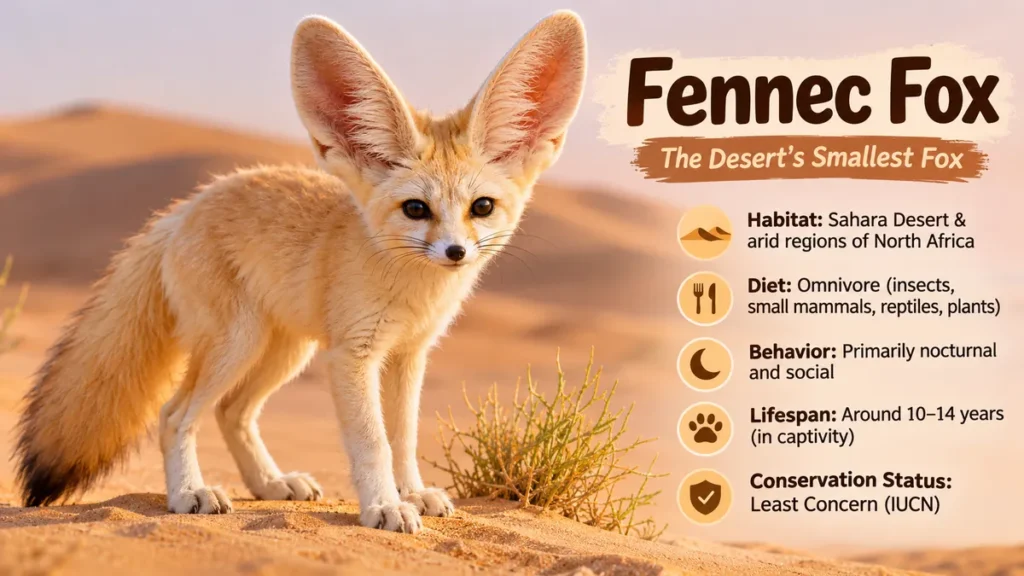
Imagine a fox small enough to fit comfortably in your arms, with ears almost as long as its head. Meet the fennec fox, one of the most distinctive animals living in the world’s harshest deserts.
The fennec fox (Vulpes zerda) is a small, nocturnal desert mammal native to North Africa, particularly the Sahara Desert. Famous for its oversized ears, sandy-colored fur, and remarkable heat-management adaptations, it is generally recognized as the smallest living fox species. It survives by hunting opportunistically, conserving water, and sheltering in underground burrows.
Despite its delicate appearance, this desert fox is a highly specialized predator. Its physical features, social behavior, and survival strategies reveal how mammals can thrive in environments where temperatures fluctuate dramatically and water is scarce.
What Is a fennec fox?
Fennec Fox Facts – CRITTERFACTS
The Little Prince’s Fox by Lukas Zeman | World Photography Organisation
10
The fennec fox belongs to the family Canidae, which includes wolves, domestic dogs, coyotes, jackals, and other foxes. Its scientific name is Vulpes zerda, and it is particularly well adapted to hot, dry environments.
Unlike larger foxes that inhabit forests, grasslands, and agricultural areas, this species is closely associated with sandy deserts and arid landscapes.
fennec fox quick facts
| Characteristic | Details |
|---|---|
| Scientific name | Vulpes zerda |
| Family | Canidae |
| Genus | Vulpes |
| Average body length | Approximately 24–41 cm (9.4–16.1 inches), excluding tail |
| Tail length | Approximately 18–31 cm (7–12 inches) |
| Weight | Approximately 0.7–1.6 kg (1.5–3.5 pounds) |
| Ear length | Up to about 15 cm (6 inches) |
| Natural habitat | Sandy deserts and arid regions |
| Geographic range | North Africa, including the Sahara |
| Diet | Omnivorous |
| Activity | Primarily nocturnal |
| Lifespan | Often around 10–14 years in captivity |
| Conservation status | Least Concern (IUCN) |
Its tiny size is especially striking when compared with the red fox (Vulpes vulpes), which is considerably larger and occupies a much broader range of habitats.
Although small, the fennec is an effective hunter with excellent hearing, fast reflexes, and strong digging abilities.
Where Does the fennec fox Live?
The natural habitat of the fennec fox stretches across the Sahara Desert and adjoining dry regions of North Africa.
Its distribution includes parts of Algeria, Egypt, Libya, Mauritania, Mali, Niger, Chad, Sudan, Tunisia, and Morocco, although local abundance varies considerably.
Desert habitat and geographic distribution
Sahara Desert nearby the Grand Erg Oriental , Tunisia -Africa
البيئة تطلق ثعلب الفنك المهدد بالانقراض بمحمية العميد بمطروح
Sahara er verdens største ørken – og den vokser | illvit.no
9
Fennec foxes favor environments with loose sandy soil, where digging is relatively easy. They are associated with several types of arid habitat:
- Sand dunes and sandy plains
- Semi-arid desert margins
- Areas with scattered grasses and shrubs
- Sandy landscapes with suitable burrow sites
Sparse vegetation is valuable because it can provide shelter, support prey populations, and help stabilize the soil around burrows.
The species is not restricted to completely barren dunes. Desert environments containing patches of vegetation can offer important feeding and shelter opportunities.
Why underground burrows are essential
Daytime temperatures in the Sahara can become extremely high. Instead of remaining exposed, fennec foxes retreat into underground dens.
Their burrow systems may contain tunnels, chambers, and multiple entrances. The surrounding soil buffers temperature changes, providing a more stable environment than the desert surface.
Burrows also serve as protection against predators and sheltered locations for raising young.
Fennecs dig using their forefeet, and their compact bodies allow them to maneuver through narrow underground passages.
Why Does the fennec fox Have Such Big Ears?
The oversized ears of the fennec fox are among the most recognizable adaptations in the animal kingdom.
They serve two major functions: detecting prey and helping the animal manage body heat.
Exceptional hearing for locating prey
Meet the Fennec Fox: Desert Survivor with Enormous Ears
Fennec foxes possess highly sensitive hearing that helps them detect small animals moving across sand or beneath its surface.
Their large external ears, called pinnae, collect sound and help the fox determine its direction.
This ability is especially valuable at night, when visual information is limited and prey may be partially hidden.
For example, a small rodent moving beneath loose sand may produce subtle vibrations and sounds. A fennec can use auditory cues to locate the animal before digging or pouncing.
How the ears help regulate temperature
Large ears also provide a substantial surface area through which heat can be exchanged with the surrounding environment.
Blood vessels within the ears can contribute to heat dissipation when conditions allow.
However, large ears do not function like an automatic cooling system under every condition. When the surrounding air is hotter than the animal’s body, losing heat becomes more difficult.
The fennec’s heat-management strategy therefore depends on several adaptations working together, including nocturnal activity, burrow use, and behavior that reduces exposure to extreme temperatures.
Other physical adaptations
The fennec fox possesses several additional features that support desert survival.
Thick fur: Its coat provides insulation against temperature extremes. Desert nights can become surprisingly cold, and dense fur helps reduce heat loss.
Sandy coloration: Pale cream or beige fur helps the animal blend into its surroundings and may reduce absorption of solar radiation compared with darker coloration.
Furry footpads: Hair covering the soles helps protect the feet from hot sand and provides traction on loose surfaces.
Compact body: A small body reduces overall resource requirements, although it also creates challenges for temperature regulation.
Bushy tail: The tail contributes to balance and can provide additional insulation when the animal rests curled up.
Together, these features make the species unusually well suited to its environment.
What Does a fennec fox Eat?
The fennec fox is an omnivore, meaning it consumes both animal and plant-based foods. Its flexible diet allows it to survive in desert environments where food availability changes with the seasons.
Unlike animals that depend on a single food source, fennecs take advantage of whatever suitable prey or vegetation is available.
Main foods in the wild
| Food category | Examples | Nutritional importance |
|---|---|---|
| Insects | Grasshoppers, locusts, beetles | Protein and energy |
| Small mammals | Mice, gerbils, other rodents | Protein and fat |
| Reptiles | Lizards, geckos, skinks | Animal protein |
| Birds | Small birds and eggs | Protein and fat |
| Plants | Roots, leaves, fruits | Nutrients and moisture |
| Other invertebrates | Spiders, scorpions | Additional food sources |
According to the Smithsonian’s National Zoo, fennecs hunt primarily at night and use their sensitive hearing to locate prey, including animals hidden beneath sand. National Zoo+1
How does a fennec fox hunt?
Hunting usually begins after sunset, when desert temperatures become more manageable.
A typical hunting sequence involves:
- Listening: The fox pauses and uses its large ears to detect movement.
- Locating: It identifies the approximate position of prey through sound.
- Approaching: It moves carefully toward the target.
- Digging or pouncing: It uses its feet and quick reflexes to capture the animal.
- Feeding: It consumes the prey or may store surplus food for later.
Fennecs generally forage alone, even though they maintain social relationships with other members of their family groups.
How can fennec foxes survive without drinking much water?
One of the species’ most impressive adaptations is its ability to survive for extended periods without access to free-standing water.
Fennecs obtain moisture from insects, small vertebrates, fruits, roots, and other foods. Their kidneys also help conserve water by reducing unnecessary fluid loss.
This does not mean that they never drink. They can consume water when it is available.
Their survival depends on a combination of dietary moisture, efficient water conservation, and avoiding excessive heat exposure.
fennec fox Behavior and Daily Life
Although fennec foxes frequently hunt alone, they are more social than their solitary nighttime activity might suggest.
They form family groups, communicate through a variety of sounds, and maintain territories around their dens.
Are fennec foxes nocturnal?
Yes. Fennec foxes are primarily nocturnal, meaning they are most active during the night.
They generally remain inside burrows during the hottest daylight hours and emerge around dusk to search for food.
This activity pattern provides several advantages:
- Reduces exposure to extreme daytime heat
- Limits unnecessary water loss
- Allows hunting when many desert animals are active
- Provides opportunities to travel across cooler sand
Some individuals may also become active during cooler mornings or evenings, particularly under managed conditions.
Social groups and family relationships
WWF Gift Guide: Adopt fennec fox – WWF.CA
Fennecs often live in family groups containing a breeding pair, their offspring, and sometimes older young.
Groups may contain as many as ten individuals, although their composition varies.
Their social interactions include playing, grooming, resting near one another, and communicating through vocalizations.
Breeding pairs are generally described as monogamous, and both parents contribute to raising their young.
What sounds do fennec foxes make?
Despite their small size, these foxes have an extensive vocal repertoire.
They can produce barks, squeaks, whimpers, growls, chatters, howls, and high-pitched shrieks.
Different sounds may be associated with excitement, alarm, territorial disputes, social contact, or defensive behavior.
They also communicate through body posture and scent marking. Urine and feces help mark territories and convey information to other foxes.
How fast and agile are they?
Fennec foxes are remarkably agile for their size.
Their powerful hind legs help them jump, change direction, and move across uneven sandy terrain.
They can leap approximately 60–90 cm (2–3 feet) vertically under suitable conditions, making their jumping ability particularly impressive relative to their body size.
Reliable measurements of their maximum running speed are limited, so precise speed claims should be treated cautiously.
fennec fox Reproduction, Babies, and Lifespan
Fennec foxes generally reproduce once a year, with breeding commonly occurring during winter.
Their reproductive behavior reflects the importance of stable family groups and protected underground nesting sites.
Mating season and pregnancy
The breeding season typically occurs around January and February, although timing can vary.
After mating, pregnancy lasts approximately 50–53 days.
Females usually give birth inside a protected burrow, where newborns remain sheltered from harsh weather and predators.
A typical litter contains two to five pups.
What are baby fennec foxes called?
WWF Responsible Pet Guide | Pages | WWF
Baby fennec foxes are called kits or pups.
Newborn kits are blind and completely dependent on their mother for warmth, protection, and nutrition.
Their development follows several important stages.
| Age | Typical development |
|---|---|
| Birth | Born with fur but eyes closed |
| 8–11 days | Eyes begin opening |
| Around 2 weeks | Begin walking |
| First several weeks | Depend heavily on maternal care |
| Around 10 weeks | Generally weaned |
| 9–11 months | Reach sexual maturity |
The male typically helps by providing food and defending the family territory.
Older offspring may also remain near their parents and participate in family interactions.
How long does a fennec fox live?
Fennec foxes may live for approximately ten years in the wild, although reliable long-term survival data from natural populations are limited.
Under human care, individuals can sometimes survive for 12 years or longer. Lifespan depends on genetics, nutrition, veterinary care, and environmental conditions.
The Smithsonian reports a lifespan of up to approximately 11 years in human care, while other zoological references document longer-lived individuals. Animal Diversity Web+2
Wild fennecs face additional risks, including predation, food shortages, disease, and human disturbance.
fennec fox Predators, Threats, and Conservation
Despite its ability to survive harsh desert conditions, the fennec fox is vulnerable to natural predators and human activities.
Its small body makes it a potential target for larger carnivores and birds of prey.
What animals hunt fennec foxes?
Potential predators include large owls, jackals, and other carnivores capable of capturing small mammals.
Eagle-owls are often mentioned as possible predators. Domestic dogs and larger terrestrial predators may also pose risks in some habitats.
However, direct observations of predation in the wild are relatively limited. The exact importance of individual predators remains poorly documented.
Fennecs reduce their exposure to danger by remaining near burrows, using camouflage, and relying on sensitive hearing to detect threats.
Is the fennec fox endangered?
Least Concern
IUCN Red List classification
The fennec fox is classified as Least Concern on the IUCN Red List, meaning the species is not currently considered globally threatened with extinction.
However, this classification does not mean every local population is secure.
Its worldwide population size has not been reliably established, partly because nocturnal animals inhabiting remote deserts are difficult to survey.
Conservation assessments indicate that the species remains relatively widespread across much of its range. IELC LibGuides+1
Main threats to survival
Human-related pressures include:
- Wildlife trade: Capture for exhibition, tourism, or exotic animal ownership
- Habitat disturbance: Expansion of settlements and infrastructure
- Road mortality: Vehicle collisions in developing desert regions
- Hunting and trapping: Direct removal from natural populations
- Environmental change: Changes in desert habitats and available resources
Some of these threats are localized rather than widespread across the species’ entire distribution.
What protections exist?
The fennec fox is listed under Appendix II of the Convention on International Trade in Endangered Species of Wild Fauna and Flora (CITES).
This means international commercial trade is regulated through a permit system rather than universally prohibited.
The species also receives legal protection in countries including Morocco, Algeria, Tunisia, and Egypt.
Protecting suitable desert habitats and monitoring wildlife trade are important components of its long-term conservation. United Parks & Resorts+1
Can a fennec fox Be Kept as a Pet?
Fennec foxes are sometimes kept as exotic pets because of their small size and appealing appearance.
However, they are wild animals, not domesticated companions like dogs.
Their natural behavior and environmental requirements make them difficult to care for responsibly.
Why fennec foxes are challenging pets
Their needs differ significantly from those of typical household pets.
Nocturnal activity: They are naturally active when most people are sleeping.
Digging behavior: Fennecs have a strong instinct to excavate burrows and may dig through flooring, furniture, or outdoor enclosures.
High activity levels: Their agility and energy require substantial opportunities for movement and exploration.
Social requirements: They naturally maintain relationships with other fennecs, making social management an important welfare consideration.
Specialized nutrition: Their diet requires appropriate animal protein, essential nutrients, and professional dietary planning.
Veterinary needs: Finding veterinarians experienced with exotic canids can be difficult.
Are fennec foxes dangerous?
Fennec foxes are not generally regarded as a major threat to humans, but they can bite or scratch when frightened, stressed, or handled improperly.
They may also display territorial behavior and defensive aggression.
Their small size should not be mistaken for domestication or an automatic willingness to be handled.
Is owning one legal?
Ownership laws vary by country, state, and municipality.
Some jurisdictions prohibit private ownership, while others require permits or impose enclosure and animal welfare requirements.
The World Wildlife Fund advises that the species’ complex housing, social, nutritional, and veterinary needs make private ownership especially challenging. WWF+1
For people interested in observing these animals, reputable wildlife conservation organizations and accredited zoological institutions offer opportunities to learn about them without encouraging unnecessary capture from the wild.
fennec fox vs. Other Fox Species
The fennec fox shares several characteristics with other members of the genus Vulpes, but its adaptations are especially pronounced.
Comparing it with the red fox and Arctic fox highlights how closely fox anatomy relates to environmental conditions.
| Feature | Fennec fox | Red fox | Arctic fox |
|---|---|---|---|
| Scientific name | Vulpes zerda | Vulpes vulpes | Vulpes lagopus |
| Typical habitat | Hot deserts | Forests, grasslands, urban areas | Arctic tundra |
| Body size | Very small | Medium-sized | Small to medium-sized |
| Ears | Extremely large relative to body | Moderate | Small and rounded |
| Coat | Pale, sandy | Often reddish | White or blue-gray seasonal forms |
| Main adaptation | Heat management and desert survival | Environmental flexibility | Cold-weather insulation |
| Diet | Omnivorous | Omnivorous | Primarily carnivorous, opportunistic |
fennec fox vs. red fox
The red fox is larger, has proportionally smaller ears, and occupies a much wider variety of habitats.
Red foxes can live in forests, farmland, grasslands, mountains, and cities.
Fennecs, by comparison, are much more specialized for sandy desert environments.
fennec fox vs. Arctic fox
The Arctic fox provides an especially interesting contrast.
Both animals belong to the same genus, yet their physical features reflect opposite environmental challenges.
The Arctic fox has compact ears, dense insulating fur, and a body shape that helps conserve heat.
The fennec has exceptionally large ears, pale fur, and behavioral adaptations that help it cope with desert heat.
These differences illustrate how natural selection can shape related species to survive in dramatically different climates.
Is the fennec fox related to the bat-eared fox?
Yes, both belong to the family Canidae, but they are classified in different genera.
The bat-eared fox (Otocyon megalotis) lives primarily in African grasslands and savannas and is strongly specialized for eating insects, particularly termites.
Although both species have conspicuously large ears, their diets, habitats, and evolutionary histories differ. National Zoo+1
Interesting fennec fox Facts That Make It Unique
Fennec fox desert Images – Free Download on Magnific (formerly Freepik)
Several lesser-known characteristics make the fennec fox particularly fascinating.
1. It is the smallest living fox species
Its compact body and low weight distinguish it from most other foxes. An adult can weigh less than many domestic cats.
2. Its ears are enormous relative to its body
With ears reaching approximately 15 cm long, the fennec has some of the most proportionally impressive ears among mammals.
3. Its feet are covered with fur
Unlike the exposed footpads of many other canids, its furry soles help protect against hot sand and improve movement across loose surfaces.
4. It can survive without regular access to standing water
The species obtains much of its required moisture from food and conserves water efficiently.
5. It is an excellent digger
Fennecs can excavate extensive underground burrow systems, sometimes with tunnels totaling several meters in length.
6. It is more social than many people expect
Family groups may include parents, pups, and older offspring that remain together for extended periods.
7. Its pale coat provides camouflage
The sandy coloration helps the animal blend into desert landscapes, making it harder for predators and prey to detect.
8. It can make surprisingly loud sounds
Despite its small body, a fennec can produce piercing shrieks, barks, and other vocalizations.
9. It is capable of impressive jumps
Its powerful hind legs allow it to leap several times its own leg length.
10. It plays a role in desert ecosystems
By feeding on insects, rodents, and other small animals, fennecs participate in desert food webs and help influence local prey populations.
Their occasional consumption of fruits and other plant material also connects them to the desert’s vegetation.
Why the fennec fox Matters to Desert Ecosystems
The fennec fox is more than an unusual-looking mammal. It is part of a complex desert ecosystem in which animals must balance energy, water, temperature, and predation risks.
As a small predator, it consumes insects, reptiles, and rodents, contributing to the interactions that regulate desert food webs.
At the same time, it can become prey for larger animals, transferring energy to higher levels of the ecosystem.
Its burrowing activity also disturbs and redistributes sand. Such activities can influence local soil conditions, although the broader ecological effects of fennec burrows have not been extensively quantified.
Studying the species provides researchers with insights into mammalian thermoregulation, water conservation, sensory adaptations, and social behavior.
The fennec fox demonstrates how specialized anatomy and flexible behavior can allow a small mammal to survive in one of Earth’s most demanding environments.
Its extraordinary ears, furry feet, underground shelter, and opportunistic diet all contribute to that success. Understanding these adaptations—and supporting the protection of its natural habitat—helps preserve an important part of North Africa’s desert wildlife.