A dark snake swimming across a pond or resting beside a muddy riverbank can be alarming, especially in the southeastern United States. Is it a harmless water snake or a venomous water moccasin?
The distinction matters, but identifying a snake by color or swimming position alone can lead to mistakes.
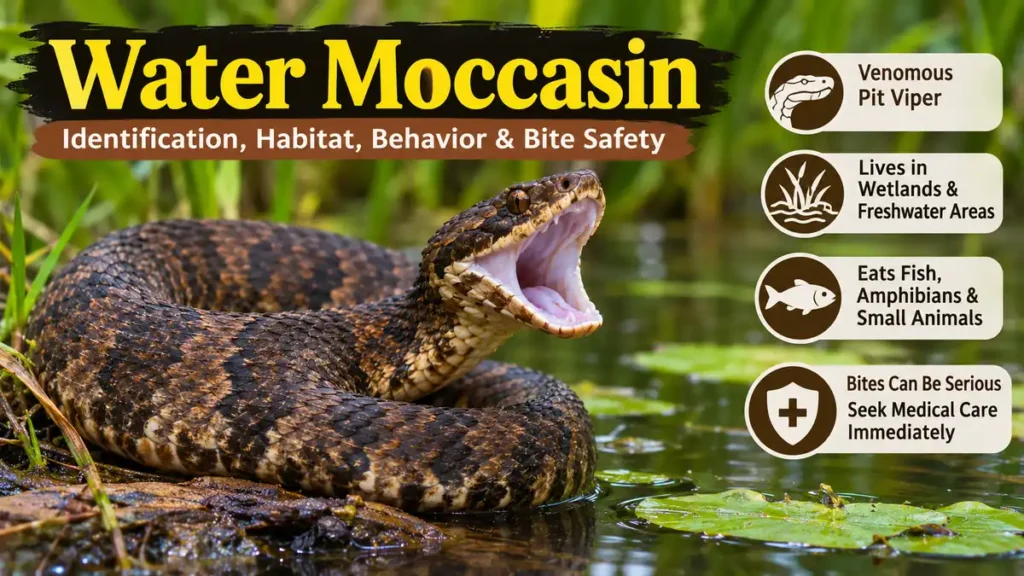
A water moccasin, also called a cottonmouth, is a venomous, semiaquatic pit viper native to the southeastern United States. It belongs to the genus Agkistrodon and is recognized for its heavy body, broad head, heat-sensing facial pits, and defensive display of a white mouth lining. Although potentially dangerous, it generally avoids unnecessary confrontation.
Understanding its appearance, habitat, and behavior helps people recognize potential encounters and respond safely without harming wildlife.
What Is a water moccasin?
The water moccasin is a venomous snake associated with freshwater habitats such as swamps, marshes, streams, lakes, and wetlands.
Its common name, cottonmouth, comes from the striking white interior of its mouth, which the snake may expose when threatened.
Cottonmouths belong to the family Viperidae and the subfamily Crotalinae, commonly called pit vipers. Other North American pit vipers include copperheads and rattlesnakes.
Like these relatives, cottonmouths possess specialized heat-sensing pits between their eyes and nostrils. These structures help them detect warm-blooded prey, particularly under low-light conditions.
Scientific classification
| Classification | Details |
|---|---|
| Common names | water moccasin, cottonmouth |
| Family | Viperidae |
| Subfamily | Crotalinae |
| Genus | Agkistrodon |
| Species | Agkistrodon piscivorus and Agkistrodon conanti |
| Snake type | Venomous pit viper |
| Habitat | Freshwater and nearby terrestrial environments |
| Diet | Fish, amphibians, reptiles, mammals, birds, and other animals |
| Reproduction | Gives birth to live young |
Historically, cottonmouth populations were commonly grouped under Agkistrodon piscivorus, with several recognized subspecies. Modern taxonomic treatments also recognize the Florida cottonmouth, Agkistrodon conanti, as a separate species.
Consequently, the term water moccasin may refer to more than one closely related cottonmouth species.
Why is it called a cottonmouth?
When a cottonmouth feels threatened, it may coil its body, raise its head, and open its mouth widely.
The bright white mouth lining contrasts with the snake’s darker exterior.
This display is a defensive warning, not proof that the animal intends to attack.
Not every cottonmouth opens its mouth when disturbed. Some remain motionless, attempt to escape, or adopt other defensive postures.
How to Identify a water moccasin
Cottonmouth identification requires examining several characteristics together. No single visible feature is completely reliable, especially when observing a snake from a distance.
Body shape and size
Adult cottonmouths have thick, muscular bodies and relatively short tails.
Many adults measure approximately 2–4 feet long, although some grow larger.
Their substantial build distinguishes them from many slender aquatic snakes, but body thickness alone cannot confirm identification.
A well-fed nonvenomous water snake may also appear unusually heavy.
Head shape and facial markings
Cottonmouths typically have broad, somewhat triangular heads that are noticeably wider than their necks.
They also possess prominent brow ridges, which can make their eyes appear partly concealed when viewed from above.
A dark stripe often extends through the eye toward the rear of the head, sometimes bordered by lighter markings.
However, a triangular head does not automatically mean a snake is venomous. Some harmless snakes flatten their heads defensively and can resemble pit vipers.
Color and body patterns
Cottonmouth coloration changes with age and varies among individuals.
Young snakes often display distinctive dark crossbands over a tan, brown, or reddish background.
Adults may retain these patterns, but many become progressively darker, sometimes appearing nearly black.
Common colors include:
- Olive brown
- Dark brown
- Grayish brown
- Nearly black
- Reddish or tan shades in younger snakes
Their bellies may display irregular dark markings.
Mud, wet scales, lighting, and natural variation can make color-based identification particularly unreliable.
Eyes and pupils
Cottonmouths have vertically elliptical pupils, a characteristic shared by many pit vipers.
Several harmless North American water snakes generally have round pupils.
Nevertheless, pupil shape is not a safe identification method for the public. Getting close enough to inspect a snake’s eyes creates unnecessary danger, and pupil appearance can vary with lighting.
Heat-sensing pits
A distinguishing anatomical feature of cottonmouths is the presence of facial pits between the nostrils and eyes.
These sensory organs detect infrared radiation and help the snake locate prey.
The pits are useful for scientific identification but are often difficult to observe without approaching dangerously close.
Juvenile cottonmouth identification
Young cottonmouths can look substantially different from adults.
They frequently have more vivid crossbands and a bright yellow or greenish-yellow tail tip.
Juveniles may move this tail tip to attract prey, a behavior known as caudal luring.
The bright tip usually fades as the snake matures.
Importantly, young cottonmouths are venomous from birth and should never be handled.
water moccasin vs. Water Snake: Key Differences
One of the most common identification challenges is distinguishing a cottonmouth from a nonvenomous water snake.
Snakes in the genus Nerodia, including northern water snakes, banded water snakes, and diamondback water snakes, are frequently mistaken for cottonmouths.
Both groups may occupy similar environments and exhibit overlapping colors and patterns.
| Feature | Cottonmouth | Nonvenomous Nerodia water snake |
|---|---|---|
| Venom | Venomous | Nonvenomous |
| Body | Usually heavy and muscular | Variable, often comparatively slender |
| Head | Broad with pronounced brow ridge | Often narrower, but may flatten defensively |
| Pupils | Vertically elliptical | Round |
| Facial pits | Present | Absent |
| Mouth display | May expose white interior | May gape or bite defensively |
| Swimming | Often swims with much of its body visible | May swim at the surface or submerged |
| Habitat | Wetlands and nearby land | Lakes, rivers, ponds, marshes, and streams |
These differences are general tendencies rather than a foolproof field-identification checklist.
Do cottonmouths swim differently from harmless snakes?
A popular claim suggests cottonmouths always swim with their entire bodies floating on the surface, while harmless water snakes swim underwater.
This is misleading.
Cottonmouths often swim buoyantly with substantial portions of their bodies visible, but they can also dive and swim underwater.
Nonvenomous water snakes can likewise swim at the surface.
Therefore, swimming posture alone cannot reliably distinguish a cottonmouth from a harmless snake.
Can harmless water snakes look like cottonmouths?
Yes.
Banded water snakes (Nerodia fasciata) and northern water snakes (Nerodia sipedon) can closely resemble cottonmouths, particularly when their coloration is dark.
Defensive behaviors can increase the resemblance. Nonvenomous water snakes may flatten their heads, inflate their bodies, strike, or release a foul-smelling musk.
These actions are normal defensive responses and do not establish that a snake is venomous.
What should you do if you cannot identify the snake?
Keep your distance and allow it to leave.
Avoid attempting to capture, kill, or reposition an unidentified snake.
A clear photograph taken from a safe distance may help a qualified wildlife specialist identify the species later.
There is no need to approach the animal for a closer picture.
Where Do Water Moccasins Live?
Cottonmouths are native to the southeastern United States, where warm temperatures and abundant freshwater habitats support their populations.
Their distribution includes parts of the Atlantic Coastal Plain, Gulf Coastal Plain, and Mississippi River drainage.
Geographic range
Cottonmouth populations occur in portions of states including:
- Florida
- Georgia
- Alabama
- Mississippi
- Louisiana
- Arkansas
- Texas
- South Carolina
- North Carolina
- Tennessee
- Kentucky
- Missouri
- Oklahoma
- Virginia
Their presence is not uniform across these states. Some occur only within particular regions or drainage systems.
A state-level range map should not be interpreted as evidence that cottonmouths inhabit every county or waterway.
For accurate local distribution, consult a state wildlife agency or a university-based herpetology resource.
Preferred habitats
Cottonmouths are semiaquatic, meaning they spend time both in water and on land.
Typical habitats include:
- Cypress swamps and forested wetlands
- Freshwater marshes
- Slow-moving rivers and creeks
- Ponds and lake margins
- Floodplains and drainage channels
- Wet ditches and seasonal wetlands
They may rest on logs, muddy banks, vegetation, or other surfaces near water.
Although strongly associated with aquatic environments, cottonmouths can travel over land and may occasionally be encountered away from obvious water sources.
Are cottonmouths found in saltwater?
Cottonmouths are primarily freshwater snakes, but they can tolerate brackish environments and occasionally occur in coastal habitats.
Some populations inhabit barrier islands or coastal wetlands.
Their presence near saltwater does not make them sea snakes. They remain terrestrial and freshwater-associated pit vipers with the ability to use certain coastal environments.
Are water moccasins found outside the United States?
Native cottonmouth populations are restricted to the United States.
They are not naturally distributed throughout Central America, South America, Europe, Asia, or Australia.
Snakes elsewhere may have similar appearances or common names, but they are not necessarily true cottonmouths.
water moccasin Behavior: Are They Aggressive?
Cottonmouths have a reputation for being unusually aggressive, yet this reputation often reflects misunderstandings of defensive behavior.
Like other wild snakes, cottonmouths generally seek to avoid unnecessary injury.
A snake may remain still, retreat, or display defensive behavior when approached.
Why do cottonmouths open their mouths?
The characteristic open-mouth display exposes the white oral lining and warns a perceived threat to stay away.
The snake may also coil, vibrate its tail, or hold its head in a defensive position.
Such behaviors indicate stress or perceived danger.
They should be interpreted as reasons to increase distance rather than invitations to interact.
Do cottonmouths chase people?
Claims that cottonmouths deliberately pursue humans are frequently exaggerated.
A snake moving toward someone may be attempting to reach shelter, water, or an escape route located in that direction.
Cottonmouths can defend themselves when cornered or threatened, but people are not prey.
The safest response is to move away calmly and give the snake an unobstructed escape route.
Are they active during the day or night?
Cottonmouths can be active during daylight and nighttime hours.
Their activity patterns depend on temperature, season, habitat, and prey availability.
During hot weather, activity may shift toward cooler periods.
In cooler seasons, snakes may bask in sunlight to regulate body temperature.
Can cottonmouths climb trees?
Yes, cottonmouths are capable of climbing low vegetation, branches, and other elevated surfaces.
However, they are not primarily arboreal snakes.
They are more commonly associated with ground-level cover, banks, shallow water, and wetland vegetation.
Do cottonmouths hibernate?
In cooler parts of their range, cottonmouths become less active during winter and may shelter in protected locations.
Reptiles experience a form of winter dormancy called brumation, which differs physiologically from mammalian hibernation.
In warmer southern environments, cottonmouths may remain intermittently active during mild winter weather.
What Do Water Moccasins Eat?
Cottonmouths are opportunistic predators with a varied diet.
Their scientific name, piscivorus, means fish-eating, reflecting the importance of fish in their feeding ecology.
However, fish are only one part of their diet.
Common prey
Cottonmouths may consume:
- Fish, including injured or dead fish
- Frogs and other amphibians
- Salamanders
- Small turtles
- Lizards
- Other snakes
- Small mammals
- Birds
- Carrion
Their diet changes according to habitat, body size, season, and prey availability.
How do cottonmouths hunt?
Cottonmouths use a combination of chemical cues, vision, and heat sensing to locate potential prey.
They may wait in ambush or actively search for food.
Their venom helps immobilize prey and begins disrupting biological tissues.
Like other snakes, cottonmouths swallow their prey whole using highly flexible jaws and specialized skull anatomy.
Do cottonmouths eat other snakes?
Yes.
Cottonmouths are known to consume other snakes, including aquatic species and occasionally other venomous snakes.
Cannibalism has also been documented.
This flexible feeding behavior allows cottonmouths to exploit different food sources within wetland ecosystems.
Their ecological role
Cottonmouths are both predators and prey.
By consuming fish, amphibians, rodents, and other animals, they participate in wetland food webs.
They may also be eaten by larger predators, including birds of prey and other wildlife.
Their presence contributes to the biological diversity of southeastern aquatic ecosystems.
How Dangerous Is a water moccasin Bite?
A cottonmouth bite is a medical emergency because its venom can cause significant pain, swelling, tissue injury, and disturbances in normal blood clotting.
The severity varies depending on the amount of venom injected, the location of the bite, the person’s health, and how quickly appropriate treatment begins.
Although fatalities are uncommon with timely medical care, serious complications can occur.
What does cottonmouth venom do?
Cottonmouth venom contains biologically active proteins and enzymes that affect tissues and blood.
Its effects are primarily cytotoxic and hemotoxic, meaning it can damage local tissues and interfere with normal blood-related processes.
Potential effects include swelling, bruising, tissue destruction, and abnormal clotting.
The degree of injury cannot be reliably determined from the appearance of fang marks.
Symptoms of a cottonmouth bite
Symptoms may include:
- Immediate pain or tenderness
- Progressive swelling around the bite
- Redness, bruising, or discoloration
- Blistering in more serious cases
- Nausea or vomiting
- Weakness or dizziness
- Abnormal bleeding or clotting problems
- Low blood pressure in severe cases
Symptoms may develop or worsen over time.
A person who initially feels relatively well still requires emergency medical evaluation after a suspected venomous snakebite.
Can a water moccasin bite kill you?
Yes, a severe untreated bite can be life-threatening.
However, modern emergency treatment and appropriate antivenom have substantially improved outcomes.
The main danger is not limited to death. Significant tissue damage, prolonged swelling, and functional impairment can occur even when the person survives.
Prompt treatment offers the best chance of preventing serious complications.
Do cottonmouths always inject venom?
No.
Like other venomous snakes, cottonmouths can sometimes deliver a dry bite, meaning little or no venom is injected.
However, it is impossible to reliably identify a dry bite immediately based on pain, swelling, or puncture marks.
Never assume a bite is harmless simply because symptoms are initially mild.
What to Do If a water moccasin Bites You
If you suspect a cottonmouth bite, call 911 or your local emergency number immediately.
Do not wait for symptoms, and do not attempt to capture the snake.
Immediate first aid
- Move away from the snake to prevent another bite.
- Call emergency services and request medical assistance.
- Remain as calm and still as possible, minimizing physical exertion.
- Remove rings, watches, and tight clothing near the affected area before swelling develops.
- Rest the affected limb in a comfortable, neutral position.
- If practical, gently wash the wound with soap and water and cover it with a clean, dry dressing.
- If swelling develops, mark its leading edge and record the time for medical professionals.
Avoid driving yourself to the hospital if emergency transportation is available.
These measures follow guidance from the CDC and the American Heart Association/American Red Cross first-aid recommendations. CDC+1
Dangerous first-aid mistakes
Never attempt to treat a cottonmouth bite by:
- Applying a tourniquet
- Cutting the wound
- Sucking out venom
- Applying ice
- Using electric shock
- Applying a tight pressure-immobilization bandage
- Drinking alcohol
- Taking aspirin or ibuprofen without medical guidance
- Attempting to catch or kill the snake
These practices may worsen tissue damage, increase complications, or delay effective treatment.
How are cottonmouth bites treated in hospitals?
Medical professionals assess the bite, monitor swelling, evaluate blood clotting, and check for systemic effects.
Treatment may include pain management, wound care, laboratory testing, and observation.
When clinically indicated, physicians administer antivenom to counteract venom effects and reduce further injury.
Antivenom is not necessarily required for every suspected bite. The decision depends on clinical findings and progression.
The American College of Medical Toxicology notes that antivenom used for North American pit vipers can treat envenomation from cottonmouths, copperheads, and rattlesnakes. ACMT+1
How long does recovery take?
Recovery depends on the severity of envenomation and the effectiveness of treatment.
Mild cases may improve relatively quickly, while serious bites can require weeks or months of recovery.
Some individuals experience lingering swelling, pain, or tissue complications.
Follow-up medical care is important even after the immediate emergency has passed.
Water Moccasin Reproduction and Life Cycle
Cottonmouths reproduce sexually and give birth to live young rather than laying eggs.
Their reproductive strategy differs from that of many familiar nonvenomous snakes.
When do cottonmouths mate?
Breeding activity varies with geographic location and seasonal temperatures.
Mating can occur during warmer periods, particularly in spring, with additional activity sometimes observed later in the year.
Male cottonmouths may engage in ritualized combat while competing for access to receptive females.
These encounters involve intertwined bodies and attempts to push competing males downward.
How many babies do cottonmouths have?
Females commonly produce litters containing several young, although litter size varies considerably.
The Florida Museum of Natural History reports approximately 1–20 young in Florida cottonmouth litters, with births typically occurring from August through October in that region. Florida Snake ID Guide
Newborn cottonmouths are independent and capable of hunting.
They also possess functional venom-delivery systems.
How long do cottonmouths live?
Cottonmouth lifespan varies with environmental conditions, predation, disease, and other factors.
Some individuals can survive for well over a decade, particularly under protected conditions.
Wild survival is more difficult to measure because individual snakes are rarely followed throughout their entire lives.
Are baby cottonmouths more dangerous than adults?
Baby cottonmouths are venomous and can cause medically significant bites.
However, the popular claim that young venomous snakes are inherently more dangerous because they cannot control venom injection is not a reliable general rule.
Adult cottonmouths have larger venom glands and can potentially deliver greater quantities of venom.
Regardless of age, every suspected cottonmouth bite deserves prompt medical attention.
How to Avoid water moccasin Encounters
The safest approach is prevention rather than attempting to remove or confront a snake.
Most encounters can end without injury when people maintain distance and allow the animal to retreat.
Safety around lakes, rivers, and swamps
When visiting cottonmouth habitat:
- Stay on established trails when possible.
- Watch where you place your hands and feet.
- Avoid stepping over logs without checking the opposite side.
- Wear sturdy footwear in brushy or wet environments.
- Use a flashlight when walking outdoors after dark.
- Avoid reaching into vegetation or underwater hiding places.
- Give resting or swimming snakes plenty of space.
Never attempt to move a snake using a stick or paddle.
A snake that appears motionless may still defend itself if disturbed.
What if you encounter one while swimming?
Move away calmly and avoid sudden attempts to grab or strike the snake.
If possible, exit the water without approaching it.
Cottonmouths are capable swimmers, but they do not regard humans as prey.
Do not assume a snake swimming toward your general direction is deliberately attacking you.
Can water moccasins bite underwater?
Cottonmouths are physically capable of opening their mouths and biting underwater.
Claims that they are unable to bite beneath the surface should not be relied upon for safety.
Avoid touching or cornering any unidentified snake in water.
What attracts cottonmouths to yards?
Properties near ponds, creeks, marshes, and drainage channels may occasionally attract cottonmouths.
Factors that can make an area suitable include abundant prey, accessible shelter, and proximity to natural wetlands.
Potential hiding places include dense vegetation, debris piles, and areas around fallen logs.
How to make your property less attractive to snakes
Practical habitat-management steps include:
- Keep grass maintained near frequently used outdoor areas.
- Remove unnecessary piles of wood, boards, and debris.
- Reduce rodent attractants such as accessible pet food.
- Seal suitable gaps around buildings.
- Maintain clear walking paths and outdoor lighting.
- Keep children and pets away from unidentified snakes.
These steps may reduce encounters but cannot guarantee that snakes will never enter a property.
If a cottonmouth remains in a high-traffic area, contact a qualified wildlife professional for assistance.
Are cottonmouths dangerous to dogs and cats?
Yes.
Pets may be bitten when investigating, chasing, or attempting to attack a snake.
A suspected cottonmouth bite in a dog or cat requires immediate veterinary attention.
Do not wait for swelling to become severe.
Keep pets leashed near wetlands and prevent them from investigating snakes or dense vegetation.
Common Myths About Water Moccasins
Misconceptions about cottonmouths contribute to unnecessary fear and the killing of harmless water snakes.
Understanding what research and wildlife observations actually support helps distinguish realistic risks from folklore.
Myth: Cottonmouths always chase people
Cottonmouths may hold their ground or move toward an escape route that happens to be near a person.
That behavior is not evidence of deliberate pursuit.
The Florida Museum of Natural History specifically describes the species’ intimidating displays as defensive rather than aggressive. Florida Snake ID Guide
Myth: Every dark snake in water is a cottonmouth
Numerous nonvenomous snakes inhabit southeastern waterways.
Many have dark coloration, thick bodies, or banded patterns.
Identification requires more than habitat and color.
Myth: Cottonmouths cannot climb
Although primarily associated with ground and water habitats, cottonmouths can climb vegetation and low branches.
Climbing ability alone does not distinguish venomous from nonvenomous species.
Myth: Cottonmouths drop from trees to attack boaters
Stories of snakes deliberately dropping into boats are not supported as typical cottonmouth hunting behavior.
In some incidents, nonvenomous water snakes resting on overhanging branches may accidentally fall into boats while trying to escape.
Myth: All cottonmouth bites are fatal
Cottonmouth bites can cause serious medical complications, but death is not inevitable.
Timely emergency treatment substantially improves the likelihood of recovery.
Myth: Killing a cottonmouth makes an area safer
Attempting to kill a venomous snake can bring a person within striking distance.
Even a dead snake’s head can remain capable of causing injury through reflexive biting.
Leaving snakes undisturbed and using professional assistance when necessary is generally safer.
Why Water Moccasins Matter to Wetland Ecosystems
Cottonmouths occupy an important ecological position in the southeastern United States.
They consume a wide variety of aquatic and terrestrial animals and contribute to the movement of energy through wetland food webs.
Their scavenging behavior also allows them to consume carrion that other predators may ignore.
On some coastal islands, cottonmouth populations feed heavily on fish remains associated with nesting waterbirds, illustrating how adaptable their feeding ecology can be.
Their ability to exploit different food sources helps them survive in diverse wetland environments.
Despite their venom, cottonmouths are not inherently harmful to ecosystems or people simply because they are present.
They are native predators with established ecological roles.
Protecting wetlands and avoiding unnecessary persecution benefits cottonmouths and many other native species.
Final Thoughts on the water moccasin
The water moccasin is a distinctive venomous pit viper that plays an important role in southeastern American wetlands.
Its heavy body, dark facial stripe, heat-sensing pits, and occasional white-mouth defensive display help distinguish it from other snakes, although identification should never require approaching an animal.
The most useful lessons are straightforward: cottonmouths are not naturally inclined to hunt or chase people, harmless water snakes are frequently mistaken for them, and a suspected bite requires immediate medical attention.
When encountering an unfamiliar snake near water, maintain a safe distance, avoid disturbing it, and allow it to move away naturally. That approach protects both people and wildlife.