Need to convert an inch measurement into millimeters? The calculation is simple, but getting the decimal places right matters when you’re measuring furniture, selecting hardware, reading engineering drawings, or working with precise dimensions.
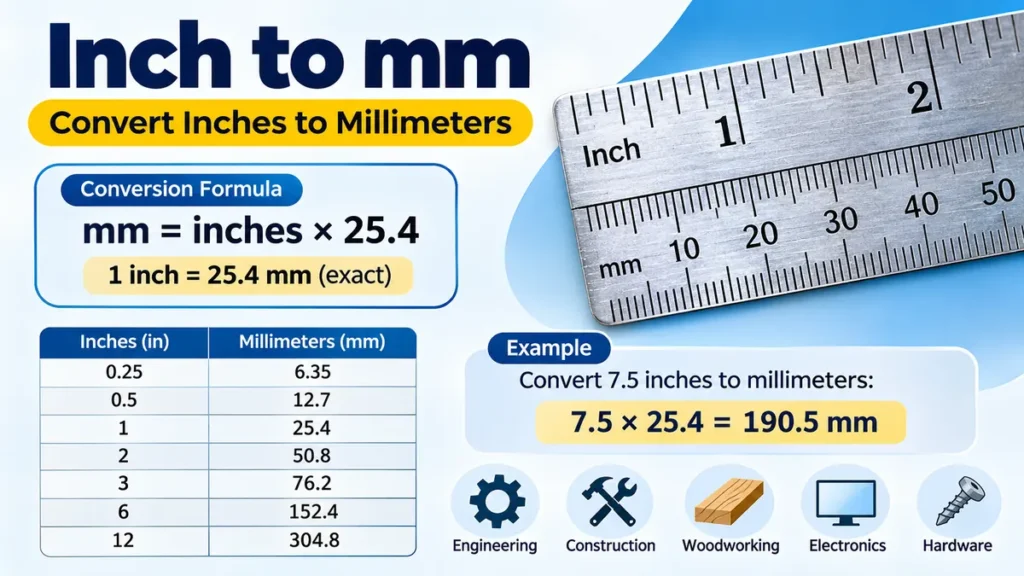
To convert inch to mm, multiply the measurement in inches by 25.4. One inch equals exactly 25.4 millimeters (mm). This conversion factor is internationally standardized and applies to whole inches, decimal inches, and fractional inches. For example, 2 inches equals 50.8 mm, while half an inch equals 12.7 mm.
The formula is:
\[ \text{Millimeters}=\text{Inches}\times25.4 \]
You can use this relationship for any length measurement, from tiny machine components to large construction dimensions.
inch to mm Conversion Formula
The inch is a unit of length used in the US customary and British imperial measurement systems. The millimeter is a metric unit of length in the International System of Units (SI).
The internationally agreed conversion is:
Exact conversion factor
1 inch = 25.4 mm
Multiply inches by 25.4 to get millimeters.
Interactive Inches to Millimeters Converter
Inches (in)Millimeters (mm)
25.4
Decimal places
246
Formula: 1 × 25.4 Copy result
Displayed values are rounded to the selected number of decimal places.
How to convert inches to mm step by step
- Write down the length in inches.
- Multiply that number by 25.4.
- Express the answer in millimeters.
- Round the result only if the application permits it.
For example, convert 7.5 inches to millimeters:
\[ 7.5\times25.4=190.5\text{ mm} \]
Therefore, 7.5 inches equals 190.5 mm.
The same formula works for measurements smaller than one inch. For example, 0.25 inches equals 6.35 mm.
Why is one inch exactly 25.4 mm?
The value 25.4 is not an approximation. It is an exact, defined conversion factor.
The international yard and pound agreement of 1959 established the international inch as exactly 25.4 millimeters. The agreement standardized length measurements among participating English-speaking countries.
The conversion can also be understood through meters:
- 1 meter = 1,000 millimeters.
- 1 inch = 0.0254 meters.
- 0.0254 × 1,000 = 25.4 millimeters.
The definition is maintained within the framework of international measurement standards. Organizations such as the National Institute of Standards and Technology (NIST) and the International Bureau of Weights and Measures (BIPM) provide authoritative information about measurement units and their relationships.
inch to mm Conversion Chart
A conversion chart provides a quick way to find common inch measurements without performing calculations.
The following table covers measurements from 0.01 to 100 inches.
| Inches (in) | Millimeters (mm) |
|---|---|
| 0.01 | 0.254 |
| 0.05 | 1.27 |
| 0.1 | 2.54 |
| 0.125 | 3.175 |
| 0.25 | 6.35 |
| 0.5 | 12.7 |
| 0.75 | 19.05 |
| 1 | 25.4 |
| 1.5 | 38.1 |
| 2 | 50.8 |
| 2.5 | 63.5 |
| 3 | 76.2 |
| 4 | 101.6 |
| 5 | 127 |
| 6 | 152.4 |
| 8 | 203.2 |
| 10 | 254 |
| 12 | 304.8 |
| 18 | 457.2 |
| 24 | 609.6 |
| 36 | 914.4 |
| 48 | 1,219.2 |
| 60 | 1,524 |
| 72 | 1,828.8 |
| 100 | 2,540 |
Every value in this chart is calculated using the exact conversion factor of 25.4.
Common inch conversions explained
1 inch to mm: One inch equals 25.4 mm. This is the base conversion used for all other measurements.
2 inches to mm: Multiply 2 by 25.4 to get 50.8 mm.
3 inches to mm: Three inches equals 76.2 mm.
4 inches to mm: Four inches equals 101.6 mm.
6 inches to mm: Six inches equals 152.4 mm.
12 inches to mm: Twelve inches equals 304.8 mm. Because 12 inches make one foot, one international foot equals exactly 304.8 mm.
These values are useful when reading specifications for tools, pipes, displays, building materials, and household products.
Fractional Inches to Millimeters Conversion
Many rulers, tape measures, drill bits, and woodworking plans use fractions rather than decimal measurements.
Common fractions include 1/2, 1/4, 1/8, 1/16, and 1/32 inch.
To convert fractional inches to millimeters, first divide the numerator by the denominator, then multiply by 25.4.
For example:
\[ \frac{3}{8}\times25.4=9.525\text{ mm} \]
Therefore, 3/8 inch equals exactly 9.525 mm.
Fractional inch to mm chart
| Fraction (in) | Decimal (in) | Millimeters |
|---|---|---|
| 1/64 | 0.015625 | 0.396875 |
| 1/32 | 0.03125 | 0.79375 |
| 1/16 | 0.0625 | 1.5875 |
| 3/32 | 0.09375 | 2.38125 |
| 1/8 | 0.125 | 3.175 |
| 5/32 | 0.15625 | 3.96875 |
| 3/16 | 0.1875 | 4.7625 |
| 7/32 | 0.21875 | 5.55625 |
| 1/4 | 0.25 | 6.35 |
| 5/16 | 0.3125 | 7.9375 |
| 3/8 | 0.375 | 9.525 |
| 7/16 | 0.4375 | 11.1125 |
| 1/2 | 0.5 | 12.7 |
| 9/16 | 0.5625 | 14.2875 |
| 5/8 | 0.625 | 15.875 |
| 11/16 | 0.6875 | 17.4625 |
| 3/4 | 0.75 | 19.05 |
| 13/16 | 0.8125 | 20.6375 |
| 7/8 | 0.875 | 22.225 |
| 15/16 | 0.9375 | 23.8125 |
| 1 | 1 | 25.4 |
How do you convert mixed fractions?
A mixed measurement combines a whole number and a fraction, such as 2 3/8 inches.
First, convert the fraction:
\[ 3\div8=0.375 \]
Add the whole number:
\[ 2+0.375=2.375 \]
Multiply by 25.4:
\[ 2.375\times25.4=60.325\text{ mm} \]
So, 2 3/8 inches equals 60.325 mm.
This method is particularly helpful when interpreting woodworking dimensions, mechanical drawings, and imperial fastener specifications.
Decimal Inches to Millimeters
Decimal inches are commonly used in machining, manufacturing, engineering, and computer-aided design (CAD).
Unlike fractional measurements, decimal inches can be converted directly without first dividing a numerator by a denominator.
For example:
\[ 0.375\times25.4=9.525\text{ mm} \]
Decimal inch conversion table
| Decimal inches | Millimeters |
|---|---|
| 0.001 | 0.0254 |
| 0.005 | 0.127 |
| 0.010 | 0.254 |
| 0.020 | 0.508 |
| 0.050 | 1.27 |
| 0.100 | 2.54 |
| 0.125 | 3.175 |
| 0.200 | 5.08 |
| 0.250 | 6.35 |
| 0.375 | 9.525 |
| 0.500 | 12.7 |
| 0.625 | 15.875 |
| 0.750 | 19.05 |
| 0.875 | 22.225 |
| 0.999 | 25.3746 |
How accurate should the result be?
The conversion factor itself is exact, but the accuracy of the final measurement depends on the precision of the original value.
Suppose a component measures 0.125 inches.
Its converted value is exactly 3.175 mm, assuming the stated inch measurement is exact.
Rounding to 3.18 mm introduces a difference of 0.005 mm.
That difference may be insignificant for ordinary household measurements but could matter when working with tight mechanical tolerances.
For precise applications, preserve sufficient decimal places and follow the tolerance requirements of the engineering drawing.
How to Convert Millimeters Back to Inches
Sometimes you need to reverse the calculation, especially when comparing metric and imperial specifications.
To convert millimeters to inches, divide the millimeter value by 25.4.
\[ \text{Inches}=\frac{\text{Millimeters}}{25.4} \]
For example, convert 100 mm to inches:
\[ 100\div25.4\approx3.9370\text{ inches} \]
Therefore, 100 mm is approximately 3.937 inches.
Millimeters to inches reference chart
| Millimeters | Inches (approx.) |
|---|---|
| 1 | 0.0394 |
| 2 | 0.0787 |
| 5 | 0.1969 |
| 10 | 0.3937 |
| 15 | 0.5906 |
| 20 | 0.7874 |
| 25 | 0.9843 |
| 50 | 1.9685 |
| 75 | 2.9528 |
| 100 | 3.9370 |
| 150 | 5.9055 |
| 200 | 7.8740 |
| 250 | 9.8425 |
| 500 | 19.6850 |
| 1,000 | 39.3701 |
Unlike the exact inch-to-millimeter conversion factor, many reverse-conversion results produce repeating decimals. The displayed inch values are rounded to four decimal places.
Inches vs. Millimeters: Understanding the Difference
Although inches and millimeters both measure length, they belong to different measurement systems.
| Feature | Inch | Millimeter |
|---|---|---|
| Symbol | in or ″ | mm |
| Measurement system | Imperial and US customary | Metric (SI) |
| Size in millimeters | 25.4 mm | 1 mm |
| Size in inches | 1 inch | Approximately 0.03937 inch |
| Common subdivisions | Fractions and decimals | Decimal metric units |
| Common applications | Construction, screens, US hardware | Engineering, manufacturing, science |
What is an inch?
An inch is a unit of length equal to exactly 25.4 millimeters.
There are 12 inches in one international foot and 36 inches in one international yard.
Inches are commonly used for screen diagonals, pipe sizes, woodworking dimensions, and construction measurements in the United States.
The inch symbol is usually written as in, although a double-prime symbol (″) is also commonly used.
What is a millimeter?
A millimeter is one-thousandth of a meter.
Its relationships to other metric units are straightforward:
- 1 mm = 0.1 centimeters.
- 10 mm = 1 centimeter.
- 100 mm = 10 centimeters.
- 1,000 mm = 1 meter.
Millimeters are widely used for mechanical dimensions, technical drawings, product specifications, and scientific measurements.
The SI prefix milli- means one-thousandth.
Is an inch bigger than a millimeter?
Yes. One inch is 25.4 times as long as one millimeter.
For a visual comparison, imagine a ruler divided into centimeters. One inch extends across 2.54 centimeters, or 25.4 individual millimeters.
Practical Applications of inch to mm Conversion
Converting inches to millimeters is useful whenever measurements from different systems need to be compared.
Engineering and manufacturing
Mechanical engineers and machinists frequently work with drawings that specify dimensions in either inches or millimeters.
For example, a shaft diameter of 0.5 inches converts to 12.7 mm.
However, a 12.7 mm shaft is not necessarily interchangeable with a nominal 13 mm component.
The difference of 0.3 mm may affect fit, alignment, and performance.
Engineering applications often require attention to dimensional tolerances, surface finishes, and manufacturing specifications rather than conversion alone.
Construction and woodworking
Woodworking plans frequently use fractional inches, particularly in the United States.
Suppose a shelf design specifies a length of 36 inches.
\[ 36\times25.4=914.4\text{ mm} \]
The converted shelf length is 914.4 mm.
For practical cutting, the required precision depends on the project. Some dimensions may be rounded to the nearest millimeter, while joinery measurements may require tighter accuracy.
Another consideration is nominal lumber sizing. A board labeled 2 × 4 inches does not necessarily have actual dimensions of 50.8 × 101.6 mm.
Always convert the actual specified dimensions rather than assuming a nominal label represents the physical measurement.
Screws, bolts, and drill bits
Hardware dimensions can be especially confusing because imperial and metric fasteners follow different sizing conventions.
A 1/4-inch diameter equals 6.35 mm.
However, a 1/4-inch bolt and an M6 bolt are not automatically interchangeable.
They may have different thread diameters, pitches, profiles, and tolerances.
Likewise, a 5/16-inch drill bit measures 7.9375 mm in diameter, which is close to 8 mm but not identical.
When selecting replacement hardware, verify the relevant thread standard and actual dimensions instead of relying on a rounded conversion.
Screen sizes and electronics
Television, monitor, laptop, and smartphone screen sizes are commonly advertised in inches.
These measurements usually refer to the diagonal of the display, not its width or height.
For example, a 15.6-inch screen diagonal equals:
\[ 15.6\times25.4=396.24\text{ mm} \]
A 15.6-inch display therefore has a nominal diagonal of 396.24 mm.
Its width and height depend on the aspect ratio. Two displays with the same diagonal measurement can have different physical dimensions.
Pipe and plumbing measurements
Pipe sizing is another area where direct conversion can be misleading.
A nominal 1-inch pipe designation does not necessarily mean the pipe has an outside diameter of exactly 25.4 mm.
Pipe dimensions may follow standards such as Nominal Pipe Size (NPS), Diameter Nominal (DN), or specific tubing specifications.
The actual inside and outside diameters depend on the standard, wall thickness, and pipe schedule.
For plumbing or industrial piping, consult the applicable dimensional standard before choosing compatible components.
Common inch to mm Conversion Mistakes
The formula is straightforward, but errors can still occur when interpreting measurements or rounding results.
Multiplying by 2.54 instead of 25.4
One inch equals 2.54 centimeters, not 2.54 millimeters.
Because 1 centimeter contains 10 millimeters:
\[ 2.54\times10=25.4\text{ mm} \]
Confusing centimeters and millimeters creates a tenfold error.
Rounding too early
Suppose a drawing specifies 7/16 inch.
The exact conversion is 11.1125 mm.
If you round this immediately to 11 mm, you lose 0.1125 mm of the original dimension.
For rough estimates, that may be acceptable. For precision work, it may not be.
Keep the full calculated value until you know the required precision.
Confusing fractions with decimals
A measurement written as 1/8 inch is not the same as 0.18 inches.
One-eighth inch equals 0.125 inches, or 3.175 mm.
Meanwhile:
\[ 0.18\times25.4=4.572\text{ mm} \]
Misreading a fractional measurement as a decimal can lead to incorrect material sizes or component selection.
Assuming converted sizes are interchangeable
A metric component with a similar numerical dimension may not be a direct substitute for an imperial component.
For example, 3/8 inch equals 9.525 mm, which is close to 10 mm.
The difference is 0.475 mm.
This can be significant for fasteners, bearings, sockets, and other fitted components.
Confusing linear, square, and cubic measurements
The 25.4 conversion factor applies to length.
For area, the factor must be squared:
\[ 1\text{ in}^2=645.16\text{ mm}^2 \]
For volume, it must be cubed:
\[ 1\text{ in}^3=16,387.064\text{ mm}^3 \]
You cannot convert square inches or cubic inches by simply multiplying by 25.4.
How to Measure Inches and Millimeters Accurately
Accurate conversion starts with accurate measurement.
A calculation cannot correct a measurement that was taken incorrectly.
Using a ruler or measuring tape
A dual-scale ruler displays inches along one edge and centimeters or millimeters along the other.
When measuring:
- Align the starting edge of the object with the ruler’s zero mark.
- Keep the ruler parallel to the measured dimension.
- Read the smallest reliable division.
- Record the measurement before converting.
- Include the appropriate unit.
Avoid measuring from a damaged ruler edge when the zero mark is not aligned with that edge.
Using digital calipers
Digital calipers are useful for measuring external diameters, internal diameters, depths, and component thicknesses.
Many models allow switching directly between inches and millimeters.
A typical digital caliper may display measurements in increments of 0.01 mm or 0.0005 inch, although display resolution does not guarantee the same level of measurement accuracy.
Before measuring, check that the jaws are clean, close correctly, and show zero when fully closed.
Understanding significant figures
Significant figures describe the precision of a reported measurement.
Consider a measured length of 2.5 inches.
The mathematical conversion is:
\[ 2.5\times25.4=63.5\text{ mm} \]
However, if 2.5 inches was measured only to the nearest tenth of an inch, reporting 63.5000 mm would imply more precision than the original measurement supports.
For scientific reporting, rounding to an appropriate number of significant figures may be necessary.
For engineering, the drawing’s specified tolerances and dimensioning conventions take precedence.
Quick Mental Conversion Between Inches and Millimeters
When a calculator is unavailable, you can estimate millimeters by multiplying inches by 25.
Since the exact factor is 25.4, this shortcut produces a result slightly below the true value for positive measurements.
For example, estimate 8 inches:
\[ 8\times25=200\text{ mm} \]
The exact answer is:
\[ 8\times25.4=203.2\text{ mm} \]
The estimate differs by 3.2 mm.
This approximation is useful for quickly comparing approximate sizes, but it should not be used when precision matters.
For a more accurate mental calculation, multiply by 25 and then add 0.4 times the inch value.
For 8 inches:
\[ (8\times25)+(8\times0.4)=203.2 \]
This produces the exact converted value without needing to multiply directly by 25.4.
Final Thoughts on inch to mm Conversion
Converting inches to millimeters requires one reliable relationship: 1 inch = 25.4 mm exactly.
Multiply inches by 25.4 to obtain millimeters, or divide millimeters by 25.4 to convert back to inches. For fractional measurements, convert the fraction to a decimal first.
Use the conversion chart for common dimensions and the calculator for custom values. When working with engineering parts, fasteners, construction materials, or other precision-sensitive measurements, retain enough decimal places and verify the actual dimensional requirements before rounding.
The conversion factor is exact, but the accuracy of your final result depends on the original measurement and how carefully you apply it.