Need to convert inches to feet but aren’t sure whether to divide or multiply? The calculation is straightforward once you know the relationship between these two common units of length.
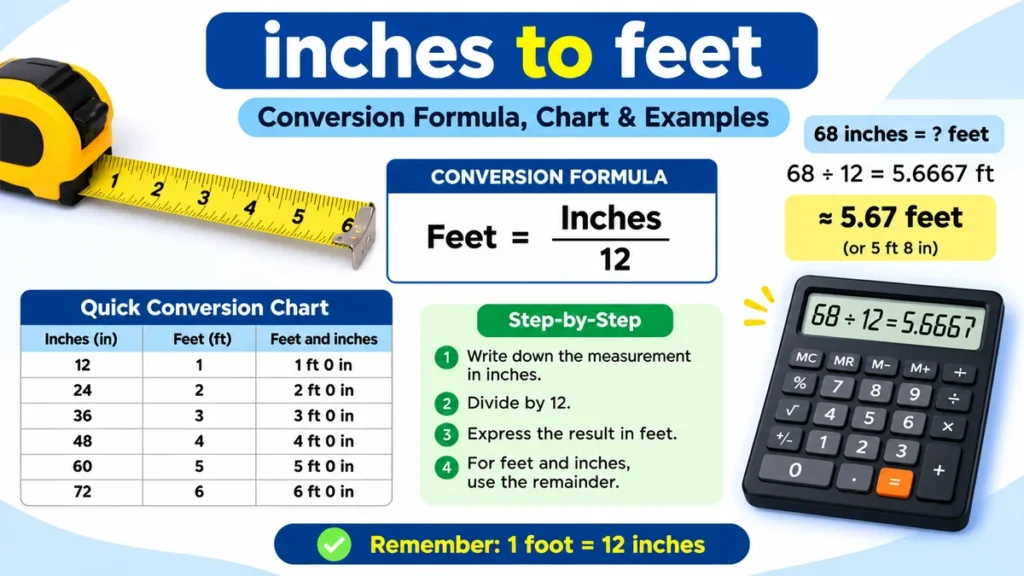
To convert inches to feet, divide the number of inches by 12. One foot contains exactly 12 inches, so the formula is feet = inches ÷ 12. For example, 36 inches equals 3 feet, 60 inches equals 5 feet, and 72 inches equals 6 feet. The same formula works for any measurement, including decimals.
This guide explains the conversion formula, provides a quick-reference chart, and shows how to express measurements in decimal feet or a combination of feet and inches.
How to Convert inches to feet
The inch and foot are units of length used in the US customary system and the British imperial system. Both are based on the same exact relationship:
CONVERSION FORMULA
\[ \text{Feet}=\frac{\text{Inches}}{12} \]
1 inch
0.083333… ft
12 inches
1 ft
Step-by-step conversion
- Write down the measurement in inches.
- Divide that number by 12.
- Express the result in feet.
- Round only if your measurement requires a shorter decimal.
For example, to convert 42 inches into feet:
\[ 42\div12=3.5\text{ feet} \]
Therefore, 42 inches equals 3.5 feet, or 3 feet 6 inches.
The calculation does not change for larger or smaller measurements. Whether you’re measuring a picture frame, a table, or a room, the same conversion factor applies.
Inches to Feet Calculator
Use this interactive calculator to convert any measurement instantly.
Enter measurementInches (in)Decimal places
4 decimals
RESULT IN FEET
5.6667
ft
Copy
Feet and inches
5 ft 8 in
Calculation: 68 ÷ 12 = 5.6667 feetReset calculator
The calculator displays both decimal feet and the feet-and-inches format. These formats describe the same physical length but serve different purposes.
For example, 68 inches is approximately 5.6667 feet, while its mixed-unit equivalent is exactly 5 feet 8 inches.
Inches to Feet Conversion Chart
The following reference table covers common measurements from 1 to 120 inches. Values with repeating decimals are rounded to four decimal places.
| Inches (in) | Feet (ft) | Feet and inches |
|---|---|---|
| 1 | 0.0833 | 0 ft 1 in |
| 2 | 0.1667 | 0 ft 2 in |
| 3 | 0.25 | 0 ft 3 in |
| 4 | 0.3333 | 0 ft 4 in |
| 5 | 0.4167 | 0 ft 5 in |
| 6 | 0.5 | 0 ft 6 in |
| 8 | 0.6667 | 0 ft 8 in |
| 10 | 0.8333 | 0 ft 10 in |
| 12 | 1 | 1 ft 0 in |
| 18 | 1.5 | 1 ft 6 in |
| 24 | 2 | 2 ft 0 in |
| 30 | 2.5 | 2 ft 6 in |
| 36 | 3 | 3 ft 0 in |
| 42 | 3.5 | 3 ft 6 in |
| 48 | 4 | 4 ft 0 in |
| 54 | 4.5 | 4 ft 6 in |
| 60 | 5 | 5 ft 0 in |
| 66 | 5.5 | 5 ft 6 in |
| 72 | 6 | 6 ft 0 in |
| 78 | 6.5 | 6 ft 6 in |
| 84 | 7 | 7 ft 0 in |
| 90 | 7.5 | 7 ft 6 in |
| 96 | 8 | 8 ft 0 in |
| 108 | 9 | 9 ft 0 in |
| 120 | 10 | 10 ft 0 in |
A useful shortcut is to memorize multiples of 12. Every additional 12 inches adds exactly one foot.
Understanding Decimal Feet vs. Feet and Inches
One of the most common conversion mistakes is confusing decimal feet with the traditional feet-and-inches notation.
For example:
- 5.5 feet = 5 feet 6 inches.
- 5.25 feet = 5 feet 3 inches.
- 5.75 feet = 5 feet 9 inches.
This happens because the fractional part of a decimal foot is based on a full foot containing 12 inches, not 10.
How to convert inches into feet and remaining inches
Divide the total number of inches by 12. The whole-number quotient gives the feet, while the remainder gives the leftover inches.
Consider 77 inches:
\[ 77=6\times12+5 \]
So, 77 inches equals 6 feet 5 inches.
In decimal feet:
\[ 77\div12=6.41666\ldots\text{ feet} \]
Both answers are correct, but they use different notation.
How to convert decimal feet into feet and inches
Suppose a measurement is 4.75 feet.
The whole-number part is 4 feet. Multiply the decimal part by 12:
\[ 0.75\times12=9\text{ inches} \]
The result is 4 feet 9 inches.
This distinction matters in construction, carpentry, architectural drawings, and height measurements.
Converting Fractional Inches to Feet
Measurements aren’t always whole numbers. A tape measure may show 15½ inches, 27¼ inches, or 40⅜ inches.
To convert fractional inches into feet, first express the fraction as a decimal, then divide the entire measurement by 12.
For example, 15½ inches becomes 15.5 inches.
\[ 15.5\div12=1.291666\ldots\text{ ft} \]
So, 15½ inches is approximately 1.2917 feet.
Here are other examples:
| Measurement | Decimal feet |
|---|---|
| 6½ inches | 0.5417 ft |
| 12¼ inches | 1.0208 ft |
| 15½ inches | 1.2917 ft |
| 24¾ inches | 2.0625 ft |
| 36⅛ inches | 3.0104 ft |
| 48½ inches | 4.0417 ft |
Fractional measurements are particularly common in woodworking, furniture assembly, and mechanical applications.
Should you round fractional measurements?
Rounding depends on how the measurement will be used.
For general comparisons, two decimal places may be sufficient. For precise fabrication, however, premature rounding can introduce measurement errors.
For example, 1⅛ inches is exactly 0.09375 feet. Rounding it to 0.09 feet and converting back produces 1.08 inches, a difference of 0.045 inches.
Keep the original fractional measurement whenever exact dimensions matter.
Common inches to feet Conversion Examples
The formula becomes easier to remember when applied to everyday situations.
Converting human height
Human height is frequently recorded in inches or feet and inches.
Suppose a person’s height is 69 inches.
\[ 69\div12=5.75\text{ ft} \]
That is 5 feet 9 inches.
| Height in inches | Height in feet and inches |
|---|---|
| 60 | 5 ft 0 in |
| 62 | 5 ft 2 in |
| 64 | 5 ft 4 in |
| 66 | 5 ft 6 in |
| 68 | 5 ft 8 in |
| 70 | 5 ft 10 in |
| 72 | 6 ft 0 in |
| 74 | 6 ft 2 in |
| 76 | 6 ft 4 in |
Remember that 5.8 feet does not mean 5 feet 8 inches. A height of 5 feet 8 inches equals approximately 5.6667 decimal feet.
Measuring furniture and household objects
Furniture dimensions are often listed in inches, while room dimensions may be recorded in feet.
For example, a desk measuring 60 inches wide is 5 feet wide.
A 30-inch-high table is:
\[ 30\div12=2.5\text{ ft} \]
That is 2 feet 6 inches.
Converting both measurements into the same unit makes it easier to compare furniture dimensions with available space.
Construction and carpentry
Builders regularly convert between inches and feet when measuring lumber, walls, and materials.
Suppose a wooden board measures 96 inches.
\[ 96\div12=8\text{ ft} \]
The board is exactly 8 feet long.
If a wall measures 150 inches:
\[ 150\div12=12.5\text{ ft} \]
The wall is 12 feet 6 inches long.
When preparing material lists, converting dimensions into consistent units helps reduce calculation errors.
Screen and television dimensions
Television and monitor sizes are generally measured diagonally in inches.
For example, a 55-inch television has a diagonal measurement of:
\[ 55\div12\approx4.5833\text{ ft} \]
That is 4 feet 7 inches diagonally.
This does not mean the television is 4 feet 7 inches wide. The actual width and height depend on its aspect ratio.
How to Convert Feet Back to Inches
The reverse conversion is equally simple.
Instead of dividing by 12, multiply the number of feet by 12.
\[ \text{Inches}=\text{Feet}\times12 \]
For example:
\[ 7\times12=84\text{ inches} \]
Therefore, 7 feet equals 84 inches.
If the measurement includes both feet and inches, convert the feet first and add the remaining inches.
For 5 feet 8 inches:
\[ (5\times12)+8=68\text{ inches} \]
This method works for height measurements, room dimensions, furniture, and other lengths.
Inches, Feet, Yards, Centimeters, and Meters
Inches and feet belong to the US customary and imperial measurement systems. Centimeters and meters belong to the International System of Units (SI), commonly called the metric system.
The internationally standardized relationships are exact:
| Unit | Equivalent |
|---|---|
| 1 inch | 2.54 centimeters |
| 1 foot | 12 inches |
| 1 foot | 30.48 centimeters |
| 1 foot | 0.3048 meters |
| 1 yard | 3 feet |
| 1 yard | 36 inches |
| 1 meter | Approximately 3.28084 feet |
These relationships make it possible to move between customary, imperial, and metric measurements without changing the physical length.
CalculateMe
+1
How to convert inches to meters
Multiply the measurement in inches by 0.0254.
For example:
\[ 48\times0.0254=1.2192\text{ m} \]
Thus, 48 inches equals exactly 1.2192 meters.
How to convert inches to centimeters
Multiply the measurement in inches by 2.54.
For example:
\[ 20\times2.54=50.8\text{ cm} \]
This is particularly useful when comparing product dimensions listed in different measurement systems.
Common Mistakes When Converting Inches to Feet
Although the conversion is simple, several errors can produce incorrect results.
Multiplying instead of dividing
When converting inches into feet, always divide by 12. Multiplication is used when converting feet into inches.
For example, 48 inches divided by 12 equals 4 feet. Multiplying 48 by 12 would produce an incorrect result for this conversion.
Treating a foot as 10 inches
One foot contains 12 inches, not 10. The conversion is based on a twelve-part relationship rather than a decimal relationship.
That is why 6 inches equals 0.5 feet, not 0.6 feet.
Confusing decimal feet with mixed measurements
A measurement of 6.25 feet means 6 feet 3 inches, not 6 feet 25 inches.
Multiply the decimal part by 12 to find the remaining inches.
Rounding too early
Suppose a measurement is 100 inches.
\[ 100\div12=8.333333\ldots\text{ ft} \]
Rounding immediately to 8.3 feet loses some precision.
For construction calculations, keep the full value or work directly with 8 feet 4 inches.
Confusing length with area
Linear feet and square feet measure different quantities.
A length of 48 inches equals 4 linear feet.
However, an area of 48 square inches equals:
\[ 48\div144=0.3333\ldots\text{ square feet} \]
There are 144 square inches in one square foot because:
\[ 12\times12=144 \]
For cubic inches to cubic feet, the divisor is 1,728 because \(12^3=1,728\).
These distinctions are essential when calculating flooring, wall coverage, volume, or material quantities.
Quick Mental Math for inches to feet
You don’t always need a calculator to perform this conversion.
Start by memorizing these common relationships:
- 3 inches = ¼ foot
- 6 inches = ½ foot
- 9 inches = ¾ foot
- 12 inches = 1 foot
- 24 inches = 2 feet
- 36 inches = 3 feet
For larger measurements, separate the inches into a multiple of 12 and a remainder.
For example, 86 inches can be expressed as 84 + 2.
Since 84 inches equals 7 feet, the answer is 7 feet 2 inches.
Another example is 125 inches.
Since 120 inches equals 10 feet, 125 inches equals 10 feet 5 inches.
This approach is useful when working with tape measures, estimating dimensions, or checking calculations without a device.
Final Thoughts on inches to feet
Converting inches to feet requires just one calculation: divide the number of inches by 12.
For decimal feet, use the complete quotient. For a feet-and-inches measurement, keep the whole feet and express the remainder in inches.
The essential relationships are 12 inches = 1 foot, 36 inches = 3 feet, and 72 inches = 6 feet.
Use the conversion chart or calculator above for quick answers, and retain exact measurements when working on projects that require precision.