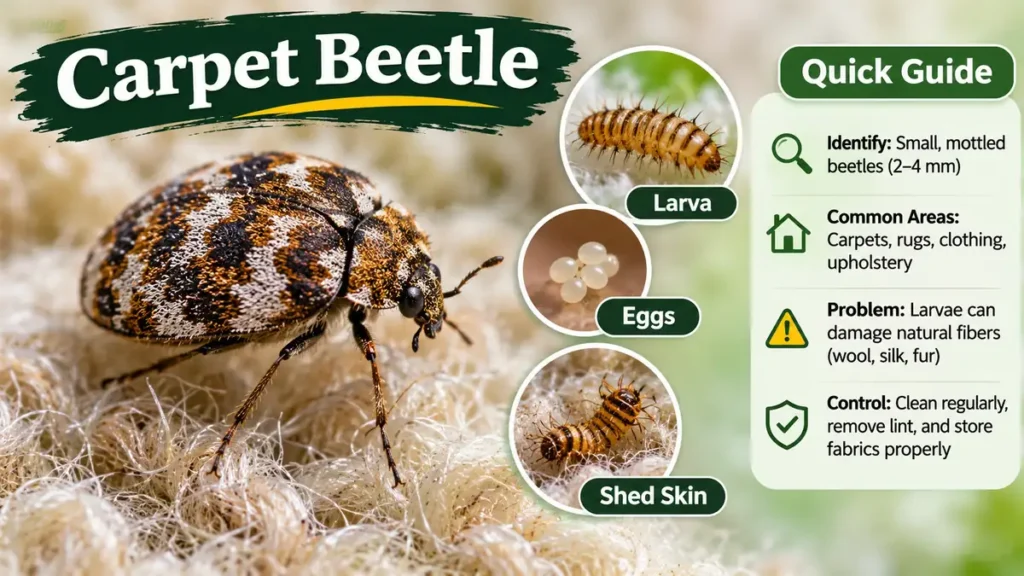
Finding tiny beetles near your windows or mysterious holes in your favorite wool sweater can be unsettling. The culprit may be a carpet beetle, a small household insect that often goes unnoticed until its larvae begin damaging fabrics, carpets, and stored belongings.
Although these insects are common, not every sighting means your home has an infestation. Understanding what they look like, where they hide, and what attracts them is the first step toward controlling the problem.
A carpet beetle is a small insect belonging to the family Dermestidae. Its larvae feed on animal-based materials such as wool, fur, feathers, and silk, while adults generally feed on pollen and nectar or do not feed. Effective control involves identifying infested materials, thorough cleaning, and preventing access to vulnerable fabrics. UC IPM+1
What Is a Carpet Beetle?
Carpet beetles are small, oval-shaped insects found in homes, museums, warehouses, and natural environments worldwide. They belong to the beetle family Dermestidae, a group that includes species adapted to feeding on dried animal materials.
Their name comes from their ability to damage wool carpets, but carpets are only one possible food source.
Carpet beetle larvae can also feed on:
- Wool clothing, blankets, and rugs
- Fur coats and animal hides
- Feathers and down-filled materials
- Silk and felt
- Pet hair, lint, and accumulated debris
- Dead insects and animal remains
- Certain stored foods, depending on the species
Outdoors, these insects have a useful ecological role. Their larvae help break down dried animal remains and other organic material.
Problems arise when they find similar food sources inside buildings.
Are Carpet Beetles Common in Homes?
Yes. Carpet beetles are widespread household insects, especially in buildings containing natural-fiber textiles, upholstered furniture, and undisturbed storage spaces.
Adult beetles can enter through open doors, windows, and gaps around screens. They may also arrive on flowers, clothing, or secondhand furniture.
Finding a single adult near a window does not automatically indicate an established infestation. According to the University of California Integrated Pest Management program, control is generally warranted when developing larvae are found in household materials. UC IPM+1
What Does a Carpet Beetle Look Like?
File:Anthrenus.verbasci.7057.jpg – Wikimedia Commons
Carpet Beetle larva – Anthrenus – BugGuide.Net
The black carpet beetle Attagenus unicolor Dermestidae family common home pest.
6
Carpet beetles have different appearances depending on their species and developmental stage.
Adult beetles are usually small, rounded or oval, and covered by a hard outer shell. Their larvae look entirely different: elongated, segmented, and covered with fine hairs or bristles.
Adult Carpet Beetle Identification
Most common household carpet beetle adults measure approximately 1.5–6 millimeters, although size varies by species.
Typical features include:
- Oval or rounded bodies
- Brown, black, white, yellow, or mottled coloration
- Hard wing covers called elytra
- Short legs and club-shaped antennae
- The ability to fly
Adults are frequently noticed on windowsills because many species are attracted to light.
What Do Carpet Beetle Larvae Look Like?
Carpet beetle larvae are usually more important to identify than adults because they cause most household damage.
Common characteristics include a brown or tan body, visible segmentation, and dense hairs. Some have distinctive tufts at the rear.
The larvae are sometimes called woolly bears, although they should not be confused with similarly named caterpillars.
They often move slowly and avoid bright, exposed areas.
Their appearance can resemble a tiny hairy worm, which explains why homeowners sometimes mistake them for other household pests.
Common Types of Carpet Beetles
Several species occur in homes, and their identification features are not identical.
| Species | Scientific name | Adult appearance | Typical characteristics |
|---|---|---|---|
| Varied carpet beetle | Anthrenus verbasci | Small, rounded, mottled white, yellow, and dark scales | Common fabric and museum pest |
| Black carpet beetle | Attagenus unicolor | Elongated oval, dark brown to black | Larvae damage textiles and stored materials |
| Furniture carpet beetle | Anthrenus flavipes | Rounded with patterned scales | Associated with upholstered furniture and natural fibers |
| Common carpet beetle | Anthrenus scrophulariae | Dark body with contrasting colored scales | Can infest wool and animal-derived materials |
| Two-spotted carpet beetle | Attagenus pellio | Dark body with two pale spots | Often associated with bird nests and stored animal materials |
These species share similar feeding habits, but differences in appearance, distribution, and development can help with identification. Natural History Museum+2
Carpet Beetle Life Cycle: Eggs, Larvae, Pupae, and Adults
The Varied Carpet Beetle: Tiny Pest That Damages Fabrics and Stored Goods
Carpet beetles undergo complete metamorphosis, passing through four distinct stages.
Understanding this cycle explains why an infestation can continue even after visible adult beetles have been removed.
1. Egg Stage
Female beetles deposit eggs near materials that can support developing larvae.
Common locations include wool clothing, carpet edges, floor cracks, upholstered furniture, and concealed storage areas.
The eggs are tiny, pale, and difficult to detect without magnification.
Depending on the species and environmental conditions, eggs often hatch within one to three weeks.
2. Larval Stage
The larval stage is the most destructive period.
Newly hatched larvae begin feeding on suitable materials and grow by repeatedly shedding their outer covering, a process called molting.
The discarded coverings, known as cast skins or exuviae, are common evidence of an infestation.
Larval development varies considerably. Some species complete this stage within months, while others require a year or longer.
Food availability, temperature, humidity, and species all influence development.
3. Pupal Stage
After reaching maturity, the larva transforms into a pupa.
During this stage, its body reorganizes into the adult beetle form.
Pupation generally occurs in a protected location, often close to where the larva developed.
4. Adult Stage
The adult emerges, mates, and may disperse to new locations.
Many adult carpet beetles feed on pollen and nectar from flowers. Others can reproduce without feeding.
Adults generally do not damage household fabrics.
| Life stage | Main activity | Household concern |
|---|---|---|
| Egg | Development before hatching | Difficult to detect |
| Larva | Feeding and growth | Primary source of material damage |
| Pupa | Transformation into adult | Can remain hidden |
| Adult | Mating and dispersal | May establish new infestations |
The full life cycle can take several months to multiple years, depending on the species and conditions. A single fixed timeline does not apply to every carpet beetle. sites.ext.vt.edu+1
What Causes Carpet Beetles in Your House?
Carpet beetles enter homes because they find access points and suitable places to reproduce.
Their presence does not necessarily mean a house is dirty. Even well-maintained properties can contain natural fibers, animal hair, or hidden insect remains that support larvae.
Natural Fibers and Stored Clothing
Wool sweaters, rugs, blankets, and fur-trimmed garments can provide food for larvae.
Clothing stored for long periods is particularly vulnerable because infestations can develop without disturbance.
Perspiration, food stains, and other residues may make some fabrics more attractive.
Pet Hair and Household Debris
Accumulations of pet hair, lint, feathers, and dead insects can support larvae.
These materials often collect beneath heavy furniture, along baseboards, behind appliances, and inside heating vents.
A carpet beetle infestation may therefore develop in places that are rarely inspected.
Bird Nests and Animal Remains
Abandoned bird nests can contain feathers, hair, and dried organic material.
Carpet beetles may develop in these nests and eventually move into nearby buildings.
Dead rodents or other animals in inaccessible structural spaces can also become infestation sources.
Flowers, Windows, and Open Doors
Adult beetles commonly visit flowers outdoors.
They may enter through open windows or doors, particularly during warmer weather.
Cut flowers can occasionally bring adults indoors.
Once inside, females may locate suitable places to deposit eggs.
Secondhand Furniture and Textiles
Used furniture, rugs, clothing, and decorative objects can sometimes carry eggs or larvae.
Inspecting these items before bringing them indoors helps reduce the chance of introducing an existing infestation.
Signs of a Carpet Beetle Infestation
Because larvae prefer dark, protected areas, damage may become visible before the insects themselves.
Recognizing several signs together is more reliable than relying on one observation.
Small Holes in Clothing and Carpets
Irregular holes in wool clothing, blankets, rugs, or other susceptible materials can indicate larval feeding.
Damage may be concentrated around seams, folds, or areas that remain undisturbed.
Carpet beetles may also damage the underside of rugs and areas near walls where cleaning is less frequent.
Shed Larval Skins
Carpet Beetle Molt at Belinda Bruch blog
cetsgzds.blob.core.windows.net
Empty larval skins are among the clearest clues.
They often appear as small, brown, segmented, hairy shells.
These coverings can remain long after the larvae have moved elsewhere.
Finding multiple cast skins near damaged textiles suggests that larvae have developed in or near that location.
Tiny Beetles Near Windows
Adult beetles are frequently found crawling or resting near windows.
They may be attracted to daylight while attempting to leave the building.
However, adult sightings alone do not establish that larvae are feeding indoors.
Larvae in Closets and Dark Corners
Check closet floors, carpet edges, under furniture, inside storage containers, and around upholstery.
Larvae may also appear along baseboards or in drawers.
They sometimes wander away from feeding sites before pupation, so the place where one is discovered may not be the original source.
Frass and Fabric Debris
Larvae produce small fecal particles known as frass.
These particles may accumulate near feeding sites, sometimes mixed with shed skins and damaged fibers.
Frass alone is not enough for identification because other insects produce similar debris.
Quick takeaway: The strongest evidence of an active infestation is finding live larvae near vulnerable materials, particularly when accompanied by fresh fabric damage and shed skins.
Are Carpet Beetles Harmful to Humans or Pets?
Carpet beetles are primarily household material pests rather than insects that directly attack people.
They do not feed on human blood, and they are not known to transmit diseases to humans.
However, their larvae can cause skin irritation in susceptible individuals.
Do Carpet Beetles Bite?
No. Carpet beetles do not bite people in the way that bed bugs, fleas, or mosquitoes do.
Their mouthparts are adapted for feeding on suitable materials, not piercing human skin.
If someone experiences itchy red bumps after finding carpet beetles, the symptoms may result from contact with larval hairs rather than actual bites.
What Is Carpet Beetle Dermatitis?
Carpet beetle dermatitis is a skin reaction associated with exposure to hairs from carpet beetle larvae.
Some individuals develop hypersensitivity to these hairs, which can cause:
- Itching or localized irritation
- Small red bumps
- Raised or inflamed patches
- Rashes resembling insect bites
- Occasionally, blister-like skin eruptions
The reaction can be confused with bed bug bites, contact dermatitis, or other skin conditions.
Penn State Extension describes documented allergic skin reactions associated with larval hairs from several dermestid beetle genera, including Anthrenus and Attagenus. Penn State Extension
A rash alone cannot confirm that carpet beetles are responsible. Persistent, severe, or unexplained symptoms should be assessed by a healthcare professional.
Can Carpet Beetles Live in Your Hair or Skin?
Carpet beetles do not normally live on humans, burrow into skin, or establish infestations in human hair.
Their larvae may feed on accumulated shed hair in the environment, but this is different from living on a person’s body.
They are not parasites like head lice.
Are Carpet Beetles Dangerous to Pets?
Carpet beetles do not normally parasitize cats or dogs.
However, larvae may feed on shed pet hair, feathers, and other organic debris in bedding or resting areas.
Regular cleaning of pet bedding and nearby floors helps reduce potential feeding sites.
If a pet develops unexplained skin irritation, do not assume carpet beetles are responsible. Fleas, allergies, and other conditions may produce similar symptoms.
How to Get Rid of Carpet Beetles Effectively
The most effective approach to carpet beetle control is to find and remove the materials supporting larval development.
Killing visible adult beetles without addressing hidden larvae or their food sources may leave the underlying infestation unchanged.
The following steps follow an integrated pest management approach that prioritizes identification, sanitation, exclusion, and monitoring.
Step 1: Locate the Infestation Source
Begin where larvae, cast skins, or damaged materials have been discovered.
Inspect:
- Wool rugs and carpet edges
- Closets containing natural-fiber clothing
- Under beds, sofas, and heavy furniture
- Upholstered furniture seams and undersides
- Air vents and baseboards
- Attics, basements, and storage spaces
- Pet bedding and accumulated lint
- Pantry shelves and stored dry foods
Look for live larvae, cast skins, frass, and damaged fibers.
If larvae are found throughout the house, investigate concealed food sources such as abandoned nests, dead insects, or animal remains.
The original breeding location may be several feet away from where a wandering larva appears.
Step 2: Vacuum Thoroughly
Vacuuming is one of the most useful nonchemical control measures.
Use attachments to clean carpet edges, baseboards, furniture seams, closet corners, and spaces beneath furniture.
Pay particular attention to areas that are rarely disturbed.
Vacuuming can physically remove larvae, eggs, adult beetles, and the debris that supports their development.
After cleaning an infested area, empty the vacuum promptly into a sealed waste bag and dispose of it outside.
Repeat cleaning regularly while monitoring for further activity.
Step 3: Wash or Dry-Clean Infested Fabrics
Wash affected clothing and washable textiles using the hottest temperature permitted by their care labels.
Appropriate laundering can kill carpet beetles and their developing stages.
Dry cleaning is another effective option for susceptible garments.
For delicate wool, silk, or valuable textiles, professional cleaning may be safer than aggressive home treatment.
Do not expose fragile fabrics to excessive heat simply to kill insects. Shrinkage, fading, and fiber damage may be irreversible.
Step 4: Use Freezing for Suitable Items
Freezing can be useful for certain textiles and small objects that cannot be washed.
The item must reach and remain at a sufficiently low temperature for long enough to kill the insects.
For example, UC IPM describes freezing suitable objects at temperatures below approximately −8°C (18°F) for two weeks as one possible treatment. Other museum protocols use colder conditions and different exposure times.
Actual effectiveness depends on temperature, object thickness, packaging, and exposure duration.
A household freezer should not automatically be assumed to meet every treatment requirement.
For valuable antiques or museum objects, follow a conservation-specific protocol.
Step 5: Remove Infested Debris and Materials
Remove accumulations of pet hair, lint, dead insects, and other organic debris.
Severely damaged or heavily infested items may need to be discarded if cleaning is impractical.
Check nearby objects before returning cleaned materials to storage.
If the source is a bird nest or animal carcass in a building cavity, arrange for safe removal. Avoid disturbing active nests or protected wildlife.
Step 6: Monitor With Sticky Traps
Sticky traps can help determine where adult beetles are active.
Place them near windowsills or suspected infestation areas and inspect them periodically.
Some pheromone traps attract particular carpet beetle species, but they are not universal.
A trap that works for one species may not attract another.
Traps are best used for monitoring rather than as a complete solution.
Step 7: Consider Targeted Insecticide Treatment Only When Necessary
Many carpet beetle infestations can be controlled without pesticides.
If cleaning, removal of food sources, and exclusion are insufficient, targeted insecticide treatment may be appropriate.
Use only products specifically labeled for carpet beetles and for the intended treatment location.
Follow all label directions, ventilation requirements, and precautions for children and pets.
Do not spray insecticides directly onto clothing, bedding, or other surfaces unless the product label explicitly permits that use.
Avoid applying pesticide dusts where they can become airborne or inhaled.
For inaccessible infestations in wall voids, valuable furnishings, or large buildings, professional assessment may be appropriate.
The University of California’s IPM guidance emphasizes that thorough sanitation and removal of infestation sources can eliminate the need for chemical treatments. UC IPM+1
How Long Does It Take to Get Rid of Carpet Beetles?
There is no universal elimination timeline.
A small, localized infestation may be resolved relatively quickly once the affected materials are identified and treated.
An established infestation involving multiple rooms or concealed breeding sites can require repeated cleaning and monitoring over several weeks or longer.
The key measure of success is not simply the disappearance of adult beetles. It is the absence of continuing larval activity and fresh material damage.
Carpet Beetle Prevention: How to Keep Them Away
Preventing reinfestation is generally easier than addressing extensive fabric damage.
The most reliable methods involve reducing accessible food sources, protecting susceptible materials, and limiting entry points.
Store Natural-Fiber Clothing Properly
Before storing seasonal clothing, clean it thoroughly.
Place pest-free wool sweaters, blankets, silk garments, and other vulnerable textiles in tightly sealed containers or suitable protective bags.
Avoid storing stained or unwashed clothing for long periods.
Inspect stored items periodically, particularly if they have been left undisturbed for months.
Maintain a Consistent Cleaning Routine
Regular vacuuming helps remove the organic debris that supports carpet beetle larvae.
Concentrate on:
- Carpet edges and underneath rugs
- Upholstered furniture and cushions
- Closet floors and storage corners
- Pet sleeping areas
- Window tracks and baseboards
- Spaces behind and beneath appliances
Cleaning is especially valuable in rooms containing wool rugs, antique furnishings, or animal-derived decorative objects.
Seal Potential Entry Points
Inspect window screens, door seals, and gaps around vents.
Repair damaged screens and close openings where practical.
These measures reduce the number of adult beetles entering from outdoors.
They may also help exclude other household insects.
Inspect Flowers and Secondhand Items
Check cut flowers for small beetles before bringing them indoors.
Inspect secondhand clothing, rugs, and furniture for larvae, shed skins, and visible damage.
Clean or isolate suspicious items until they can be examined properly.
Do Cedar, Vinegar, and Essential Oils Repel Carpet Beetles?
Several home remedies are commonly suggested, but their effectiveness varies.
| Method | What it can do | Limitation |
|---|---|---|
| Vacuuming | Removes insects and food debris | Must reach hidden areas |
| Washing and dry cleaning | Can kill insects in suitable textiles | Fabric care restrictions apply |
| Freezing | Can kill developing stages under validated conditions | Requires sufficient cold and exposure time |
| Cedar products | Some cedar compounds affect young larvae | Not reliable against established infestations |
| Vinegar cleaning | Helps remove surface dirt | Not a proven complete insect treatment |
| Essential oils | Some compounds show insecticidal or repellent activity in laboratory settings | Household effectiveness and safety are uncertain |
| Sticky traps | Helps monitor adult activity | Does not remove hidden larvae |
Cedar is particularly misunderstood.
Fresh cedar compounds may affect some larvae, but effectiveness decreases as the wood ages. A cedar chest is not a dependable substitute for clean, sealed storage.
Likewise, vinegar and essential oils should not replace the established methods of finding and removing infestation sources. Ask IFAS+1
Can Carpet Beetles Come Back After Cleaning?
Yes, especially when the original food source remains.
Recurring larvae may indicate that an overlooked location still supports development.
Common examples include animal hair beneath furniture, old bird nests, dead insects inside structural cavities, or untreated stored textiles.
Repeated sightings should prompt a more focused inspection rather than indiscriminate pesticide application.
Carpet Beetle vs. Bed Bug vs. Clothes Moth
Carpet beetles are sometimes confused with bed bugs, fleas, and clothes moths.
These pests differ significantly in appearance, feeding behavior, and the problems they cause.
File:Anthrenus.verbasci.7057.jpg – Wikimedia Commons
Carpet beetle
Bed Bug Species | Rentokil Pest Control
Bed bug
Webbing Clothes Moth: What to know
Clothes moth
| Feature | Carpet beetle | Bed bug | Clothes moth |
|---|---|---|---|
| Adult appearance | Small, oval, often patterned | Flat, reddish-brown | Small, narrow-winged moth |
| Main food | Animal-based materials during larval stage | Blood | Animal fibers during larval stage |
| Bites humans | No | Yes | No |
| Fabric damage | Yes, from larvae | Not typical feeding damage | Yes, from larvae |
| Common hiding places | Closets, carpets, furniture | Bed frames, mattress seams, cracks | Closets and stored textiles |
| Distinctive evidence | Hairy larvae and cast skins | Fecal spots, shed skins, live bugs | Larval webbing or cases |
How to Tell Carpet Beetles From Bed Bugs
Bed bugs are flattened, wingless insects that feed on blood.
They commonly hide near sleeping areas and emerge to feed.
Carpet beetle adults have hard wing covers, and their larvae are distinctly hairy.
Although carpet beetle dermatitis may resemble bed bug bites, skin symptoms alone cannot reliably distinguish the two.
Physical insect identification is necessary.
Carpet Beetles vs. Clothes Moths
Both carpet beetle larvae and clothes moth larvae damage animal-based fabrics.
Clothes moth larvae may leave silk webbing, tubes, or portable cases, depending on the species.
Carpet beetle larvae typically leave bristly shed skins and fecal pellets without producing silk webbing.
Damage patterns may also differ, although fabric holes alone are not conclusive evidence.
Can Carpet Beetles Damage Synthetic Carpets?
Carpet beetle larvae generally do not digest entirely synthetic fibers such as polyester, nylon, or acrylic.
However, a synthetic carpet can still harbor larvae if it contains animal hair, lint, dead insects, or other suitable food.
Blended fabrics containing wool or other animal fibers may also be vulnerable.
Finding larvae on a synthetic carpet does not necessarily mean they are eating the carpet itself.
When Is a Carpet Beetle Infestation Serious?
The seriousness of an infestation depends on the extent of larval activity, the materials affected, and whether the breeding source can be located.
A few adult beetles near windows are usually less concerning than repeated discoveries of larvae in stored clothing.
Signs of a More Extensive Infestation
A larger problem may be present when:
- Live larvae appear repeatedly in several rooms.
- Fresh holes develop in multiple garments or rugs.
- Numerous cast skins accumulate in concealed areas.
- Cleaning does not reduce activity.
- Beetles appear to originate from inaccessible structural spaces.
- Valuable textiles or collections are being damaged.
Carpet beetles can be particularly troublesome in museums, archives, textile storage facilities, and buildings containing taxidermy or natural history specimens.
Their larvae can damage preserved insects, animal skins, feathers, and historic textiles.
Institutions often use integrated pest management programs involving inspections, environmental controls, monitoring traps, and carefully selected treatments.
When Professional Pest Control May Be Needed
Professional assistance may be appropriate when the infestation source cannot be located, damage continues after thorough cleaning, or larvae are developing in inaccessible areas.
Specialist treatment may also be necessary for antique rugs, delicate upholstery, and valuable collections.
For museums and conservation settings, techniques such as controlled freezing or low-oxygen treatment may be considered under professional protocols.
Routine household fumigation is generally unnecessary for minor infestations.
Do Carpet Beetles Ever Go Away on Their Own?
Adult beetles may eventually leave or die, but an established larval population can continue developing if suitable food remains available.
Because some larvae survive for extended periods, simply waiting is unreliable.
Removing food sources and treating infested items is a more effective approach than hoping the insects disappear naturally.
Final Thoughts on Carpet Beetle Identification and Control
A carpet beetle is a small but potentially damaging household insect, particularly during its larval stage. While adult beetles are often visible near windows, the larvae usually remain hidden in carpets, clothing, furniture, and undisturbed spaces.
The most useful first step is to confirm whether live larvae are present and identify what they are feeding on.
Thorough vacuuming, proper textile cleaning, removal of infested materials, and sealed storage can resolve many household infestations without chemical treatment.
If new larvae or fresh fabric damage continue to appear, investigate hidden food sources and monitor the affected areas.
Understanding the difference between an occasional adult beetle and an established larval infestation helps prevent unnecessary treatments while protecting clothing, furnishings, and other valuable belongings.