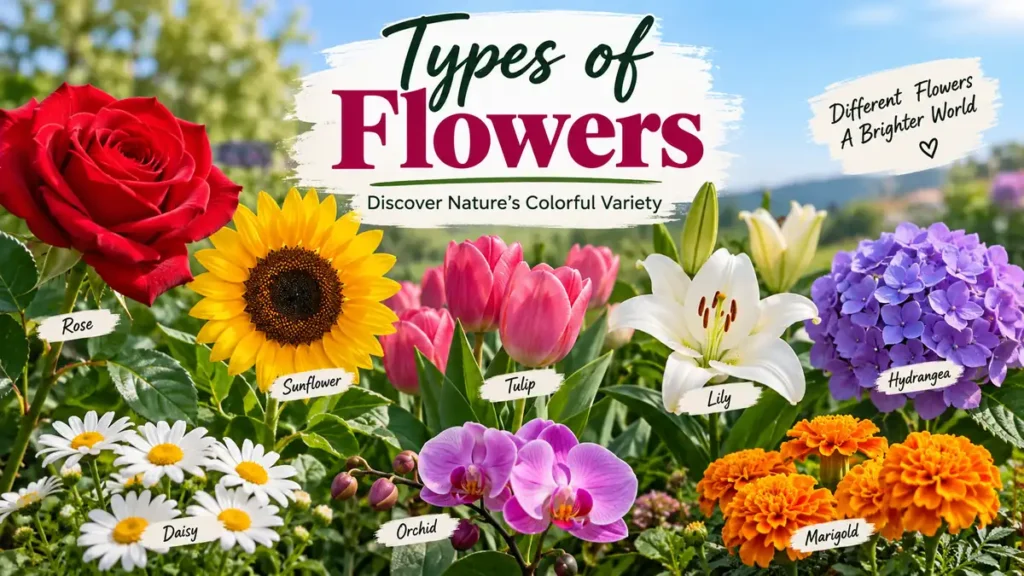
Flowers are far more diverse than the familiar roses, tulips, and daisies found in gardens and bouquets. Some emerge from bulbs for only a few weeks each spring, others flower for months, and tropical species can produce extraordinary blooms unlike anything found in a temperate garden.
Types of flowers include roses, tulips, lilies, daisies, sunflowers, orchids, chrysanthemums, peonies, carnations, hydrangeas, irises, dahlias, marigolds, and thousands of other flowering plants. They can also be grouped as annuals, biennials, perennials, bulbs, shrubs, vines, wildflowers, aquatic flowers, and tropical plants according to their life cycle and growth habit.
Botanically, flowering plants are called angiosperms. They occur in an enormous range of habitats and differ in flower structure, color, fragrance, season, pollination strategy, and lifespan. Recent flower references consequently organize them in several ways rather than treating every flower as the same kind of plant.
This guide introduces 60 recognizable flower types while also explaining the categories that make flower identification and garden planning easier.
What Are the Main Types of Flowers?
There is no single botanical category called a “type of flower.” A flower can be classified simultaneously by its botanical family, life cycle, growth habit, bloom season, habitat, flower form, or horticultural use.
For everyday gardening, the most useful groups are:
| Flower category | What it means | Common examples |
|---|---|---|
| Annuals | Complete their life cycle in one growing season | Sunflower, zinnia, cosmos |
| Biennials | Usually grow leaves first year and flower second year | Foxglove, hollyhock |
| Perennials | Live for several years and can flower repeatedly | Peony, coneflower, iris |
| Bulbs and bulb-like plants | Grow from underground storage structures | Tulip, daffodil, crocus |
| Flowering shrubs | Woody plants producing seasonal flowers | Hydrangea, lilac, azalea |
| Flowering vines | Climbing or trailing flowering plants | Wisteria, clematis, morning glory |
| Tropical flowers | Plants associated with warm climates | Hibiscus, plumeria, bird of paradise |
| Aquatic flowers | Grow in or around water | Lotus, water lily |
| Wildflowers | Flowering plants growing naturally or in naturalized settings | Poppy, cornflower, goldenrod |
These categories overlap. An iris, for example, is a perennial, while a sunflower may be described as an annual, a cut flower, a pollinator plant, and a member of the daisy family.
Annual Flowers
An annual germinates, grows, flowers, produces seed, and completes its life cycle within one growing season.
Popular annual flowers include:
- Zinnias
- Cosmos
- Petunias
- Marigolds
- Nasturtiums
- Many sunflowers
- Sweet alyssum
Gardeners value annuals because many produce color continuously when faded blooms are removed. The trade-off is that new plants generally have to be grown or planted again for the next season, although self-seeding species may return on their own.
Perennial Flowers
Perennials survive for multiple years. Their above-ground growth may disappear during a cold or dry season while roots, crowns, rhizomes, or other structures remain alive.
Peonies, coneflowers, daylilies, bee balm, phlox, and many irises are familiar examples.
A perennial does not necessarily flower throughout the year. Some have a relatively short annual flowering period, while others bloom repeatedly over a long season.
Biennial Flowers
Biennials normally complete their life cycle across two growing seasons. They commonly establish vegetative growth during the first season, survive a dormant period, then flower and set seed during the second.
Foxglove is a classic example, although individual species and cultivars can behave differently depending on climate.
Bulb Flowers
Gardeners commonly use the term bulb flowers broadly for plants grown from bulbs and similar underground storage organs.
Tulips and daffodils grow from true bulbs, while crocuses grow from corms and dahlias are commonly grown from tuberous roots. These distinctions matter when propagating and storing plants, even though garden centers may group them together.
Quick Takeaway: Annual, perennial, and biennial describe a plant’s life cycle. “Bulb” describes an underground storage structure or, in casual gardening language, a broader group of plants grown from such structures. They are not competing classifications.
60 Popular Types of Flowers and Their Names
The following flower list combines familiar garden flowers, cut flowers, shrubs, vines, wildflowers, and tropical species.
1. Rose
Roses (Rosa spp.) are woody flowering plants ranging from compact shrubs to large climbers. Their flowers may be single, semi-double, or densely packed with petals.
Rose colors include red, pink, white, yellow, peach, orange, purple-toned shades, and numerous blends. Modern garden roses include hybrid teas, floribundas, shrub roses, miniatures, and climbers.
They remain especially prominent in ornamental gardens and the cut-flower trade. Roses also have a very long history of cultivation.
2. Tulip
Tulips (Tulipa spp.) are spring-flowering bulbs known for their clean, cup-shaped blooms.
They come in a remarkable range of forms, including single, double, fringed, lily-flowered, parrot, and peony-like types. Depending on the cultivar, flowers can be white, yellow, orange, red, pink, purple, or multicolored.
Tulips are especially associated with spring beds, containers, mass plantings, and cut-flower arrangements.
3. Lily
True lilies belong to the genus Lilium.
Their large flowers commonly have six prominent tepals and occur in white, yellow, orange, pink, red, and patterned combinations. Asiatic and Oriental lilies are among the most familiar garden groups.
Not every plant called a lily is a true lily. Calla lilies, daylilies, and water lilies belong to different botanical groups.
4. Sunflower
The common sunflower, Helianthus annuus, is a fast-growing annual native to North America.
What appears to be one large flower is actually a flower head composed of many smaller florets. Familiar varieties have golden-yellow rays surrounding a dark center, but cultivars also occur in cream, bronze, orange, burgundy, and bicolored forms.
Sunflowers are useful for cut flowers, seeds, wildlife, and pollinator-friendly planting.
5. Daisy
“Daisy” is a common name applied to numerous members of the Asteraceae family.
The common daisy, Bellis perennis, typically produces white ray florets around a yellow center. Gerbera daisies, Shasta daisies, and African daisies belong to different genera.
Their cheerful, open flower heads make daisies popular in lawns, borders, containers, and bouquets.
6. Orchid
The Orchidaceae family contains an extraordinary variety of flowering plants.
Popular cultivated orchids include Phalaenopsis, Cattleya, Dendrobium, and Cymbidium. Orchid flowers are notable for specialized structures and complex relationships with pollinators.
Many tropical orchids are epiphytes that naturally grow attached to trees rather than rooted in ordinary soil.
7. Daffodil
Daffodils (Narcissus spp.) are spring-flowering bulbs recognized by a central trumpet or cup surrounded by petal-like tepals.
Yellow is the classic color, but varieties also occur in white, cream, orange, salmon, and combinations of these shades.
Once established in suitable conditions, many daffodils can naturalize and return for years.
8. Peony
Peonies (Paeonia spp.) are famous for large, lush flowers and their relatively brief but spectacular flowering season.
Common colors include white, cream, blush, pink, coral, and deep red. Herbaceous peonies die back seasonally, while tree peonies develop persistent woody stems.
Established peonies can be remarkably long-lived when planted in suitable conditions.
9. Hydrangea
Hydrangeas are flowering shrubs known for large clusters of individual flowers.
Popular types include bigleaf hydrangea (Hydrangea macrophylla), panicle hydrangea (H. paniculata), smooth hydrangea, and oakleaf hydrangea.
In some bigleaf cultivars, flower color is influenced by soil chemistry and the plant’s ability to access aluminum, which helps explain why certain plants can shift between pinkish and blue shades.
10. Carnation
Carnations (Dianthus caryophyllus) produce ruffled flowers, often with a spicy or clove-like fragrance.
They are available in white, pink, red, yellow, peach, purple, green, and multicolored cultivars.
Their sturdy stems and relatively durable flowers make carnations familiar cut flowers.
11. Chrysanthemum
Chrysanthemums, often called mums, belong to the daisy family.
Their flower heads appear in numerous forms, including daisy, pompon, decorative, spider, and incurved types.
They are strongly associated with autumn displays in many temperate regions, although greenhouse production makes cut chrysanthemums widely available beyond their natural garden season.
12. Iris
Irises are distinctive perennials named for the genus Iris.
Many have three upright segments called standards and three lower segments called falls. Bearded iris is especially recognizable because of the fuzzy “beard” along the falls.
Purple and blue-violet are iconic colors, but irises occur in white, yellow, pink, orange, near-black shades, and intricate bicolors.
13. Dahlia
Dahlias produce some of the most varied flower forms found in ornamental gardens.
Cultivars range from compact plants with simple open blooms to tall plants carrying enormous decorative flowers. Forms include cactus, ball, pompon, anemone, decorative, and waterlily dahlias.
They are commonly grown from tuberous roots.
14. Marigold
Garden marigolds usually belong to the genus Tagetes.
French marigolds and African marigolds are widely grown annuals with flowers in yellow, gold, orange, rust, cream, and bicolored combinations.
Their tolerance of heat and long flowering period make them useful for sunny beds and containers.
15. Lavender
Lavandula species are aromatic flowering plants associated with narrow leaves and spikes of small flowers.
Purple is the familiar color, although cultivars may have violet, pink, or white flowers.
Lavender generally performs best in sunny positions with excellent drainage and is valued for fragrance as well as ornamental use.
16. Poppy
“Poppy” includes several genera, but Papaver contains many familiar species.
Their delicate, tissue-like petals can surround striking dark centers. Red field poppies are iconic, while ornamental poppies may be orange, pink, white, purple, or bicolored.
California poppy, despite the common name, belongs to the genus Eschscholzia.
17. Geranium
The name geranium can cause confusion.
True Geranium species are often called hardy geraniums or cranesbills. Many colorful container plants commonly sold as “geraniums” actually belong to the related genus Pelargonium.
Both groups are valuable ornamentals, but they differ in growth habit, flower structure, and cold tolerance.
18. Petunia
Petunias are popular warm-season bedding plants producing trumpet-shaped flowers.
Modern cultivars include compact, spreading, trailing, single, and double forms in nearly every major ornamental color.
They are particularly useful in hanging baskets, window boxes, containers, and sunny borders.
19. Zinnia
Zinnia elegans and related zinnias are heat-loving annuals.
Their flowers range from simple daisy-like forms to densely double blooms. Colors include red, orange, yellow, pink, purple, white, green, and combinations.
Zinnias are also useful in pollinator gardens because open-flowered forms can provide accessible resources for insects.
20. Begonia
Begonias form a diverse ornamental group grown for flowers, foliage, or both.
Wax begonias are commonly used as bedding plants, tuberous begonias produce showy flowers, and rex begonias are grown primarily for dramatic leaves.
Many prefer protection from harsh midday sun, although light requirements vary among groups.
21. Hibiscus
Hibiscus flowers are often recognized by their broad petals and prominent central staminal column.
Tropical hibiscus (Hibiscus rosa-sinensis) produces vivid flowers in warm climates, while hardy hibiscus species can survive much colder winters.
Colors range from white and yellow to orange, pink, red, and multicolored forms.
22. Jasmine
Jasmine belongs primarily to the genus Jasminum.
Many species produce small white or yellow flowers prized for fragrance. Depending on the species, plants may grow as shrubs or climbers.
The word “jasmine” is also used for unrelated fragrant plants, so botanical names are useful when selecting one for a garden.
23. Gardenia
Gardenia jasminoides is an evergreen shrub known for glossy foliage and intensely fragrant white or creamy flowers.
Gardenias prefer warm conditions, acidic growing media, and consistent care. They can be more demanding than many common flowering shrubs but are highly valued for their scent.
24. Magnolia
Magnolias are trees and shrubs producing conspicuous flowers, often before or alongside new foliage.
Flowers may be white, cream, pink, purple, or yellow depending on the species and cultivar.
Some magnolias are deciduous and adapted to temperate climates, while others are evergreen.
25. Lilac
Lilacs (Syringa spp.) are woody shrubs celebrated for clusters of fragrant spring flowers.
Classic common lilac flowers are purple or lavender, but cultivars also appear in white, pink, blue-toned purple, and deep violet.
They generally perform best where winters provide sufficient cold for normal dormancy.
26. Azalea
Azaleas belong within the genus Rhododendron.
They produce masses of spring flowers in shades such as white, pink, red, purple, orange, and salmon.
Many thrive in acidic, organically rich, well-drained soil and appreciate conditions similar to those favored by other rhododendrons.
27. Camellia
Camellias are evergreen shrubs with glossy leaves and elegant flowers.
Depending on species and cultivar, flowering can occur from autumn through spring. Flowers may be single, semi-double, or extremely full.
White, pink, and red are the dominant colors.
28. Aster
The name aster is associated with star-shaped, daisy-like flowers.
Modern botanical classification has moved many North American plants formerly placed in Aster into genera such as Symphyotrichum, while true Aster species remain important ornamentals.
Late-flowering asters can provide valuable seasonal color and pollinator resources.
29. Anemone
Anemone species include spring woodland plants and showy garden flowers.
Japanese anemones are known for late-season flowers, while Anemone coronaria is widely grown for colorful cut blooms.
Flower colors include white, pink, red, purple, and blue-violet.
30. Ranunculus
Florists often use “ranunculus” for Ranunculus asiaticus, which produces densely layered, rose-like flowers.
Their thin petals create an almost paper-like texture. Cultivars are available in cream, yellow, orange, salmon, pink, red, burgundy, and multicolored combinations.
They favor relatively cool growing conditions.
Types of Flowers for Gardens and Landscapes
Not every attractive flower is primarily a florist’s stem. Many are better appreciated as garden plants, where their growth habit, flowering period, and ecological role become just as important as the individual bloom.
31. Coneflower
Echinacea species, especially purple coneflower, produce prominent central cones surrounded by ray florets.
They are durable perennials in appropriate climates and work well in naturalistic gardens and pollinator plantings.
32. Black-Eyed Susan
Rudbeckia flowers typically combine golden-yellow rays with dark central discs.
They bring strong summer and autumn color and are frequently used in prairie-style, cottage, and wildlife-friendly gardens.
33. Coreopsis
Coreopsis, sometimes called tickseed, includes annual and perennial species.
Most produce cheerful yellow flowers, although cultivated forms may feature red, pink, white, or bicolored patterns.
34. Yarrow
Achillea millefolium and ornamental yarrow cultivars form flattened clusters of numerous tiny flowers.
Yarrow is often chosen for sunny, relatively dry gardens and can attract a variety of beneficial insects.
35. Bee Balm
Monarda produces distinctive flower clusters in red, pink, purple, or white.
Also called bergamot, bee balm is a popular perennial for pollinator-oriented gardens.
36. Phlox
Phlox ranges from low, mat-forming spring plants to tall summer-flowering perennials.
Garden phlox produces rounded clusters in white, pink, lavender, purple, and bicolored forms.
37. Delphinium
Delphiniums are known for tall vertical spikes covered in flowers.
Blue is particularly associated with the genus, but purple, white, pink, and other shades are also available.
Their height makes them dramatic back-of-border plants.
38. Lupine
Lupinus species produce upright flower spikes with distinctive pea-family blossoms.
Blue, purple, pink, yellow, red, and bicolored cultivars are grown ornamentally, while wild lupines occur in various habitats.
39. Columbine
Aquilegia flowers are immediately recognizable by their unusual petals and backward-pointing spurs.
They are particularly useful in woodland-style and partly shaded gardens, depending on species and climate.
40. Bleeding Heart
The classic bleeding heart, Lamprocapnos spectabilis, produces arching stems carrying heart-shaped pink-and-white or white flowers.
It is a favorite for shaded and woodland gardens and often becomes dormant as conditions turn hot.
41. Foxglove
Foxgloves produce tall spikes of tubular, often spotted flowers.
Many familiar forms are associated with Digitalis purpurea, commonly grown as a biennial or short-lived perennial.
Foxgloves contain potent cardiac glycosides and should not be eaten.
42. Hollyhock
Alcea rosea is a traditional cottage-garden plant producing flowers along tall upright stems.
Single and double forms occur in white, yellow, pink, red, purple, and nearly black shades.
43. Pansy
Pansies are cool-season flowers known for their broad overlapping petals and characteristic face-like markings.
Modern garden pansies are complex hybrids and come in an enormous variety of colors.
44. Primrose
Primroses belong to the genus Primula.
Many flower during cool weather and are associated with spring gardens. Their compact growth and bright flowers make them useful along borders and in containers.
45. Sweet Alyssum
Lobularia maritima forms low cushions of tiny white, lavender, pink, or purple flowers.
Its honey-like fragrance and spreading habit make it useful along edges, between larger plants, and in containers.
Climbing, Tropical and Unusual Types of Flowers
Flowers are not limited to compact garden plants. Some climb several meters, others grow on trees in tropical forests, and aquatic species keep their roots underwater.
46. Wisteria
Wisteria is a vigorous woody vine producing long hanging clusters of pea-like flowers.
Purple and lavender are the best-known colors, with white and pink cultivars also available.
Because some wisterias can become extremely large—and some species are invasive in particular regions—species selection and structural support matter.
47. Clematis
Clematis is a diverse genus of mostly climbing plants.
Depending on the type, flowers may be small and bell-shaped or broad and spectacular. Purple, blue, pink, red, white, and bicolored cultivars are common.
Different pruning groups flower on old wood, new growth, or both, so correct identification helps with maintenance.
48. Morning Glory
Morning glories are fast-growing vines with funnel-shaped flowers.
Many popular ornamental forms belong to Ipomoea. Their flowers often open in the morning and may fade later in the day.
Blue, purple, pink, white, and magenta varieties are widely grown.
49. Honeysuckle
Lonicera includes both shrubs and climbing plants.
Many species produce tubular flowers that attract pollinators, followed by berries. Some are wonderfully fragrant.
Certain honeysuckle species can spread aggressively outside their native ranges, so local suitability should be checked before planting.
50. Bougainvillea
Bougainvillea is a warm-climate woody vine or shrub famous for vivid displays.
The showy pink, purple, red, orange, white, or yellow structures are actually bracts surrounding much smaller true flowers.
It thrives in bright sun and warm conditions.
51. Bird of Paradise
Strelitzia reginae produces one of the most recognizable tropical flower forms, resembling a colorful bird.
Orange sepals and blue-purple petals emerge from a rigid bract. Its architectural foliage is also a major ornamental feature.
52. Plumeria
Plumeria, also called frangipani, consists of tropical trees and shrubs with waxy, often highly fragrant flowers.
White-and-yellow flowers are classic, while cultivated varieties also include pink, red, peach, and multicolored forms.
53. Anthurium
Anthuriums are tropical members of the arum family.
The glossy heart-shaped structure people often identify as the flower is a spathe. The many tiny true flowers are carried on the central spike, called a spadix.
Red is iconic, but cultivars occur in pink, white, green, purple, orange, and other shades.
54. Protea
Proteas are striking plants native primarily to southern Africa.
Their dramatic flower heads are surrounded by colorful bracts and have become distinctive elements in floral design.
They are adapted to particular climates and often require excellent drainage.
55. Passion Flower
Passiflora species have extraordinarily complex flowers featuring a conspicuous corona of thread-like structures.
Many are climbing vines. Some Passiflora species also produce edible passion fruit, although not every ornamental species is grown for fruit.
56. Lotus
The sacred lotus, Nelumbo nucifera, is an aquatic perennial with large leaves and flowers held above the water.
Lotus should not be confused with water lilies. Despite their superficially similar aquatic habit, they belong to different botanical families.
57. Water Lily
Water lilies belong to the family Nymphaeaceae.
Their floating leaves and flowers are familiar features of ponds and slow-moving water. Hardy and tropical types differ in climate requirements, growth, and flower characteristics.
58. Crocus
Crocuses are small plants grown from corms, not true bulbs.
Many familiar garden crocuses flower near the beginning of spring, sometimes emerging through snow. Others bloom in autumn.
Purple, lavender, yellow, and white flowers are common.
59. Hyacinth
Garden hyacinths (Hyacinthus orientalis) grow from bulbs and produce dense spikes of strongly fragrant flowers.
They are classic spring plants and occur in blue, purple, pink, white, yellow, and salmon shades.
60. Allium
Ornamental alliums belong to the same genus that includes onions, garlic, and chives.
Many garden varieties produce spherical flower heads composed of dozens or hundreds of small star-like blossoms.
Purple is especially common, but white, pink, blue, and yellow species also exist.
Types of Flowers by Blooming Season
Bloom time is one of the most practical ways to organize flowering plants.
Exact timing changes with latitude, climate, elevation, cultivar, and weather, so a plant described as a “spring flower” in one region may bloom earlier or later elsewhere. Flower references therefore treat bloom periods as typical windows rather than fixed calendar dates.
| Season | Common flowers |
|---|---|
| Spring | Tulip, daffodil, crocus, hyacinth, iris, lilac, peony |
| Summer | Rose, sunflower, zinnia, dahlia, lavender, coneflower |
| Autumn | Chrysanthemum, aster, dahlia, goldenrod, some anemones |
| Winter or cool season | Hellebore, pansy, snowdrop, some camellias |
Which Flowers Bloom for the Longest Time?
Annuals such as zinnias, petunias, marigolds, and cosmos can provide an extended display because their biological goal is to keep flowering and eventually produce seed.
Removing spent flowers—known as deadheading—can prolong flowering in many species.
Some modern roses and perennials also rebloom, while plants such as peonies may provide a spectacular but considerably shorter annual display.
Types of Flowers by Growth Habit
Growth habit matters because two flowers that look attractive together in photographs may require completely different amounts of space.
Herbaceous Flowers
Herbaceous plants have non-woody stems. Many annuals and perennials fall into this group.
Examples include:
- Zinnia
- Peony
- Coneflower
- Poppy
- Delphinium
- Phlox
Some herbaceous perennials die back to ground level during dormancy and regrow from their underground structures.
Flowering Shrubs
Shrubs retain woody stems and create a more permanent framework in a landscape.
Common flowering shrubs include hydrangea, lilac, gardenia, camellia, azalea, and many roses.
They can provide height and structure even when they are not in flower.
Flowering Trees
Many trees are valued for seasonal blossom.
Magnolia is one example, while flowering cherries, crabapples, dogwoods, and certain ornamental pears are other familiar landscape trees.
Tree blossoms can be spectacular but relatively brief, so foliage, mature size, fruit, roots, and year-round appearance should also influence plant selection.
Flowering Vines
Clematis, wisteria, honeysuckle, morning glory, and some roses climb or scramble over supports.
They are useful where gardeners want vertical color on trellises, arches, pergolas, fences, or walls.
Their growth rates vary enormously. A delicate clematis and a mature wisteria should not be treated as structurally equivalent plants.
Wildflowers, Native Flowers and Garden Flowers
The term wildflower describes a flowering plant growing in a relatively natural or uncultivated setting rather than a single botanical group.
A native flower is more specific: it occurs naturally within a defined geographic region without human introduction.
The distinction matters.
A flower can grow wild without being native. Introduced plants sometimes escape gardens and naturalize. A few become invasive, spreading aggressively and affecting native ecosystems.
Examples frequently associated with wildflower plantings include:
- Poppies
- Cornflowers
- Lupines
- Black-eyed Susans
- Coneflowers
- Yarrow
- Coreopsis
- Goldenrod
For wildlife gardening, locally native plants are often more useful than choosing a generic packet simply labeled “wildflower mix.” The species in a mix should suit the region, soil, rainfall, and local ecosystem.
How Flower Shapes Differ
Flower identification becomes easier when you look beyond color.
Daisy-Shaped Flowers
Sunflowers, asters, chrysanthemums, coneflowers, zinnias, and daisies can have a daisy-like appearance.
Many belong to Asteraceae, where what looks like a single flower is actually an inflorescence composed of multiple tiny florets.
Trumpet-Shaped Flowers
Petunias, morning glories, some lilies, daffodils, and honeysuckles can produce trumpet- or funnel-like forms.
Long floral tubes may influence which pollinators can efficiently reach nectar.
Flower Spikes
Delphiniums, foxgloves, lupines, gladioli, lavender, and snapdragons produce flowers along elongated stems or spike-like structures.
These vertical forms are useful for adding height to a planting.
Flower Clusters
Hydrangeas, lilacs, yarrow, phlox, and many alliums group numerous smaller flowers into larger, highly visible displays.
The exact botanical type of inflorescence differs among them.
How to Choose Between Different Types of Flowers
A beautiful flower is not automatically the right plant for a particular garden. Start with growing conditions, then choose appearance.
1. Check Your Climate
A tropical hibiscus and a hardy coneflower tolerate very different winters.
Gardeners in the United States commonly use USDA Plant Hardiness Zones to estimate whether perennial plants can survive typical winter minimum temperatures. Hardiness zones are useful, but they do not account for every factor affecting plant performance.
Summer heat, humidity, rainfall, wind, elevation, and local microclimates also matter.
2. Measure Sunlight
“Full sun” generally means a site receives substantial direct sunlight, but heat intensity and regional climate also influence how plants respond.
Sunflowers, lavender, zinnias, roses, and many dahlias generally flower best with plenty of sun.
Begonias, bleeding hearts, and certain woodland plants can perform better with partial shade.
Do not guess. Observe the planting area at several times during the day.
3. Understand Your Soil
Soil influences drainage, oxygen around roots, water availability, and nutrient uptake.
Lavender dislikes persistently waterlogged conditions, while aquatic plants such as lotus and water lilies obviously have completely different requirements.
Improving drainage or selecting a plant naturally adapted to the site is often more successful than repeatedly trying to force an unsuitable flower to survive.
4. Consider Mature Size
A plant in a nursery pot may be misleadingly small.
Before planting, check mature height and spread. Tall delphiniums can shade low plants, vigorous vines can overwhelm weak supports, and shrubs such as hydrangeas may eventually occupy substantial space.
5. Plan for a Sequence of Flowers
A garden containing only spring bulbs can become relatively quiet once their flowers fade.
Combining different bloom periods creates a longer display:
- Crocus and daffodil for early color
- Tulips, iris, and peonies for spring
- Roses, lavender, lilies, and coneflowers for summer
- Dahlias, asters, and chrysanthemums for later color
Actual timing should always be adjusted for local climate.
6. Think About Pollinators
Flowers differ in how useful and accessible they are to bees, butterflies, moths, hummingbirds, and other pollinators.
Open flower forms can sometimes offer easier access to pollen and nectar than extremely dense double flowers.
For a wildlife-friendly garden, prioritize a diverse selection of locally suitable plants that flower at different times rather than relying on one ornamental species.
Common Flower-Choosing Mistakes
One of the most common mistakes is selecting a flower from its appearance alone.
A striking plant will still struggle if its basic environmental requirements are wrong.
Other frequent problems include:
- Planting sun-loving flowers in deep shade
- Overwatering drought-tolerant plants
- Putting moisture-loving plants in rapidly drying soil
- Ignoring mature plant size
- Assuming every perennial is hardy in every climate
- Treating every plant sold as a “bulb” as a true botanical bulb
- Expecting spring flowers to bloom all summer
- Planting aggressive vines beside weak structures
- Choosing non-native species without checking invasive status
- Assuming common names identify a plant precisely
Scientific names are particularly helpful with ambiguous common names. “Geranium,” “lily,” and “daisy,” for example, may refer to very different plants depending on context.
What Is the Difference Between a Flower, Species and Variety?
These words are often mixed together in flower lists, but they do not mean the same thing.
A flower is the reproductive structure produced by an angiosperm.
A species is a botanical classification. The common sunflower, for example, is Helianthus annuus.
A genus groups related species. Rosa is the genus containing roses, while Tulipa contains tulips.
A cultivar is a cultivated plant selected for particular characteristics and maintained through horticulture. Garden centers therefore may offer many named cultivars belonging to one species or hybrid group.
“Variety” is often used informally for any distinctive garden form, although variety also has a more specific meaning in botanical taxonomy.
This explains why lists of flower names can contain a mixture of genera, species, hybrids, horticultural groups, and common names rather than equivalent taxonomic units. Large flower catalogs explicitly make this distinction because everyday flower names do not always correspond to one species.
What Are the Most Common Types of Flowers?
Roses, tulips, lilies, sunflowers, daisies, orchids, daffodils, chrysanthemums, carnations, hydrangeas, peonies, irises, dahlias, lavender, and marigolds are among the flower names people encounter most frequently in gardens and floral arrangements.
But “common” depends heavily on location.
A plumeria may be an everyday landscape plant in a tropical climate while requiring protected indoor conditions in a cold region. Snowdrops thrive where winters suit their growth cycle but are inappropriate for many hot climates.
That is why useful flower identification combines the flower’s appearance with its location, growth habit, leaves, season, and botanical name.
Which Types of Flowers Are Easiest to Grow?
For a beginner, the easiest choice is usually a plant naturally suited to the local environment.
In many warm, sunny summer gardens, zinnias, marigolds, cosmos, and sunflowers are relatively straightforward annuals when provided with appropriate soil, water, and light.
Established perennials can reduce yearly replanting, but “perennial” does not automatically mean low-maintenance. Some need division, staking, pruning, winter protection, or careful moisture management.
Native flowering plants can be particularly practical because suitable species are already adapted to regional conditions. The key word is suitable: even a native plant will struggle when placed in the wrong light or soil.
Which Flowers Are Best for Bouquets?
Cut-flower performance depends on stem strength, vase life, availability, fragrance, flower form, and how well a stem handles harvesting.
Popular cut flowers include:
| Flower | Why it is commonly used |
|---|---|
| Rose | Strong focal flower with many colors |
| Carnation | Durable and available in many shades |
| Lily | Large, dramatic blooms |
| Tulip | Clean form and strong seasonal character |
| Peony | Large, full flowers |
| Ranunculus | Layered petals and compact form |
| Dahlia | Wide variety of shapes and colors |
| Chrysanthemum | Diverse forms and generally good longevity |
| Sunflower | Bold, recognizable appearance |
| Hydrangea | Large flower clusters that add volume |
| Orchid | Sculptural form and tropical character |
| Freesia | Delicate flowers with notable fragrance |
A good bouquet usually benefits from contrasting forms rather than using flowers that all have the same shape and scale.
Flower Safety: Beautiful Does Not Mean Edible
One gap in simple flower lists is safety.
Some ornamental flowers and other plant parts contain compounds that can cause irritation or poisoning if eaten. Foxglove, for example, contains powerful cardiac glycosides.
Lilies are another important case: certain Lilium and Hemerocallis species are dangerously toxic to cats, and exposure can become a veterinary emergency.
Even plants with edible flowers should not automatically be eaten from a florist, nursery, roadside, or chemically treated garden. Correct identification and knowledge of pesticide exposure are essential.
If a flower is being selected for a home with children or pets, toxicity deserves the same attention as color and bloom season.
Understanding the Huge Diversity of Types of Flowers
Learning the types of flowers becomes much easier once you stop treating flowers as one enormous list of names.
Start with the broad categories: annuals, biennials, perennials, bulbs and bulb-like plants, shrubs, vines, tropical plants, wildflowers, and aquatic species. Then look at bloom season, flower shape, habitat, light requirements, and botanical relationships.
From familiar roses, tulips, lilies, daisies, sunflowers, and orchids to unusual proteas, passion flowers, lotuses, and bird-of-paradise blooms, each plant represents a different solution to growth and reproduction.
For practical identification or garden planning, the best next step is simple: identify the flower by both its common and scientific name, then check its mature size, climate tolerance, sunlight, soil, water, and flowering season. That gives you far more useful information than the flower’s appearance alone.