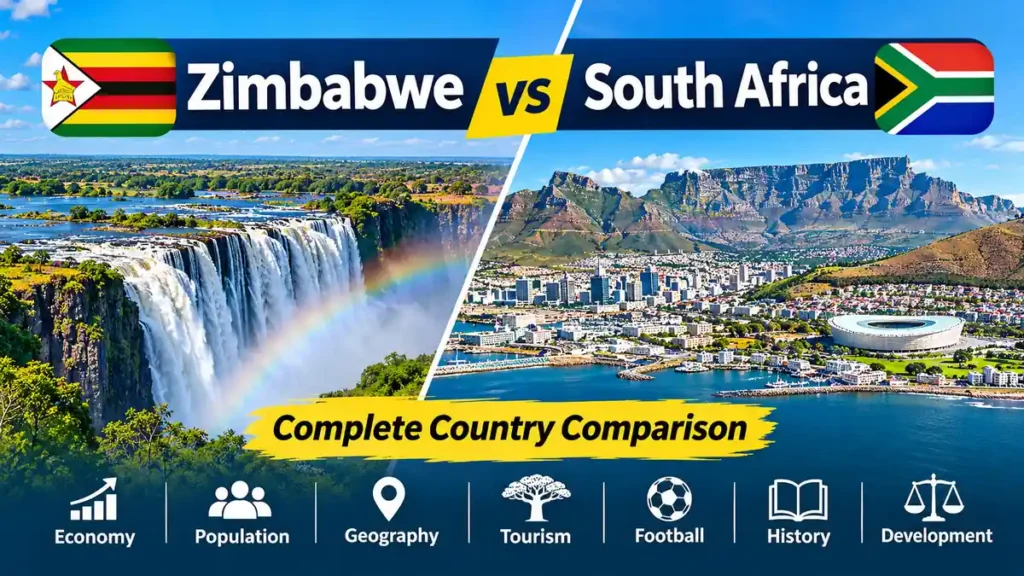
Zimbabwe and South Africa are neighboring countries in Southern Africa, sharing historical connections, cultural traditions, economic relationships, and a busy international border. Yet their differences in economic development, population, infrastructure, geography, and employment opportunities are substantial.
The zimbabwe vs south africa comparison reveals that South Africa has a much larger economy, a bigger population, and more extensive infrastructure, while Zimbabwe has important agricultural and mineral resources, distinctive cultural heritage, and internationally recognized natural attractions. Both countries face development challenges, but their economic circumstances and opportunities differ considerably.
Zimbabwe vs South Africa: Quick Comparison
The following table highlights the main differences between the two countries, using 2025 economic and population figures where available.
| Category | Zimbabwe | South Africa |
|---|---|---|
| Region | Southern Africa | Southern Africa |
| Capital | Harare | Pretoria, Cape Town, Bloemfontein |
| Population (2025) | 16.95 million | 64.75 million |
| Total area | 390,757 km² | Approximately 1.22 million km² |
| GDP (2025) | $51.22 billion | $427.18 billion |
| GDP per capita (2025) | $3,021 | $6,598 |
| GDP growth (2025) | 8.1% | 1.1% |
| Main currencies | Zimbabwe Gold (ZiG), alongside foreign currencies | South African rand (ZAR) |
| Coastline | Landlocked | Atlantic and Indian Oceans |
| Major languages | Shona, Ndebele, English | Zulu, Xhosa, English, Afrikaans, and others |
| Famous attraction | Victoria Falls | Kruger National Park |
| Football team nickname | The Warriors | Bafana Bafana |
Population and GDP figures are from the World Bank, while geographical figures are consistent with international country reference data. Data+2
South Africa’s economy is approximately 8.3 times larger than Zimbabwe’s based on these GDP figures. However, economic size alone does not determine living conditions, employment prospects, or individual well-being.
1. Geography and Natural Environment
Where are Zimbabwe and South Africa located?
Zimbabwe is a landlocked country north of South Africa. It borders Zambia, Mozambique, Botswana, and South Africa. Its geography includes high plateaus, savannas, mountain ranges, and river valleys.
South Africa occupies the southernmost part of the African continent. It borders Namibia, Botswana, Zimbabwe, Mozambique, Eswatini, and Lesotho, with Lesotho entirely surrounded by South African territory.
South Africa has a significant geographical advantage in international maritime trade because it has access to both the Atlantic and Indian Oceans. Zimbabwe depends heavily on regional transport corridors and neighboring countries’ ports for overseas shipping.
Land area and climate
South Africa is more than three times the size of Zimbabwe.
Zimbabwe generally experiences a subtropical climate influenced by elevation, with a rainy summer season and a comparatively dry winter.
South Africa has greater climatic diversity, including Mediterranean conditions around Cape Town, semi-arid regions in the interior, and subtropical conditions along parts of its eastern coastline.
These differences influence agricultural production, tourism, water availability, and settlement patterns.
Major natural attractions
Is One Day Enough to See Victoria Falls? | ®ExcursionMania
Zimbabwe — Victoria Falls
One of the world’s most spectacular waterfalls, located on the Zambezi River.
How much does a Kruger National Park safari cost?
South Africa — Kruger National Park
A major wildlife destination known for its extensive ecosystems and safari experiences.
Zimbabwe also features Hwange National Park, Mana Pools National Park, and the Eastern Highlands. South Africa offers Table Mountain, the Drakensberg Mountains, the Garden Route, and numerous protected wildlife areas.
2. Zimbabwe vs South Africa Economy
Economic performance is among the most significant differences between the two countries.
South Africa has a diversified economy with substantial financial services, manufacturing, mining, telecommunications, agriculture, and tourism industries.
Zimbabwe relies more heavily on mining, agriculture, trade, and services, with economic activity influenced by currency instability, infrastructure constraints, and investment conditions.
GDP and economic growth
GDP comparison
Nominal GDP in current US dollars, 2025. Source: World Bank.
$0$150B$300B$450BZimbabweSouth Africa
South Africa’s GDP of approximately $427.18 billion considerably exceeds Zimbabwe’s $51.22 billion.
However, the World Bank’s 2025 figures indicate that Zimbabwe recorded faster annual GDP growth, at 8.1%, compared with South Africa’s 1.1%. Data
This distinction matters. A smaller economy can experience a higher growth percentage without approaching the total production or income levels of a much larger economy.
Major industries in Zimbabwe
Zimbabwe has several important economic sectors:
- Mining: Gold, platinum, lithium, diamonds, and other minerals.
- Agriculture: Tobacco, maize, cotton, livestock, and horticultural products.
- Tourism: Victoria Falls, wildlife reserves, and historical attractions.
- Manufacturing: Food processing, beverages, textiles, and other industrial activities.
Agriculture is particularly important for rural employment and livelihoods, although droughts and changing rainfall patterns create production risks.
Major industries in South Africa
South Africa has a broader industrial and services base.
Its major sectors include financial services, automotive manufacturing, mineral extraction, retail, transportation, telecommunications, and tourism.
Johannesburg is a major commercial and financial center, while Durban and Cape Town play important roles in logistics, trade, and tourism.
The country’s established banking system, industrial capacity, and international commercial connections support its regional economic influence.
Nevertheless, electricity reliability, transport infrastructure, unemployment, and inequality remain significant challenges.
3. Population, Languages, and Cultural Differences
Which country has a larger population?
South Africa has approximately 64.75 million residents, compared with Zimbabwe’s 16.95 million, according to 2025 World Bank population data.
That makes South Africa’s population approximately 3.8 times larger. Data
Population size influences domestic consumer markets, labor availability, infrastructure demand, and public service requirements.
Zimbabwe has a smaller population and substantial rural communities, although Harare and Bulawayo remain major urban centers.
South Africa has several large metropolitan areas, including Johannesburg, Cape Town, Durban, Pretoria, and Gqeberha.
Languages spoken in both countries
Zimbabwe recognizes 16 official languages, including Shona, Ndebele, and English.
Shona and Ndebele are particularly important in everyday communication, while English is widely used in formal education, government, and business.
South Africa recognizes 12 official languages, including isiZulu, isiXhosa, Afrikaans, English, Sesotho, and South African Sign Language. World Bank Group
Both countries have multilingual societies, although the distribution of languages differs.
Cultural traditions and heritage
Zimbabwe’s cultural identity is strongly associated with Shona and Ndebele traditions, traditional music, stone sculpture, storytelling, and historical sites such as Great Zimbabwe.
South Africa is known for its diverse cultural communities, including Zulu, Xhosa, Sotho, Tswana, Afrikaans-speaking, and other populations.
Both countries share elements of Southern African cultural heritage, including music, dance, family traditions, and regional cuisines.
Popular foods include sadza in Zimbabwe and pap in South Africa, both typically prepared from maize meal.
4. Cost of Living, Employment, and Quality of Life
Is Zimbabwe cheaper than South Africa?
Zimbabwe may have lower prices for some locally produced goods, housing arrangements, and services, particularly outside major urban centers.
However, it is not accurate to assume that everything in Zimbabwe is cheaper.
Imported products, fuel, electricity, and certain household essentials can be expensive because of transportation costs, currency conditions, and supply constraints.
South Africa offers a wider range of consumer products, formal retail chains, and established financial services. Living expenses vary considerably between cities and neighborhoods.
For example, accommodation in central Cape Town or Johannesburg can cost substantially more than housing in smaller South African towns.
A useful comparison should consider rent, groceries, transport, healthcare, utilities, and earnings together rather than comparing individual prices.
Employment opportunities
South Africa has a larger formal labor market, with opportunities across finance, technology, healthcare, manufacturing, construction, tourism, and professional services.
Zimbabwe offers opportunities in agriculture, mining, education, tourism, trade, and entrepreneurship, but its formal employment market is smaller.
The World Bank’s modeled International Labour Organization estimates for 2025 indicate unemployment of approximately 32.4% in South Africa and 9.3% in Zimbabwe. Data
These figures require careful interpretation. Unemployment measurements can differ from broader experiences of economic insecurity, particularly where informal employment, subsistence activities, and underemployment are common.
A lower unemployment estimate does not automatically mean that workers enjoy higher earnings or better job security.
Healthcare and education
South Africa has a more extensive network of universities, specialist hospitals, medical facilities, and research institutions.
Major universities include the University of Cape Town, University of the Witwatersrand, Stellenbosch University, and University of Pretoria.
Zimbabwe also has established educational institutions, including the University of Zimbabwe, Midlands State University, and the National University of Science and Technology.
Healthcare access varies within both countries. South Africa has substantial private medical capacity alongside a public system facing resource and service-delivery pressures.
Zimbabwe’s healthcare system faces infrastructure, staffing, equipment, and financing challenges, especially in underserved areas.
The World Bank reports life expectancy at birth in 2024 of approximately 63 years for Zimbabwe and 66 years for South Africa. Data
These national averages provide context but do not capture every difference in healthcare quality, regional access, or individual outcomes.
5. Zimbabwe vs South Africa: Tourism and Travel
Both countries attract international visitors, but they offer somewhat different tourism experiences.
Tourism in Zimbabwe
Great Zimbabwe – 3D Virtual Tour
Elephants at a waterhole with reflection
Top 10 Reasons to Visit Mana Pools
8
Zimbabwe’s best-known attractions include Victoria Falls, Great Zimbabwe, Hwange National Park, and Mana Pools.
Victoria Falls is particularly significant because it combines natural scenery with activities such as guided tours, river excursions, and adventure tourism.
Great Zimbabwe provides an important connection to the region’s precolonial history, while national parks support wildlife conservation and nature-based tourism.
Tourism in South Africa
Garden Route South Africa: Essential Tips + Itinerary | Two Wandering Soles
A deep dive into South Africa’s Lowveld – Conscious Explorer
7
South Africa offers a broader combination of major cities, beaches, national parks, mountains, and established tourism infrastructure.
Cape Town is known for Table Mountain and coastal scenery. Kruger National Park attracts wildlife enthusiasts, while the Garden Route is popular for road trips.
South Africa also has a significant wine tourism industry, especially in the Western Cape.
Which is better for tourists?
The answer depends on the experience a traveler wants.
Zimbabwe is particularly attractive for visitors interested in Victoria Falls, wildlife, historical heritage, and nature-focused itineraries.
South Africa may be more convenient for travelers seeking a combination of major cities, coastal attractions, restaurants, wildlife reserves, and varied accommodation.
Both countries require sensible travel planning, including checking entry requirements, transport arrangements, health guidance, and local safety conditions.
6. Zimbabwe vs South Africa Football Rivalry
Football is one of the strongest sporting connections between Zimbabwe and South Africa.
The Zimbabwe national football team is known as the Warriors, while South Africa’s national team is called Bafana Bafana.
Both teams compete in competitions organized by the Confederation of African Football (CAF), including the Africa Cup of Nations (AFCON), FIFA World Cup qualification, and regional competitions.
Head-to-head football results
South Africa has generally held the advantage in recent competitive meetings.
| Date | Competition | Result |
|---|---|---|
| 3 September 2021 | FIFA World Cup qualifying | Zimbabwe 0–0 South Africa |
| 11 November 2021 | FIFA World Cup qualifying | South Africa 1–0 Zimbabwe |
| 11 June 2024 | FIFA World Cup qualifying | South Africa 3–1 Zimbabwe |
| 10 October 2025 | FIFA World Cup qualifying | Zimbabwe 0–0 South Africa |
| 29 December 2025 | Africa Cup of Nations | Zimbabwe 2–3 South Africa |
These results are documented in historical international match records. 11v11+1
Who won the latest Zimbabwe vs South Africa match?
In the latest senior men’s international meeting recorded through November 2026, South Africa defeated Zimbabwe 3–2 on 29 December 2025 in the Africa Cup of Nations group stage.
The match was played in Marrakech, Morocco, and continued a competitive regional rivalry. FB Ref
FIFA World Cup history
South Africa has a stronger record of qualification for the men’s FIFA World Cup.
It participated in the 1998, 2002, and 2010 tournaments, hosting the competition in 2010.
South Africa also qualified for the 2026 FIFA World Cup, while Zimbabwe finished bottom of their qualifying group. Confédération Africaine de Football
Zimbabwe has yet to qualify for a men’s FIFA World Cup finals tournament.
Despite that difference, Zimbabwe has produced notable footballers, including Peter Ndlovu, Knowledge Musona, and Khama Billiat.
South Africa’s football history includes players such as Benni McCarthy, Steven Pienaar, and Lucas Radebe.
The rivalry remains important because of geographic proximity, migration, shared football culture, and regional sporting pride.
7. Historical and Political Relationships
Zimbabwe and South Africa have historical links shaped by colonialism, liberation movements, regional trade, and migration.
Zimbabwe gained internationally recognized independence in 1980, ending white-minority rule under the former Rhodesian political system.
South Africa held its first fully democratic national elections in 1994, marking the end of apartheid rule and the beginning of a new constitutional political order.
These transitions occurred under different historical circumstances but had lasting regional consequences.
Government and political systems
Zimbabwe is a republic with an executive presidency and a parliamentary system.
South Africa is a constitutional democracy with a president elected by the National Assembly.
Both countries have political parties, legislatures, judicial institutions, and constitutional frameworks, although their institutional arrangements and political histories differ.
Trade and regional cooperation
Zimbabwe and South Africa are members of the Southern African Development Community (SADC), an organization promoting regional cooperation, trade, development, and integration.
South Africa is an important trading partner for Zimbabwe, supplying manufactured products, machinery, fuel-related goods, and consumer products.
Zimbabwe exports minerals, agricultural commodities, and other products to regional and international markets.
The countries are connected by major transport routes, particularly through the Beitbridge border crossing.
Migration between Zimbabwe and South Africa
Migration is a significant part of their relationship.
Many Zimbabweans have moved to South Africa for employment, education, family connections, and economic opportunities.
This movement supports cross-border family networks and remittance flows, but it also creates policy challenges involving documentation, employment rights, immigration enforcement, and access to public services.
Migration patterns should not be reduced to a single economic explanation. Family circumstances, educational goals, professional opportunities, and political conditions can all influence individual decisions.
8. Infrastructure, Transport, and Development
South Africa has more extensive infrastructure overall, including major seaports, international airports, national highways, rail networks, and industrial facilities.
Its principal commercial ports include Durban, Cape Town, and Ngqura.
Zimbabwe has important road and rail connections but faces challenges related to maintenance, investment, electricity supply, and transport efficiency.
Electricity and energy
South Africa’s electricity system has experienced significant supply constraints and periods of load shedding, affecting businesses and households.
Zimbabwe also faces electricity shortages, influenced by generation limitations, demand, and the availability of power imports.
Both countries have opportunities to expand solar power and other renewable energy sources.
Digital connectivity
South Africa has a larger telecommunications market, with established mobile networks, broadband services, and a growing technology sector.
Zimbabwe also has mobile telecommunications and internet services, although affordability, coverage, and infrastructure quality vary by location.
Reliable digital connectivity matters for education, banking, remote employment, and business development in both countries.
9. Which Country Is More Developed?
South Africa is generally more developed than Zimbabwe when measured by economic size, GDP per capita, industrial diversification, and the scale of infrastructure.
Its higher average economic output per person and broader financial and manufacturing sectors provide advantages.
However, development is multidimensional.
South Africa faces high unemployment, substantial inequality, poverty, and differences in public service access.
Zimbabwe faces challenges involving currency stability, investment, infrastructure, and household purchasing power, but it also possesses significant natural resources, agricultural capacity, and human capital.
The IMF has highlighted South Africa’s structural challenges, including weak growth and inequality, despite its relatively developed economic institutions. International Monetary Fund
A meaningful assessment should therefore consider education, healthcare, economic security, employment quality, infrastructure, and access to opportunity rather than GDP alone.
Zimbabwe vs South Africa: Main advantages and challenges
| Area | Zimbabwe | South Africa |
|---|---|---|
| Economic strength | Mineral and agricultural resources | Larger, diversified economy |
| Major advantage | Natural attractions and resource potential | Infrastructure and industrial capacity |
| Employment | Smaller formal job market | Larger market but high unemployment |
| Tourism | Waterfalls, wildlife, historical heritage | Cities, beaches, wildlife, varied landscapes |
| International trade | Depends on regional port access | Direct access to major maritime routes |
| Development challenge | Currency and infrastructure pressures | Inequality, unemployment, infrastructure constraints |
Final Thoughts on zimbabwe vs south africa
The zimbabwe vs south africa comparison highlights two neighboring countries with shared regional connections but markedly different economic structures, population sizes, and development conditions.
South Africa leads in total economic output, infrastructure scale, industrial diversification, and average GDP per capita. Zimbabwe stands out for its mineral resources, agricultural potential, cultural heritage, and natural attractions such as Victoria Falls.
In football, South Africa has enjoyed greater recent success, including victory in the countries’ December 2025 AFCON encounter and qualification for the 2026 FIFA World Cup.
Neither country can be understood through a single statistic. Comparing their economic indicators alongside employment conditions, geography, history, culture, and public services provides a more accurate picture of their strengths and challenges.