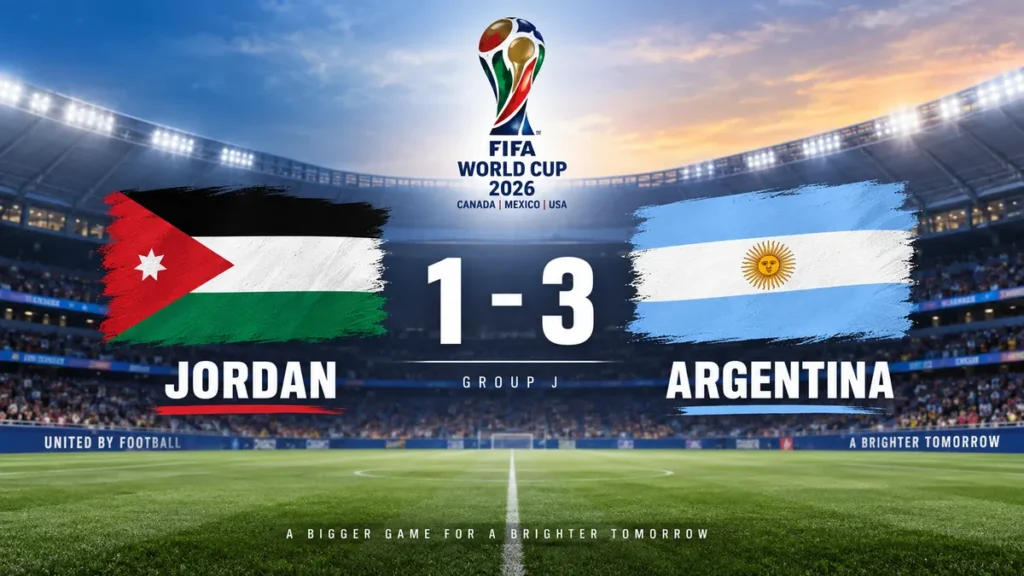
The jordan vs argentina matchup delivered a historic first meeting between the two national teams at the FIFA World Cup 2026. Jordan arrived at the tournament as World Cup debutants, while Argentina entered as the defending champions. Their Group J meeting in Arlington ended with Argentina winning 3-1, but Jordan produced a competitive second-half response before Lionel Messi put the game beyond reach.
Quick answer: Argentina beat Jordan 3-1 in their FIFA World Cup 2026 Group J match at Dallas Stadium in Arlington, Texas. Giovani Lo Celso, Lautaro Martínez and Lionel Messi scored for Argentina, while Mousa Al-Tamari scored Jordan’s goal. Messi came off the bench and struck an 80th-minute free kick.
jordan vs argentina Final Score and Match Details
The match was played on June 27, 2026 local time at Dallas Stadium in Arlington, Texas, with the fixture ending in the early hours of June 28 in UTC and many international time zones.
| Match detail | Information |
|---|---|
| Competition | FIFA World Cup 2026 |
| Stage | Group J |
| Match | Jordan vs Argentina |
| Final score | Jordan 1-3 Argentina |
| Venue | Dallas Stadium, Arlington, Texas |
| Attendance | 70,649 |
| Jordan scorer | Mousa Al-Tamari, 55′ |
| Argentina scorers | Giovani Lo Celso 19′, Lautaro Martínez 31′ (pen.), Lionel Messi 80′ |
| Half-time score | Jordan 0-2 Argentina |
Argentina already had first place in Group J secured before kickoff, allowing coach Lionel Scaloni to make nine changes from the starting XI that had beaten Austria 2-0. Messi was consequently among the substitutes rather than in the starting lineup.
The changes did not prevent Argentina from controlling much of the match. Lo Celso opened the scoring, Lautaro Martínez doubled the advantage from the penalty spot, and Messi later completed the scoring after Al-Tamari had briefly given Jordan hope.
How Jordan vs Argentina Unfolded
Argentina controls the opening stages
The contrast between the two teams was apparent in possession.
Argentina wanted to circulate the ball patiently and make Jordan defend for long stretches. Jordan were more comfortable dropping into a compact shape and looking for opportunities to attack quickly when possession changed hands.
That approach initially kept the score level, but Argentina’s technical quality eventually created the breakthrough.
Giovani Lo Celso makes it 1-0
Argentina went ahead in the 19th minute through Giovani Lo Celso.
It was an important moment for a heavily rotated Argentine side. Rather than relying entirely on its usual starters, Argentina showed that its wider squad could maintain the possession-oriented approach associated with Scaloni’s team.
Lo Celso’s goal gave Argentina control of the scoreboard as well as the ball.
Lautaro Martínez converts the penalty
The defending champions doubled their advantage in the 31st minute.
This time, Lautaro Martínez scored from the penalty spot to make it 2-0.
The goal put Jordan in a difficult position. A team built to defend compactly and attack space now had to find a way to create more attacking situations without becoming overly exposed.
Argentina took the two-goal advantage into half-time.
Mousa Al-Tamari Gives Jordan Hope
Jordan did not simply accept the direction of the match.
Coach Jamal Sellami introduced Mousa Al-Tamari at half-time, and the change quickly had an effect.
In the 55th minute, Al-Tamari scored to reduce the deficit to 2-1.
For Jordan, it was one of the defining moments of their first World Cup campaign. Al-Tamari was already one of the country’s most recognizable attacking players and part of the talented generation that had helped transform Jordan’s international standing.
The goal also changed the feel of the contest.
At 2-0, Argentina had substantial breathing room. At 2-1, Jordan were one moment away from an equalizer.
That made the next phase particularly important.
Lionel Messi Comes Off the Bench
Scaloni responded by turning to his strongest options.
Lionel Messi entered in the 60th minute, replacing Lautaro Martínez. Thiago Almada replaced Lo Celso at the same time, while Alexis Mac Allister entered shortly afterward for Nico Paz.
Messi therefore played only the final half-hour, but he still left the decisive individual mark on the match.
Messi’s 80th-minute free kick
In the 80th minute, Messi scored directly from a free kick to make the score 3-1.
It was his sixth goal of the 2026 World Cup and meant he had scored in seven consecutive World Cup matches, which FIFA reported as a new record.
The goal effectively ended Jordan’s hopes of completing a comeback.
Argentina managed the closing minutes and secured its third victory of the group stage.
jordan vs argentina Goals Timeline
The scoring sequence tells the story clearly:
- 19′ – Giovani Lo Celso: Argentina take a 1-0 lead.
- 31′ – Lautaro Martínez: Penalty makes it 2-0.
- 55′ – Mousa Al-Tamari: Jordan respond and cut the deficit to 2-1.
- 80′ – Lionel Messi: Free kick restores Argentina’s two-goal advantage at 3-1.
There were effectively two different periods in the game. Argentina controlled the first half and established a comfortable lead, while Jordan’s improvement after the interval briefly made the contest much tighter.
Messi’s introduction then gave Argentina another level of attacking quality.
Jordan vs Argentina Match Stats
The statistics underline Argentina’s control of possession and territory.
| Statistic | Jordan | Argentina |
|---|---|---|
| Possession | 26.7% | 73.3% |
| Shots | 5 | 12 |
| Shots on target | 1 | 4 |
| Corners | 2 | 6 |
| Accurate passes | 228 | 737 |
| Passing accuracy | 80% | 92% |
| Yellow cards | 3 | 0 |
| Red cards | 0 | 0 |
Argentina completed more than three times as many accurate passes and held roughly 73% of possession. Jordan, meanwhile, attempted only five shots and recorded one effort on target.
Expected-goals data published for the match also showed Argentina ahead 2.13 to 0.74 in xG, consistent with the difference in attacking opportunities.
What the statistics actually tell us
Possession alone does not explain a football match, but the passing figures are particularly revealing here.
Argentina completed 737 accurate passes at 92% accuracy, compared with Jordan’s 228 at 80%. That reflects Argentina’s ability to retain possession, move Jordan’s defensive block and dictate the game’s rhythm.
Jordan’s challenge was different.
With much less possession, they needed their attacking moments to be efficient. Al-Tamari’s goal demonstrated why Jordan could still threaten despite having relatively little of the ball.
Jordan Starting Lineup vs Argentina
Jordan started in a 3-4-2-1 formation.
Jordan XI: Yazeed Abulaila; Husam Abu Dahab, Yazan Al-Arab, Abdallah Nasib; Mohannad Abu Taha, Ehsan Haddad, Noor Al-Rawabdeh, Nizar Al-Rashdan; Ali Azaizeh, Odeh Fakhoury; Ali Olwan.
Jamal Sellami had attacking options available from the bench, most notably Mousa Al-Tamari and Mahmoud Al-Mardi.
The decision to introduce Al-Tamari at half-time proved significant almost immediately when he scored ten minutes later.
Argentina Starting Lineup vs Jordan
Argentina used a heavily rotated lineup because first place in Group J had already been secured.
Argentina XI: Emiliano Martínez; Exequiel Palacios, Nicolás Otamendi, Marcos Senesi, Nicolás Tagliafico; Giuliano Simeone, Nico Paz, Leandro Paredes, Giovani Lo Celso; Lautaro Martínez, Julián Álvarez.
The bench included several major names, including Lionel Messi, Alexis Mac Allister, Rodrigo De Paul, Enzo Fernández and Cristian Romero.
Scaloni’s willingness to make nine changes was one of the most revealing aspects of the match.
Argentina were not simply trying to survive the final group fixture. The rotated team was still expected to control possession and play within the same broad tactical framework.
FIFA later noted that, aside from the two reserve goalkeepers, every Argentine outfield player had received playing time during the tournament by this stage.
Tactical Analysis: Why Argentina Controlled the Game
1. Argentina dominated possession
The biggest tactical difference was Argentina’s ability to keep the ball.
With Paredes operating in midfield and technically secure players around him, Argentina could recycle possession rather than forcing attacks.
Jordan consequently spent long stretches without the ball.
That does more than limit attacking opportunities. It also forces defensive players to constantly shift laterally, track runners and decide when to leave their shape to pressure the ball.
2. Jordan protected central areas
Jordan’s 3-4-2-1 gave Sellami additional defensive numbers through the middle.
Against a technically superior opponent, that approach made sense. Leaving large central spaces for Argentina’s midfielders and forwards would have created even greater problems.
The downside was that Jordan sometimes struggled to establish sustained possession after winning the ball.
3. Argentina’s squad depth mattered
The match demonstrated why squad depth becomes so important during a long World Cup.
Players including Lo Celso, Nico Paz, Giuliano Simeone, Palacios and Marcos Senesi received starting opportunities, while Messi and Mac Allister could be introduced later.
Scaloni had described his squad before the tournament as containing players capable of offering different roles and greater verticality when required.
Against Jordan, that flexibility allowed Argentina to rotate extensively without losing overall control.
4. Al-Tamari changed Jordan’s attacking threat
Jordan became more dangerous when Mousa Al-Tamari entered.
His direct running offered something that had been difficult to produce consistently during the first half: a way to turn a defensive recovery into an immediate attacking threat.
His 55th-minute goal was the reward.
5. Messi settled the contest
Jordan’s goal created a potentially uncomfortable final half-hour for Argentina.
Messi’s introduction altered that equation.
He provided another player capable of retaining possession under pressure, combining around the penalty area and deciding the game from a set piece.
His free kick restored Argentina’s two-goal cushion with ten minutes of normal time remaining.
Quick takeaway: Argentina’s advantage came from more than individual talent. Their possession, passing quality and squad depth allowed them to dictate most of the match, while Jordan’s best period came after Al-Tamari gave them greater directness in transition.
Was jordan vs argentina Their First-Ever Meeting?
Yes.
The 2026 World Cup encounter was the first senior international match between Jordan and Argentina. The teams had never previously met in an official competition or senior friendly.
That means the senior men’s head-to-head record after the match stood at:
| Head-to-head record | Total |
|---|---|
| Matches | 1 |
| Argentina wins | 1 |
| Jordan wins | 0 |
| Draws | 0 |
| Argentina goals | 3 |
| Jordan goals | 1 |
The historical gap between the teams made the fixture especially notable.
Argentina came into the tournament as one of international football’s most decorated national sides. Jordan were experiencing the World Cup for the first time.
Why the Match Was Historic for Jordan
Jordan’s presence at the tournament was itself a major achievement.
The country had attempted to qualify for the World Cup nine times previously before finally reaching the 2026 finals. Qualification was secured in June 2025 after a 3-0 victory over Oman, featuring an Ali Olwan hat-trick, combined with South Korea’s victory over Iraq.
Jordan had already shown significant progress in Asian football.
At the AFC Asian Cup 2023, the Nashama reached the final for the first time before losing 3-1 to hosts Qatar. The team then carried that momentum into World Cup qualification.
Key attacking figures during this period included:
- Mousa Al-Tamari
- Ali Olwan
- Yazan Al-Naimat
FIFA described that trio as central to the generation that took Jordan to the global stage.
Ali Olwan was especially productive during qualifying, scoring nine goals in 13 matches according to FIFA’s pre-tournament profile of the World Cup debutants.
Facing the defending world champions was therefore not simply another fixture. It was part of Jordan’s first experience competing at the highest level of men’s international football.
Argentina Entered as Defending World Champions
Argentina arrived at the 2026 tournament with completely different expectations.
Lionel Scaloni’s team had won the 2022 FIFA World Cup in Qatar, giving Argentina its third world championship after 1978 and 1986.
The 2026 squad retained a substantial core of experienced players while introducing younger or newer options such as Nico Paz, Valentín Barco and José Manuel López.
Argentina’s Group J opponents were:
- Algeria
- Austria
- Jordan
By the time Argentina faced Jordan, the defending champions had already secured first place in the group.
That context explains the extensive rotation.
Rather than risking unnecessary fatigue across the regular starting lineup, Scaloni used the fixture to distribute minutes and assess alternatives while maintaining competitive momentum.
Lionel Messi’s Role in Jordan vs Argentina
One of the biggest questions surrounding the fixture was whether Messi would play.
He did, but he did not start.
Messi entered after 60 minutes and scored 20 minutes later.
The goal carried historical significance beyond the match itself. According to FIFA, it was Messi’s sixth goal of the 2026 tournament and extended his scoring run to seven consecutive World Cup matches.
It also demonstrated the unusual situation Jordan faced.
After spending an hour dealing with Julián Álvarez and Lautaro Martínez, Jordan then had to defend a fresh Messi for the closing stages.
That level of attacking depth was one of Argentina’s clearest advantages.
Mousa Al-Tamari’s Importance to Jordan
If Messi was Argentina’s headline substitute, Al-Tamari played the equivalent role for Jordan.
He entered at half-time and scored ten minutes later.
Al-Tamari’s importance went beyond that single goal. He had been one of the major attacking figures in Jordan’s rise through Asian football and World Cup qualifying.
His style gave Jordan a useful weapon against teams that dominated possession: pace and directness once space became available.
Against Argentina, those qualities helped Jordan turn a match that appeared comfortable at 2-0 into a genuine contest at 2-1.
Although Jordan could not complete the comeback, the goal ensured their historic first match against Argentina was not entirely one-sided on the scoreboard.
What Did the Result Mean for Group J?
Argentina completed the group stage in first place with a perfect record, while Austria and Algeria also progressed to the Round of 32. Jordan finished bottom of Group J.
For Argentina, the 3-1 win maintained momentum heading into the knockout rounds.
For Jordan, it brought their first-ever World Cup campaign to an end.
Jordan lost all three of its group matches against Austria, Algeria and Argentina, but reaching the tournament had already represented a milestone in the country’s football history.
Sellami left his position shortly after the tournament. FIFA reported on July 5 that Jordan and the Moroccan coach had parted ways following the completion of the team’s World Cup campaign.
What Happened to Argentina After Beating Jordan?
Argentina’s tournament continued deep into the knockout stage.
After finishing first in Group J, Scaloni’s team advanced through the expanded World Cup’s Round of 32 and continued all the way to the final.
FIFA’s tournament schedule records Argentina beating Cape Verde 3-2 after extra time, Egypt 3-2, Switzerland 3-1 and England 2-1 before facing Spain in the final. Spain eventually defeated Argentina 1-0 after extra time.
The Jordan game therefore became one chapter in another long Argentine World Cup campaign.
It was also Messi’s final World Cup tournament. FIFA subsequently reported that he announced his international retirement on August 31, 2026, after Argentina’s defeat in the final.
What Can Be Learned From the Match?
For Argentina, the strongest takeaway was squad depth.
Scaloni changed nine starters and still fielded a side containing established internationals such as Emiliano Martínez, Nicolás Otamendi, Nicolás Tagliafico, Leandro Paredes, Lo Celso, Álvarez and Lautaro Martínez.
Then Messi, Mac Allister, Almada and other options were available from the bench.
For Jordan, the lesson was different.
The match showed the difficulty of playing without much possession against an elite technical team, but it also demonstrated that Jordan could create meaningful attacking moments when they played directly and decisively.
Al-Tamari’s goal was the clearest example.
Jordan were beaten, but the 3-1 scoreline also captured the progress that had taken them from repeated qualification disappointment to sharing a World Cup pitch with the defending champions.
jordan vs argentina: Final Summary
The first jordan vs argentina match ended 3-1 to Argentina at the FIFA World Cup 2026.
Giovani Lo Celso opened the scoring in the 19th minute before Lautaro Martínez converted a penalty in the 31st. Mousa Al-Tamari came off the bench and scored in the 55th minute to bring Jordan back into the contest, but substitute Lionel Messi’s 80th-minute free kick secured Argentina’s victory.
The numbers reflected Argentina’s overall control: roughly 73% possession, 12 shots, four efforts on target and 737 accurate passes. Jordan had less of the ball but found a way to threaten after half-time.
More importantly, the fixture connected two very different football stories. Argentina were defending world champions with one of international football’s deepest squads. Jordan were competing at their first World Cup after decades of attempts to qualify.
That contrast made their first-ever meeting historically significant even before kickoff. Argentina ultimately had too much control and depth, but Jordan’s second-half response ensured their encounter became more than a routine group-stage result.