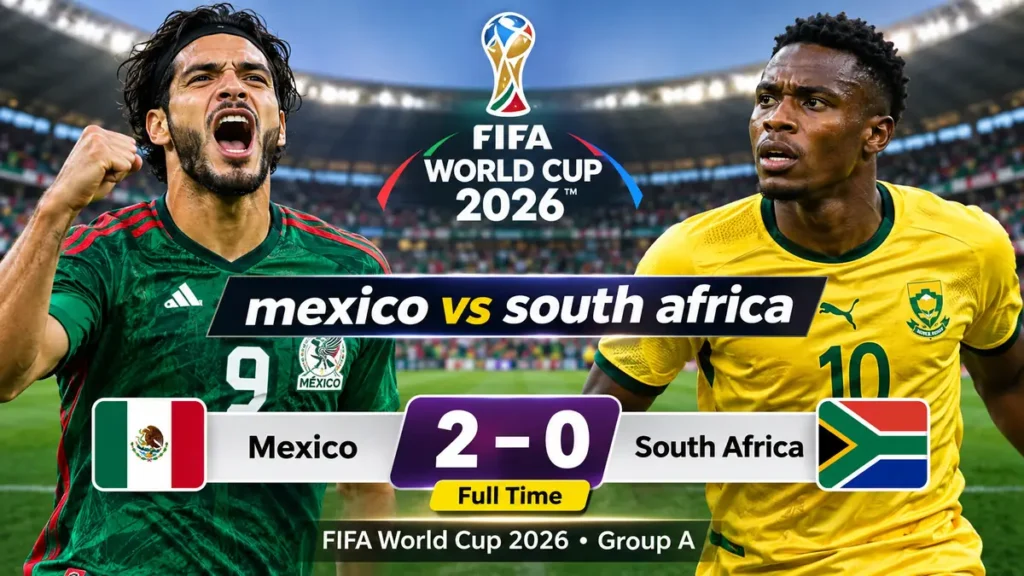
The 2026 FIFA World Cup began with a memorable meeting between Mexico and South Africa. Sixteen years after the two nations opened the 2010 tournament with a 1-1 draw, they reunited for another World Cup curtain-raiser—this time in Mexico City.
The mexico vs south africa match on June 11, 2026, ended in a 2-0 victory for Mexico. Julián Quiñones scored in the ninth minute, and Raúl Jiménez added the second goal in the 67th minute. Three red cards, a passionate home crowd, and contrasting tactical performances made the Group A encounter particularly eventful. FIFA Football Data Platform+1
mexico vs south africa: 2026 Match Overview
Mexico National Football Team Logo | Citypng
Mexico
2 – 0
Full time
South Africa – TheSportsDB.com
South Africa
FIFA World Cup 2026 · Group A · June 11, 2026
| Match detail | Information |
|---|---|
| Competition | 2026 FIFA World Cup |
| Stage | Group A |
| Venue | Estadio Azteca, Mexico City |
| Final score | Mexico 2–0 South Africa |
| Half-time score | Mexico 1–0 South Africa |
| Mexico scorers | Julián Quiñones, Raúl Jiménez |
| Mexico manager | Javier Aguirre |
| South Africa manager | Hugo Broos |
| Attendance | 80,824 |
| Referee | Wilton Sampaio |
The result gave Mexico three points in its opening Group A fixture. South Africa, returning to the World Cup for the first time since hosting the competition in 2010, began its campaign with a defeat. FB Ref+1
Mexico vs South Africa Match Highlights and Key Moments
Mexico v South Africa: Group A – FIFA World Cup 2026
Mexico v South Africa: Group A – FIFA World Cup 2026
7
First half: Mexico takes an early lead
Mexico started aggressively, pressing South Africa’s defenders and looking to create opportunities before the visitors could settle into their passing rhythm.
Raúl Jiménez tested goalkeeper Ronwen Williams in the opening minutes, signaling Mexico’s attacking intentions.
In the ninth minute, South Africa made a costly mistake while attempting to build possession from the back. Sphephelo Sithole lost the ball under pressure, allowing Julián Quiñones to capitalize and score.
Mexico continued creating chances, with Quiñones also hitting the post before the interval. South Africa gradually enjoyed more possession but struggled to generate dangerous attacks.
The first half ended 1-0 in Mexico’s favor. Reuters+1
Second half: Red cards change the contest
South Africa’s hopes of recovering suffered a major setback shortly after half-time.
Sphephelo Sithole was dismissed after bringing down Brian Gutiérrez as the Mexican attacker advanced toward goal. Playing with ten men forced South Africa to adjust its defensive structure.
Mexico used its numerical advantage to maintain territorial control and increase pressure on the visitors.
In the 67th minute, Roberto Alvarado delivered a cross that Raúl Jiménez converted with a close-range header, doubling Mexico’s lead.
The closing stages brought further disciplinary drama. South African substitute Themba Zwane was sent off in the 84th minute following a VAR review, while Mexican defender César Montes received a red card in stoppage time.
Mexico finished with ten players, South Africa with nine, and the hosts secured a 2-0 victory. Bundesliga+2
Match timeline
| Minute | Event |
|---|---|
| 9′ | Julián Quiñones scores for Mexico |
| 17′ | Teboho Mokoena receives yellow card |
| 23′ | Brian Gutiérrez receives yellow card |
| Half-time | Mexico leads 1–0 |
| 49’–50′ | Sphephelo Sithole sent off |
| 67′ | Raúl Jiménez scores Mexico’s second |
| 84′ | Themba Zwane sent off |
| 90+2′ | César Montes sent off |
| Full-time | Mexico wins 2–0 |
The match became the first World Cup opening fixture to feature three dismissals, adding an unusual historical distinction to the encounter. AP News+1
mexico vs south africa Match Statistics
The statistical comparison illustrates Mexico’s dominance in possession, attacking volume, and overall chance creation.
| Statistic | Mexico | South Africa |
|---|---|---|
| Goals | 2 | 0 |
| Ball possession | 61% | 39% |
| Total shots | 16 | 3 |
| Shots on target | 4 | 2 |
| Expected goals (xG) | 1.41 | 0.07 |
| Passes attempted | 520 | 335 |
| Pass completion | 90% | 81% |
| Corner kicks | 3 | 1 |
| Fouls committed | 12 | 11 |
| Yellow cards | 1 | 2 |
| Red cards | 1 | 2 |
Match statistics reported by Football Web Pages; possession figures may differ slightly across providers. Football Web Pages+1
Attacking comparison
Mexico
South Africa
05101520Total shotsShots on targetExpected goals
Mexico created substantially more shots and expected goals.
What do the statistics reveal?
Mexico’s 16 attempts compared with South Africa’s three demonstrate how effectively the home team controlled attacking territory.
The expected goals figures are especially revealing. Mexico generated approximately 1.41 xG, while South Africa produced only 0.07 xG.
Expected goals estimate the likelihood that shots will result in goals based on factors such as distance, angle, and chance characteristics. They are not a prediction of the final score.
South Africa’s extremely low xG suggests that its limited opportunities were generally difficult to convert. Mexico, by contrast, combined greater shot volume with better scoring positions.
Possession alone does not guarantee victory, but Mexico paired its advantage on the ball with more effective attacking play.
Mexico vs South Africa Head-to-Head Record
Mexico and South Africa have met five times in senior international football, including two FIFA World Cup matches, a CONCACAF Gold Cup encounter, and two other international fixtures.
Mexico holds the stronger historical record.
3
Mexico wins
1
Draws
1
South Africa wins
Head-to-head record through November 2026. 11v11+1
Complete head-to-head results
| Date | Match | Score | Competition |
|---|---|---|---|
| Oct. 6, 1993 | Mexico vs South Africa | 4–0 | Friendly |
| June 7, 2000 | Mexico vs South Africa | 4–2 | US Nike Cup |
| July 8, 2005 | South Africa vs Mexico | 2–1 | CONCACAF Gold Cup |
| June 11, 2010 | South Africa vs Mexico | 1–1 | FIFA World Cup |
| June 11, 2026 | Mexico vs South Africa | 2–0 | FIFA World Cup |
11v11+1
Across these five meetings, Mexico has scored 12 goals and South Africa has scored five.
South Africa’s only victory came in the 2005 CONCACAF Gold Cup, when Bafana Bafana defeated Mexico 2-1.
The World Cup record is more favorable to Mexico: one victory, one draw, and no defeats.
The historic 2010 World Cup opening match
South Africa v Mexico: Group A – 2010 FIFA World Cup
The most famous earlier meeting between these teams took place on June 11, 2010, at Soccer City in Johannesburg.
South Africa hosted the first FIFA World Cup held on African soil, and its opening match against Mexico carried enormous national significance.
After a scoreless first half, Siphiwe Tshabalala gave the hosts the lead in the 55th minute with a powerful left-footed strike.
His goal became one of the tournament’s defining moments, celebrated by thousands of supporters inside the stadium and millions watching worldwide.
Mexico responded through Rafael Márquez in the 79th minute, securing a 1-1 draw.
The game attracted 84,490 spectators and remains an important chapter in South African football history. FIFA World Cup 26+2
Why the 2010 and 2026 meetings are historically significant
Both games took place on June 11, exactly 16 years apart.
They also shared an unusual distinction: each was the opening fixture of a FIFA World Cup hosted, or co-hosted, by one of the participating nations.
In 2010, South Africa welcomed Mexico to Johannesburg. In 2026, Mexico welcomed South Africa to Mexico City.
The outcomes were different. South Africa earned a point in 2010, while Mexico secured all three points in 2026.
This connection makes the rivalry more historically interesting than its relatively small number of international meetings might suggest.
Tactical Analysis: How Mexico Defeated South Africa
Mexico’s victory was not simply the result of playing against opponents who received two red cards. The hosts established an attacking advantage early and maintained control as the match developed.
Mexico’s high pressing disrupted South Africa
Mexico frequently pressured South Africa when the visitors attempted to move the ball out of their defensive third.
This approach produced the opening goal.
Rather than allowing South Africa to build comfortably through midfield, Mexico’s attackers closed down passing options and challenged defenders in dangerous positions.
The early breakthrough strengthened Mexico’s tactical position because South Africa now needed to take greater risks to equalize.
Mexico controlled midfield possession
Erik Lira and Álvaro Fidalgo contributed to Mexico’s midfield organization, while Brian Gutiérrez helped connect possession with attacking movement.
Mexico’s passing accuracy of approximately 90% reflected its ability to retain possession and move the ball into useful positions.
South Africa relied on players such as Teboho Mokoena and Jayden Adams to compete centrally, but sustained Mexican pressure made it difficult to establish consistent attacking combinations.
Once South Africa was reduced to ten players, maintaining midfield coverage became even more challenging.
South Africa struggled to create chances
South Africa’s attacking options included Lyle Foster and Iqraam Rayners, with Oswin Appollis and Evidence Makgopa later introduced.
However, the visitors found it difficult to connect midfield possession with meaningful opportunities inside Mexico’s penalty area.
Mexico’s defensive organization limited South Africa to three total shots.
South Africa also faced the challenge of balancing defensive protection with the need to chase the game.
That balance became harder after Sithole’s dismissal.
Substitutions and game management
Both managers adjusted their teams during the second half.
Hugo Broos introduced Thalente Mbatha and Themba Zwane in an attempt to reshape South Africa’s midfield.
Javier Aguirre brought on players including Gilberto Mora, Luis Chávez, Edson Álvarez, Armando González, and Alexis Vega.
These changes helped Mexico manage its advantage while maintaining attacking options.
The introduction of fresh players also allowed the hosts to control the tempo during the closing stages, although Montes’ late dismissal prevented an entirely comfortable finish. FB Ref+1
Key Players in Mexico vs South Africa
Julián Quiñones: Mexico’s early breakthrough
Quiñones was central to Mexico’s attacking performance.
His ninth-minute goal rewarded Mexico’s aggressive start and immediately placed South Africa under pressure.
He also threatened the opposition goal later in the first half, striking the post.
His movement and willingness to pressure defenders contributed to Mexico’s attacking effectiveness.
Raúl Jiménez: Experience and finishing quality
Jiménez provided Mexico’s second goal with a header from Roberto Alvarado’s delivery.
The experienced forward also created an early scoring opportunity that forced Ronwen Williams into action.
His performance demonstrated the value of intelligent positioning and clinical finishing, especially against a team defending with fewer players.
Ronwen Williams: South Africa’s goalkeeper
Williams faced sustained pressure throughout the match.
Although South Africa conceded twice, the goalkeeper made saves that prevented Mexico from extending its lead.
The team’s problems were not confined to goalkeeping. Defensive turnovers, limited attacking opportunities, and disciplinary incidents all contributed to the defeat.
Sphephelo Sithole: A decisive dismissal
Sithole was involved in two crucial moments.
His loss of possession contributed to Mexico’s opening goal, and his second-half red card left South Africa with ten players.
Those incidents significantly changed the tactical demands facing Hugo Broos’ team.
César Montes: A late setback for Mexico
Montes helped organize Mexico’s defense for much of the encounter.
However, his stoppage-time dismissal meant Mexico finished with ten players.
The red card did not change the result, but it added to the disciplinary consequences of an unusually eventful World Cup opener. Confédération Africaine de Football+2
What the Result Meant for Group A
The 2026 World Cup featured an expanded 48-team format, making group-stage results especially important for qualification.
Mexico and South Africa competed in Group A alongside South Korea and Czechia.
The 2-0 result provided Mexico with three points and a positive goal difference of two after its opening fixture.
For South Africa, the defeat meant beginning with zero points and a negative goal difference.
| Group A team | Opening-match implication |
|---|---|
| Mexico | Three points and a +2 goal difference |
| South Africa | Zero points and a −2 goal difference |
| South Korea | Also faced Mexico in the group |
| Czechia | Also faced South Africa in the group |
These figures describe the immediate consequences of the Mexico–South Africa opener, not the final Group A standings.
The expanded competition allowed the top two teams from each group and the eight best third-place teams to progress to the round of 32.
That format meant South Africa’s opening defeat did not automatically eliminate it. Remaining group matches still offered opportunities to collect points.
For Mexico, the victory was an encouraging response to its disappointing group-stage elimination at the 2022 World Cup. AP News+2
Mexico vs South Africa: Comparing Their Football Histories
Mexico and South Africa represent different continental football traditions.
Mexico competes in CONCACAF, the confederation covering North America, Central America, and the Caribbean. South Africa belongs to CAF, the Confederation of African Football.
Both countries have hosted the men’s FIFA World Cup, but their tournament histories differ considerably.
Mexico’s World Cup experience
Mexico has a long history of participation in the men’s World Cup.
The country hosted the tournament in 1970 and 1986 before becoming a co-host in 2026 alongside the United States and Canada.
Its best historical World Cup finishes came in 1970 and 1986, when it reached the quarterfinals.
Mexico’s national team, commonly known as El Tri, has developed a reputation for technical football, attacking movement, and passionate support.
South Africa’s World Cup history
South Africa’s national team is known as Bafana Bafana.
Its modern international history is closely connected to the country’s return to international sporting competition during the early 1990s.
South Africa made its men’s World Cup debut in 1998 and also participated in 2002 and 2010.
Hosting the 2010 tournament was a landmark achievement for African football.
The 2026 competition marked South Africa’s return after missing the previous three editions.
Continental competitions and playing identities
Mexico has traditionally competed in the CONCACAF Gold Cup, where it has enjoyed considerable success.
South Africa competes in the Africa Cup of Nations, winning the tournament in 1996.
Both teams have experienced changes in playing style across generations.
Mexico is frequently associated with possession-oriented attacking football, while South Africa has combined technical midfield play with pace, defensive organization, and counterattacking opportunities.
These descriptions are broad historical tendencies rather than fixed tactical identities. Individual coaches, opponents, and available players influence how each team performs.
Major Lessons From the 2026 Encounter
The Mexico–South Africa opener offered several lessons about international tournament football.
Early goals can reshape an entire match. Mexico’s ninth-minute breakthrough forced South Africa to abandon the comfort of a level score and pursue an equalizer.
Playing out from the back requires composure. South Africa’s defensive turnover showed how dangerous mistakes become when opponents apply coordinated pressure.
Discipline matters as much as tactics. Two dismissals severely restricted South Africa’s ability to recover. Mexico also experienced the consequences of a late red card.
Chance quality provides context beyond possession. Mexico’s superior expected goals and shot volume supported the impression that the hosts created the more meaningful attacking opportunities.
Home advantage can create momentum. The atmosphere at Estadio Azteca provided a memorable setting for Mexico’s opening victory, although the result ultimately depended on execution on the pitch.
The match also reinforced an important distinction: a comfortable final score does not necessarily mean every phase of the performance was flawless. Mexico controlled much of the contest but still had areas to improve, including discipline.
Final Thoughts on mexico vs south africa
The mexico vs south africa encounter on June 11, 2026, produced a deserved 2-0 victory for Mexico in the opening match of the FIFA World Cup.
Julián Quiñones and Raúl Jiménez delivered the goals, while Mexico’s pressing, possession, and attacking efficiency established the foundation for success.
South Africa showed periods of resilience but struggled to create opportunities and suffered from costly defensive and disciplinary mistakes.
The result also added a new chapter to a distinctive World Cup rivalry. Sixteen years after their historic 1-1 draw in Johannesburg, Mexico and South Africa once again opened football’s biggest tournament—this time with the hosts celebrating victory.
For readers comparing these national teams, the central facts are clear: Mexico leads the overall head-to-head record with three wins, one draw, and one defeat, and its 2026 performance demonstrated the stronger attacking execution on the day.