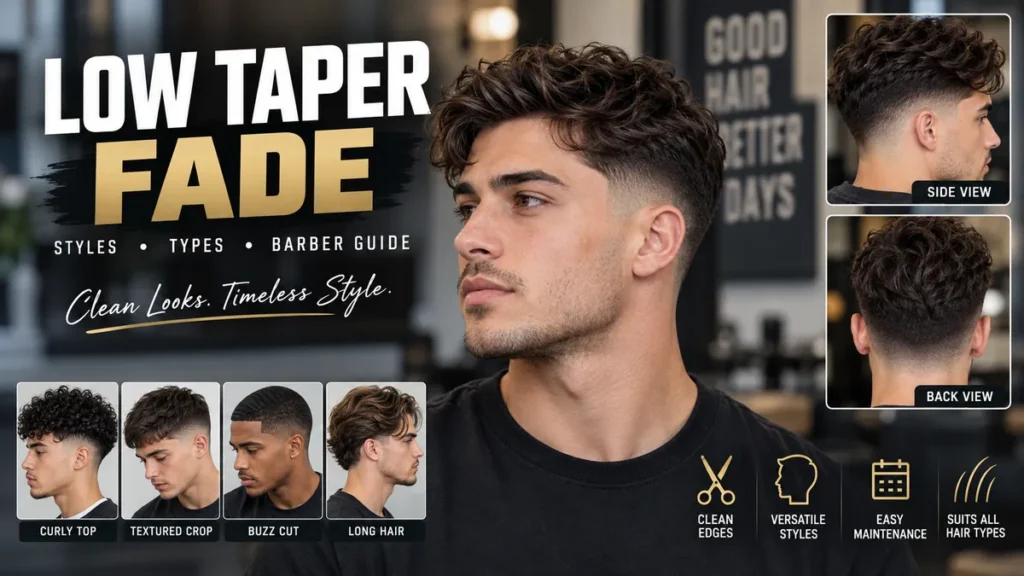
A haircut can look completely different depending on where the blend begins. That small detail is why the low taper fade has become such a recognizable men’s haircut: it cleans up the edges without removing most of the hair from the sides.
Unlike a dramatic skin fade, the taper stays concentrated near the sideburns, ears, and neckline. You keep more weight and shape through the sides while getting a crisp, graduated finish around the perimeter.
A low taper fade is a haircut in which the hair gradually becomes shorter near the sideburns and neckline, with the transition positioned low on the head. Most of the sides remain relatively full, while clippers create a smooth blend toward a short guard, zero length, or skin at the lowest point.
That basic structure can work with straight, wavy, curly, or coily hair and can be combined with everything from a buzz cut and textured crop to longer curls, a quiff, or a slick back.
What Is a low taper fade?
The easiest way to understand the haircut is to separate the three terms.
Low describes where the transition happens. The taper begins near the natural hairline, usually around the sideburns and just above the ears, rather than climbing far up the sides.
Taper means the hair progressively becomes shorter toward an edge. A traditional taper is usually localized around areas such as the temples, sideburns, and nape instead of removing length across the entire side of the head.
Fade describes the smooth transition between different lengths. Depending on the requested finish, the shortest section may end at a #1 or #0.5 guard, zero, or skin.
This terminology is not perfectly standardized between barbers. Some professionals use “low taper” and “low taper fade” interchangeably, while others reserve “fade” for blends that reach zero or skin. That is why showing a reference photo and explaining the amount of scalp exposure you want is often more reliable than relying on the haircut name alone.
What Does a Low Taper Look Like?
From the front, the change can be surprisingly subtle. Much of the side panel remains dark and full.
Look closer at the temple and sideburn and you will see the hair gradually shorten toward the edge. A similar transition occurs around the nape.
From behind, the neckline appears cleaner and more deliberate without the large faded area associated with many conventional low, mid, or high fades.
This compact placement is one reason the haircut works well when you want clean edges without sacrificing density through the sides.
Quick Takeaway: Think of a low taper as an edge-focused haircut. The barber cleans and blends the lowest areas while preserving much more of your existing side length.
low taper fade vs Low Fade, Mid Fade, and High Fade
“Taper” and “fade” are frequently used as if they mean exactly the same thing. In practice, the amount of hair removed and the location of the transition can produce noticeably different silhouettes.
| Haircut | Where the blend occurs | Side coverage | Overall effect |
|---|---|---|---|
| Low taper fade | Sideburns and neckline | Most side weight retained | Subtle and clean |
| Low fade | Low around sides and back | More lower-side hair removed | More visible gradient |
| Mid fade | Around middle of sides | Moderate removal | Stronger contrast |
| High fade | Higher toward temples | Much more side hair removed | Bold contrast |
| Skin taper | Localized edges ending at skin | Most sides retained | Sharp edges with high contrast |
A particularly useful distinction is low taper vs low fade.
A low taper normally concentrates the shortest blending around the sideburns and nape. A low fade creates a more continuous faded band around the lower sides and back. The second option therefore exposes more scalp and removes more weight.
Is a Low Taper the Same as a Skin Fade?
Not necessarily.
“Low” describes placement, while “skin” describes the shortest length. A taper can finish at a guarded length such as #1 or #0.5, or it can be taken down to zero or skin.
If you dislike visible scalp, explicitly tell your barber you want a low taper but not a skin taper.
That one sentence can prevent a much shorter haircut than you expected.
Why the low taper fade Works With So Many Hairstyles
The biggest advantage of this haircut is not any single appearance. It is how little it dictates about the rest of your hair.
Because the taper occupies a relatively small area, you can retain length, density, curls, waves, or volume elsewhere.
This makes it useful for someone who wants a sharper outline but does not want the sides aggressively faded.
It Preserves Weight on the Sides
High fades remove a substantial amount of side hair. A low taper does the opposite: it keeps most of that weight.
That can make the haircut feel less severe and gives your barber more material for shaping the overall silhouette.
The Grow-Out Is Relatively Forgiving
Every short fade eventually grows out. The difference is how obvious that regrowth becomes.
Because a low taper has a smaller transition zone and retains more surrounding hair, new growth can blend into the haircut more naturally than it does with a large high-contrast skin fade.
A very sharp skin taper will still lose definition quickly, particularly around the neckline.
It Does Not Dictate the Top
The top can be extremely short or several inches long.
Common combinations include:
- textured crop
- crew cut
- buzz cut
- curly top
- textured fringe
- side part
- comb over
- slick back
- quiff
- pompadour
- blowout
- mullet
This flexibility is consistently reflected in current barber and hairstyle guides.
Best low taper fade Styles
There is no single version that everyone should request. The best variation depends on your hair texture, current length, density, growth pattern, and how much contrast you want.
Classic Low Taper Fade
The classic version keeps things simple: a compact blend at the temples and neckline with enough length remaining on the sides to create a natural silhouette.
It is a useful starting point if you have never had a fade because the barber does not need to remove large amounts of hair.
Ask for a conservative blend rather than immediately requesting skin. You can always go shorter during the appointment.
Low Taper Fade With Textured Top
A textured top introduces separation and movement while the taper gives the edges structure.
Instead of combing every strand into place, the top is usually point-cut or otherwise texturized so sections fall in slightly different directions.
A matte clay or paste can provide control without creating a glossy finish.
Low Taper Fade With Fringe
A fringe shifts attention toward the front of the hairstyle.
The top can be worn forward naturally, cut into a shorter textured fringe, or left longer and messier. Keeping the taper low prevents the sides from becoming too disconnected from the heavier front.
Low Taper Fade With Curly Hair
Curly hair and a low taper are a particularly natural combination because the haircut lets you retain curl volume.
The barber can clean the sideburns and neckline without cutting away the shape of the curls higher on the sides.
For tighter curls and coils, preserving moisture matters more than trying to make every strand sit identically. A leave-in conditioner or lightweight curl product can help manage definition and frizz.
Low Taper Fade With Straight Hair
Straight hair makes transitions highly visible, so a smooth blend matters.
Keeping enough weight above the taper helps prevent the side from looking hollow. Point-cut texture on top can also reduce a blocky appearance, particularly with thick, straight hair.
A crop, side sweep, side part, quiff, or longer layered top can all work with this foundation.
Low Taper Fade With Wavy Hair
Natural waves provide movement without requiring the dramatic contrast of a high fade.
A low taper cleans the perimeter while leaving enough length for the wave pattern to remain visible. Sea salt spray or a lightweight styling cream can enhance movement when appropriate for your hair.
Avoid removing too much weight from the sides if your waves need length to form properly.
Low Taper Fade With Coily Hair
Coily and tightly textured hair can create a particularly clear transition because of the contrast between the full texture and closely tapered edges.
The top might remain natural, rounded, twisted, sponged, or otherwise shaped according to preference.
The key is deciding how low the shortest point should go. People prone to razor bumps may prefer a guarded finish instead of a razor or foil-shaver skin finish.
Low Taper Fade With Long Hair
A common misconception is that a fade requires the whole haircut to be short.
It does not.
Only the tapered area needs to become short. The top can remain long, and much of the side length can also stay intact when the blend is localized around the edges.
This approach can clean up longer hairstyles without changing their overall character.
Low Taper Fade With a Buzz Cut
A buzz cut keeps the top short, while the low taper adds graduation around the perimeter.
Even though both areas are short, the change in length prevents the haircut from appearing completely uniform.
This combination also puts more emphasis on head shape and the quality of the hairline work.
Low Taper Fade With a Mullet
A modern mullet depends on preserving length toward the back, which makes a localized taper useful.
Rather than fading the entire side aggressively, the barber can clean the temple area while leaving enough hair behind the ear to connect with the longer back.
Low Taper Fade With a Beard
The transition does not have to stop at the sideburn.
A barber can blend the haircut into facial hair, creating a gradual change from the temple into the beard. The important part is deciding whether you want the beard connection preserved, disconnected, or faded.
Which Hair Types Work With a low taper fade?
One reason the style appears across so many haircut collections is that the fade itself does not depend on a particular texture.
| Hair type | What the taper adds | Main consideration |
|---|---|---|
| Straight | Cleaner outline and subtle contrast | Blend lines can be more visible |
| Wavy | Structure without removing movement | Preserve enough length for waves |
| Curly | Clean edges while retaining volume | Avoid unnecessary bulk removal |
| Coily | Defined perimeter and strong texture contrast | Protect hair and scalp from over-cutting |
| Fine | Adds shape around the edges | Avoid excessive side removal |
| Thick | Controls the perimeter | Manage bulk above the taper |
Hair density is just as relevant as texture.
Two
can require completely different techniques if one has very fine hair and the other has dense, coarse growth.
Growth direction also matters around the crown, nape, and temples. A good barber adapts the blend rather than forcing identical guard numbers onto every client.
Does a low taper fade Suit Every Face Shape?
Face shape can influence how you style the top, but it should not be treated as a rigid rule for deciding whether you can wear a taper.
The top often changes the apparent proportions of the face more dramatically than the small faded area itself.
For example, adding substantial height with a quiff or pompadour can visually lengthen the face. A flatter textured crop produces a different effect. Keeping more side volume can also create a wider overall silhouette than a high skin fade.
Current hairstyle references commonly pair low tapers with oval, square, and longer face shapes, but your head shape, hairline, density, beard, and chosen top style all contribute to the final result.
Rather than asking only, “Does this work for my face shape?” ask:
What overall silhouette do I want the finished haircut to create?
That gives your barber much more useful information.
How to Ask Your Barber for a low taper fade
Walking into the shop and saying only “low taper” leaves several decisions unresolved.
Two barbers can interpret that request differently.
A clearer request sounds something like:
“I want a low taper around the sideburns and neckline. Keep the blend compact and preserve the weight above the ears. Take the bottom to a #0.5, but don’t turn it into a full low fade. Keep the top at my current length and add some texture.”
Change the #0.5 to your preferred shortest length.
Your barber needs to know six things:
- Taper placement: Tell them you want the blend kept low.
- Shortest length: Choose skin, zero, #0.5, #1, or another guarded length.
- Side weight: Explain how full you want the hair above the taper.
- Top length: Give an approximate length or say exactly how much you want removed.
- Top texture: Specify natural, textured, messy, smooth, curly, brushed back, or another finish.
- Neckline and hairline: Discuss whether you want natural edges or a sharper line-up.
Barber terminology varies, so photographs remain extremely useful. A clear side view shows the fade height; a back view shows how you want the nape treated.
Should You Ask for Skin, Zero, 0.5, or 1?
This decision controls the contrast.
Skin creates the sharpest transition and exposes the most scalp.
Zero leaves extremely short stubble.
#0.5 produces a softer finish while remaining visibly tapered.
#1 keeps more hair at the bottom and generally creates the most conservative appearance among these choices.
Guard lengths are useful references, but clipper systems and barber techniques can vary. They should be treated as communication tools rather than universal specifications.
If you are uncertain, start longer. Hair can be shortened immediately; it cannot be restored during the appointment.
Quick Takeaway: Fade height and shortest length are separate choices. Tell your barber both.
How Barbers Create a low taper fade
Understanding the basic process makes it easier to recognize good work and communicate changes.
The exact method varies between professionals, but the general process is straightforward.
1. Establish the Overall Shape
Before fading anything, the barber considers the desired top length, side weight, head shape, hair density, and growth pattern.
This matters because the taper should support the haircut rather than exist as an isolated patch of short hair.
2. Set the Lowest Guideline
The barber establishes where the shortest area will sit around the temple, sideburn, and neckline.
For a genuine low taper, this zone remains compact.
If the initial guideline climbs too high, the finished result can begin to resemble a mid taper or conventional low fade.
3. Build the Gradient
Different clipper lengths and lever positions are used to transition gradually from the shortest area into the longer hair.
The objective is to remove visible lines while retaining enough darkness and weight above the taper.
4. Blend Into the Longer Hair
Clipper-over-comb, guards, or scissor-over-comb may be used to connect the short taper with the longer side panel.
Dense or longer hairstyles may require more scissor work to preserve shape.
5. Refine the Perimeter
Finally, the barber cleans the sideburns, around the ears, and neckline.
A trimmer, clipper, razor, or foil shaver may be involved depending on the requested finish and skin sensitivity.
How Long Does a low taper fade Last?
The haircut does not suddenly become “bad” on a particular day. Instead, the crispest details gradually soften.
Current barber guidance commonly places a sharp refresh somewhere around two to four weeks, although a softer guarded taper can remain presentable longer. Hair growth rate and your preferred level of sharpness matter considerably.
A useful practical guide is:
| Desired appearance | Approximate refresh schedule |
|---|---|
| Very crisp | Every 2–3 weeks |
| Tidy but slightly grown in | Every 3–4 weeks |
| Relaxed, low-maintenance grow-out | Around 4–6 weeks |
These are not biological rules. Someone whose hair grows quickly may notice sideburn and neckline regrowth much sooner.
A skin taper also appears to change faster because the contrast between bare skin and new growth is obvious.
What Grows Out First?
Usually, the neckline and sideburn definition.
The gradient itself gradually becomes softer, but fresh growth at the lowest points can make the perimeter look less precise before the overall haircut loses its shape.
This is why a quick professional edge cleanup can sometimes extend the visual life of the cut without requiring a complete haircut.
How to Style a low taper fade at Home
The fade itself requires almost no daily styling. Your routine depends mainly on what you keep on top.
For Straight or Fine Hair
Use a small amount of lightweight paste, styling cream, or matte clay.
Fine hair can collapse when overloaded with heavy wax, so start with less product than you think you need.
For Wavy Hair
A lightweight cream or sea salt spray can help emphasize movement.
Work the product through damp hair, then finger-style or use controlled airflow from a dryer if you want additional volume.
For Curly or Coily Hair
Moisture usually matters more than strong hold.
Leave-in conditioner, curl cream, or an appropriate lightweight oil can help maintain definition and manage dryness. Avoid repeatedly manipulating the tapered edges simply to make them appear sharper.
For a Slick Back, Side Part, or Quiff
Use a product matched to your desired finish.
A pomade can provide more shine and definition, while clay or paste gives a drier, more textured result. A blow dryer can help establish direction and volume before product is applied.
How to Maintain the Cut Without Ruining the Fade
A common mistake is trying to recreate the blend at home between barber appointments.
Cleaning obvious stray hairs around the neckline is one thing. Moving the fade line or experimenting with multiple guards is another.
Once a new guideline is accidentally cut into the side, correcting it may require the barber to take the fade higher.
For normal maintenance:
- keep your scalp and hair clean without excessive washing
- use styling products appropriate for your texture
- prevent heavy product buildup around the hairline
- avoid repeatedly shaving sensitive areas if you develop irritation
- use clean tools if you perform minor edge maintenance
- leave significant blending work to your barber
People prone to razor bumps or irritation should tell their barber before requesting a skin finish. Stopping at a guarded length and avoiding repeated razor or foil-shaver passes can reduce very close cutting at the skin surface.
Common low taper fade Mistakes
A technically clean fade can still be the wrong haircut if the consultation was unclear.
Taking the Fade Too High
This is probably the most important mistake.
Once too much side weight is removed, the haircut no longer has the subtle character that makes a low taper distinctive.
If you want a compact taper, say so explicitly.
Choosing Guard Numbers Without Considering the Hair
A #0.5 on one person’s dense dark hair can look very different from the same guard on fine or light-colored hair.
Use guard numbers to communicate approximate length, not to design the entire haircut.
Ignoring the Back
People often bring only a front-facing inspiration photo.
The neckline is a major component of a taper. Bring or inspect a rear view whenever possible.
Asking for a Skin Finish Despite Skin Irritation
Maximum contrast is not mandatory.
A #0.5 or #1 can still produce a polished taper without shaving the lowest area completely bare.
Removing Too Much Side Weight From Curly Hair
Curls depend on shape and distribution.
Aggressively thinning or fading the sides can change the entire silhouette. If retaining curl volume matters, tell the barber before the taper begins.
Copying a Photo Without Considering Hair Density
An inspiration photo is a reference, not a guarantee.
Hairline position, density, curl pattern, growth direction, head shape, and top length all affect the outcome.
Ask the barber to reproduce the structure you like rather than expecting an exact duplicate.
Is a low taper fade Low Maintenance?
It depends on what you call maintenance.
Daily styling can be extremely easy because the taper itself needs almost no attention. If the top is short or naturally styled, you may spend only a few minutes on your hair.
Keeping the haircut freshly barbered is different.
A skin or zero taper can begin showing regrowth relatively quickly, while a softer #0.5 or #1 finish is generally more forgiving. Current barber references suggest roughly two to three weeks for a consistently crisp appearance, with longer intervals possible if you are comfortable with softer edges.
The top also changes the equation.
A buzz cut with a taper may require almost no morning styling. A long quiff, curly fringe, blowout, or slick back can take considerably more effort even though the taper is identical.
So the complete hairstyle—not simply the fade—determines the real maintenance level.
Who Should Consider a low taper fade?
A low taper makes sense when you want cleaner edges while preserving the overall fullness of your haircut.
It is particularly useful if you:
- want to try a fade without dramatically shortening the sides
- prefer subtle rather than high-contrast transitions
- have curls or waves you want to preserve
- wear longer hair but want a cleaner neckline
- want flexibility to change the hairstyle on top
- prefer a softer grow-out than an aggressive high skin fade
- need a haircut that can shift easily between neat and relaxed styling
It may be less suitable if your main goal is maximum scalp exposure or a dramatic disconnected effect. A mid, high, or full skin fade creates much stronger contrast.
Final Takeaway
The low taper fade works because it changes a small but visually important part of the haircut. Instead of stripping away the sides, it concentrates the shortest blending around the sideburns and neckline while preserving weight above them.
It can support straight, wavy, curly, and coily textures and pair with short crops, buzz cuts, fringes, curls, quiffs, slick backs, mullets, and longer hairstyles.
The most important decision is not simply whether to get a low taper fade. Decide how low you want the blend, how short you want the bottom, how much side weight you want to preserve, and what shape you want on top.
Take clear side and back reference photos to your barber and describe those details. That gives the barber enough information to adapt the cut to your actual hair rather than relying on a haircut name alone.