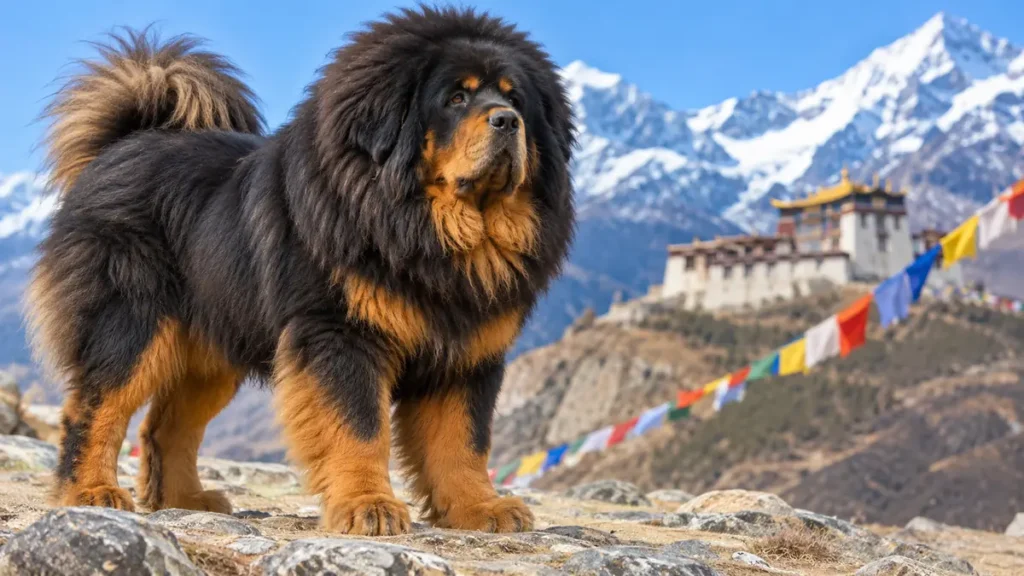
The tibetan mastiff looks like a lion, behaves like a watchful guardian, and has a personality unlike most household dogs. Behind its enormous mane and powerful appearance is an intelligent, independent breed that has protected people and livestock for centuries.
But this impressive dog is not suitable for every household. Understanding its natural instincts, exercise requirements, training challenges, and health needs is essential before considering life with one.
The tibetan mastiff is a large, powerful livestock guardian breed originating from the Himalayan region of Tibet. Known for its thick double coat, protective temperament, and independent personality, it typically weighs 70–150 pounds and lives around 10–12 years. This loyal breed requires experienced handling, early socialization, secure outdoor space, and consistent care.
tibetan mastiff Breed Overview and Key Characteristics
The Tibetan Mastiff, also known as Do-Khyi, belongs to the Working Group recognized by the American Kennel Club (AKC). It was developed to guard livestock, homes, and settlements rather than perform repetitive obedience tasks.
Its combination of physical strength, territorial awareness, and independent judgment makes it distinctly different from more cooperative companion breeds.
| Characteristic | Breed information |
|---|---|
| Breed name | Tibetan Mastiff |
| Origin | Tibet and the Himalayan region |
| Traditional name | Do-Khyi |
| Breed group | Working Group (AKC) |
| Height | Males generally 26+ inches; females 24+ inches |
| Weight | Approximately 70–150 pounds (32–68 kg), sometimes more |
| Lifespan | Approximately 10–12 years |
| Temperament | Loyal, protective, intelligent, independent |
| Coat type | Thick, weather-resistant double coat |
| Common colors | Black, black and tan, brown, blue-gray, gold |
| Exercise needs | Moderate daily activity |
| Grooming | Weekly brushing; intensive seasonal shedding |
| Trainability | Intelligent but independent-minded |
| Climate preference | Cool and cold environments |
| Best suited for | Experienced owners with secure property |
These figures are general breed guidelines rather than strict limits for every individual. Body condition, genetics, sex, and overall health influence a dog’s final size and development. American Kennel Club+2
What Makes the Tibetan Mastiff Unique?
Several characteristics distinguish this breed from other large dogs:
- Independent judgment: Historically, these dogs made protective decisions without constant human direction.
- Strong territorial instincts: They naturally monitor unfamiliar people, animals, and activity around their property.
- Lion-like appearance: A dense mane around the neck and shoulders creates an unusually imposing silhouette.
- Seasonal activity patterns: Many are more alert during evenings and nighttime.
- Slow physical maturity: They develop gradually, often continuing to fill out well beyond puppyhood.
- Deep family loyalty: They typically form strong bonds with familiar people while remaining reserved around strangers.
Their defining feature is not aggression. It is a combination of watchfulness, confidence, and the ability to make decisions independently.
History and Origin of the Tibetan Mastiff
The Tibetan Mastiff developed in the harsh mountain environments of Tibet and surrounding Himalayan regions, where livestock protection was essential for survival.
For generations, these dogs guarded sheep, goats, homes, and settlements against predators and unfamiliar intruders. Their substantial coats provided insulation, while their size and vocal warnings helped discourage potential threats.
Ancient Himalayan Guardian Dogs
Tibetan communities traditionally relied on large guardian dogs to protect valuable livestock and property.
These animals needed to work with limited supervision, often in remote areas where human intervention was not immediately available.
That environment favored dogs with several practical abilities:
- Recognizing unfamiliar movement around livestock.
- Remaining alert during nighttime hours.
- Withstanding cold temperatures and challenging terrain.
- Responding decisively to perceived threats.
- Living and working alongside familiar animals and people.
Their protective nature was developed for a specific purpose. It remains deeply embedded in the modern breed.
From Tibetan Monasteries to International Recognition
Large Tibetan guardian dogs also became associated with monasteries, villages, and traveling caravans.
Historical accounts often connect them with European travelers, including Marco Polo, although descriptions of enormous Asian dogs should not automatically be treated as precise records of the modern breed.
One documented milestone occurred in 1847, when a Tibetan Mastiff named Siring was presented to Queen Victoria.
Interest in the breed subsequently expanded beyond Asia, although it remained relatively uncommon compared with other working dogs. VCA Animal Hospitals+1
Is the Tibetan Mastiff an Ancient Breed?
Yes, its roots lie in longstanding Himalayan livestock-guardian traditions.
However, claims that today’s Tibetan Mastiff is the direct ancestor of every modern mastiff or mountain dog go beyond what historical evidence can conclusively establish.
The modern pedigree breed has been shaped by selective breeding and kennel-club standards. It shares a historical relationship with Asian livestock guardians, but its ancestry is more complex than a single uninterrupted bloodline.
tibetan mastiff Size, Weight, and Physical Appearance
The Tibetan Mastiff is one of the most visually impressive guardian breeds, combining a broad frame with heavy bone, muscular limbs, and a dense coat.
Despite its size, a healthy dog should remain balanced and capable of agile movement. Excessive bulk is not necessarily desirable.
How Big Does a Tibetan Mastiff Get?
Adult males are generally larger and more heavily built than females.
| Measurement | Male | Female |
|---|---|---|
| Typical height | 26–29 inches | 24–27 inches |
| Approximate weight | 90–150 pounds | 70–120 pounds |
| Physical build | Broad, muscular, heavy-boned | Powerful, generally lighter |
| Coat appearance | Often more prominent mane | Usually less pronounced mane |
| Maturity | Often 3–4 years or longer | Often 2–3 years |
The height figures reflect common breed-standard ranges. Weight varies substantially between bloodlines and individuals.
The AKC standard specifies minimum adult heights and emphasizes sound structure rather than exaggerated size. images.akc.org+2
Why Do Tibetan Mastiffs Look Like Lions?
The distinctive lion-like appearance comes primarily from their thick mane.
Longer guard hairs grow around the neck, shoulders, and upper chest, creating a rounded silhouette that makes the head appear exceptionally large.
Males frequently develop more pronounced manes than females.
Their appearance is further enhanced by:
- A broad skull and strong muzzle.
- Deep-set, almond-shaped eyes.
- Medium-sized, V-shaped ears.
- A thick, feathered tail carried over the back.
- A muscular body with substantial bone.
- A dense undercoat beneath coarse outer hair.
The mane is a natural coat characteristic, not a separate lion-like breed variety.
Tibetan Mastiff Coat Colors
Recognized coat colors vary slightly among kennel-club standards.
Common colors include black, black and tan, brown, blue-gray, and shades of gold ranging from pale gold to deeper reddish tones.
Some dogs have tan markings above the eyes, around the muzzle, or on the legs.
The Royal Kennel Club and AKC maintain formal breed standards describing acceptable colors, markings, proportions, and movement.
Unusual coat colors should not automatically be interpreted as evidence of superior genetics or rarity. The Kennel Club+1
How Fast Do Tibetan Mastiff Puppies Grow?
Tibetan Mastiff puppies grow rapidly during their early months, but full maturity takes considerably longer.
A typical developmental pattern looks like this:
| Age | General development |
|---|---|
| 0–3 months | Rapid early growth and social development |
| 3–6 months | Noticeable increases in height and body mass |
| 6–12 months | Continued skeletal growth and adolescent behavior |
| 12–24 months | Increasing muscle development and physical maturity |
| 2–4+ years | Gradual filling out and mature adult appearance |
Individual growth rates differ. Puppies should be assessed using veterinary growth guidance and body-condition scoring rather than pushed toward a particular weight.
Overfeeding a large-breed puppy to encourage rapid growth can place unnecessary stress on developing joints.
Tibetan Mastiff Temperament and Personality
The Tibetan Mastiff temperament is often described as loyal, protective, calm, intelligent, and strong-willed.
Those traits can make the breed a dependable companion in the right environment, but they also create challenges.
Unlike breeds developed to work closely under constant instruction, Tibetan Mastiffs were selected to evaluate situations independently.
Are Tibetan Mastiffs Aggressive?
Tibetan Mastiffs are not inherently aggressive toward everyone they encounter.
However, they possess strong guarding instincts and can respond defensively when they perceive a threat to their family or territory.
A well-adjusted dog may remain calm around familiar people while displaying considerable suspicion toward strangers.
Behavior depends on several factors, including:
- Genetics and individual temperament.
- Early socialization experiences.
- Training methods and household management.
- Previous interactions with unfamiliar people.
- Stress, fear, pain, and environmental conditions.
Protectiveness should never be confused with uncontrolled aggression.
A dog that repeatedly lunges, threatens visitors, or cannot be safely managed needs professional behavioral assessment rather than encouragement to guard more intensely.
Are Tibetan Mastiffs Good Family Dogs?
They can become affectionate and loyal family companions, particularly in experienced households that understand livestock-guardian behavior.
They often enjoy remaining close to familiar family members, even when they are not constantly seeking attention.
However, their size, strength, and territorial instincts require careful management.
Families with young children face additional challenges because even a friendly large dog can accidentally knock over a child.
Children should never be left unsupervised with any dog, especially one of this size.
Households with older children, predictable routines, and adults experienced with guardian breeds are generally better suited.
How Do They Behave Around Strangers?
A Tibetan Mastiff may initially observe visitors from a distance rather than greeting them enthusiastically.
This reserved behavior is consistent with its traditional guarding role.
Some individuals become comfortable after a calm introduction, while others remain cautious even with repeated exposure.
Visitors should not be encouraged to approach suddenly, lean over the dog, or force physical contact.
Instead, introductions should be controlled, with the dog given space and the owner maintaining safe management.
Can Tibetan Mastiffs Live With Other Dogs?
Many can coexist with other dogs, especially when introduced appropriately during puppyhood.
However, some become territorial or less tolerant of unfamiliar dogs as they mature.
Compatibility depends on individual personalities, previous social experiences, and household structure.
Supervised introductions, separate feeding areas, and management of valuable resources can reduce conflict.
Smaller pets should also be introduced carefully. Although Tibetan Mastiffs were historically raised around livestock, that does not guarantee every individual will behave safely around cats or other small animals.
Why Do Tibetan Mastiffs Bark at Night?
Nighttime barking is closely connected to the breed’s historical role as a guardian.
These dogs often become more attentive to unfamiliar sounds and movement after dark.
They may bark at passing animals, distant noises, or people approaching their territory.
This behavior can create difficulties in densely populated neighborhoods.
Training, environmental management, adequate daytime enrichment, and reducing exposure to nighttime triggers can help. Nevertheless, owners should not expect to eliminate all alert barking from a naturally vigilant guardian breed.
Quick takeaway: A Tibetan Mastiff is typically affectionate with its own family but cautious around unfamiliar people. Its independent personality makes early socialization, secure boundaries, and consistent management essential.
Tibetan Mastiff Training and Socialization
Training a Tibetan Mastiff requires patience, consistency, and an understanding of how livestock guardian dogs think.
These dogs are intelligent enough to learn commands, but they may question whether following an instruction is necessary.
That independence is not a sign of low intelligence. It reflects generations of breeding for autonomous decision-making.
Are Tibetan Mastiffs Easy to Train?
They are generally more challenging to train than highly cooperative breeds such as Labrador Retrievers or Golden Retrievers.
A Tibetan Mastiff may understand a command perfectly but choose not to respond immediately, particularly when distracted by something it considers important.
Successful training relies on:
- Positive reinforcement using rewards the dog values.
- Short, engaging training sessions.
- Consistent household rules.
- Calm handling without intimidation.
- Frequent practice in different environments.
- Realistic expectations about instinctive guarding behavior.
Harsh punishment can increase fear, defensive reactions, and conflict. Reward-based training is the safer and more effective foundation. American Kennel Club+1
How to Train a Tibetan Mastiff Puppy
Early training should focus on communication, confidence, and safe behavior rather than advanced guarding exercises.
- Begin with name recognition. Reward the puppy for turning toward you when called.
- Teach basic commands. Introduce sit, stay, come, leave it, and settle using positive reinforcement.
- Practice leash walking. Develop loose-leash habits before the dog becomes physically difficult to control.
- Introduce handling exercises. Gradually teach the puppy to accept brushing, ear examinations, nail care, and veterinary handling.
- Reward calm behavior. Reinforce relaxed responses to visitors, everyday noises, and unfamiliar surroundings.
- Practice controlled greetings. Allow the puppy to observe people without requiring interaction with everyone.
- Build reliable management routines. Teach comfortable separation, crate or resting-area use, and safe behavior around gates and doors.
Training should continue throughout adolescence and adulthood.
Why Is Early Socialization So Important?
The early socialization period is a critical stage in canine development.
Puppies benefit from carefully managed exposure to different people, surfaces, sounds, animals, and environments.
For a Tibetan Mastiff, the goal is not to make the dog enthusiastically greet every stranger. It is to help the dog remain composed and confident around ordinary situations.
For example, a puppy can learn to observe a delivery worker without barking or rushing toward the gate.
Socialization should be gradual and positive. Forcing a frightened puppy into uncomfortable interactions can make defensive behavior worse.
Owners should follow veterinary guidance on vaccination safety while providing appropriate early experiences.
Can a Tibetan Mastiff Be Trained as a Guard Dog?
The breed already possesses natural guarding instincts.
Encouraging aggressive behavior or teaching a dog to threaten unfamiliar people is unnecessary and potentially dangerous.
Training should emphasize impulse control, calm responses, reliable handling, and appropriate boundaries.
A qualified trainer experienced with livestock guardian breeds can help address territorial behavior without increasing aggression.
Tibetan Mastiff Exercise and Living Requirements
Despite their enormous size, Tibetan Mastiffs are not exceptionally high-energy dogs.
They were developed for watchful guarding rather than continuous running, making moderate daily activity more suitable than strenuous endurance exercise.
How Much Exercise Does a Tibetan Mastiff Need?
Many healthy adults benefit from approximately 45–60 minutes of daily walking and activity, adjusted for age, fitness, temperature, and veterinary advice.
The PDSA recommends at least an hour of daily exercise, while the AKC emphasizes moderate activity and opportunities for natural patrolling behavior. American Kennel Club+1
A balanced routine might include:
| Activity | Suggested duration |
|---|---|
| Morning walk | 20–30 minutes |
| Evening walk | 20–30 minutes |
| Short training exercises | 5–10 minutes |
| Supervised yard exploration | As appropriate |
| Puzzle games or scent activities | 10–15 minutes |
These activities can overlap rather than being treated as a rigid schedule.
Puppies require shorter, age-appropriate exercise sessions. Repeated forced running, excessive jumping, and strenuous activity should be avoided while their joints are developing.
Do Tibetan Mastiffs Need a Large Yard?
A securely fenced yard is highly beneficial.
These dogs naturally investigate their surroundings and may patrol their territory.
A suitable outdoor area should have:
- Strong fencing appropriate for a large, powerful dog.
- Secure gates and reliable latches.
- Shade and constant access to fresh water.
- Comfortable resting areas.
- Protection from extreme weather.
- Space for supervised movement and exploration.
An ordinary low fence may be insufficient for a determined dog.
A yard is not a replacement for walks, training, or interaction with family members.
Can a Tibetan Mastiff Live in an Apartment?
Apartment living is generally unsuitable for most Tibetan Mastiffs.
Their large size, nighttime alert barking, territorial instincts, and need for controlled outdoor access can create significant difficulties in shared residential buildings.
Even a spacious apartment may lack the environmental conditions needed to manage the breed comfortably.
A house with secure outdoor space is usually a more practical setting.
Can Tibetan Mastiffs Live in Hot Weather?
Tibetan Mastiffs are adapted to cooler environments and are particularly vulnerable to overheating in hot, humid conditions.
Their thick double coat provides insulation, but it does not eliminate the risk of heatstroke.
During warm weather:
- Exercise during cooler morning or evening hours.
- Provide continuous access to fresh drinking water.
- Offer well-ventilated, shaded, or air-conditioned resting areas.
- Avoid hot pavement.
- Never leave the dog inside a parked vehicle.
- Reduce strenuous activity during heatwaves.
Heavy panting, weakness, excessive drooling, confusion, vomiting, and collapse can indicate heatstroke.
Suspected heatstroke is a veterinary emergency. Move the dog into a cooler environment, begin cooling with cool water while avoiding the nose and mouth, and seek emergency veterinary assistance immediately.
Tibetan Mastiff Grooming, Shedding, and Coat Care
The Tibetan Mastiff has a dense double coat consisting of coarse outer guard hairs and a softer, woolly undercoat.
This coat protects against cold weather and helps shield the dog from environmental conditions.
Although it looks difficult to maintain, grooming requirements are moderate during much of the year.
Do Tibetan Mastiffs Shed a Lot?
Yes, particularly during their major seasonal shedding period.
Many Tibetan Mastiffs shed their undercoat heavily once a year, commonly in late spring or early summer.
This process is often called blowing the coat.
During this period, large amounts of loose undercoat can come away over several weeks.
Some shedding may also occur throughout the year, depending on climate and individual coat characteristics.
How Often Should You Brush a Tibetan Mastiff?
Weekly brushing is often sufficient during periods of lighter shedding, although some dogs benefit from brushing several times a week.
During seasonal coat shedding, daily brushing may be necessary.
Useful grooming tools include:
- Slicker brush for removing loose surface hair.
- Long-pin brush for working through the outer coat.
- Wide-tooth metal comb for the mane and tail.
- Undercoat rake for removing loose seasonal undercoat.
- Nail clippers or a suitable nail grinder.
Brush gently and inspect areas where tangles commonly develop, particularly behind the ears, around the neck, and near the hindquarters.
Should You Shave a Tibetan Mastiff?
Routine shaving is generally not recommended.
The double coat has protective functions, and removing it does not reliably prevent overheating.
Shaving may also affect coat regrowth and leave the skin more exposed to sunlight.
Severe matting or a medical condition may require clipping under professional guidance.
The AKC breed standard favors a natural coat rather than extensive trimming. American Kennel Club
Bathing, Nail Care, and Dental Hygiene
Most Tibetan Mastiffs do not require frequent bathing unless they become particularly dirty or develop a veterinary skin condition.
Use a dog-appropriate shampoo and dry the thick undercoat thoroughly.
Nails should be checked regularly and trimmed before they become overgrown.
Routine dental brushing with dog-safe toothpaste helps reduce plaque and periodontal disease.
Ear examinations are also useful, particularly when a dog develops an unusual odor, redness, discharge, or frequent head shaking.
Tibetan Mastiff Health Problems and Lifespan
Tibetan Mastiffs are generally robust dogs, but they can develop inherited and acquired health conditions.
Their large body size makes joint health particularly important, while their facial structure and thick coat create additional considerations.
How Long Do Tibetan Mastiffs Live?
The typical Tibetan Mastiff lifespan is approximately 10–12 years, although some individuals live longer.
Longevity depends on genetics, nutrition, body condition, preventive veterinary care, and environmental factors.
Maintaining a healthy weight is especially important because obesity increases stress on the joints and may worsen existing orthopedic problems.
Common Health Conditions
| Health condition | What owners should know |
|---|---|
| Hip dysplasia | Abnormal hip development that can cause pain and arthritis |
| Elbow dysplasia | Joint development problems that may cause front-leg lameness |
| Hypothyroidism | Reduced thyroid hormone production affecting metabolism and energy |
| Entropion | Inward rolling of the eyelid, potentially damaging the cornea |
| Ectropion | Outward rolling of the eyelid, causing irritation or exposure |
| Gastric dilatation-volvulus (GDV) | Potentially fatal stomach expansion and twisting |
| Ear infections | Inflammation or infection causing discomfort and discharge |
| Skin disorders | Irritation, infection, or other problems that may be harder to notice beneath thick fur |
These are recognized health concerns, not conditions that every Tibetan Mastiff will develop. PDSA+1
Hip and Elbow Dysplasia
Hip dysplasia occurs when the hip joint develops abnormally, leading to instability and potentially painful arthritis.
Elbow dysplasia involves developmental abnormalities affecting the elbow joint.
Possible warning signs include limping, stiffness after resting, difficulty rising, and reluctance to climb stairs.
Maintaining appropriate body condition, avoiding excessive puppy growth, and arranging veterinary examinations can help manage orthopedic health.
The Orthopedic Foundation for Animals (OFA) and the British Veterinary Association (BVA) provide recognized evaluation frameworks for breeding dogs.
Hypothyroidism
Hypothyroidism occurs when the thyroid gland produces insufficient thyroid hormones.
Affected dogs may develop weight gain, lethargy, coat thinning, skin problems, or reduced activity.
Diagnosis requires veterinary evaluation and appropriate blood testing.
Dogs with confirmed hypothyroidism commonly require ongoing thyroid hormone replacement and monitoring.
Eye Problems
Entropion and ectropion are among the eye conditions associated with the breed.
Entropion causes the eyelid to roll inward, allowing hair or eyelashes to irritate the eye.
Ectropion causes the eyelid to roll outward, potentially exposing sensitive tissues.
Persistent tearing, redness, discharge, squinting, or discomfort should prompt veterinary assessment.
An ophthalmologist can evaluate eye health, and some conditions require surgical correction.
Bloat and Gastric Dilatation-Volvulus
Gastric dilatation-volvulus, commonly called GDV or bloat, is a serious emergency that can affect large, deep-chested dogs.
The stomach expands and may twist, interfering with blood circulation.
Warning signs include:
- Repeated unsuccessful attempts to vomit.
- A swollen or painful abdomen.
- Excessive salivation.
- Restlessness and distress.
- Weakness or collapse.
A dog showing these symptoms needs immediate emergency veterinary care.
Owners can discuss individual risk factors and preventive gastropexy with their veterinarian.
Recommended Health Screening
The American Tibetan Mastiff Association, the AKC parent club, recommends screening breeding dogs for important inherited conditions.
Recommended evaluations include:
- Hip evaluation.
- Elbow evaluation.
- Ophthalmologist examination.
- Thyroid evaluation.
These tests help identify potential health risks, although they cannot guarantee that every puppy will remain free from disease. American Kennel Club
Regular veterinary checkups, parasite prevention, vaccinations, and prompt investigation of unusual symptoms remain important throughout life.
Tibetan Mastiff Diet and Nutrition
A Tibetan Mastiff needs a complete, balanced diet appropriate for its age, body condition, and activity level.
Large size does not automatically mean the dog should eat unlimited quantities of food.
Overfeeding can lead to obesity and place additional strain on the joints.
What Should a Tibetan Mastiff Eat?
Puppies should receive food formulated for the growth of large-breed dogs.
These diets are designed to support controlled skeletal development with appropriate nutrient levels.
Adult dogs generally need a nutritionally complete maintenance diet, while senior dogs may benefit from adjustments based on health and activity.
In the United States, food labeled as meeting Association of American Feed Control Officials (AAFCO) nutrient profiles for the appropriate life stage provides a useful nutritional reference.
How Much Food Does a Tibetan Mastiff Need?
Food requirements vary considerably.
A 75-pound adult with a sedentary lifestyle may require substantially fewer calories than a muscular 140-pound dog with regular activity.
Rather than relying on breed size alone, feeding amounts should consider:
- Current and ideal body weight.
- Age and growth stage.
- Neutering status.
- Daily activity.
- Calorie density of the food.
- Body-condition score.
Begin with the food manufacturer’s feeding guidance and adjust portions with veterinary advice.
Feeding Schedule and Practical Tips
Many adult Tibetan Mastiffs do well with two measured meals daily.
Puppies generally require more frequent meals depending on age.
Useful feeding practices include keeping fresh water available, measuring portions consistently, limiting excessive treats, and avoiding sudden dietary changes.
Treats should usually account for no more than about 10% of daily calorie intake.
Owners should also discuss feeding routines and GDV prevention with their veterinarian, particularly for large, deep-chested dogs.
Supplements such as omega-3 fatty acids or glucosamine should be considered based on individual veterinary recommendations rather than automatically added to every diet.
Tibetan Mastiff Compared With Other Large Dog Breeds
The Tibetan Mastiff shares some characteristics with other large working dogs, but its temperament and historical function make it distinctive.
Tibetan Mastiff vs English Mastiff
| Feature | Tibetan Mastiff | English Mastiff |
|---|---|---|
| Traditional role | Livestock and property guardian | Estate guardian and companion |
| Coat | Thick double coat | Short, dense coat |
| Typical temperament | Independent and territorial | Generally calm and affectionate |
| Training style | Requires substantial patience | Often more responsive to routine |
| Exercise | Moderate | Moderate |
| Climate sensitivity | Particularly sensitive to heat | Also vulnerable to overheating |
The English Mastiff is generally heavier, while the Tibetan Mastiff has a more weather-resistant coat and pronounced livestock-guardian instincts.
Tibetan Mastiff vs Great Pyrenees
Both breeds were developed to protect livestock and possess independent personalities.
The Great Pyrenees, originating from the Pyrenees Mountains, is typically recognized for its predominantly white coat.
Both breeds may bark at unfamiliar activity and require secure boundaries.
The Tibetan Mastiff often displays stronger reserve around strangers, although individual temperament varies.
Neither breed should be assumed to have reliable off-leash recall simply because it has received obedience training.
Tibetan Mastiff vs Caucasian Shepherd
The Caucasian Shepherd Dog is another powerful livestock guardian associated with mountainous regions.
Both breeds can be territorial, suspicious of unfamiliar people, and challenging for inexperienced handlers.
The Caucasian Shepherd is often especially formidable in physical size and guarding intensity.
However, breed comparisons cannot reliably predict the behavior of an individual dog.
Training, genetics, early experiences, and management remain decisive factors.
Is a Tibetan Mastiff the Right Dog for Your Lifestyle?
The Tibetan Mastiff is best suited to people who appreciate independent guardian behavior and can provide consistent, responsible management.
Its striking appearance should not be the primary reason for choosing the breed.
Advantages of Living With a Tibetan Mastiff
A well-adjusted Tibetan Mastiff may offer several positive qualities:
- Strong loyalty toward familiar family members.
- Naturally watchful behavior.
- A calm indoor demeanor when its needs are met.
- Moderate rather than extreme exercise demands.
- Excellent adaptation to cooler climates.
- A distinctive appearance and rich working heritage.
Many owners value the breed’s quiet confidence and independence.
Challenges Owners Should Understand
The same qualities that make Tibetan Mastiffs effective guardians can complicate household life.
Common challenges include territorial barking, difficulty with unfamiliar visitors, limited off-leash reliability, and substantial physical strength.
Seasonal shedding can also be demanding.
Veterinary care, transportation, boarding, and food expenses may be higher than for smaller dogs.
Their thick coats create particular difficulties in hot climates.
Are Tibetan Mastiffs Good for First-Time Owners?
Generally, no.
Most first-time dog owners benefit from breeds that are more socially adaptable, easier to handle physically, and more responsive to routine training.
A Tibetan Mastiff requires confident, experienced management without harshness.
Even experienced owners should research the breed carefully and understand the differences between livestock guardians and conventional companion dogs.
Can Tibetan Mastiffs Be Left Alone?
They can tolerate periods of separation when gradually trained, but they should not be left isolated for long stretches without appropriate care.
Extended isolation may contribute to barking, destructive behavior, frustration, and stress.
They also should not be treated as outdoor security equipment.
Despite their independence, Tibetan Mastiffs need social contact, veterinary care, exercise, and meaningful interaction with their families.
Understanding the True Cost of Care
The financial commitment extends well beyond routine food expenses.
Large-breed veterinary treatment may require higher medication doses, specialized equipment, or additional assistance during examinations.
Other recurring considerations include:
- Preventive healthcare and vaccinations.
- Parasite control.
- Quality nutrition.
- Grooming equipment.
- Professional training when necessary.
- Secure fencing and property maintenance.
- Emergency veterinary expenses.
Prospective owners should consider these long-term responsibilities rather than focusing only on the dog’s appearance or rarity.
Interesting Facts About the Tibetan Mastiff
The breed has several unusual biological and historical characteristics.
Female Tibetan Mastiffs Often Have One Heat Cycle Per Year
Unlike many domestic dogs that commonly experience approximately two estrous cycles annually, Tibetan Mastiff females frequently have one reproductive cycle per year.
This seasonal reproductive pattern is associated with the breed’s traditional development in environments with pronounced seasonal changes.
Individual variation occurs, and reproductive concerns should be evaluated by a veterinarian. VCA Animal Hospitals
They Are Often More Active at Night
Their historical guarding duties favored awareness during hours when livestock and settlements were vulnerable.
Modern Tibetan Mastiffs may still spend much of the day resting and become more attentive after sunset.
This helps explain why nighttime barking can be a persistent management challenge.
Their Coats Change Dramatically With the Seasons
A Tibetan Mastiff can appear significantly larger during winter because of its dense undercoat.
After seasonal shedding, the same dog may look noticeably slimmer.
This change does not necessarily indicate weight loss.
Regular body-condition checks help distinguish normal coat changes from actual changes in body mass.
They Mature More Slowly Than Many Breeds
Tibetan Mastiffs may take several years to achieve their full adult appearance.
Males often continue developing substantial muscle and coat characteristics after reaching adult height.
This slow maturation affects expectations for nutrition, exercise, behavior, and training.
They Are Not Typical Retrieving Dogs
Many Tibetan Mastiffs have little interest in repetitive games such as fetch.
Their historical work involved monitoring territory and responding to environmental changes rather than repeatedly retrieving objects.
Scent activities, supervised exploration, and short training games may be more engaging.
Final Thoughts on the tibetan mastiff
The tibetan mastiff is an extraordinary guardian breed with deep Himalayan roots, a powerful build, and a distinctive lion-like appearance.
Its loyalty and calm confidence can be deeply rewarding, but those qualities come with substantial responsibilities.
The breed needs early socialization, patient training, moderate daily exercise, regular grooming, appropriate nutrition, and preventive veterinary care. Its territorial instincts, independence, and sensitivity to heat also require careful consideration.
For experienced owners with suitable space, secure boundaries, and a clear understanding of livestock-guardian behavior, a Tibetan Mastiff can become a devoted companion.
The most useful next step is to evaluate the breed’s needs against your household, climate, daily routine, and ability to provide safe lifelong care.