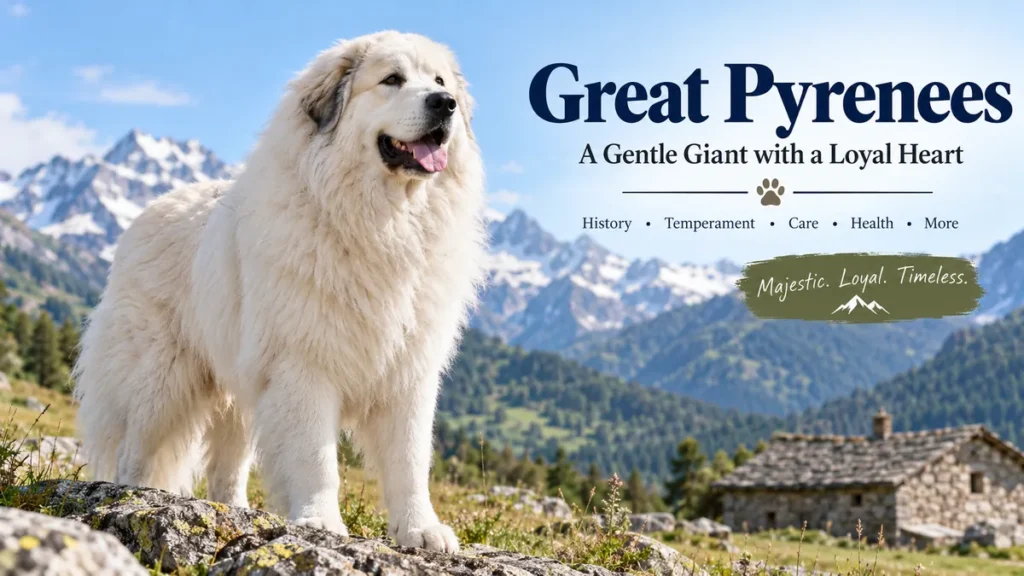
The great pyrenees is hard to overlook: a giant white dog with a calm expression, a weather-resistant coat, and centuries of livestock-guarding instinct behind it. Yet the breed is more complex than its gentle appearance suggests. These dogs are affectionate with family but independent, watchful, strong-willed, and naturally protective.
The great pyrenees is a large livestock guardian breed developed in the Pyrenees Mountains between France and Spain. Known for its thick white double coat, calm temperament, independence, and protective instincts, an adult typically stands 25–32 inches tall, weighs about 85–100+ pounds, and has an average lifespan of 10–12 years.
Understanding that guardian heritage explains almost everything about living with this breed—from nighttime barking to training challenges.
great pyrenees Breed Overview
The Great Pyrenees belongs to the American Kennel Club’s Working Group. In other parts of the world, particularly the United Kingdom, the breed is commonly known as the Pyrenean Mountain Dog.
| Characteristic | Typical Great Pyrenees |
|---|---|
| Breed size | Giant |
| Height | 25–32 inches |
| Weight | About 85–100+ pounds |
| Life expectancy | 10–12 years |
| Coat | Thick, weather-resistant double coat |
| Common colors | White; white with gray, badger, tan, or reddish-brown markings |
| Temperament | Calm, patient, independent, protective |
| Original purpose | Livestock guardian |
| Exercise needs | Moderate |
| Shedding | Heavy |
| Trainability | Intelligent but independent |
| AKC group | Working Group |
Male Great Pyrenees are generally larger. Purina lists males at approximately 27–32 inches and 100–130 pounds, while females are typically 25–29 inches and 85–120 pounds. Individual dogs can fall outside these ranges.
Their size is only part of what makes them impressive. The combination of a substantial frame, dense coat, plume-like tail, and composed posture gives the breed its distinctive appearance.
What Were Great Pyrenees Bred For?
Great Pyrenees were developed as livestock guardian dogs, not herding dogs.
That distinction matters.
A herding breed moves livestock according to a handler’s instructions. A livestock guardian stays with the animals, watches for danger, evaluates threats, and intervenes when necessary.
For centuries, Great Pyrenees protected sheep and other livestock against predators such as wolves and bears in the mountainous region separating France and Spain.
That job required several qualities:
- confidence without constant human reassurance
- patience around vulnerable animals
- physical strength
- territorial awareness
- willingness to work independently
- alertness at night
- tolerance of harsh weather
Those traits remain visible in modern companion dogs.
A Pyr that pauses before following a command isn’t necessarily confused. Independent decision-making was deliberately valuable in its original work.
Quick Takeaway: The Great Pyrenees was designed to make decisions without continuous human direction. Its famous independence isn’t simply stubbornness—it reflects centuries of livestock-guardian selection.
Great Pyrenees History and Origin
The breed takes its name from the Pyrenees Mountains, which form a natural border between France and Spain.
Its history stretches back centuries, although precise claims about extremely ancient origins should be treated cautiously. Historical and breed sources generally connect its ancestors with large livestock guardian dogs that accompanied pastoral communities into the region.
The American Kennel Club notes archaeological evidence of similar dogs in the Pyrenean region dating to roughly 1800–1000 B.C.
From Mountain Guardian to Royal Dog
The dogs spent generations working alongside shepherds, guarding livestock as flocks moved between valleys and higher mountain pastures.
Their reputation eventually spread beyond farms.
During the 17th century, the breed became associated with French nobility, and King Louis XIV is traditionally credited with declaring it the Royal Dog of France.
The breed later reached North America. Purina notes that General Lafayette brought Great Pyrenees to the United States in 1824, while Mary Crane subsequently played an important role in establishing and preserving the breed in America.
Today, Great Pyrenees can still be found protecting livestock, but many live primarily as family companions.
The job may have changed. The instincts have not disappeared.
Great Pyrenees Temperament and Personality
A well-socialized Great Pyrenees is commonly described as calm, patient, affectionate, intelligent, independent, and protective.
The American Kennel Club breed description emphasizes the Pyr’s mellow nature combined with vigilance as a guardian.
That combination can initially seem contradictory.
Inside the house, an adult may spend hours quietly resting. Outside, the same dog may immediately become alert when it hears an unfamiliar sound.
Are Great Pyrenees Aggressive?
Aggression should not be considered a normal defining characteristic of a properly bred and socialized Great Pyrenees.
However, this is a guardian breed.
Great Pyrenees were developed to recognize potential threats and protect their territory and charges. They may therefore be naturally reserved or suspicious around unfamiliar people and animals.
Early socialization is particularly valuable.
Puppies should gradually experience different people, environments, surfaces, sounds, animals, vehicles, handling situations, and everyday household activities.
The objective isn’t to eliminate the dog’s guardian instinct. It is to help the dog distinguish ordinary life from genuine threats.
Are Great Pyrenees Affectionate?
Usually, yes.
Many form strong attachments to their households and are gentle and patient with familiar people. Their affection may be quieter than that of breeds constantly seeking attention.
Some Pyrs want physical affection; others prefer simply lying somewhere they can watch everyone.
Their historical role helps explain this behavior. Staying close enough to protect the flock mattered more than constantly interacting with the shepherd.
Why Are Great Pyrenees So Independent?
Imagine guarding sheep overnight while the shepherd sleeps several hundred yards away.
Waiting for instructions whenever a wolf approaches would make a poor guardian.
Great Pyrenees therefore needed enough confidence and intelligence to evaluate situations independently.
Modern dogs retain much of that mindset. They may understand exactly what their owner wants and still decide that something else deserves their attention.
This is one reason conventional repetitive obedience drills can be frustrating for both dog and handler.
Are Great Pyrenees Good Family Dogs?
For a household prepared for their size and guardian behavior, Great Pyrenees can be affectionate family companions.
They are frequently patient and gentle with family members. However, an adult is physically enormous, so interactions between any giant dog and young children should be supervised. Even a friendly dog can accidentally knock over a small child.
Children should also learn appropriate canine boundaries: don’t climb on the dog, disturb it while eating or sleeping, pull its coat, or treat it like furniture.
Are Great Pyrenees Good With Other Dogs?
Many live successfully with other dogs, particularly when appropriately socialized.
Individual temperament still matters.
Their guardian heritage can contribute to territorial behavior, especially around unfamiliar dogs entering the property. Careful introductions are preferable to assuming every Pyr will automatically welcome another dog.
What About Cats and Other Animals?
Great Pyrenees have historically lived among livestock, so many individuals can coexist successfully with other household animals.
PetMD notes that they can live well with other pets, although individual dogs may appreciate having their own quiet space.
A dog’s previous experiences, socialization, age, temperament, and the behavior of the other animal all influence the outcome.
Never rely solely on breed reputation when introducing animals.
Great Pyrenees Size and Appearance
The Great Pyrenees is unmistakably a giant dog.
According to AKC information, adults generally stand around 25–32 inches at the shoulder. Females commonly begin around 85 pounds, while adult males commonly weigh 100 pounds or more.
The breed should look powerful without appearing cumbersome.
Great Pyrenees Coat
One of its defining characteristics is the weather-resistant double coat.
It consists of:
- a dense, soft undercoat
- longer, coarser outer guard hairs
The coat evolved for life in mountainous weather rather than simply for appearance.
White is the characteristic color, although markings may occur in gray, badger, tan, or reddish-brown shades.
Males can develop especially noticeable hair around the neck and shoulders, creating a mane-like appearance.
Why Do Great Pyrenees Have Double Dewclaws?
One unusual breed characteristic is the presence of double dewclaws on the hind legs.
They are part of the breed standard and contribute to the distinctive structure of a purebred Pyr.
Owners should remember these extra nails during routine nail care. Because dewclaws may not contact the ground enough to wear naturally, they can become overgrown when neglected.
Great Pyrenees Training: Why It Can Be Challenging
Great Pyrenees are intelligent.
But intelligence and obedience aren’t the same thing.
This breed was developed to work independently rather than wait for continuous commands. Consequently, a Pyr may learn a behavior quickly while showing little enthusiasm for repeating it twenty times.
AKC recommends early training and socialization, using short, varied sessions, consistency, patience, and positive reinforcement.
Start Training Early
Training should begin during puppyhood rather than waiting until the dog becomes physically enormous.
Prioritize practical everyday behaviors:
- responding reliably to its name
- walking calmly on a leash
- accepting grooming and handling
- waiting at doors and gates
- settling calmly indoors
- leaving objects when asked
- greeting people appropriately
- tolerating veterinary examinations
A 25-pound puppy pulling on its leash is inconvenient. A 100-pound adult doing the same thing can become genuinely difficult to manage.
Positive Reinforcement Works Better
Harsh punishment is particularly poorly suited to independent guardian breeds.
Reward the behavior you want with food, play, praise, access to something desirable, or another meaningful reward.
Keep sessions short enough that the dog remains engaged.
Instead of repeatedly drilling “sit” for ten minutes, practice several useful behaviors for a few minutes and incorporate them naturally throughout the day.
Socialization Isn’t Optional
A giant territorial dog needs to understand what normal human life looks like.
Controlled puppyhood exposure should include visitors, children, friendly dogs, delivery activity, traffic, grooming, car travel, veterinarians, household noises, and different environments.
Socialization does not mean forcing a frightened puppy into interactions. Positive, gradual exposure is more productive.
Why Do Great Pyrenees Bark So Much?
Barking is one of the most important practical considerations before living with this breed.
Great Pyrenees were historically responsible for warning predators away from livestock. Barking was therefore useful working behavior—not an undesirable habit.
They were also expected to remain particularly alert after dark. AKC notes the breed’s historical tendency toward nocturnal awareness, since predators frequently approached livestock at night.
A modern Pyr may bark at:
- people walking outside
- neighboring dogs
- wildlife
- vehicles
- unfamiliar sounds
- movement around property boundaries
- sounds humans barely notice
Training and environmental management can reduce unnecessary barking, but expecting complete silence from a livestock guardian is unrealistic.
Quick Takeaway: If frequent barking would create serious problems with neighbors, consider this characteristic carefully. Barking is deeply connected to what Great Pyrenees were bred to do.
Great Pyrenees Exercise Needs
Their enormous size can give the impression that Great Pyrenees require hours of intense exercise.
Generally, they don’t.
PetMD describes them as relatively low-energy compared with many working breeds, while regular walks and appropriate outdoor activity help maintain physical and mental health.
For healthy adults, moderate daily activity may include walks, exploring a secure yard, hiking, or purposeful activities.
Working Pyrs naturally accumulate activity while patrolling property and livestock.
Do Great Pyrenees Need a Big Yard?
A large property is useful, but acreage alone doesn’t create a well-adjusted dog.
What matters is having adequate physical space, appropriate exercise, mental stimulation, secure containment, and regular interaction.
A fenced yard can be particularly valuable because guardian dogs may patrol beyond boundaries if given the opportunity.
Secure fencing is preferable to relying entirely on recall.
Can a Great Pyrenees Live in an Apartment?
Physically, some calm adults may adapt to indoor living better than their giant size suggests.
Practically, apartments introduce several challenges:
- limited space
- shared walls
- nighttime barking
- elevators and stairs
- fewer secure outdoor areas
- difficulty managing a giant dog in narrow communal spaces
PetMD notes that some can adapt to urban households, while other breed guidance emphasizes that more space is generally preferable.
The individual dog and living environment matter considerably.
Great Pyrenees Grooming and Shedding
That enormous white coat produces exactly what many prospective owners expect:
hair. Lots of it.
Great Pyrenees are substantial shedders, with seasonal periods when shedding can become particularly heavy.
Fortunately, the outer coat is relatively resistant to dirt and tangling. Weekly brushing is commonly recommended for routine maintenance, with more frequent grooming during heavy shedding.
Basic Grooming Routine
A practical routine includes:
- brushing at least weekly
- checking behind the ears and other friction areas for mats
- trimming nails regularly
- checking double dewclaws
- monitoring ears for debris or irritation
- maintaining dental hygiene
- bathing when genuinely necessary
PetMD cites the Great Pyrenees Club of America recommendation that approximately a 30-minute brushing session can help maintain the coat.
Should You Shave a Great Pyrenees?
Generally, no.
The double coat provides protection from weather and sunlight. AKC breed guidance specifically cautions against shaving it simply because the weather becomes warm.
Instead, maintain the coat by brushing out loose undercoat and provide appropriate heat management.
Dogs living in warm climates need reliable shade, cool indoor areas, fresh water, and exercise scheduled during cooler parts of the day.
Any unusual coat removal needed for medical treatment should be discussed with a veterinarian.
Great Pyrenees Feeding and Nutrition
Nutrition matters especially during puppyhood because giant breeds undergo substantial skeletal development.
Great Pyrenees puppies should receive nutritionally complete food formulated appropriately for large or giant-breed growth rather than simply being encouraged to grow as quickly as possible. Purina specifically recommends large-breed puppy nutrition during their extended development period.
Keeping an appropriate body condition throughout life is also valuable because excess weight adds stress to joints.
Rather than choosing portions based only on breed averages, consider:
- age
- current weight
- body condition
- activity level
- reproductive status
- individual metabolism
- health conditions
- veterinary recommendations
What About Bloat?
Like other deep-chested large and giant dogs, Great Pyrenees can be at risk for gastric dilatation-volvulus (GDV), commonly called bloat.
GDV is an emergency in which the stomach expands and can rotate. Purina includes bloat among health concerns relevant to the breed.
Signs can include a swollen abdomen, repeated unsuccessful attempts to vomit, excessive salivation, restlessness, weakness, or collapse.
Suspected GDV requires immediate emergency veterinary attention.
Owners of giant breeds should discuss individual risk and prevention strategies—including whether preventive gastropexy is appropriate—with their veterinarian.
Great Pyrenees Health Problems
Great Pyrenees are generally robust dogs, but their size and genetics make certain conditions worth knowing about.
Commonly discussed concerns include hip dysplasia, elbow dysplasia, patellar luxation, eye disorders, growth disorders, and GDV/bloat.
Hip and Elbow Dysplasia
Hip dysplasia and elbow dysplasia involve abnormal development of the respective joints.
Over time, poor joint congruity can contribute to pain, reduced mobility, and osteoarthritis.
Genetics play an important role, but nutrition, body condition, growth rate, and activity during development can also affect orthopedic health.
Possible signs include:
- stiffness
- limping
- reluctance to climb stairs
- difficulty getting up
- reduced willingness to exercise
- altered gait
Patellar Luxation
A luxating patella occurs when the kneecap moves outside its normal position.
PetMD identifies patellar luxation as one inherited orthopedic problem seen in the breed.
Severity varies considerably, so diagnosis and treatment should be based on veterinary evaluation.
Chondrodysplasia
Chondrodysplasia is an inherited skeletal growth disorder reported in Great Pyrenees.
It can produce abnormal limb, trunk, and muzzle development. Responsible breeding programs can reduce inherited disease risk by screening breeding animals and avoiding affected genetic combinations where appropriate.
Eye Health
Eye disorders also occur within the breed.
Changes such as persistent redness, cloudiness, unusual discharge, squinting, or obvious vision difficulty warrant veterinary examination.
Responsible breeding matters because health screening can identify some inherited risks before dogs are bred.
How Long Do Great Pyrenees Live?
The typical Great Pyrenees lifespan is around 10–12 years.
That is a respectable lifespan for a giant breed, although no individual dog’s longevity can be predicted from breed averages alone.
Factors that influence long-term health include genetics, appropriate nutrition, body condition, preventive veterinary care, dental health, parasite prevention, exercise, and early treatment of disease.
Regular veterinary examinations become increasingly valuable as the dog ages.
Great Pyrenees Puppies and Growth
A fluffy Great Pyrenees puppy can make it easy to forget how large that puppy will become.
The first year should focus on building habits that will remain manageable when the dog exceeds 100 pounds.
Focus on Controlled Growth
Faster growth isn’t necessarily healthier growth.
Giant-breed puppies require balanced nutrition designed to support controlled skeletal development.
Avoid deliberately overfeeding a puppy to make it “bigger.”
A veterinarian can monitor body condition and growth during routine puppy examinations and adjust feeding recommendations when necessary.
Protect Developing Joints
Puppies need activity, exploration, and play, but repetitive high-impact exercise isn’t necessary.
Age-appropriate walks, free movement, controlled play, and mental enrichment are preferable to forcing a young puppy through strenuous endurance exercise.
Slippery floors can also be challenging for rapidly growing dogs, so providing good traction around frequently used areas is sensible.
Teach Handling Early
Get the puppy comfortable with having its:
- paws handled
- nails trimmed
- ears checked
- mouth examined
- coat brushed
- body gently inspected
This becomes enormously valuable when that puppy grows into a giant adult.
Great Pyrenees in Hot and Cold Weather
The breed’s dense double coat developed in a mountainous environment and provides excellent protection in cold weather.
Many Pyrs naturally enjoy cool temperatures.
Hot weather requires more active management.
Exercise should take place during cooler hours, and the dog should always have access to fresh water, shade, and a cool resting environment.
Watch for signs of overheating such as excessive panting, weakness, confusion, heavy drooling, vomiting, or collapse. Heatstroke is an emergency.
The answer isn’t automatically shaving the dog. Maintaining the double coat while preventing overheating is generally more appropriate.
Great Pyrenees as Livestock Guardian Dogs
Although many now live as pets, working Great Pyrenees continue doing the job for which the breed was developed.
A livestock guardian differs fundamentally from a conventional guard dog.
The animal typically lives near sheep, goats, poultry, cattle, or other livestock and develops a relationship with the animals it protects.
It watches the surrounding environment, patrols territory, uses barking as a deterrent, and may confront predators when necessary.
Herding Dog vs. Livestock Guardian
| Herding Dog | Great Pyrenees Guardian |
|---|---|
| Moves livestock | Protects livestock |
| Frequently follows handler commands | Often works independently |
| Controls movement of flock | Lives alongside flock |
| Often highly responsive to direction | Makes independent decisions |
| Example task: gather sheep | Example task: deter predators |
Confusing these two working styles leads to unrealistic expectations.
The independence that can frustrate a pet owner is exactly what historically allowed a Pyr to protect animals when no shepherd was nearby.
Common Great Pyrenees Behaviors Owners Should Expect
Certain behaviors make much more sense when viewed through the breed’s history.
Nighttime Alertness
Many Pyrs become particularly watchful after sunset.
Predators historically approached livestock during the night, and AKC historical material identifies nocturnal awareness as part of the breed’s working heritage.
That instinct can translate into nighttime barking in suburban homes.
Patrolling
A Great Pyrenees may repeatedly walk the perimeter of a property.
To the dog, this can be purposeful work rather than aimless wandering.
Secure boundaries are therefore extremely important.
Digging
Some individuals dig to create cool resting places or simply because they enjoy the behavior.
Providing appropriate outdoor areas and sufficient enrichment can help manage unwanted excavation.
Selective Hearing
Owners sometimes describe their Pyr as having “selective hearing.”
Usually the dog has heard the command.
The more accurate explanation is that an independently minded guardian may assign its own priorities to what is happening around it.
Reliable training still matters, but owners should understand the temperament they’re working with.
Is a Great Pyrenees Good for First-Time Owners?
It isn’t impossible, but this breed can present a steep learning curve for someone who has never owned a dog.
AKC guidance generally considers Great Pyrenees better suited to experienced owners because of their enormous size, physical strength, independent temperament, and guardian instincts.
A committed first-time owner can still succeed with preparation and professional guidance.
The bigger question is whether the household can realistically manage:
- a 100-pound-plus dog
- substantial shedding
- frequent barking
- strong guardian instincts
- independent behavior
- secure fencing
- early socialization
- consistent lifelong training
- giant-breed food and veterinary expenses
Falling in love with the appearance is easy.
Living successfully with the instincts behind that appearance requires more thought.
Great Pyrenees vs. Pyrenean Mastiff
These breeds are sometimes confused because both originated around the Pyrenees and historically protected livestock.
They are nevertheless distinct breeds.
| Feature | Great Pyrenees | Pyrenean Mastiff |
|---|---|---|
| Primary historical role | Livestock guardian | Livestock guardian |
| Region | Pyrenees Mountains | Spanish Pyrenees |
| Coat appearance | Predominantly white | White with more prominent colored markings |
| Overall build | Large and powerful | Generally heavier and more massive |
| Temperament | Calm, independent, watchful | Calm, protective, independent |
PetMD notes that Pyrenean Mastiffs are generally larger and typically show more coat coloration.
The Pyrenean Mountain Dog, however, isn’t another breed—it is another name for the Great Pyrenees.
What Living With a Great Pyrenees Is Really Like
Living with a Pyr involves accepting some contradictions.
You get an enormous dog that may spend much of the afternoon sleeping.
A gentle family companion may transform into a serious watchdog when someone approaches the property.
A dog intelligent enough to understand a command quickly may see little reason to repeat it.
A beautiful white coat comes with substantial shedding.
And a dog capable of quietly observing its surroundings for hours may suddenly decide that a distant nighttime noise requires the entire neighborhood’s attention.
These aren’t necessarily flaws. Most are predictable consequences of the job the breed performed for generations.
The most successful households work with those characteristics rather than trying to turn the dog into something it isn’t.
Is the great pyrenees the Right Dog for You?
The great pyrenees combines impressive size with a remarkably calm and nurturing personality. Centuries of protecting livestock created a dog that is patient with its family, vigilant about its surroundings, capable of independent decisions, and willing to stand between vulnerable animals and danger.
That heritage also creates practical challenges.
Expect heavy shedding, significant barking, independent training behavior, secure-containment requirements, and the responsibilities that come with owning a giant breed.
For someone prepared for those realities, the Great Pyrenees can be a deeply devoted companion and capable guardian. For anyone considering one, the most useful next step is to spend time around mature Great Pyrenees—not just puppies—and learn firsthand how their size, coat, barking, and guardian temperament fit everyday life.