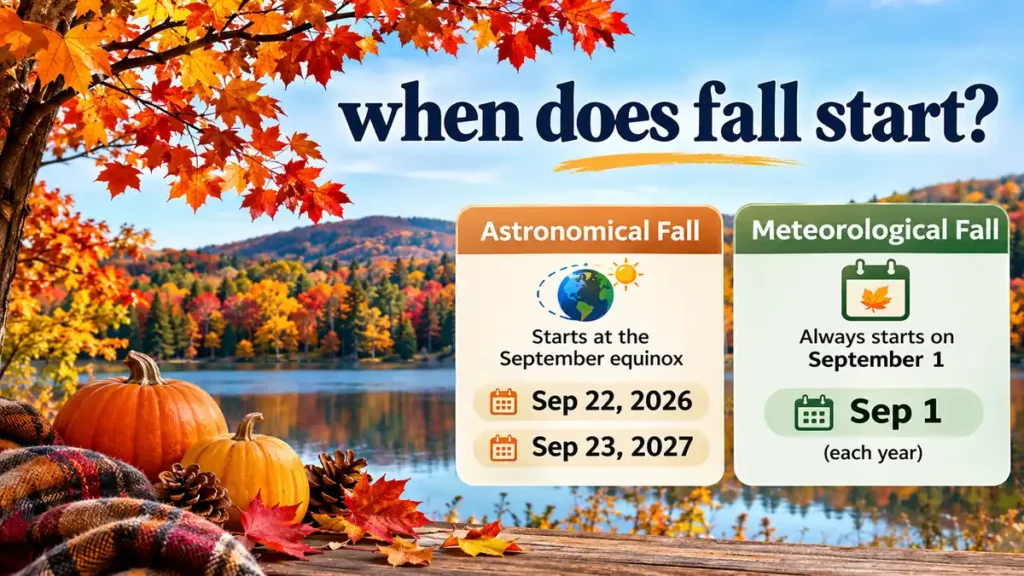
Fall doesn’t begin on the same calendar date every year. Depending on how the seasons are measured, autumn can officially start on September 1 or around September 22–23.
If you’re wondering when does fall start, the answer depends on whether you’re using the astronomical or meteorological definition of the seasons.
In the Northern Hemisphere, astronomical fall began on September 22, 2026, and will begin on September 23, 2027, in the United States. Meteorological fall always starts on September 1. Astronomical autumn begins at the September equinox, while meteorological autumn follows a fixed three-month calendar from September through November. When Is Fall?+1
When does fall start in 2026 and 2027?
The first day of fall depends on the year, your location, and the seasonal calendar being used.
In the United States, Canada, and most other Northern Hemisphere countries, astronomical autumn generally begins between September 22 and September 23. Occasionally, the equinox falls on September 24 in certain time zones and years.
Here are the confirmed dates for 2026 and 2027.
| Season definition | Fall 2026 starts | Fall 2027 starts |
|---|---|---|
| Astronomical fall (U.S. Eastern Time) | September 22 | September 23 |
| Meteorological fall | September 1 | September 1 |
| Astronomical fall (UTC) | September 23 | September 23 |
| Meteorological fall ends | November 30 | November 30 |
The September equinox occurred at approximately 00:05 UTC on September 23, 2026, corresponding to 8:05 p.m. Eastern Daylight Time on September 22.
In 2027, it will occur at approximately 06:01 UTC on September 23, or 2:01 a.m. Eastern Daylight Time. First Day of Spring season.+1
What time did fall start in 2026?
2026 AUTUMNAL EQUINOX — UNITED STATES
Eastern (EDT)
8:05 PM
Sep 22, 2026
Central (CDT)
7:05 PM
Sep 22, 2026
Mountain (MDT)
6:05 PM
Sep 22, 2026
Pacific (PDT)
5:05 PM
Sep 22, 2026
Times rounded to the nearest minute, based on the published 00:05 UTC equinox.
The equinox happens at one specific moment worldwide. Time zones simply determine which local date and clock time people experience.
This explains why one source might list September 22 as the first day of fall while another lists September 23. Both can be correct for their respective locations.
Astronomical fall vs. meteorological fall: What’s the difference?
There are two widely used systems for determining when the seasons begin and end.
Astronomical seasons are based on Earth’s position relative to the Sun. Meteorological seasons are based on fixed calendar months that correspond broadly with annual temperature patterns.
| Feature | Astronomical fall | Meteorological fall |
|---|---|---|
| Starting event | Autumnal equinox | Fixed calendar date |
| Northern Hemisphere start | September 22–23, usually | September 1 |
| Northern Hemisphere end | December solstice | November 30 |
| Determined by | Earth’s orbit and axial tilt | Calendar months |
| Common uses | Astronomy, calendars, seasonal traditions | Weather records, climate analysis |
| Changes each year? | Yes, slightly | No |
The National Oceanic and Atmospheric Administration (NOAA) explains that meteorologists and climatologists use fixed seasonal periods to make weather and climate comparisons more consistent. National Oceanic and Atmospheric Administration+1
What is astronomical fall?
Astronomical fall begins at the autumnal equinox, when the Sun crosses the celestial equator from north to south.
In the Northern Hemisphere, this marks the transition from astronomical summer to autumn.
Astronomical autumn continues until the December solstice, when winter begins.
Because Earth’s journey around the Sun doesn’t align perfectly with our calendar, the exact equinox date and time vary slightly from year to year.
What is meteorological fall?
Meteorological fall always includes three complete months:
- September
- October
- November
It begins on September 1 and ends on November 30 in the Northern Hemisphere.
This system is especially useful for comparing average temperatures, rainfall, snowfall, and other weather statistics between years.
For example, a climatologist comparing autumn temperatures over 30 years can analyze the same September-to-November period each year instead of adjusting for changing equinox dates.
Quick takeaway: Both definitions are correct. Astronomical fall follows the Sun’s apparent seasonal movement, while meteorological fall uses fixed calendar months.
What is the autumnal equinox, and why does fall begin then?
The Autumnal Equinox kicks off the beginning of fall this Thursday
When is the first day of fall 2025 autumnal equinox? When is the winter solstice?
Temperate Deciduous Forest Biome
The autumnal equinox is an astronomical event that occurs when the Sun’s apparent position crosses the celestial equator heading southward.
The celestial equator is an imaginary projection of Earth’s equator into the sky.
During the September equinox, the Sun is positioned directly above Earth’s equator at the instant of the crossing.
This event marks the start of astronomical fall in the Northern Hemisphere and astronomical spring in the Southern Hemisphere.
Why does the equinox happen?
Earth rotates on an axis tilted approximately 23.4 degrees relative to the plane of its orbit around the Sun.
This axial tilt causes different parts of the planet to receive varying amounts of sunlight throughout the year.
During Northern Hemisphere summer, the northern half of Earth is tilted toward the Sun. Days are generally longer, and sunlight arrives more directly.
As Earth continues orbiting the Sun, the Northern Hemisphere gradually becomes tilted away from it.
At the September equinox, neither hemisphere is tilted toward the Sun. Afterward, the Northern Hemisphere receives progressively less daylight until the December solstice.
These changes in sunlight drive the familiar seasonal cycle.
Are day and night exactly equal on the fall equinox?
Not quite.
The word equinox comes from Latin roots meaning equal night, but daylight and darkness are not precisely 12 hours each at most locations.
Two factors explain the difference:
- Atmospheric refraction: Earth’s atmosphere bends sunlight, making the Sun appear above the horizon even when it is geometrically below it.
- The Sun’s apparent size: Sunrise begins when the upper edge of the Sun appears, while sunset ends when that edge disappears.
As a result, daylight usually lasts slightly longer than 12 hours on the equinox.
The date when daytime and nighttime are closest to equal is sometimes called the equilux. It can occur several days away from the equinox, depending on latitude.
The Royal Museums Greenwich provides further explanations of equinoxes, Earth’s tilt, and the astronomical seasons. Royal Museums Greenwich+1
When does fall start in different countries?
The start of autumn is not identical everywhere because Earth has two hemispheres with opposite seasons.
United States and Canada
In the United States and Canada, fall generally begins around September 22 or 23 under the astronomical definition.
Meteorological autumn begins September 1.
This applies to locations such as New York, Chicago, Toronto, Vancouver, and Los Angeles, although the exact local equinox time varies by time zone.
United Kingdom and Europe
In the United Kingdom, astronomical autumn usually begins around September 22 or 23.
In 2026, the September equinox occurred on September 23 at approximately 1:05 a.m. British Summer Time.
Meteorological autumn in the UK begins September 1.
Some traditional seasonal calendars also use different cultural or natural markers, so references to autumn’s beginning may vary.
India and Pakistan
India and Pakistan are geographically in the Northern Hemisphere, so the September equinox also marks the beginning of astronomical autumn there.
However, their seasonal weather patterns differ from those of North America and Europe.
Monsoon conditions, regional rainfall, and temperature patterns strongly influence how autumn is experienced.
In many areas, September remains warm, while noticeably cooler conditions arrive later in October or November.
Australia and New Zealand
Australia and New Zealand are in the Southern Hemisphere, where the seasons are reversed.
Meteorological autumn begins March 1 and continues through May 31.
Astronomical autumn begins at the March equinox, usually around March 20 or 21.
In 2027, the March equinox will occur on March 20 at approximately 20:24 UTC. When Is Fall?+1
Northern vs. Southern Hemisphere fall dates
| Region | Astronomical fall begins | Meteorological fall begins |
|---|---|---|
| United States | September 22–23, usually | September 1 |
| Canada | September 22–23, usually | September 1 |
| United Kingdom | September 22–23, usually | September 1 |
| Most of Europe | September 22–23, usually | September 1 |
| India and Pakistan | September 22–23, usually | September 1 |
| Australia | March 20–21, usually | March 1 |
| New Zealand | March 20–21, usually | March 1 |
| Southern South America | March 20–21, usually | March 1 |
Near the equator, seasonal changes are often described in terms of wet and dry periods rather than four distinct temperature-based seasons.
When does fall start and end each year?
Astronomical fall generally lasts about three months, beginning with the autumnal equinox and ending at the winter solstice.
Meteorological fall lasts exactly three calendar months.
The following table shows the astronomical beginning of autumn in the Northern Hemisphere for several years, using U.S. Eastern Time.
| Year | First day of astronomical fall | Day of week |
|---|---|---|
| 2025 | September 22 | Monday |
| 2026 | September 22 | Tuesday |
| 2027 | September 23 | Thursday |
| 2028 | September 22 | Friday |
| 2029 | September 22 | Saturday |
| 2030 | September 22 | Sunday |
| 2031 | September 23 | Tuesday |
| 2032 | September 22 | Wednesday |
These dates are based on published equinox calculations. The local calendar date may differ in other time zones. First Day of Spring season.+1
Why does the first day of fall change?
Earth takes approximately 365.2422 days to complete its annual seasonal cycle.
However, a typical calendar year contains 365 days, while a leap year contains 366.
This difference causes equinox times to shift relative to the calendar.
The Gregorian calendar uses leap years to keep calendar dates aligned with the seasons over long periods.
Without these adjustments, the dates of equinoxes and solstices would gradually drift.
When does fall end in 2026?
In the Northern Hemisphere, astronomical fall ends at the December solstice.
In 2026, that solstice occurs on December 21 at approximately 20:50 UTC, or 3:50 p.m. Eastern Standard Time.
Meteorological fall ends on November 30, with meteorological winter beginning December 1.
Therefore, someone using the astronomical calendar can still be experiencing fall during much of December, even though the meteorological calendar considers that period winter.
What changes when fall begins?
2K Quad HD Autumn Forest Path — Leaves, Trees & Fall Colors | 2560×1600 | Wallpaper Abyss
Autumn Pumpkin Market Picture Game | Free Online Picture Games
A path with red and yellow maple leaves at times
7
The beginning of fall marks a gradual shift in daylight, temperature, vegetation, and animal behavior.
However, these changes don’t necessarily begin on the exact date of the equinox.
Weather and ecological conditions respond to sunlight and temperature over time rather than changing instantly when the astronomical season starts.
1. Days become shorter
After the June solstice, daylight hours gradually decrease in the Northern Hemisphere.
By the September equinox, most places experience approximately 12 hours of daylight.
The days continue getting shorter until the December solstice, which brings the shortest daylight period of the year in the Northern Hemisphere.
For example, New York City experiences noticeably less daylight in late October than in early September.
At higher northern latitudes, the change in day length is even more dramatic.
2. Temperatures gradually decrease
As the Northern Hemisphere receives less direct solar energy, average temperatures generally begin declining.
However, the cooling process is delayed because land, oceans, and the atmosphere retain heat from summer.
This phenomenon is called seasonal lag.
It explains why September can still feel like summer in many regions, even after astronomical autumn has officially begun.
In warmer areas, including parts of the southern United States, genuinely cool weather may not arrive until October or November.
3. Leaves change color
One of autumn’s most recognizable features is the changing color of deciduous tree leaves.
During spring and summer, leaves contain abundant chlorophyll, the green pigment involved in photosynthesis.
As daylight decreases and temperatures change, many trees begin breaking down chlorophyll.
Other pigments become more visible:
- Carotenoids: Produce yellow and orange colors.
- Anthocyanins: Contribute red and purple shades in certain species.
- Tannins and other compounds: Contribute to brown coloration.
Maple, oak, birch, and aspen trees are well-known for their seasonal foliage.
The timing of peak fall colors depends on location, elevation, tree species, temperature, and moisture conditions.
4. Wildlife prepares for winter
Many animals respond to shorter days and changing food availability.
Some birds begin seasonal migration toward warmer regions.
Squirrels and other mammals increase food-gathering activity, while certain animals build energy reserves for winter.
Insects may enter dormant stages, and some plants reduce growth as temperatures fall.
These biological responses are influenced by environmental signals, particularly photoperiod, the amount of daylight within a 24-hour period.
5. Harvest season arrives
Autumn is traditionally associated with harvesting crops that mature toward the end of the growing season.
In many temperate Northern Hemisphere regions, seasonal produce includes apples, pumpkins, squash, pears, and certain varieties of grapes.
The precise harvest schedule varies considerably with climate, crop variety, and agricultural practices.
This connection between autumn and agriculture also explains the historical significance of harvest celebrations.
Does fall weather begin on September 1 or September 22?
Neither date guarantees the arrival of cooler weather.
September 1 marks the beginning of meteorological autumn, while the September equinox marks the astronomical transition.
Actual weather conditions vary by geography and year.
For instance, a city in northern Canada may experience chilly nights and early frost before September begins.
Meanwhile, parts of Arizona, Texas, or Florida may remain hot well into October.
This difference occurs because seasonal weather is influenced by several factors, including latitude, elevation, ocean currents, prevailing winds, and regional climate.
When does it actually start feeling like fall?
The answer depends on where you live.
| Region | Typical arrival of noticeable autumn conditions |
|---|---|
| Northern United States | September to early October |
| Northeastern United States | September through October |
| Midwestern United States | September through October |
| Southern United States | October through November |
| Southern Canada | Late August through September |
| United Kingdom | September through October |
| Northern Europe | August through September |
| Warmer Mediterranean regions | October through November |
These are broad seasonal patterns, not fixed forecasts.
A particularly warm year may delay autumn-like temperatures, while an early cold spell can make fall feel as though it has arrived ahead of schedule.
Quick takeaway: The official start of autumn is a calendar or astronomical event. The arrival of autumn weather is a gradual regional process.
When is peak fall foliage season?
Peak fall foliage refers to the period when deciduous trees display their most vibrant autumn colors.
It doesn’t happen everywhere at the same time.
In the Northern Hemisphere, higher elevations and northern latitudes generally experience color changes earlier than warmer southern regions.
For example:
- Northern New England and parts of Canada often see peak foliage from late September into early October.
- Many areas of the northeastern and midwestern United States reach peak color during October.
- Parts of the southern Appalachian Mountains experience peak foliage from October into early November.
- Warmer southern locations may not reach peak color until November or later.
Weather conditions can shift these periods significantly.
A combination of sunny days, cool nights, and adequate moisture often supports colorful autumn foliage.
Extended drought, severe storms, or unusually warm temperatures can affect the timing and intensity of leaf color.
The autumnal equinox itself does not determine the exact day leaves begin changing color.
Why is autumn also called fall?
The words autumn and fall refer to the same season.
Autumn developed from older European language traditions, including the Latin word autumnus.
Fall became associated with the season through expressions referring to the falling of leaves.
Both terms were historically used in English.
Over time, fall became especially common in American English, while autumn remained more widely used in British English.
Today, both words are understood in the United States, Canada, the United Kingdom, and many other English-speaking regions.
There is no scientific distinction between the two terms.
The astronomical event marking the beginning of the season is generally called the autumnal equinox, regardless of whether people commonly say fall or autumn.
How is the beginning of fall connected to the four seasons?
The four astronomical seasons are determined by two equinoxes and two solstices.
In the Northern Hemisphere, these events mark the transitions between spring, summer, autumn, and winter.
| Season | Astronomical starting event | Approximate date |
|---|---|---|
| Spring | March equinox | March 20–21 |
| Summer | June solstice | June 20–21 |
| Fall | September equinox | September 22–23 |
| Winter | December solstice | December 21–22 |
The equinoxes occur when the Sun crosses the celestial equator.
The solstices occur when the Sun reaches its most northerly or southerly apparent position in the sky.
Together, these events divide the annual seasonal cycle.
Is fall the same length every year?
No. Astronomical seasons don’t all have exactly the same duration.
Earth travels around the Sun in an elliptical orbit rather than a perfect circle.
Its orbital speed changes slightly throughout the year, affecting the time between successive equinoxes and solstices.
Consequently, astronomical autumn doesn’t last precisely the same number of days every year.
Meteorological fall, however, always contains 91 days: 30 in September, 31 in October, and 30 in November.
Does daylight saving time affect the start of fall?
Daylight saving time doesn’t change when autumn begins.
The equinox is an astronomical event independent of civil clock adjustments.
However, daylight saving time can affect the local clock time used to describe the event.
In most of the United States, daylight saving time ends on the first Sunday in November.
In 2026, that date was November 1.
The clocks moving backward can make evening darkness feel more noticeable, but daylight hours have already been decreasing naturally since the June solstice.
The change in clock time does not alter Earth’s rotation, orbit, or the amount of sunlight reaching a location.
When does fall start according to nature?
Nature doesn’t follow a single universal seasonal calendar.
Instead, plants and animals respond to environmental conditions, including sunlight, temperature, rainfall, and soil moisture.
Scientists sometimes study these recurring biological events through phenology.
Phenology examines the seasonal timing of natural processes such as flowering, leaf emergence, migration, fruit development, and leaf fall.
A phenological definition of autumn may therefore focus on observable changes rather than an equinox or fixed date.
For example, researchers might track when particular trees begin changing color or shedding leaves.
This approach can help scientists understand how ecosystems respond to seasonal weather patterns and long-term climate change.
It also explains why the biological beginning of fall may arrive earlier or later than the official astronomical date.
When does fall start? Final takeaway
Fall begins on September 1 under the meteorological calendar and around September 22–23 under the astronomical calendar in the Northern Hemisphere.
In the United States, astronomical fall began on September 22, 2026, and will begin on September 23, 2027.
In the Southern Hemisphere, autumn begins around March 20 under the astronomical definition or March 1 under the meteorological definition.
The autumnal equinox marks a precise astronomical transition, but cooler temperatures, colorful foliage, and other seasonal changes arrive gradually.
For the most accurate seasonal date, use the astronomical equinox for your location. For weather statistics and monthly climate comparisons, use the meteorological calendar.