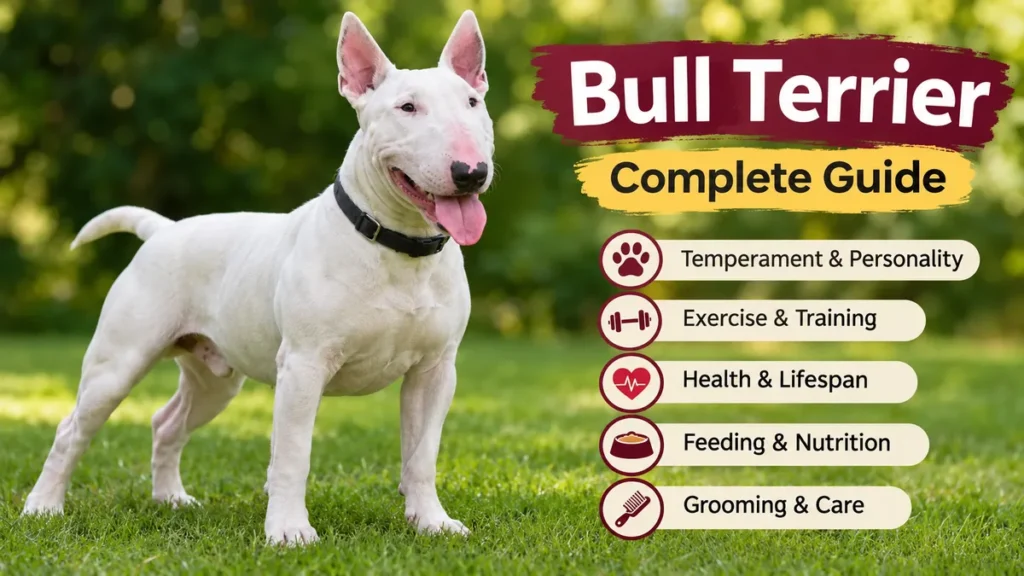
With its egg-shaped head, muscular body, and mischievous personality, the bull terrier is one of the most recognizable dog breeds in the world. But behind that unusual appearance is an energetic, affectionate companion that requires thoughtful training, daily exercise, and consistent attention.
The bull terrier is a medium-sized, muscular dog breed developed in England during the 19th century. Known for its distinctive head, playful temperament, and strong attachment to its family, it typically lives 12–13 years. These dogs thrive with early socialization, positive reinforcement training, regular exercise, and close human companionship.
Understanding the breed’s history, behavior, health risks, and care requirements helps explain why these dogs can be wonderful companions in the right household—and challenging pets when their needs are underestimated.
What Is a bull terrier?
The bull terrier is a purebred dog belonging to the terrier group. Originally developed from bulldog-and-terrier crosses, the modern breed combines physical strength with an enthusiastic, often comical personality.
The American Kennel Club (AKC) recognizes the breed as a distinct member of its Terrier Group. The The Kennel Club in the United Kingdom also maintains an official breed standard.
Собаки для частного дома: ТОП-50 пород с фото и описанием
The portrait of the young beautiful bull terrier portrait in a brindle color
9
bull terrier breed characteristics
| Characteristic | Details |
|---|---|
| Origin | England |
| Breed group | Terrier |
| Height | No fixed height requirement in the standard breed |
| Typical weight | Approximately 50–70 pounds (23–32 kg) |
| Lifespan | Approximately 12–13 years |
| Coat | Short, smooth, dense |
| Coat colors | White, brindle, black brindle, red, fawn, and combinations |
| Temperament | Playful, affectionate, energetic, independent |
| Exercise needs | Moderate to high |
| Grooming needs | Low to moderate |
| Trainability | Intelligent but sometimes stubborn |
| Suitable household | Active, committed owners |
These figures describe the standard breed. The Miniature Bull Terrier is a separately recognized breed with a smaller size.
Why does a bull terrier have an egg-shaped head?
The breed’s most distinctive physical feature is its long, curved head, which lacks the pronounced forehead stop seen in many other dogs.
Its profile slopes smoothly from the top of the skull toward the nose, creating what breeders describe as a downfaced appearance.
Other recognizable characteristics include small triangular eyes, naturally upright ears, a powerful neck, and a compact, muscular body.
The head shape is a result of selective breeding rather than a special adaptation for hunting or fighting. It should not be confused with a requirement for an exaggerated appearance that compromises a dog’s comfort or health.
History and Origin of the bull terrier
The modern breed developed in 19th-century Britain from earlier bulldog-and-terrier crosses.
These early dogs were associated with blood sports, including bull-baiting and dog fighting. As those activities declined, breeders increasingly selected dogs for appearance and companionship.
James Hinks and the development of the breed
James Hinks, an English dog breeder working in Birmingham, played a significant role in establishing the recognizable white Bull Terrier during the 1800s.
Historical accounts associate his breeding program with refinement of the earlier bull-and-terrier type, including crosses involving the now-extinct English White Terrier.
The breed’s familiar curved head developed more gradually through later selective breeding.
From working dog to family companion
By the late 19th and early 20th centuries, Bull Terriers were increasingly recognized as distinctive show dogs and companions.
The American Kennel Club recognized the breed in 1885.
Although the breed’s ancestors had a fighting history, modern Bull Terriers should be evaluated as individual dogs. Their behavior depends on genetics, socialization, training, health, and environment—not simply historical associations.
bull terrier Temperament and Personality
Bull Terriers are often described as playful, courageous, affectionate, and strong-willed.
Their personalities can be entertaining, but their enthusiasm and physical strength make clear boundaries especially valuable.
Are Bull Terriers good family dogs?
Bull Terriers can be excellent family companions when properly trained, socialized, and supervised.
Many form close relationships with household members and enjoy participating in daily activities.
Their strengths include:
- Strong attachment to familiar people
- Playful and entertaining behavior
- Enthusiasm for games and outdoor activities
- Confidence in familiar environments
- Willingness to learn when training is engaging
However, these dogs may become overexcited during play. Their muscular build means that accidental bumps or jumping can be difficult for small children to manage.
Adults should supervise all interactions between dogs and young children, regardless of breed.
Are Bull Terriers aggressive?
Aggression is not an inevitable characteristic of the breed.
Individual Bull Terriers vary considerably in their tolerance of unfamiliar dogs, strangers, and other animals.
Some are sociable and relaxed, while others display dog-directed reactivity or conflict, particularly without appropriate socialization and management.
Warning signs may include stiff posture, hard staring, growling, lunging, or repeated attempts to escape uncomfortable situations.
Responsible ownership involves recognizing these signals, preventing rehearsed aggressive behavior, and seeking professional guidance when needed.
Punishment-based methods can increase fear or conflict and are not recommended.
Can a bull terrier live with other pets?
Some Bull Terriers live successfully with other dogs and cats, especially when introductions are gradual and relationships are managed carefully.
However, the breed’s terrier ancestry can be associated with a strong interest in chasing smaller animals.
Compatibility should never be assumed.
Supervised introductions, separate feeding areas, secure spaces, and careful management of toys can help reduce conflict.
A dog that persistently stalks or chases small pets may require permanent separation from them.
Do Bull Terriers suffer from separation anxiety?
Some individuals develop separation-related distress, particularly when they are accustomed to constant companionship.
Possible signs include destructive behavior near exits, persistent vocalization, pacing, and distress when a caregiver prepares to leave.
Gradual alone-time training, predictable routines, and appropriate enrichment may help prevent problems.
Dogs showing significant distress should receive a veterinary assessment and a structured behavior plan rather than being expected to simply tolerate prolonged isolation.
bull terrier Size, Weight, and Physical Appearance
A standard Bull Terrier is a sturdy, medium-sized dog with a broad chest, strong shoulders, and substantial bone structure.
According to the AKC, typical adults measure approximately 21–22 inches (53–56 cm) at the shoulder and weigh 50–70 pounds (23–32 kg). American Kennel Club+1
Individual dogs may fall outside these averages while remaining healthy.
Male vs. female Bull Terriers
| Feature | Male | Female |
|---|---|---|
| Typical build | Often heavier and more muscular | Often slightly lighter |
| Height | Usually similar, with individual variation | Usually similar, with individual variation |
| Temperament | Varies by individual | Varies by individual |
| Exercise needs | High | High |
| Grooming | Short-coat maintenance | Short-coat maintenance |
Sex alone does not reliably predict aggression, trainability, or suitability for a household.
White vs. colored Bull Terriers
The breed is traditionally divided into two coat varieties for showing purposes: white and colored.
White Bull Terriers may have pigmentation or markings on the head, while colored dogs can display brindle, red, fawn, black brindle, or combinations with white.
Coat color does not determine personality. However, white pigmentation is relevant when considering inherited deafness, making hearing screening particularly valuable.
Training a bull terrier Successfully
Bull Terriers are intelligent dogs, but they do not always respond well to repetitive or forceful training.
They often learn quickly when activities are rewarding, varied, and engaging. Their independence can make them appear stubborn when they are bored, distracted, or insufficiently motivated.
The AKC recommends positive reinforcement and emphasizes making training enjoyable. American Kennel Club
How to train a bull terrier puppy
Start with basic behaviors that support everyday safety and communication.
- Teach name recognition. Reward the puppy for looking toward you when its name is spoken.
- Introduce sit and down. Use food rewards or toys to encourage the desired behavior without physically forcing positions.
- Practice recall. Begin indoors, then progress to a securely enclosed outdoor space.
- Teach loose-leash walking. Reward movement beside you and avoid allowing pulling to become the normal walking pattern.
- Develop impulse control. Practice waiting briefly before meals, doors, and exciting games.
- Build calm behavior. Reward relaxed settling on a mat or bed.
Short sessions of approximately five minutes are often easier for puppies to manage than lengthy drills.
Several brief sessions throughout the day provide opportunities to reinforce learning without overwhelming the dog.
Socialization during puppyhood
Early socialization helps puppies develop confidence around unfamiliar people, environments, sounds, surfaces, and animals.
The goal is not to force interaction with everyone. Instead, puppies should learn that new experiences can be safe and predictable.
Useful experiences include controlled exposure to traffic sounds, bicycles, visitors, veterinary handling, grooming equipment, and calm dogs.
Avoid crowded dog parks or uncontrolled introductions as a substitute for structured socialization.
A veterinarian can advise on safe exposure based on the puppy’s vaccination status and local disease risks.
Common training mistakes
One frequent mistake is treating stubbornness as deliberate defiance.
A dog that ignores a command may be distracted, frightened, overstimulated, or uncertain about what is being requested.
Other mistakes include inconsistent household rules, insufficient reinforcement, excessive punishment, and expecting a young dog to behave like a mature adult.
If a Bull Terrier repeatedly jumps, grabs clothing, or becomes excessively excited, focus on teaching alternative behaviors and managing the environment.
For serious reactivity, resource guarding, or biting, consult a qualified reward-based behavior professional.
Exercise and Mental Stimulation Requirements
Bull Terriers need regular physical activity and mental enrichment to remain healthy and emotionally balanced.
The People’s Dispensary for Sick Animals (PDSA) recommends at least one hour of daily exercise for healthy adult English Bull Terriers. PDSA
This is a general guideline rather than a rigid requirement. Age, fitness, weather, medical conditions, and individual temperament all influence appropriate activity.
How much exercise does a bull terrier need?
A practical daily routine for a healthy adult might include:
| Activity | Example duration |
|---|---|
| Morning walk | 25–30 minutes |
| Training or scent games | 10–15 minutes |
| Afternoon play | 15–20 minutes |
| Evening relaxed walk | 15–20 minutes |
These activities can overlap, and the schedule should be adapted to the individual dog.
Puppies need shorter, gentler activity periods with plenty of rest. Forced running, repetitive jumping, and strenuous exercise should be avoided while their bodies are developing.
Senior dogs may benefit from slower walks, low-impact games, and more frequent rest breaks.
Best activities for Bull Terriers
Many enjoy fetch, supervised tug games, scent work, food puzzles, and interactive training.
Some also participate in dog sports such as:
- Agility
- Rally obedience
- Tracking
- Scent work
- Flyball
- Structured obedience competitions
Activities should suit the dog’s physical condition and training level.
Preventing boredom and destructive behavior
A bored Bull Terrier may chew furniture, dig, steal objects, or repeatedly demand attention.
These behaviors can have several causes, including insufficient stimulation, anxiety, frustration, or unmet physical needs.
Rotating safe toys, offering food-dispensing puzzles, practicing short training sessions, and providing appropriate chewing outlets can help.
Because Bull Terriers have powerful jaws and may swallow toy fragments, choose durable, appropriately sized products and supervise chewing. Seek urgent veterinary advice if a dog swallows an object that could cause an obstruction.
bull terrier Health Problems and Lifespan
The typical Bull Terrier lifespan is approximately 12–13 years, although individual dogs may live shorter or longer lives.
Genetics, preventive healthcare, diet, body condition, exercise, and early diagnosis all influence long-term health.
The Bull Terrier Club of America and the Orthopedic Foundation for Animals identify several important inherited conditions for screening. BULL TERRIER CLUB of AMERICA+1
Common health concerns
| Health condition | What owners should know |
|---|---|
| Congenital deafness | May affect one or both ears |
| Kidney disease | Some inherited disorders can impair kidney function |
| Heart disease | Congenital or acquired abnormalities may occur |
| Patellar luxation | The kneecap moves out of its normal position |
| Skin allergies | Can cause itching, inflammation, and recurrent infections |
| Lethal acrodermatitis | Rare inherited disorder affecting skin and development |
| Dental abnormalities | Misaligned teeth may cause discomfort or oral problems |
These are breed-associated risks, not conditions every Bull Terrier will develop.
Deafness and BAER testing
Congenital sensorineural deafness is an important concern, especially in white-coated dogs.
A puppy may be deaf in one ear yet respond normally to many everyday sounds, making the condition difficult to identify through casual observation.
The Brainstem Auditory Evoked Response (BAER) test measures electrical responses associated with hearing and can identify deafness in one or both ears.
The breed club recommends BAER testing for puppies before they leave for their new homes. Amazon Web Services, Inc.
A deaf dog can still enjoy a good quality of life with appropriate communication, visual cues, secure environments, and careful handling.
Kidney disease
Bull Terriers may be affected by inherited kidney disorders, including hereditary nephritis and polycystic kidney disease.
Early kidney problems can be difficult to recognize because obvious symptoms may not appear until disease has progressed.
Possible signs include increased thirst, frequent urination, reduced appetite, vomiting, and weight loss.
A urine protein-to-creatinine ratio, commonly abbreviated UPC or UP/C, helps assess abnormal protein loss through the kidneys.
Veterinarians may recommend additional blood tests, urine testing, blood pressure measurement, or ultrasound depending on the dog’s history.
Heart disease
Heart conditions reported in the breed include aortic stenosis and mitral valve abnormalities.
Some affected dogs have no obvious symptoms initially.
Others may develop exercise intolerance, fainting, weakness, coughing, or breathing difficulties.
Cardiac screening can include listening for heart murmurs and, when indicated, echocardiography performed by a veterinary cardiologist.
Collapse or significant breathing difficulty requires immediate veterinary attention.
Patellar luxation
Patellar luxation occurs when the kneecap slips out of its normal position.
Affected dogs may occasionally skip on one hind leg, hold a leg up, or develop persistent lameness.
Severity varies. Mild cases may require monitoring, while more serious cases may need surgical assessment.
Maintaining a healthy body weight can reduce unnecessary stress on the joints.
Skin allergies and irritation
Bull Terriers can develop allergic skin disease, sometimes associated with environmental allergens, parasites, or food-related reactions.
Symptoms may include persistent scratching, paw licking, redness, ear inflammation, and recurrent skin infections.
A veterinarian can investigate the cause rather than relying on repeated changes in shampoo or diet.
Dogs with white or sparsely pigmented skin also need protection from excessive sun exposure, particularly on vulnerable areas such as the nose and ears.
Lethal acrodermatitis
Lethal acrodermatitis (LAD) is a rare, serious inherited condition associated with abnormal skin development, impaired growth, and immune-related problems.
It is inherited in an autosomal recessive pattern, meaning an affected puppy inherits the relevant disease-associated variant from both parents.
DNA testing can help identify affected dogs and carriers for responsible breeding decisions.
The Bull Terrier Club of America includes LAD among its recommended health screening considerations. BULL TERRIER CLUB of AMERICA
Recommended health screening
For breeding dogs, important evaluations include:
- BAER hearing testing
- Cardiac examination
- Kidney assessment using a urine protein-to-creatinine ratio
- Patellar examination
- Relevant DNA testing, including LAD screening
The Orthopedic Foundation for Animals (OFA) maintains health screening programs and records that can help document results.
Routine veterinary visits remain necessary even when inherited-disease screening is normal.
Quick takeaway: Health testing reduces uncertainty but cannot guarantee a disease-free dog. Combining appropriate screening with preventive veterinary care provides the best foundation for long-term wellbeing.
Feeding and Nutrition for a bull terrier
A balanced diet helps maintain the breed’s muscular body, supports healthy growth, and reduces the risk of obesity.
Bull Terriers should eat a complete and balanced diet appropriate for their age, activity level, and medical needs.
What should a bull terrier eat?
Most healthy dogs can thrive on a reputable commercial diet formulated to meet recognized nutritional standards, such as those established by the Association of American Feed Control Officials (AAFCO) or the European Pet Food Industry Federation (FEDIAF).
A suitable diet provides protein, fats, carbohydrates, vitamins, and minerals in appropriate proportions.
Puppies require food formulated for growth, while adult dogs generally need maintenance nutrition. Senior dogs may benefit from adjustments based on their body condition and health.
Home-prepared diets should be formulated with veterinary guidance to avoid nutritional deficiencies.
How often should you feed a Bull Terrier?
| Life stage | General feeding frequency |
|---|---|
| 8–12 weeks | 3–4 meals daily |
| 3–6 months | 3 meals daily |
| 6–12 months | Usually 2 meals daily |
| Adults | Usually 2 meals daily |
| Seniors | Usually 2 meals, adjusted as needed |
Portion sizes depend on the food’s calorie density, the dog’s weight, body condition, and daily activity.
A veterinarian can help determine an appropriate calorie target.
Preventing obesity
Excess weight increases stress on joints and may complicate existing medical conditions.
Owners should monitor body condition rather than relying on the number displayed on a scale alone.
In a dog with a healthy body condition, the ribs should generally be easy to feel beneath a thin layer of tissue, and a waist should be visible from above.
Training treats should count toward daily calorie intake.
Avoid toxic foods such as chocolate, grapes, raisins, onions, and products containing xylitol.
Fresh drinking water should always be available.
Grooming and Everyday Care
The Bull Terrier’s short coat is relatively easy to maintain, but regular grooming remains essential.
Coat brushing and shedding
Bull Terriers shed throughout the year, with some experiencing more noticeable seasonal shedding.
Weekly brushing with a soft-bristle brush or grooming mitt removes loose hair and distributes natural skin oils.
During heavier shedding periods, more frequent brushing may help keep the coat tidy.
Bathing and skin care
Most healthy Bull Terriers only need bathing when dirty or noticeably odorous.
Use a gentle shampoo designed for dogs and rinse thoroughly to prevent irritation.
Frequent bathing with harsh products can worsen dry or sensitive skin.
Persistent itching, redness, or unpleasant odors warrant veterinary assessment.
Ear cleaning and dental care
Check the ears regularly for redness, discharge, or unusual smells.
Clean them only when necessary, using a veterinarian-approved product. Avoid inserting cotton swabs deep into the ear canal.
Dental care is equally important.
Daily brushing with dog-safe toothpaste is ideal, although gradual training may be necessary before a dog accepts it comfortably.
Veterinary dental examinations help identify periodontal disease and tooth alignment problems.
Nail trimming
Nails should be trimmed when they become too long.
Overgrown nails can interfere with normal walking and cause discomfort.
Owners who are unsure how to avoid cutting the sensitive quick can ask a veterinarian or professional groomer for guidance.
bull terrier vs. Miniature Bull Terrier
The standard Bull Terrier and Miniature Bull Terrier share a similar appearance, but they are recognized as separate breeds.
Бультерьер: фото, цена, характер, описание породы | РБК Life
Standard Bull Terrier
Miniature Bull Terrier Dog: Breed Facts, Prices & Breeders | Creatures
Miniature Bull Terrier
| Feature | Standard Bull Terrier | Miniature Bull Terrier |
|---|---|---|
| Height | Typically 21–22 inches | 10–14 inches |
| Weight | Typically 50–70 pounds | Often 18–28 pounds |
| Head shape | Egg-shaped | Egg-shaped |
| Coat | Short and smooth | Short and smooth |
| Personality | Playful, energetic | Playful, energetic |
| Exercise | Regular daily exercise | Regular daily exercise |
| Living space | Needs room for activity | Smaller body, still active |
The miniature variety is not simply an undersized standard dog. It has its own breed standard and some distinct health considerations, including primary lens luxation.
Both breeds require socialization, enrichment, training, and veterinary care.
Is a Bull Terrier the same as a Pit Bull?
No. The Bull Terrier is a distinct recognized breed.
The term pit bull is commonly used for several breeds and mixed-breed dogs, including the American Pit Bull Terrier and dogs with similar physical characteristics.
The American Staffordshire Terrier and Staffordshire Bull Terrier are also separate recognized breeds.
Although these dogs share elements of historical ancestry, they differ in appearance, breed standards, and individual characteristics.
A Bull Terrier’s curved head and triangular eyes make it particularly distinctive.
Living With a Bull Terrier
A Bull Terrier’s suitability depends more on the household’s lifestyle and ability to provide appropriate care than on the size of the home alone.
Can Bull Terriers live in apartments?
Yes, some Bull Terriers adapt well to apartment living.
They need reliable opportunities for exercise, mental stimulation, and toilet breaks.
An apartment dog should also learn to settle calmly indoors and cope with everyday sounds such as neighbors, elevators, and visitors.
A garden can be useful, but it does not replace interactive exercise or time with the owner.
Are Bull Terriers good for first-time owners?
They can be challenging for inexperienced owners.
Their strength, excitement, independence, and occasional dog-directed reactivity require consistent management.
First-time owners who invest in structured training and understand canine behavior may succeed, but those seeking an especially easygoing or naturally compliant dog may find the breed demanding.
The PDSA identifies experienced, active households as particularly suitable for English Bull Terriers. PDSA
Can Bull Terriers tolerate hot or cold weather?
Their short coat provides limited insulation in cold conditions.
Some individuals benefit from a properly fitted dog coat during cold-weather walks.
In hot weather, avoid strenuous exercise during the warmest hours, provide shade and water, and never leave a dog unattended in a parked vehicle.
Heavy panting, weakness, collapse, or confusion can indicate heat-related illness and require urgent veterinary attention.
Are Bull Terriers noisy?
Bull Terriers are not necessarily constant barkers, although individuals vary.
They may vocalize when excited, frustrated, frightened, or alerting their owners to something unfamiliar.
Sudden changes in barking behavior should prompt consideration of environmental triggers, discomfort, and health problems.
Raising a Healthy Bull Terrier Puppy
Puppyhood is an important period for establishing habits that influence behavior and health throughout adulthood.
A structured routine should include appropriate sleep, socialization, training, veterinary care, and controlled exercise.
Puppy development stages
| Age | Development and care priorities |
|---|---|
| 8–12 weeks | Settling into the home, toilet training, gentle handling |
| 3–4 months | Positive socialization, basic cues, bite inhibition |
| 4–6 months | Leash skills, impulse control, appropriate chewing |
| 6–12 months | Adolescent behavior, consistent training, controlled exercise |
| 12–18 months | Continued physical and behavioral maturation |
| 18–24 months | Many dogs approach full adult maturity |
These stages are approximate. Individual development varies.
Puppy biting and chewing
Mouthing is common in young dogs, particularly during teething.
Provide appropriate chew toys and redirect biting toward acceptable objects.
If play becomes too rough, calmly interrupt the interaction and resume when the puppy is settled.
Avoid encouraging biting games involving hands or clothing.
Toilet training
Take puppies outdoors after waking, eating, playing, and at regular intervals throughout the day.
Reward successful toileting immediately.
Accidents should be cleaned thoroughly without punishment. Punishing a puppy after an accident does not teach where toileting should occur and may create anxiety.
Choosing a healthy puppy
A responsible breeder should provide clear information about the parents’ health, temperament, and relevant screening results.
Important records include BAER hearing results, appropriate parental cardiac and kidney screening, patellar evaluations, and relevant genetic testing.
The puppy should be alert, appropriately active, and comfortable in a clean environment.
A breeder should also explain the puppy’s socialization history and provide veterinary and vaccination documentation.
The Dog Breeding Reform Group highlights health certificates, identification records, and early socialization as important considerations. DBRG – Dog Breeding Reform Group
Adoption through an established rescue organization is another route. Adult dogs may offer the advantage of a more observable temperament, although a careful assessment and adjustment period remain necessary.
Common Challenges and Practical Solutions
Even well-socialized Bull Terriers can develop behavioral difficulties.
Understanding the underlying cause is more effective than treating every unwanted behavior as disobedience.
| Challenge | Possible cause | Helpful approach |
|---|---|---|
| Jumping on visitors | Excitement and learned habits | Reward four paws on the floor |
| Pulling on walks | Excitement or insufficient training | Practice loose-leash walking |
| Destructive chewing | Boredom, anxiety, or teething | Provide safe chewing outlets and enrichment |
| Chasing animals | Prey drive | Use secure management and recall training |
| Ignoring commands | Distraction or unclear reinforcement | Train in easier environments first |
| Guarding food or toys | Anxiety about losing resources | Avoid confrontation and seek behavior support |
| Excessive barking | Frustration, fear, or environmental triggers | Identify and address the cause |
Some Bull Terriers also exhibit repetitive behaviors such as persistent spinning or tail chasing.
Occasional playful spinning is not necessarily concerning, but frequent, prolonged, or difficult-to-interrupt behavior deserves veterinary assessment. Pain, neurological problems, anxiety, and compulsive disorders may need to be considered.
Early intervention is preferable to waiting until a behavior becomes severe.
Is a bull terrier the Right Dog for Your Lifestyle?
The Bull Terrier can be a rewarding companion, but its needs should be understood before bringing one into a household.
The breed may be a good fit when:
- Daily exercise and enrichment are realistic commitments.
- Household members enjoy interactive play and training.
- Consistent, reward-based training is available.
- There is time for companionship and supervision.
- Owners are prepared for routine and unexpected veterinary expenses.
The breed may be less suitable when:
- A dog must regularly remain alone for very long periods.
- The household wants a naturally low-energy companion.
- There is little time for training or exercise.
- Small pets cannot be safely managed around a dog with strong chasing instincts.
- Owners are uncomfortable handling a powerful, enthusiastic dog.
The right environment is not necessarily a large property. A smaller home with attentive owners, predictable routines, and adequate exercise can be more suitable than a large yard where the dog receives little interaction.
How to support long-term wellbeing
The most effective care routine combines several elements: appropriate nutrition, regular exercise, preventive veterinary care, positive training, and opportunities for companionship.
Health screening is particularly relevant because inherited conditions can affect the breed even when a dog appears healthy.
Behavior also changes with age. Puppies require patient guidance, adolescents often need reinforced boundaries, and senior dogs may need adjustments to activity and diet.
Owners who adapt their approach throughout these life stages are better positioned to maintain their dog’s comfort and quality of life.
Final Thoughts on the bull terrier
The bull terrier is an affectionate, energetic, and distinctive breed whose appeal extends far beyond its unusual appearance.
Its playful personality and devotion can make it an engaging family companion, but its strength, independence, exercise requirements, and inherited health risks demand responsible ownership.
Early socialization, reward-based training, appropriate health screening, balanced nutrition, and regular veterinary care provide a strong foundation for a healthy life.
For anyone considering this breed, the most useful next step is to understand its everyday needs and spend time with well-socialized adult Bull Terriers before making a long-term commitment.