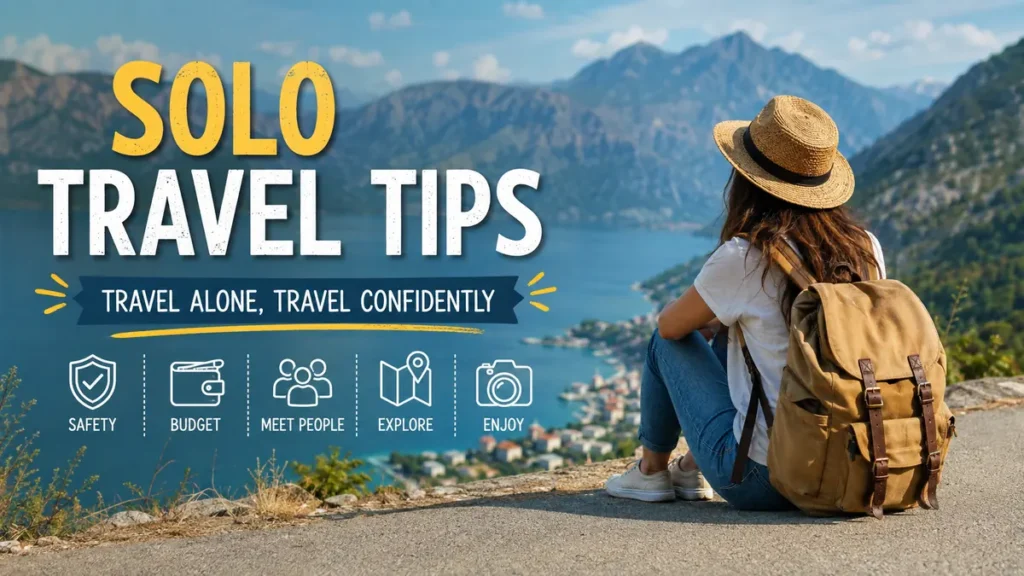
Traveling alone can feel intimidating before the first trip. There is no companion to double-check directions, watch your luggage, split expenses, or decide where to eat. Yet that independence is exactly what makes solo travel so rewarding.
The best solo travel tips focus on preparation without overplanning: research your destination, choose safe accommodation, keep someone informed of your plans, protect your documents and money, stay connected, budget for single-person costs, and leave enough flexibility to enjoy unexpected experiences. You can travel independently without spending every moment alone.
Solo travel has also become increasingly mainstream. Google searches for the subject reached record levels in the United States in 2026, while research cited by Axios found freedom and spontaneity among the main attractions for people traveling alone.
The goal is not to eliminate every uncertainty. It is to create enough structure that you can confidently handle whatever the trip brings.
Solo Travel Tips for Planning Your First Trip
A successful solo journey usually starts before you leave home.
When choosing your first destination, resist the temptation to select somewhere purely because it looks impressive on social media. Your first solo trip is much easier when the destination matches your actual comfort level.
Consider:
- Overall safety and current travel guidance
- Public transportation
- Walkability
- Language barriers
- Mobile internet availability
- Accommodation options
- Your daily budget
- Local customs and laws
- Weather
- Activities you genuinely enjoy
- Distance from home
- Ease of getting from the airport or station to your accommodation
For first-time solo travelers, destinations with straightforward transportation and well-developed tourism infrastructure tend to be easier to navigate. Experienced travelers may feel comfortable accepting more logistical uncertainty.
Start Smaller Than Your Dream Trip
Your first independent adventure does not need to involve three continents and six border crossings.
Try:
- Eating alone in your own city.
- Taking a solo day trip.
- Spending a weekend in another city.
- Taking a short domestic flight or train journey.
- Progressing to an international solo trip when you feel ready.
This gradual approach helps you learn how you react when plans change, you become lost, or you have to make decisions without anyone else’s input.
Even experienced solo travelers frequently recommend easing into the experience rather than making your first independent journey unnecessarily complicated.
Research Your Destination Beyond Tourist Attractions
Knowing the famous sights is useful. Knowing how the destination actually works is more useful.
Before leaving, research:
- Entry and visa requirements
- Passport validity requirements
- Local laws
- Cultural expectations
- Neighborhoods
- Common tourist scams
- Emergency numbers
- Airport transportation
- Public transport operating hours
- Currency and payment methods
- Mobile data options
- Healthcare access
- Seasonal weather
- Political demonstrations or disruptions
Travel conditions can change, so government travel advisories should be checked close to departure rather than months in advance and then forgotten. The U.S. Department of State, for example, advises international travelers to review current advisories, entry rules, local laws, and destination-specific information.
Travelers from other countries should use their own government’s equivalent service as well.
Solo Travel Tips for Staying Safe When Traveling Alone
Solo travel does not automatically make a trip unsafe, but it removes one layer of backup. If you lose your passport, become sick, miss the last train, or feel uncomfortable around someone, you need to make the next decision yourself.
Think of solo travel safety in layers rather than relying on a single gadget or trick.
Share Your Basic Itinerary
At least one trusted person should know:
- Where you are staying
- Flight or train details
- Your approximate route
- Important bookings
- When you expect to return
- How to contact you
You do not need to report every coffee stop. The purpose is to ensure someone knows where to start looking if they unexpectedly cannot reach you.
A simple habit works well: send a quick message after arriving in a new city or accommodation.
U.S. travelers can also use the State Department’s Smart Traveler Enrollment Program, or STEP, which provides destination alerts and can help an embassy or consulate contact travelers or their emergency contacts during emergencies.
Other nationalities should check whether their government offers a similar traveler-registration service.
Arrive During Daylight When Possible
Landing at 1:30 p.m. and figuring out the metro system is usually easier than doing the same thing after midnight.
Daylight gives you more transportation choices, more people to ask for assistance, and better visibility when judging an unfamiliar neighborhood.
If a late arrival cannot be avoided, organize the first transfer before you land. Use an official airport taxi counter, reputable rideshare service, hotel transfer, or another transportation option appropriate for the destination.
Don’t Advertise That You’re Alone
You can be friendly without telling strangers your complete itinerary.
Be cautious about sharing:
- Your room number
- Your accommodation address
- How long you are staying
- Where you are going next
- That nobody expects you back
- That nobody nearby knows you
If someone makes you uncomfortable, you do not owe them accurate personal information.
Trust Changes in the Situation, Not Just Your Instincts
“Trust your gut” is common travel advice, but practical observation is even better.
Notice when:
- Someone keeps following you.
- A driver takes an unexpected route without explanation.
- A previously busy area becomes deserted.
- Someone is aggressively pushing you to accept help.
- A stranger becomes unusually interested in where you’re staying.
- A situation involves pressure, secrecy, or urgency.
Leaving early is better than waiting for absolute proof that something is wrong.
Be Careful With Alcohol
Solo travelers do not have a built-in friend watching their drink or noticing when they are becoming impaired.
Know your limit, keep control of your drink, and avoid becoming so intoxicated that you cannot navigate back to your accommodation.
The U.S. State Department specifically advises women travelers to monitor their drinks, avoid accepting drinks from strangers, and remain aware of alcohol consumption.
The principle is useful for any traveler.
Choose Solo-Friendly Accommodation Carefully
The cheapest bed is not necessarily the best solo-travel bargain.
Location matters enormously when you are alone.
A room costing slightly more near reliable transportation, restaurants, and busy streets may be better value than a remote bargain requiring expensive taxis every night.
Before booking, check:
- Recent guest reviews
- Neighborhood comments
- Reception hours
- Secure door locks
- Luggage storage
- Lockers at hostels
- Distance from public transport
- Late-night access
- Nearby food options
- Whether previous solo guests felt comfortable
Read the written reviews rather than relying only on the numerical rating.
Hotels, Hostels, Guesthouses, or Rentals?
Each accommodation style has advantages.
| Accommodation | Main Advantage | Possible Drawback |
|---|---|---|
| Hotel | Privacy, staffed reception | Often more expensive |
| Hostel dorm | Cheap and social | Less privacy |
| Hostel private room | Privacy plus social spaces | Can cost close to a hotel |
| Guesthouse | Personal atmosphere | Facilities vary |
| Apartment rental | Kitchen and extra space | Less immediate support |
| Homestay | Local interaction | Less independence |
Hostels deserve particular attention for solo travelers. You do not necessarily have to sleep in a dormitory. Many hostels provide private rooms while still offering lounges, breakfasts, tours, communal kitchens, and activities where meeting people happens naturally.
If social interaction matters to you, look for reviews describing the property’s atmosphere rather than simply choosing the cheapest hostel.
Keep Your Phone and Essential Information Available
For a solo traveler, a working phone is much more than entertainment.
It can provide:
- Navigation
- Translation
- Transportation bookings
- Digital boarding passes
- Accommodation details
- Emergency communication
- Banking access
- Currency conversion
- Local information
International connectivity can come through roaming, a local SIM, an eSIM, or Wi-Fi, depending on the destination and your phone.
Still, never build your entire travel system around having an internet connection.
Download Offline Maps
Save your destination in Google Maps or another navigation app before leaving reliable Wi-Fi.
Also save:
- Hotel address
- Airport or station
- Important attractions
- Nearby hospital or clinic
- Embassy or consulate if relevant
- Transportation hubs
A screenshot of the accommodation’s address in the local language can be surprisingly useful when communicating with taxi drivers.
Carry a Power Bank
Navigation, photography, translation, ride-hailing, and mobile data can drain a battery quickly.
A small charged power bank removes one of solo travel’s most unnecessary problems: being somewhere unfamiliar with 2% battery remaining.
Protect Your Passport, Money, and Important Documents
Avoid keeping everything valuable in one place.
If your passport, all your bank cards, and every piece of cash disappear together, a frustrating problem becomes a serious one.
Use redundancy.
Keep:
- Your primary bank card in your wallet.
- A backup card somewhere separate.
- Some emergency cash away from your wallet.
- Digital copies of important documents in secure storage.
- Necessary travel documents accessible offline.
Do not casually leave your passport in a backpack that you then place underneath a café table.
For accommodation with reliable safes or lockers, use them appropriately for items you do not need during the day.
Know What You Would Do If Your Phone Disappeared
This is one of the most overlooked solo travel tips.
Before traveling, determine:
- How you would access your email without your phone
- How you would contact family
- How to freeze bank cards
- How to access your accommodation reservation
- Whether you know essential passwords
- How you would locate or remotely erase the device
Write critical information somewhere other than the phone itself.
A backup system seems unnecessary right up until the moment it becomes extremely necessary.
Budget Differently When Traveling Alone
Solo travel provides freedom, but it does not always provide the lowest per-person cost.
With two travelers, hotel rooms, taxis, rental cars, and some tours can be divided between two people. Alone, you cover the whole expense.
Some cruises and organized tours also charge a single supplement, an additional cost resulting from one person occupying space commonly priced around double occupancy.
Build a Realistic Solo Travel Budget
Break your budget into:
| Category | Examples |
| Transportation | Flights, trains, buses, taxis |
| Accommodation | Hotel, hostel, guesthouse |
| Food | Restaurants, groceries, snacks |
| Activities | Tours, museums, tickets |
| Connectivity | SIM, eSIM, roaming |
| Insurance | Trip and medical coverage |
| Local transport | Metro, buses, rideshares |
| Emergency fund | Unexpected expenses |
Then calculate a realistic daily amount rather than relying on a vague total.
Save Money Where It Doesn’t Reduce Safety
Good places to economize include:
- Traveling outside peak season
- Using public transportation
- Staying in hostel private rooms
- Choosing guesthouses
- Walking when appropriate
- Eating local food
- Buying groceries occasionally
- Taking free walking tours
- Using free museum days
- Booking accommodation with breakfast
- Avoiding unnecessary checked luggage
Being budget-conscious should not mean taking an unsafe overnight route or staying in an area that consistently receives poor safety reviews simply to save a small amount.
Get Travel Insurance That Matches the Trip
Travel insurance is particularly worth considering when nobody else is with you to help manage an emergency.
Coverage varies considerably, so check what a policy actually includes rather than assuming that “travel insurance” covers everything.
Depending on the policy, useful protection may include:
- Emergency medical expenses
- Medical evacuation
- Trip cancellation
- Trip interruption
- Delayed baggage
- Lost baggage
- Travel delays
- Emergency assistance
The CDC advises international travelers to determine whether their existing health insurance covers treatment abroad and to consider additional coverage for healthcare and emergency evacuation.
Medical evacuation deserves special attention for remote trips. The CDC notes that emergency transportation from a remote location to an appropriate hospital can exceed $100,000 in some circumstances.
Read exclusions carefully, particularly if your trip involves trekking, diving, skiing, motorbikes, or other activities that ordinary policies may restrict.
Solo Travel Tips for Meeting People Without Losing Independence
One misconception about solo travel is that you spend the entire trip alone.
You decide how social the experience becomes.
Some days you might want hours without conversation. On another day, dinner alone might suddenly feel lonely.
Build optional social opportunities into your itinerary.
Join a Walking Tour Early
A walking tour on your first or second day can accomplish several things at once.
You learn:
- How the city is laid out
- Which neighborhoods interest you
- Local history
- Transportation basics
- Places worth revisiting
You also meet other travelers without committing to spending the entire trip with them.
Take a Class or Small-Group Activity
Good options include:
- Cooking classes
- Food tours
- Photography walks
- Hiking groups
- Surf lessons
- Language exchanges
- Museum tours
- Cycling tours
- Day trips
Interest-based activities make conversation easier because everyone already shares something to discuss.
Food and cooking experiences are particularly social because conversation happens naturally around a shared table. Group activities are also commonly recommended by experienced solo travelers as an easy way to combine independence with company.
Use Common Spaces
Hostel lounges, guesthouse breakfasts, communal tables, cafés, coworking spaces, and group excursions provide low-pressure opportunities for meeting people.
You do not need a clever opening line.
Simple questions work:
“Have you been here long?”
“What did you do today?”
“Is that tour worth taking?”
Solo travelers are often more receptive to conversation precisely because they are traveling independently.
Don’t Force Yourself to Socialize
Meeting people is an option, not an obligation.
If you are enjoying dinner with a book, wandering through a museum alone, or spending an evening watching a movie in your room, nothing has gone wrong.
One of solo travel’s greatest benefits is finally being able to organize time around your own energy.
Learn How to Enjoy Eating Alone
For some first-time travelers, solo dining feels more intimidating than navigating an airport alone.
The discomfort generally disappears with practice.
Try:
- Sitting at the bar or counter
- Choosing outdoor seating
- Visiting markets or food halls
- Bringing a book
- Writing in a journal
- Going earlier than the dinner rush
- Trying restaurants with communal tables
You may eventually discover that eating alone is enjoyable.
There is no debate about where to eat, no pressure to finish simultaneously, and nobody judging you for ordering dessert first.
Travel + Leisure’s 2026 advice for solo travelers similarly emphasizes that being alone does not necessarily mean being lonely and that solo dining can become an opportunity to observe your surroundings or interact with others.
Don’t Overplan Your Solo Travel Itinerary
Planning is useful because you are responsible for every logistical decision.
Too much planning can remove the freedom that made traveling alone attractive in the first place.
A balanced itinerary might contain:
Fixed:
- Flights
- First accommodation
- High-demand attractions
- Essential transportation
- Activities requiring advance reservations
Flexible:
- Restaurants
- Neighborhood walks
- Secondary attractions
- Café stops
- Day trips with frequent availability
- Free afternoons
Leave space for recommendations from locals and travelers you meet.
Condé Nast Traveler’s solo travel guidance similarly recommends retaining flexibility because some of the best suggestions may appear after you arrive.
Don’t Schedule Every Hour
Solo travelers make every decision themselves.
That freedom is exciting, but continual decision-making can become exhausting.
A free afternoon is not wasted travel time.
Sleep late. Sit in a park. Return to a café you loved. Spend three hours in a museum instead of one because nobody is waiting.
Your schedule belongs to you.
Pack Lighter Than You Think You Need To
When traveling with someone, you can ask them to watch your suitcase while you buy tickets or go to the restroom.
Alone, your luggage follows you.
That makes mobility especially valuable.
Try to pack so you can comfortably:
- Lift your luggage onto a train
- Carry it upstairs
- Walk several blocks
- Maneuver through stations
- Use public transportation
- Keep track of every bag simultaneously
Useful Solo Travel Essentials
Depending on the destination, practical items may include:
- Power bank
- Universal adapter
- Reusable water bottle
- Small first-aid kit
- Medication
- Luggage lock
- Lightweight day bag
- Copies of travel documents
- Backup bank card
- Comfortable walking shoes
- Earplugs
- Portable charger cable
CDC packing guidance also recommends carrying relevant insurance documentation and keeping information about medical facilities and embassy or consular services available when traveling internationally.
Avoid filling your bag with gadgets marketed specifically to travelers unless they solve a real problem you expect to encounter.
Respect Local Culture and Laws
Traveling independently does not exempt you from local expectations.
Research standards concerning:
- Clothing
- Religious sites
- Photography
- Alcohol
- Public behavior
- Relationships
- Transportation
- Medication
- Drones
- Protected areas
Something ordinary at home can be restricted somewhere else.
Cultural awareness also affects how people respond to you. Learning a few local words—hello, thank you, please, excuse me—can transform routine interactions.
You are visiting someone’s home, not walking through a theme park built for tourists.
What to Do When Solo Travel Feels Lonely
Even people who love traveling alone sometimes feel lonely.
It may happen on the third night rather than the first. You might see families eating together, couples watching a sunset, or groups laughing in a hostel and suddenly wish somebody familiar were beside you.
That feeling does not mean the trip was a mistake.
Try changing your environment rather than sitting alone with the feeling.
You could:
- Call somebody at home.
- Join a walking tour.
- Eat at a lively food market.
- Book a group activity.
- Spend time in a hostel or café common area.
- Visit somewhere familiar from earlier in the trip.
- Take a rest day.
Traveling alone does not require proving that you never need other people.
Give Yourself Familiarity
Constant novelty can become tiring.
Small routines help.
Visit the same café for breakfast. Go for an evening walk along the same street. Buy snacks from the same supermarket.
After several days, unfamiliar surroundings begin to feel temporarily like your own neighborhood.
Common First-Time Solo Travel Mistakes
Most solo travel problems are less dramatic than people imagine.
They usually come from poor logistics.
Booking the Cheapest Accommodation Without Checking the Area
A bargain room becomes expensive when you constantly require taxis or do not feel comfortable walking nearby.
Arriving Without Knowing How to Reach Your Accommodation
Research the airport or station transfer before you land.
Packing Too Much
Everything you bring becomes your responsibility.
Carrying All Your Money Together
One lost wallet should not remove access to every source of funds.
Telling Everyone You’re Traveling Alone
Be social, but maintain boundaries.
Planning Every Minute
Overplanning leaves no room for discoveries or changing your mind.
Planning Almost Nothing
The opposite creates unnecessary stress, especially on arrival.
Drinking More Than You Normally Would
Being significantly impaired is riskier when nobody you trust is nearby.
Ignoring Your Own Travel Style
You do not need to stay in a party hostel because solo travelers supposedly do.
Nor must you visit every major attraction because a guidebook says you should.
The trip should reflect what you actually enjoy.
A Simple First-Time Solo Travel Routine
If you want a straightforward framework, use this sequence.
Before Leaving
- Research the destination.
- Check current entry requirements and travel advisories.
- Book your first accommodation.
- Plan airport transportation.
- Arrange appropriate insurance.
- Create document backups.
- Separate money and cards.
- Download offline maps.
- Arrange mobile connectivity.
- Share essential itinerary information with someone you trust.
When You Arrive
- Get connected to mobile data or reliable Wi-Fi.
- Tell your contact that you arrived.
- Find your accommodation before exploring.
- Learn the immediate neighborhood.
- Locate an ATM, supermarket, pharmacy, and transport stop.
- Ask accommodation staff about areas or situations to avoid.
- Take a short orientation walk during daylight.
During the Trip
- Keep important belongings controlled.
- Stay aware without becoming paranoid.
- Check in periodically with someone at home.
- Leave room for spontaneous plans.
- Join social activities when you want company.
- Rest when you need to.
- Change plans whenever something no longer feels right.
That combination of structure and flexibility works far better than trying to predict every possible problem.
The Best Solo Travel Tips Are About Independence, Not Isolation
The greatest advantage of solo travel is not being able to say that you traveled alone. It is discovering how differently a trip feels when every decision belongs to you.
You can wake up early for sunrise without convincing anybody else. You can spend an entire afternoon in one museum, cancel an activity because you’re tired, talk to strangers over dinner, change cities unexpectedly, or simply sit somewhere beautiful without having to entertain another person.
Good solo travel tips create a safety net without turning the journey into a rigid checklist. Research your destination, protect your documents and money, choose accommodation thoughtfully, stay connected, keep someone informed, budget realistically, and understand local customs. Then leave enough space for the part no guide can plan.
Your first solo trip does not need to be fearless, perfect, or ambitious. It only needs to be manageable.
Once you realize you can navigate an unfamiliar place, solve small problems, enjoy your own company, and decide what happens next, traveling alone starts feeling much less like traveling without somebody—and much more like traveling entirely on your own terms.