Searching for bumpdots.com can be surprisingly confusing. Some results describe it as a general digital publication, while others associate the name with physical “bump dots” used as tactile accessibility markers. Those are two different ideas, and separating them is the first step toward understanding the website.
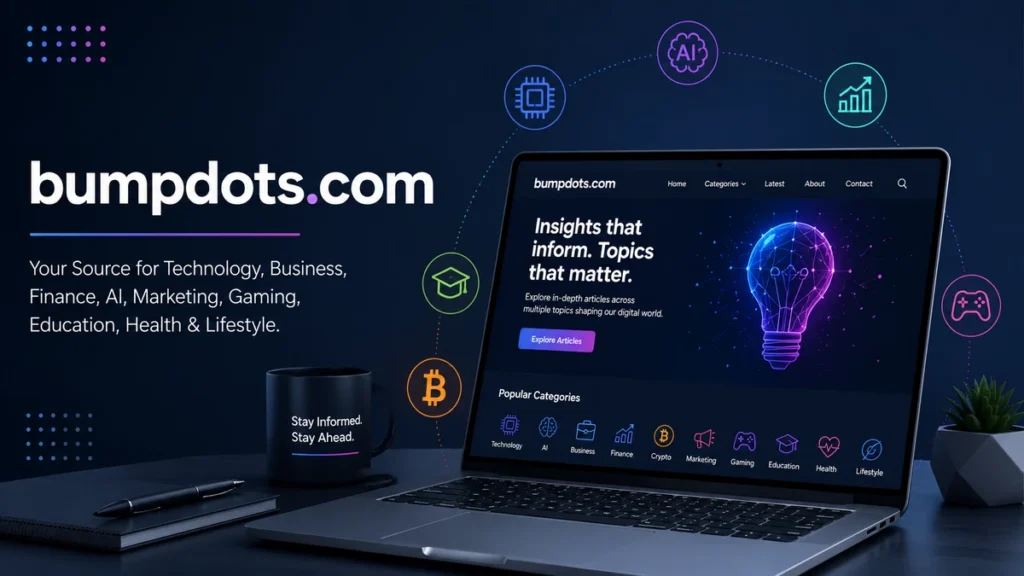
Available information connected directly with the brand describes bumpdots.com as an independent digital publication launched in 2024. Its content spans technology, artificial intelligence, business, finance, cryptocurrency, digital marketing, gaming, education, health, lifestyle, and related online trends. The stated editorial emphasis is on clarity, context, and helping readers form informed viewpoints rather than limiting the publication to a single subject.
Quick answer: bumpdots.com is best understood as a multi-topic online publication rather than a website dedicated specifically to tactile bump-dot products. It publishes informational material across interconnected subjects, with technology, business, finance, digital culture, education, health, and lifestyle among the areas associated with the platform.
What Is bumpdots.com?
bumpdots.com is an online publishing platform built around informational content.
Instead of concentrating on one narrow niche, the publication covers several categories that frequently overlap. A story about artificial intelligence, for example, may have implications for business, digital marketing, education, finance, or everyday technology use.
That broader structure appears intentional. Public descriptions connected with the platform characterize it as an independent publication interested in the ideas, technologies, brands, platforms, and trends shaping the modern digital environment.
This makes bumpdots.com closer to a multi-category digital magazine or knowledge publication than a specialized single-topic blog.
The domain itself was registered on May 13, 2024. Public WHOIS information currently lists its registration through May 13, 2030.
The basic idea behind the platform
At a practical level, the publication’s approach can be summarized in three parts:
- covering subjects people encounter online and in everyday life;
- explaining those subjects in accessible language;
- connecting individual developments with their broader context.
This model is useful when a topic does not fit neatly into one category.
Artificial intelligence is a good example. AI can simultaneously be a technology story, a business issue, a financial development, an educational tool, and a digital-marketing concern. A multi-topic publication has room to examine those connections rather than forcing the subject into a single silo.
What Topics Does bumpdots.com Cover?
The subject range associated with bumpdots.com is broad.
Descriptions connected with the publication identify areas including technology, artificial intelligence, business, finance, cryptocurrency, digital marketing, gaming, education, health, lifestyle, brands, online platforms, and wider digital trends.
That breadth helps explain why two visitors can encounter the domain while researching completely different questions.
Technology and artificial intelligence
Technology is one of the natural pillars of a publication focused on the modern digital world.
This area can include emerging technologies, internet platforms, software, digital services, AI developments, and the ways new technologies influence consumers and organizations.
Artificial intelligence deserves particular attention because it increasingly overlaps with almost every other online industry.
For readers, useful AI coverage should do more than repeat announcements. It should explain what a technology does, where it can realistically be used, what limitations exist, and why a development matters.
That contextual approach is consistent with how bumpdots.com publicly describes its editorial direction.
Business and entrepreneurship
Business is another subject associated with the publication.
Business-focused informational content can range from understanding companies and digital platforms to examining marketing practices, changing business models, workplace technologies, and entrepreneurship.
This category naturally overlaps with technology.
A new digital platform is not merely a technology product. It may also introduce a new revenue model, change consumer behavior, create opportunities for businesses, or disrupt an established industry.
Covering those connections gives readers more context than looking at the technology alone.
Finance and cryptocurrency
Finance and cryptocurrency are also identified among the subjects associated with bumpdots.com.
These topics require particular care because financial information can have real-world consequences.
A useful informational publication should distinguish between explaining a financial concept and telling readers what financial decision to make. Definitions, industry developments, terminology, risks, and background information can help people understand a subject without presenting speculation as certainty.
Cryptocurrency makes this distinction especially important because markets and individual projects can change rapidly.
Readers should therefore treat dated financial or crypto articles as snapshots and verify current figures before relying on them.
Digital marketing and online platforms
Digital marketing sits at the intersection of business and technology.
Search engines, social networks, advertising systems, content platforms, analytics tools, and changing online behavior all influence how businesses reach audiences.
This makes the category particularly suitable for a multi-topic publication.
An update to an online platform, for example, can affect creators, marketers, businesses, advertisers, and consumers simultaneously. Understanding the surrounding context is often more useful than simply knowing that an update occurred.
Gaming and digital culture
Gaming has grown far beyond standalone entertainment.
Modern games interact with online communities, streaming, hardware, software, virtual economies, social platforms, and internet culture.
As a result, gaming coverage can naturally sit beside broader technology and digital-trend reporting.
Digital culture also gives a publication room to examine online services, emerging communities, viral platforms, and other internet phenomena readers may encounter without immediately understanding.
Education
Education increasingly overlaps with technology.
Online learning platforms, educational software, AI tools, digital resources, and changing approaches to studying have made the relationship even stronger.
Informational education content is most valuable when it explains a concept clearly and helps readers understand how something works rather than simply repeating definitions.
Students may need a straightforward introduction. Teachers may want context. Parents may be trying to understand a platform or trend their children have encountered.
Clear language can serve all three groups without making the material unnecessarily technical.
Health and lifestyle
Health and lifestyle broaden the publication beyond technology and business.
Lifestyle subjects can cover practical issues that affect everyday routines, habits, consumer decisions, and general well-being.
Health content, however, deserves a higher standard of caution.
Online articles can help readers understand terminology or prepare better questions, but they should not replace qualified medical advice. Readers should pay attention to sourcing, publication dates, author expertise, and whether claims are supported by credible evidence.
Why Is There Confusion About bumpdots.com and “Bump Dots”?
This is one of the most important points for anyone researching bumpdots.com.
The words “bump dots” already have an established generic meaning outside the website name.
Bump dots are small raised tactile markers that can be attached to buttons, controls, switches, appliances, keyboards, and other surfaces. They can provide tactile reference points, particularly for people who are blind or have low vision.
Because the domain name contains the same words, search engines may surface pages that assume bumpdots.com is an accessibility-product website.
Several third-party pages currently make exactly that association. Some describe the domain as a source for tactile markers or accessibility products, while other search results describe it as a multi-topic publication.
That contradiction matters.
bumpdots.com vs. bump dots
| Term | Meaning |
|---|---|
| bumpdots.com | A domain associated with an independent multi-topic digital publication |
| Bump dots | Raised tactile markers used to identify controls, buttons, positions, or objects by touch |
| Tactile markers | A broader category of touch-based physical markers |
| Braille | A standardized tactile reading and writing system based on raised-dot patterns |
These concepts should not automatically be treated as interchangeable.
A domain name can resemble an established product term without the website itself being dedicated to that product category.
Why search results can disagree
Search engines discover information from many sources, not just a website’s own pages.
Third-party publishers may interpret a brand name, repeat information from another article, or publish their own description of a website. Once multiple pages repeat the same interpretation, users can encounter conflicting explanations.
That is visible in the current search landscape around bumpdots.com.
Some pages describe an accessibility platform. Others describe a broad information website. Brand-associated profiles, meanwhile, describe bumpdots.com as an independent digital publication focused on technology, AI, business, finance, cryptocurrency, digital marketing, gaming, education, health, lifestyle, and related subjects.
For that reason, readers should distinguish between first-party or brand-associated descriptions and unsupported third-party assumptions.
Who Is bumpdots.com For?
Because it covers multiple subjects, bumpdots.com does not appear to target one narrowly defined type of reader.
Its broader audience can include people researching unfamiliar online topics, students seeking accessible explanations, professionals following developments outside their main field, entrepreneurs learning about digital trends, and everyday readers trying to understand a company, platform, technology, or concept.
The common thread is information discovery.
A reader does not necessarily need specialist knowledge before arriving at an article. Clear explanatory content can act as an entry point before that person moves into more technical or authoritative resources.
Beginners researching unfamiliar subjects
People frequently search for a name because they encountered it somewhere else.
They might have seen:
- an unfamiliar website;
- a technology term;
- a company or product;
- a new online service;
- a financial concept;
- an AI tool;
- a gaming platform;
- or a trending internet phrase.
A useful introductory article should answer the immediate questions first: What is it? What does it do? Why does it matter? Are there limitations or risks? What should I verify next?
That structure makes complex topics easier to approach.
Professionals and entrepreneurs
Business owners and professionals often need information outside their own specialties.
A marketer may need to understand AI. An entrepreneur may need background on cryptocurrency. An educator may need to understand a new digital platform.
Multi-category publications can help readers build that initial context without requiring specialist knowledge in every field.
How to Use bumpdots.com Effectively
The usefulness of any general information website depends partly on how readers approach it.
A practical method is to treat an article as the beginning of research rather than automatically as the final authority.
1. Identify what kind of article you are reading
First determine whether the page is:
- an explanatory guide;
- a review;
- a news-based article;
- a comparison;
- an opinion;
- or a general overview.
Different article types require different levels of verification.
A basic definition may remain useful for years. A cryptocurrency price, software feature, company policy, or health recommendation can become outdated much faster.
2. Check the publication or update date
Freshness matters when the underlying subject changes quickly.
Technology, AI, finance, search engines, social platforms, regulations, and online services evolve continuously.
An article can have been accurate when published but no longer reflect current conditions.
3. Separate facts from interpretation
Good informational reading involves recognizing the difference between a verifiable fact and an author’s interpretation.
For example, a product’s release date can be verified.
Whether that product represents the future of its industry is an opinion that requires evidence and context.
This distinction becomes especially important in articles involving emerging technology, investment trends, or rapidly growing companies.
4. Follow important claims to primary sources
When a decision matters, move closer to the original source.
Depending on the subject, that might mean checking:
- official company documentation;
- government websites;
- regulatory agencies;
- academic research;
- recognized professional organizations;
- product documentation;
- or direct announcements.
This is particularly important for medical, legal, financial, and safety-related information.
5. Compare multiple reliable sources
No single publication needs to answer every possible question.
If a subject affects your money, health, legal rights, education, or professional decisions, compare several credible sources before acting.
The purpose of an explanatory article is often to give you enough context to conduct that deeper research intelligently.
Is bumpdots.com a News Website or a Knowledge Website?
The distinction is not always absolute.
Based on its public descriptions, bumpdots.com is better characterized as a digital publication covering ideas, technologies, platforms, and trends than as a traditional breaking-news organization.
Traditional news sites tend to prioritize events as they happen.
Knowledge-oriented publications can take a different approach by explaining what something means, how it works, and how it connects with a larger subject.
The second model can give an article a longer useful lifespan.
For example, breaking news might report that a new AI product has launched. An explanatory article might instead examine what the product does, who developed it, how its features compare with existing approaches, its limitations, and why the launch matters.
Both formats have value, but they serve different reader needs.
How to Judge Information on a Multi-Niche Publication
Broad coverage offers convenience, but it also gives readers more responsibility.
Expertise in artificial intelligence does not automatically equal expertise in medicine. Experience in digital marketing does not automatically establish authority in finance.
That principle applies to bumpdots.com and virtually every other multi-topic publication.
Look for clear sourcing
Specific factual claims should be traceable.
Statistics deserve sources. Research findings should identify the underlying research. Company claims should ideally point toward company information or independent evidence.
The more consequential a claim is, the stronger its evidence should be.
Consider the author and subject
Author expertise matters differently depending on the topic.
A general technology explainer may not require an academic researcher. Detailed medical guidance, financial recommendations, or legal interpretation deserves considerably stronger credentials and sourcing.
Readers should increase their scrutiny as the potential consequences increase.
Watch for exaggerated certainty
Be cautious when any website promises guaranteed outcomes.
Statements such as guaranteed financial returns, guaranteed rankings, instant health results, or absolute safety usually deserve additional scrutiny.
Credible informational writing acknowledges uncertainty where uncertainty genuinely exists.
Check whether the information can be independently verified
Trust improves when a reader can confirm important details elsewhere.
Dates, specifications, company ownership, regulations, research findings, and official policies are often independently verifiable.
If a significant claim appears only on one obscure page and nowhere authoritative, treat it cautiously until better evidence is available.
What Makes the Name bumpdots.com Memorable?
From a branding perspective, “Bumpdots” is short and distinctive.
It also demonstrates an interesting challenge of internet branding: memorable names can already have meanings outside the brand itself.
Because “bump dots” is associated with tactile markers, people searching for the domain may encounter accessibility-related information alongside content describing the digital publication.
That does not necessarily tell users anything about the quality of the site. It simply means understanding search context becomes important.
When searching specifically for the publication, using the complete domain bumpdots.com rather than only “bump dots” can help clarify intent.
When Should You Verify Information Elsewhere?
Verification is useful for any online research, but certain topics deserve extra attention.
Health information
Use health articles for general education, not diagnosis or personalized treatment.
Check significant medical claims against recognized health authorities or qualified healthcare professionals.
Financial and cryptocurrency information
Market conditions can change within minutes.
Verify prices, regulations, product availability, fees, risks, and investment-related claims using current primary or authoritative sources before making financial decisions.
Technology and AI
Software features, pricing plans, model capabilities, availability, and company policies can change rapidly.
Always check current official documentation when exact specifications matter.
Business information
Company leadership, ownership, services, pricing, and policies can change.
A publication date therefore matters when researching a business or platform.
Education
Requirements differ between institutions and jurisdictions.
When an article discusses admissions, qualifications, grading policies, or official requirements, verify the details with the relevant institution.
The Broader Role of Multi-Topic Digital Publications
The internet has created an unusual information problem.
There is more material available than ever before, but finding understandable context can still be difficult.
Specialist publications provide depth. News organizations provide timely reporting. Official documentation provides primary information. Academic research provides rigorous evidence.
General digital publications occupy another position: they can translate unfamiliar subjects into approachable explanations.
Their greatest value comes when they help readers understand enough about a topic to ask better questions and identify stronger primary sources.
That is especially relevant as technology increasingly connects previously separate areas of life.
AI affects education and business.
Cryptocurrency combines finance and technology.
Digital marketing depends on software platforms and consumer behavior.
Gaming intersects with entertainment, technology, communities, and digital economies.
A publication covering these areas together can highlight relationships that would be harder to see if each topic were treated in complete isolation.
What Readers Should Know Before Relying on bumpdots.com
The simplest approach is the same one that works across the wider web: read critically.
Use bumpdots.com to discover and understand topics, but evaluate individual articles according to the strength of their evidence.
Pay particular attention to:
- how recently the article was published or updated;
- whether important claims identify credible sources;
- whether the author distinguishes fact from opinion;
- whether time-sensitive information is still current;
- whether high-stakes advice is supported appropriately;
- and whether important facts can be confirmed through primary sources.
This approach does not require distrusting online publications. It means using them intelligently.
A clear explanatory article can save substantial research time. It becomes more valuable, not less, when readers know which details deserve independent verification.
Final Thoughts on bumpdots.com
bumpdots.com is best understood from the available brand-associated information as an independent multi-topic digital publication launched in 2024, with subject areas connected to technology, artificial intelligence, business, finance, cryptocurrency, digital marketing, gaming, education, health, lifestyle, and broader digital trends.
The biggest source of confusion is its name. “Bump dots” is also a term for physical tactile markers, and several third-party pages have interpreted the domain through that accessibility meaning. Current search results therefore contain conflicting descriptions.
For readers, the useful distinction is simple: bumpdots.com refers to the online publication, while bump dots can separately refer to tactile markers used for touch-based identification.
Once that distinction is clear, the website fits into a familiar role in modern publishing: a broad informational platform designed to help readers explore different subjects and understand the context surrounding them.
As with any general publication, its articles are most useful when combined with sensible source checking—especially for health, finance, legal matters, and rapidly changing technologies.
That is the practical way to approach bumpdots.com: use it to build understanding, then verify high-stakes or time-sensitive details through the most authoritative source available.