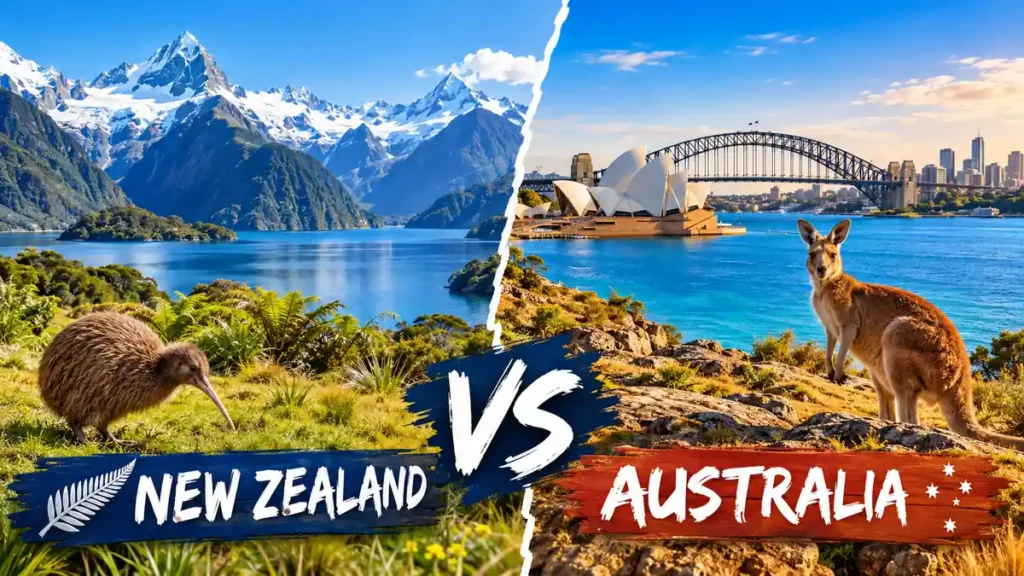
New Zealand and Australia are two of the Southern Hemisphere’s most appealing countries, known for spectacular landscapes, distinctive wildlife, strong sporting traditions, and high living standards. Yet despite their geographical proximity and shared history, living in or visiting these countries can feel remarkably different.
The new zealand vs australia comparison comes down to geography, population, climate, employment, living costs, culture, and lifestyle. Australia offers larger cities, a broader economy, and diverse environments, while New Zealand is known for its compact geography, dramatic mountains, and outdoor lifestyle. Neither country is universally better; the right choice depends on individual priorities.
new zealand vs australia: Quick Comparison
Both countries are developed democracies in Oceania, use English extensively, and maintain close economic and political relationships. However, their size, population distribution, and natural environments differ significantly.
| Feature | New Zealand | Australia |
|---|---|---|
| Capital | Wellington | Canberra |
| Largest city | Auckland | Sydney |
| Population | Approximately 5.3 million | Approximately 27 million |
| Land area | About 268,000 km² | About 7.7 million km² |
| Currency | New Zealand dollar (NZD) | Australian dollar (AUD) |
| Government | Parliamentary constitutional monarchy | Federal parliamentary constitutional monarchy |
| Main Indigenous peoples | Māori | Aboriginal and Torres Strait Islander peoples |
| Climate | Mostly temperate and maritime | Tropical, arid, subtropical, and temperate |
| Major industries | Agriculture, tourism, services, technology | Mining, services, education, agriculture, technology |
| Famous natural attractions | Milford Sound, Southern Alps, Rotorua | Great Barrier Reef, Uluru, Great Ocean Road |
| Popular sports | Rugby union, cricket, netball | Australian rules football, cricket, rugby, swimming |
| Geographic character | Two main islands and smaller islands | Continental landmass and surrounding islands |
Population figures are approximate mid-2020s estimates rather than live census counts.
The biggest distinction is scale. Australia is roughly 29 times larger by land area and has more than five times New Zealand’s population. This difference influences almost everything, from the size of the job market to how people travel.
Geography and Natural Landscapes


4
New Zealand: Mountains, Lakes, and Green Landscapes
New Zealand lies southeast of Australia across the Tasman Sea. Its two principal landmasses, the North Island and South Island, contain mountains, forests, lakes, volcanic regions, and long stretches of coastline.
The South Island is especially famous for the Southern Alps, including Aoraki/Mount Cook, the country’s highest mountain. Fiordland National Park, Milford Sound/Piopiotahi, and the glaciers of the West Coast attract visitors interested in hiking and dramatic scenery.
The North Island offers a different experience. Rotorua is known for geothermal activity and Māori cultural experiences, while the central volcanic plateau contains Tongariro National Park.
New Zealand’s compact geography makes it possible to encounter strikingly different landscapes within relatively short distances. However, mountain roads, winding routes, and ferry crossings can make journeys longer than they appear on a map.
Australia: Deserts, Rainforests, and Tropical Coastlines
Australia is the world’s sixth-largest country by total area. Its geography includes deserts, tropical rainforests, coastal plains, mountain ranges, grasslands, and coral reef systems.
Some of its best-known natural landmarks include:
- The Great Barrier Reef off Queensland
- Uluru in the Northern Territory
- The Great Ocean Road in Victoria
- The Blue Mountains near Sydney
- Kakadu National Park
- The Daintree Rainforest in tropical Queensland
- The Australian Alps across parts of New South Wales, Victoria, and the Australian Capital Territory
Australia’s immense size creates a wider range of environments, but traveling between major destinations often requires flights or lengthy drives.
Key takeaway: New Zealand offers dramatic landscape variety within a smaller area, while Australia provides a greater geographical range across much longer distances.
Climate and Weather Differences
Climate is one of the most practical considerations when comparing these countries.
What Is the Weather Like in New Zealand?
New Zealand generally experiences a temperate maritime climate, although conditions vary considerably by region and altitude.
Summers run from December through February, while winter occurs from June through August.
Auckland has relatively mild winters and warm summers. Wellington is known for frequent strong winds, while Queenstown experiences colder winters and provides access to alpine skiing.
Rainfall can be substantial, especially along the South Island’s western coast.
Is Australia Hotter Than New Zealand?
Australia is generally warmer, particularly in its northern and interior regions. However, describing the entire country as hot would be misleading.
Darwin experiences a tropical climate with distinct wet and dry seasons. Brisbane has humid subtropical conditions, Sydney has relatively mild winters, and Melbourne is known for changeable weather.
Perth has a Mediterranean climate, with hot, dry summers and wetter winters. Canberra and Tasmania experience comparatively cool winters, and Australia’s alpine areas receive seasonal snowfall.
| Climate factor | New Zealand | Australia |
|---|---|---|
| Summer | Generally mild to warm | Warm to extremely hot, depending on region |
| Winter | Cool, with alpine snow | Mild in many coastal areas; cold inland and alpine |
| Rainfall | Frequent in many regions | Highly variable |
| Tropical conditions | Absent | Present in the north |
| Desert environments | No extensive hot deserts | Extensive arid interior |
| Snow sports | Major tourism activity | Available in southeastern alpine regions |
For people who prefer cooler summers and a generally greener environment, New Zealand may be more appealing. Those seeking warmer weather and a wider choice of climates may prefer Australia.
Both countries face environmental hazards. New Zealand has significant earthquake and volcanic risks, while Australia experiences bushfires, floods, tropical cyclones, and extreme heat. Risks vary by location.
Cost of Living: Is New Zealand Cheaper Than Australia?
The cost of living is one of the most frequently discussed differences between the two countries. Both have relatively expensive housing markets, particularly in their largest cities.
However, a lower price does not necessarily mean better affordability. Salaries, taxes, housing expenses, and currency exchange rates all affect purchasing power.
Housing and Rent
In New Zealand, Auckland is generally among the most expensive housing markets. Wellington and Queenstown can also be costly, particularly for rental properties in desirable neighborhoods.
Australia’s Sydney has an especially expensive housing market, while Melbourne, Brisbane, Perth, and Adelaide offer different combinations of housing costs and income opportunities.
Housing affordability can change considerably between suburbs, even within the same city.
A September 2026 cost-of-living comparison estimated that Australia was approximately 6% more expensive overall than New Zealand. However, its underlying data comes from user-submitted prices, so it should be treated as an indicative comparison rather than an official national price index.
Expatistan, cost of living comparisons
Groceries, Utilities, and Transportation
New Zealand imports many manufactured goods, and its smaller market can contribute to relatively high prices for certain products.
Australia has a larger domestic market and more extensive distribution networks, although distances and regional supply conditions still influence prices.
Everyday expenses include:
- Groceries and household essentials
- Electricity and heating or cooling
- Internet and mobile services
- Public transportation and fuel
- Rent, insurance, and local rates
- Healthcare and childcare costs
Transport expenses depend heavily on location. A person living near public transport in central Melbourne may have very different costs from someone living in a rural New Zealand community where a car is essential.
Comparing Salaries With Living Expenses
Australian wages are generally higher in many occupations, but higher salaries do not automatically produce greater savings.
For example, someone earning more in Sydney may spend substantially more on rent than a comparable worker in Christchurch.
A useful affordability calculation is:
Monthly disposable income = Take-home salary − Rent − Utilities − Groceries − Transportation − Other essential expenses
This comparison should use current exchange rates and actual local prices rather than national averages alone.
Jobs, Salaries, and Economic Opportunities
Australia has a substantially larger economy and workforce. That creates a broader selection of employers, industries, and career paths.
New Zealand has a smaller labor market but offers opportunities across established sectors, particularly for people with relevant experience and qualifications.
Employment Opportunities in Australia
Australia’s major industries include mining, healthcare, construction, finance, education, professional services, agriculture, and information technology.
Sydney and Melbourne are important centers for finance, business services, and technology. Brisbane, Perth, and Adelaide also support substantial employment across construction, engineering, healthcare, and other industries.
Perth has particularly strong links to mining and resources, while Canberra offers opportunities in government and related professional services.
Employment Opportunities in New Zealand
New Zealand’s economy includes agriculture, dairy production, tourism, food processing, healthcare, construction, education, and professional services.
Auckland is its largest commercial center, while Wellington is important for public administration and professional services.
Christchurch supports engineering, construction, technology, and manufacturing. Regional employment can be closely connected to agriculture, tourism, and local industries.
new zealand vs australia: Salary Comparison
Published figures for 2026 illustrate the difference in statutory minimum wages.
| Wage indicator | New Zealand | Australia |
|---|---|---|
| Adult minimum hourly wage, 2026 | NZ$23.95 | A$26.44 |
| Effective date | April 1, 2026 | July 1, 2026 |
| Currency | NZD | AUD |
| General salary pattern | Lower in many comparable roles | Higher in many comparable roles |
These figures are in different currencies and are not directly comparable without conversion. Australia’s national minimum wage also operates alongside industry awards and employment classifications.
MoneyBalance
+1
When evaluating employment opportunities, consider salary after tax, retirement contributions, annual leave, professional licensing requirements, and long-term career development.
Australia may offer more choices for specialized careers because of its larger economy. New Zealand can be attractive to workers who value smaller communities or particular regional industries.
Lifestyle, Culture, and Quality of Life

New ZealandSmaller urban centers and easy access to outdoor recreation.

AustraliaLarge metropolitan centers with diverse cultural and professional opportunities.
Everyday Life in New Zealand
New Zealand is often associated with an outdoor-oriented lifestyle. Hiking, cycling, kayaking, fishing, and camping are popular activities.
The country’s relatively small population means that many communities feel less metropolitan than Australia’s largest cities.
However, this does not mean every New Zealand location is quiet. Auckland experiences traffic congestion, housing pressures, and the challenges common to major cities.
The country also has an active arts, music, and food culture, particularly in Auckland, Wellington, and Christchurch.
Everyday Life in Australia
Australia combines major international cities with regional towns, coastal communities, and remote settlements.
Sydney offers a large metropolitan environment with beaches and a prominent harbor. Melbourne is recognized for its arts, sporting events, cafés, and cultural institutions.
Brisbane is associated with warmer weather and access to southeastern Queensland’s coastal attractions, while Perth provides a distinctive west-coast lifestyle.
Australia’s greater population also supports a wider range of large-scale entertainment, professional sporting competitions, and specialized services.
Work-Life Balance
Both countries have employment protections, paid leave entitlements, and established workplace standards.
Actual work-life balance depends on the employer, industry, commute, and individual circumstances.
A professional in Auckland may work longer hours than someone in regional Australia, while another person may experience the opposite.
National stereotypes are not reliable substitutes for evaluating a specific job and lifestyle.
Education and Healthcare Systems
Universities and Higher Education
Australia and New Zealand both have internationally recognized universities and established systems for domestic and international students.
Notable Australian universities include:
- University of Melbourne
- University of Sydney
- Australian National University
- University of Queensland
Leading New Zealand institutions include:
- University of Auckland
- University of Otago
- Victoria University of Wellington
- University of Canterbury
Australian universities generally offer a larger total range of institutions and programs because of the country’s size.
New Zealand also provides respected education, with strengths in areas such as agriculture, environmental sciences, engineering, and health.
Students should compare specific programs, accreditation, tuition fees, scholarship eligibility, and graduate employment outcomes.
Healthcare in Australia
Australia operates Medicare, a publicly funded healthcare system that helps eligible residents access medical services.
Public hospitals provide treatment for eligible patients, while private health insurance can provide additional options.
Medicare does not make every healthcare service free. Gap payments, dental care, and other expenses may apply.
Eligibility also varies according to residency and visa status.
Healthcare in New Zealand
New Zealand has a publicly funded healthcare system that provides many services to eligible residents.
Its Accident Compensation Corporation (ACC) scheme offers no-fault personal injury cover for qualifying injuries, including many injuries sustained by visitors.
ACC does not replace ordinary medical insurance for illnesses or cover every expense.
In both countries, healthcare access can be more limited in remote communities than in major cities.
Wildlife, Nature, and Outdoor Activities

New Zealand wildlifeKiwi, kea, tuatara, and distinctive native ecosystems.

Australian wildlifeKangaroos, koalas, wombats, and other native species.
Wildlife in New Zealand
New Zealand developed unique ecosystems through millions of years of geographical isolation.
Its native wildlife includes kiwi, kea, kākāpō, tuatara, and several distinctive marine species.
Unlike Australia, New Zealand has no native terrestrial snakes and no established wild snake populations.
The country has historically had relatively few native land mammals, making its birdlife particularly distinctive.
Conservation is an important issue because introduced predators, habitat loss, and environmental changes threaten many native species.
Wildlife in Australia
Australia is famous for marsupials and other animals found naturally in few or no other places.
Its wildlife includes kangaroos, koalas, wombats, platypuses, echidnas, crocodiles, and numerous snake species.
Some Australian animals can be dangerous, including certain snakes, spiders, jellyfish, and crocodiles.
However, serious wildlife incidents are relatively uncommon for people following appropriate safety guidance.
The risks depend heavily on the environment. Tropical northern Australia has different wildlife hazards from urban Melbourne or Tasmania.
Outdoor Adventures
New Zealand is particularly popular for:
- Multi-day hiking and Great Walks
- Skiing and snowboarding
- Bungee jumping and jet boating
- Glacier and alpine experiences
- Kayaking and scenic road trips
Australia offers:
- Surfing and beach activities
- Snorkeling and scuba diving
- Desert exploration
- Tropical rainforest experiences
- National park hiking
- Camping and long-distance road trips
Both countries offer outstanding outdoor recreation, but their natural environments produce very different experiences.
Tourism: Which Country Is Better to Visit?
For travelers, the choice depends on preferred scenery, activities, available time, and budget.
New Zealand is especially attractive for alpine landscapes, scenic drives, and adventure tourism. Australia is well suited to travelers interested in beaches, major cities, tropical environments, and distinctive wildlife.
Best Places to Visit in New Zealand

Queenstown
Known for adventure sports, alpine scenery, Lake Wakatipu, and access to nearby ski resorts.

Milford Sound
A spectacular fiord surrounded by steep mountains and waterfalls, particularly impressive after rainfall.

Rotorua
Famous for geothermal attractions, Māori cultural experiences, and volcanic landscapes.
Other popular destinations include Auckland, Wellington, Lake Tekapo, Abel Tasman National Park, and Aoraki/Mount Cook National Park.
Best Places to Visit in Australia

Sydney
Known for Sydney Harbour, the Opera House, the Harbour Bridge, and famous coastal beaches.

Great Barrier Reef
The world’s largest coral reef system, offering marine wildlife experiences and snorkeling opportunities.

Uluru
A culturally significant sandstone monolith within Uluru-Kata Tjuta National Park.
Other highlights include Melbourne, Tasmania, the Gold Coast, the Whitsunday Islands, and Kakadu National Park.
Which Country Is More Affordable for Tourists?
Travel costs vary by season, accommodation, transport, and destination.
New Zealand road trips can become expensive because of rental vehicles, fuel, and accommodation in popular tourism centers. Australia can involve significant domestic flight expenses because of the distance between attractions.
For either country, traveling outside peak holiday periods may reduce accommodation costs.
A shorter trip focused on one region is often more practical than trying to visit every major attraction.
4.8
4.6
Use two fingers to move the map
Use ctrl + scroll to zoom the map
All groups
History, Indigenous Cultures, and National Identity
Although Australia and New Zealand share elements of British colonial history, their Indigenous cultures, political development, and national identities are distinct.
Māori Culture in New Zealand
Māori are the Indigenous Polynesian people of New Zealand.
Te reo Māori is an official language, and Māori traditions, arts, place names, and cultural practices contribute significantly to national identity.
The Treaty of Waitangi, signed in 1840 between representatives of the British Crown and many Māori chiefs, remains central to discussions about governance, rights, and the Crown–Māori relationship.
Traditional practices such as haka, whakairo (carving), and weaving are important expressions of Māori culture, although their meanings and uses vary by context.
Aboriginal and Torres Strait Islander Cultures in Australia
Aboriginal and Torres Strait Islander peoples represent diverse Indigenous cultures with histories extending back tens of thousands of years.
Their cultures include numerous languages, distinct cultural traditions, sophisticated systems of environmental knowledge, and strong connections to Country and Sea Country.
Australia’s colonial history involved dispossession, violence, and policies that continue to influence contemporary discussions about Indigenous rights and reconciliation.
Neither country’s Indigenous population should be treated as a single culturally uniform group.
Language and Communication
English is widely spoken in both countries, but vocabulary and accents differ.
New Zealand English contains distinctive expressions and words influenced by te reo Māori.
Australian English has its own pronunciation patterns, informal expressions, and regional characteristics.
Examples include jandals in New Zealand and thongs in Australia for flip-flops. Australians also commonly use arvo to mean afternoon.
These differences are generally easy for English speakers to understand.
Sports: new zealand vs australia Rivalry
Sport is one of the most visible expressions of the relationship between these neighboring countries.
Both have strong sporting cultures, and their international competitions attract substantial public attention.
Rugby Union
Rugby union is especially prominent in New Zealand, where the national men’s team, the All Blacks, is an important part of the country’s sporting identity.
Australia’s men’s national rugby union team is known as the Wallabies.
The two teams compete for the Bledisloe Cup, a historic trans-Tasman rugby trophy.
New Zealand has traditionally enjoyed considerable success in this rivalry, although individual matches and competitive periods have varied.
Cricket
Cricket is popular in both countries.
Australia has a long record of success in international men’s and women’s cricket, including major ICC tournaments.
New Zealand’s national men’s cricket team, the Black Caps, has also achieved notable success, including winning the inaugural ICC World Test Championship in 2021.
Matches between Australia and New Zealand are particularly significant in limited-overs cricket and major international tournaments.
Other Popular Sports
| Sport | New Zealand | Australia |
|---|---|---|
| Rugby union | Major national sport | Popular, particularly in certain regions |
| Cricket | Widely followed | Major national sport |
| Rugby league | Popular | Major professional competition |
| Australian rules football | Limited following | One of the leading spectator sports |
| Netball | Highly popular | Highly popular |
| Football (soccer) | Growing following | Established professional competitions |
| Sailing | Strong international tradition | Strong international tradition |
Australia’s larger population supports a greater number of professional sporting leagues, while New Zealand has achieved exceptional international success in several sports relative to its population.
Immigration, Residency, and Citizenship
Australia and New Zealand maintain close migration relationships, but their immigration systems are not identical.
Moving to Australia
Australia offers several immigration pathways, including employer-sponsored visas, skilled migration, family migration, and eligible temporary work arrangements.
Eligibility may depend on occupation, qualifications, English proficiency, age, skills assessments, and other criteria.
New Zealand citizens generally benefit from special entry arrangements under the Trans-Tasman Travel Arrangement. However, their immigration status and access to certain benefits or citizenship pathways depend on applicable rules.
Moving to New Zealand
New Zealand has immigration pathways for skilled workers, eligible family members, students, and other categories.
Employment offers, occupational registration, salary thresholds, and other conditions may affect eligibility.
Australian citizens and eligible Australian permanent residents benefit from special arrangements when traveling to and living in New Zealand.
Citizens of other countries generally need to meet the relevant visa requirements.
Is It Easier to Immigrate to Australia or New Zealand?
There is no universal answer.
The easier pathway depends on nationality, qualifications, occupation, family circumstances, and current immigration policies.
Before making a decision, applicants should consult the official immigration authorities:
Visa eligibility, processing arrangements, and residency requirements can change. Information from recruitment agencies or social media should not replace official guidance.
Safety and Environmental Risks
Both countries are generally considered safe places to live and travel, but their risks differ.
New Zealand is often recognized for its peaceful social environment and relatively low levels of certain forms of violent crime.
Australia also has established public safety institutions and generally high living standards.
However, safety cannot be evaluated through a single national ranking. Crime rates, road conditions, natural hazards, and emergency-service access vary by location.
Natural Hazards in New Zealand
New Zealand lies along the boundary between the Pacific and Australian tectonic plates.
This contributes to earthquakes, volcanic activity, and associated geological hazards.
The 2010–2011 Canterbury earthquake sequence demonstrated the potential consequences of seismic activity for urban communities.
Flooding, landslides, and severe weather also affect parts of the country.
Natural Hazards in Australia
Australia’s principal environmental hazards include bushfires, floods, extreme heat, tropical cyclones, and drought.
Northern coastal areas may experience tropical cyclones, while southeastern regions can face severe bushfire seasons.
Visitors should also follow local beach safety advice, including swimming between patrol flags where provided.
Neither country is entirely free of natural disasters. Understanding local hazards matters more than assuming one country is automatically safer in every situation.
Which Country Offers a Better Quality of Life?
Quality of life includes income, healthcare, education, environmental conditions, housing, safety, and personal well-being.
Both Australia and New Zealand perform well internationally across many measures of human development.
Australia’s larger economy can provide broader career choices and higher earnings in many sectors.
New Zealand’s smaller scale, natural landscapes, and outdoor recreation opportunities can appeal to people seeking a different pace of life.
Nevertheless, a person’s experience depends on individual circumstances.
Someone living in a comfortable, affordable home in regional Australia may enjoy better work-life balance than a person facing high housing costs in Auckland. The reverse may also be true.
Rather than selecting a country based on national reputation, it is more useful to compare specific cities, jobs, neighborhoods, and household budgets.
new zealand vs australia: Which One Should You Choose?
The best choice depends on what matters most.
| Your main priority | Country to consider first | Why |
|---|---|---|
| Larger job market | Australia | More employers and industries |
| Alpine scenery and hiking | New Zealand | Extensive mountain and fiord landscapes |
| Tropical beaches | Australia | Tropical and subtropical coastal regions |
| Compact road trips | New Zealand | Major scenic regions are comparatively close |
| Large metropolitan lifestyle | Australia | Greater range of major cities |
| Rugby union culture | New Zealand | Strong national rugby tradition |
| Desert and reef exploration | Australia | Distinctive continental environments |
| Cooler, temperate conditions | New Zealand | Predominantly maritime climate |
| International university options | Australia | Larger university sector |
| Smaller communities | New Zealand | Lower national population and smaller urban centers |
These are broad tendencies, not absolute rules. Tasmania, for example, offers cooler weather and mountainous landscapes within Australia, while Auckland provides a substantial metropolitan environment in New Zealand.
For a relocation decision, the most useful comparison involves actual job offers, housing costs, visa eligibility, healthcare access, and personal circumstances.
For tourism, the decision is simpler: prioritize the landscapes and activities that interest you most, then build an itinerary around a realistic travel period.
Final Verdict
The new zealand vs australia comparison reveals two closely connected countries with different strengths.
Australia stands out for its larger economy, metropolitan opportunities, diverse climates, tropical coastlines, and vast natural environments.
New Zealand distinguishes itself through dramatic alpine scenery, relatively compact travel routes, Māori cultural heritage, and a strong outdoor recreation culture.
For employment and specialized professional opportunities, Australia may be the stronger choice for many people. For mountain scenery, temperate weather, and scenic road trips, New Zealand may have the advantage.
Neither country is objectively better across every category. The most meaningful decision comes from matching each country’s characteristics to your priorities, budget, and long-term plans.