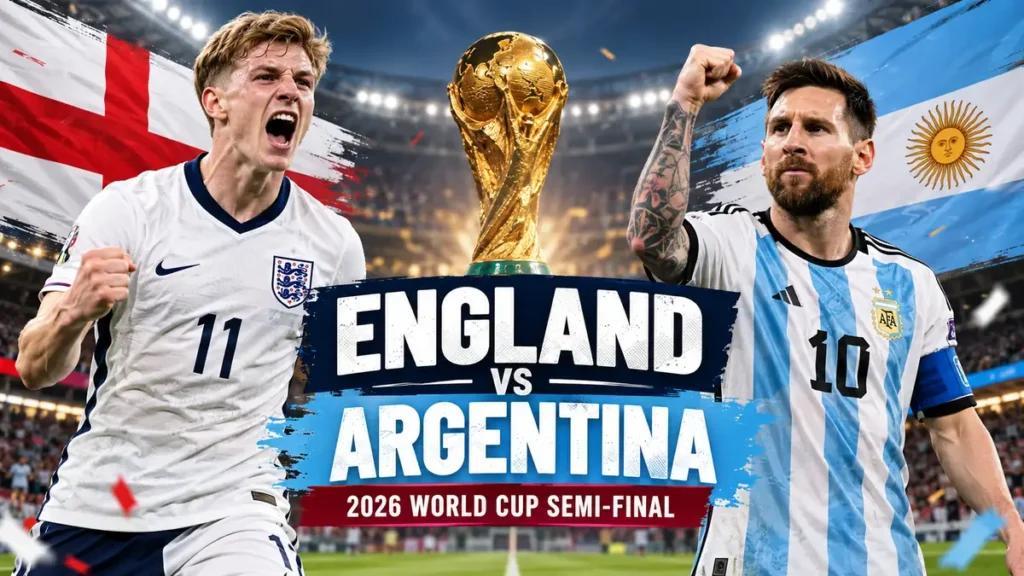
The latest england vs argentina clash added another dramatic chapter to one of international football’s most famous rivalries. England appeared to be heading toward the 2026 FIFA World Cup final after Anthony Gordon broke the deadlock, but Argentina transformed the match in the closing minutes.
Argentina defeated England 2-1 in the 2026 FIFA World Cup semi-final on July 15 at Mercedes-Benz Stadium in Atlanta. Gordon scored for England in the 55th minute before Enzo Fernández equalized in the 85th. Lautaro Martínez then struck in stoppage time to complete Argentina’s comeback and send Lionel Scaloni’s side into the final.
The result was especially significant because England and Argentina had not met in a senior international for 21 years. Their reunion brought together the modern stars of both teams while reviving memories of Diego Maradona, David Beckham and several unforgettable World Cup encounters.
england vs argentina 2026: Match at a Glance
| Match detail | Information |
|---|---|
| Competition | FIFA World Cup 2026 |
| Stage | Semi-final |
| Date | July 15, 2026 |
| Venue | Mercedes-Benz Stadium, Atlanta |
| Result | England 1-2 Argentina |
| England scorer | Anthony Gordon, 55′ |
| Argentina scorers | Enzo Fernández, 85′; Lautaro Martínez, 90+2′ |
| Attendance | 68,239 |
| Outcome | Argentina advanced to the World Cup final |
The official England match centre records a 0-0 half-time score before all three goals arrived during the second half. Argentina’s two late goals turned what had looked like an England victory into a painful elimination.
How the England vs Argentina Semi-Final Unfolded
A tense first half
Given the history surrounding this fixture and the prize awaiting the winner, neither team found an early breakthrough.
Argentina had more of the ball and attempted to establish control through midfield, while England looked for opportunities to attack more directly. The opening 45 minutes finished goalless.
The disciplinary battle was already developing. Elliot Anderson was booked for England in the 37th minute, while Lisandro Martínez received a yellow card five minutes later. Cristian Romero was then booked shortly after half-time.
For England, keeping Argentina scoreless through the first half provided the platform they needed. The Three Lions did not have to dominate possession; they needed to remain compact and make their attacking moments count.
That opportunity arrived ten minutes after the restart.
Anthony Gordon puts England ahead
England took the lead in the 55th minute.
Morgan Rogers delivered the ball across the penalty area and Anthony Gordon converted, putting England 1-0 ahead. The goal changed the atmosphere of the semi-final and suddenly placed England within reach of their first men’s World Cup final since 1966.
At this stage, the challenge shifted.
England no longer needed to find the opening goal. They had to protect their advantage against the defending world champions.
That proved far more difficult.
Argentina’s Late Comeback Changes Everything
The decisive period of england vs argentina came during the final minutes.
England remained ahead as the match entered its closing stages, but Argentina continued applying pressure. The statistical picture reflected that territorial advantage: one match-data source recorded Argentina with 64% possession, 15 shots and six corners compared with England’s 36% possession, five shots and one corner.
Eventually, England’s resistance broke.
Enzo Fernández makes it 1-1
In the 85th minute, Enzo Fernández equalized for Argentina.
His goal erased England’s advantage and completely altered the momentum of the semi-final. Instead of protecting a route into the final, England suddenly faced the possibility of extra time—or worse.
Argentina sensed an opportunity to finish the contest before the additional period was needed.
Lautaro Martínez scores the winner
That moment came in stoppage time.
Lautaro Martínez scored in the 92nd minute, with Lionel Messi credited with the assist in the match timeline, completing Argentina’s remarkable turnaround.
England had led until the 85th minute.
Seven minutes later, they were behind.
The final whistle confirmed a 2-1 Argentina victory, ending England’s World Cup campaign at the semi-final stage and sending Argentina into another final.
Why Argentina Beat England
The final score does not tell the whole tactical story.
England demonstrated that they could frustrate Argentina and attack effectively when space appeared. Gordon’s goal was evidence that a more direct approach could create problems for Lionel Scaloni’s team.
The larger problem was sustaining that approach once England went ahead.
Argentina controlled more of the ball
Argentina’s possession advantage allowed them to keep England defending for longer periods.
The available match statistics show a clear contrast:
| Statistic | England | Argentina |
|---|---|---|
| Possession | 36% | 64% |
| Shots | 5 | 15 |
| Shots on target | 2 | 5 |
| Corners | 1 | 6 |
| Fouls | 11 | 15 |
| Yellow cards | 1 | 3 |
These figures show why the closing stages became increasingly difficult for England. Argentina generated substantially more shooting opportunities and territorial pressure.
Possession alone does not win football matches, but repeatedly surrendering the ball against a technically strong side increases defensive pressure.
England became increasingly defensive
England’s approach after taking the lead subsequently became part of the discussion surrounding the defeat.
In September, Anthony Gordon reflected on the Argentina match while discussing England’s style under Thomas Tuchel. He argued that England should emphasize their own strengths—including directness, physicality and counterattacking—rather than trying to reproduce the possession control associated with teams such as Spain.
That provides useful context for understanding the semi-final.
England had found success through a direct attacking move for Gordon’s goal. Once the team dropped deeper, however, Argentina had more opportunities to establish possession near England’s defensive third.
Argentina remained patient
Argentina did not abandon their approach when Gordon scored.
Instead, Scaloni’s team continued circulating the ball, creating attacks and forcing England to defend. Enzo Fernández eventually found the equalizer before Lautaro Martínez delivered the decisive finish.
It was a reminder that protecting a narrow lead against an elite international side can be as difficult as taking the lead in the first place.
Lionel Messi’s Role Against England
Lionel Messi entered the match as Argentina’s captain and one of the central figures surrounding the fixture.
He did not score, but the match timeline credits Messi with assists for both Argentina goals—Enzo Fernández’s equalizer and Lautaro Martínez’s stoppage-time winner.
That contribution mattered because England had largely prevented Argentina from scoring for more than 80 minutes.
Messi’s influence was therefore not measured by a goal of his own. His involvement in the decisive attacks helped Argentina convert their late pressure into the two moments that determined the semi-final.
The game also carried historical significance for Messi personally. When England and Argentina previously played a senior international in 2005, the then-18-year-old Messi was suspended and did not participate.
The 2026 semi-final therefore gave him the opportunity to participate directly in a rivalry whose biggest World Cup moments had previously belonged to earlier generations.
England vs Argentina Head-to-Head History
The rivalry extends much further back than the 2026 semi-final.
England and Argentina first met in 1951, and their subsequent encounters included friendlies, tournament matches and some of the most discussed games in World Cup history.
Their World Cup rivalry is particularly important.
Before 2026, the countries had met five times at the FIFA World Cup: 1962, 1966, 1986, 1998 and 2002. The Atlanta semi-final became their sixth World Cup meeting.
1962: England 3-1 Argentina
Their first World Cup encounter took place in Chile.
England won 3-1, with Ron Flowers, Bobby Charlton and Roger Hunt scoring. It established the earliest major-tournament chapter of the rivalry.
1966: England 1-0 Argentina
Four years later, the teams met in the World Cup quarter-final at Wembley.
England won 1-0 and subsequently went on to win the tournament—the country’s first and, to date, only men’s FIFA World Cup title.
The match itself became remembered as a particularly heated encounter, adding an early competitive edge to the relationship between the teams.
1986: Argentina 2-1 England
No England-Argentina match has generated more lasting discussion than their 1986 World Cup quarter-final in Mexico.
Diego Maradona scored twice in Argentina’s 2-1 victory.
His first became universally associated with the “Hand of God”, while his second—an extraordinary solo run through the England defense—became one of the World Cup’s most celebrated goals. FIFA itself highlights the 1986 match as one of the defining moments in the countries’ rivalry.
Argentina went on to win the 1986 World Cup.
1998: Argentina eliminate England on penalties
Another classic arrived at France 1998.
The round-of-16 match finished 2-2 before Argentina advanced in a penalty shootout.
Michael Owen scored one of the memorable goals of his England career, while David Beckham was sent off following an incident involving Diego Simeone.
England’s tournament ended on penalties, adding another painful episode to the rivalry.
2002: David Beckham gets his moment
England finally had another World Cup opportunity against Argentina in 2002.
This time, David Beckham scored from the penalty spot as England won 1-0 during the group stage.
The result carried extra significance for Beckham after the criticism he had received following his dismissal against Argentina four years earlier.
2026: Argentina 2-1 England
Twenty-four years after their previous World Cup meeting, Argentina gained another victory.
Unlike 1986 or 1998, the defining feature was not controversy or a penalty shootout. It was the timing of Argentina’s comeback.
England were leading with only minutes remaining before Fernández and Martínez reversed the result.
Why Is England vs Argentina Such a Famous Rivalry?
The rivalry stands apart because relatively few meetings have produced an unusually large number of memorable moments.
These teams do not play one another every season. They belong to different confederations—England to UEFA and Argentina to CONMEBOL—so competitive meetings normally require both sides to cross paths at the World Cup.
That rarity gives each encounter additional significance.
The football history alone includes:
- England’s 1966 quarter-final victory
- Diego Maradona’s two famous goals in 1986
- David Beckham’s red card in 1998
- Argentina’s penalty-shootout victory in the same tournament
- Beckham’s winning penalty in 2002
- Argentina’s dramatic late comeback in the 2026 semi-final
The 2026 match was also their first meeting of any kind in 21 years, following England’s 3-2 friendly victory in Geneva in November 2005.
That combination of rarity, World Cup importance and memorable individual moments has helped keep the fixture relevant across generations.
What Happened After Argentina Beat England?
Argentina’s victory sent Lionel Scaloni’s team into the 2026 FIFA World Cup final against Spain. The result gave the defending champions the opportunity to compete for another world title.
England, meanwhile, moved into the bronze-medal match against France.
The Three Lions responded with an extraordinary 6-4 victory over France in Miami on July 18, according to England’s official results.
The Argentina defeat nevertheless remained an important reference point when England returned to international action.
By September, both Harry Kane and Anthony Gordon had publicly reflected on aspects of England’s approach during the semi-final, particularly how the team managed the game after moving ahead.
That makes the match relevant beyond the result itself. It became part of a wider discussion about how England should play against elite opponents and how effectively the team can protect an advantage under pressure.
What the 2026 Match Added to the Rivalry
Every generation seems to have its own defining england vs argentina moment.
For supporters who remember 1986, it may always be Maradona. For another generation, the defining images are Beckham’s dismissal in 1998 and his penalty four years later.
The 2026 semi-final created a new reference point.
Anthony Gordon’s goal seemed capable of sending England into the World Cup final. Instead, Enzo Fernández’s late equalizer changed the contest before Lautaro Martínez completed the comeback in stoppage time.
There was no penalty shootout and no single controversial incident required to make the match memorable.
The drama came from the speed with which the outcome changed.
Final Takeaway
The latest england vs argentina encounter lived up to the history surrounding the fixture. England led through Anthony Gordon and remained ahead until the 85th minute, but Argentina’s pressure eventually produced a dramatic turnaround.
Enzo Fernández equalized before Lautaro Martínez scored the stoppage-time winner, giving Argentina a 2-1 victory in the 2026 FIFA World Cup semi-final and another memorable result in this historic international rivalry.
From the 1966 quarter-final and Maradona’s unforgettable 1986 performance to Beckham’s redemption in 2002 and Argentina’s late comeback in Atlanta in 2026, England against Argentina remains a fixture capable of producing moments that survive long after the final whistle.