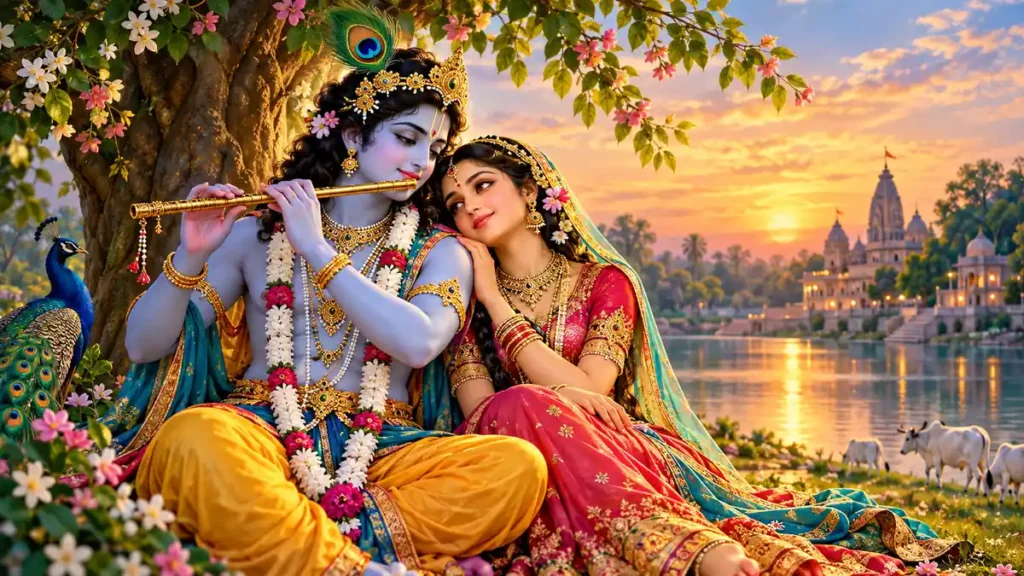
Few sacred relationships in Hindu devotional culture are as recognizable as radha krishna. Krishna playing his flute beside Radha has inspired poetry, music, dance, temple worship, paintings, festivals, and generations of devotees.
Yet their relationship is often reduced to a simple love story. Within several Vaishnava traditions, it carries a much deeper meaning. Radha represents extraordinary devotion and longing for the Divine, while Krishna is worshipped as the divine beloved. Their relationship expresses bhakti—love and devotion directed toward God—and explores themes of union, separation, surrender, joy, and spiritual longing.
radha krishna represents divine love and the relationship between the devotee and God. Radha embodies selfless devotion and intense spiritual longing, while Krishna represents the divine beloved. Their union and separation are interpreted in several Vaishnava traditions as expressions of bhakti and the soul’s desire for closeness to the Divine.
The keyword and topic covered here are radha krishna, exactly as specified in the source brief.
Who Are radha krishna?
Radha and Krishna form a celebrated divine couple within Hinduism, especially in Krishna-centered traditions of Vaishnavism.
Krishna is one of Hinduism’s most widely worshipped deities. In Vaishnava traditions he is associated with Vishnu, while Krishna-centered schools may worship him as the Supreme Being himself. Stories of his childhood and youth are closely connected with Gokul, Vrindavan, the gopis, the Yamuna River, cowherding, and his flute.
Radha is remembered as Krishna’s beloved and, in important devotional traditions, as the foremost among the gopis of Vrindavan. Her significance goes far beyond being a romantic companion. She becomes an embodiment of intense devotion to Krishna.
Different Hindu traditions explain Radha’s theological identity in different ways. In Gaudiya Vaishnava theology, for example, she is closely associated with Krishna’s hladini shakti, his bliss-giving or pleasure potency. Other traditions have their own theological understandings of the divine pair.
This diversity matters. There is no single version of every detail of the Radha-Krishna tradition accepted identically by all Hindus.
Radha
Radha is associated with love, devotion, spiritual longing, compassion, and complete dedication to Krishna.
Her importance became particularly influential through devotional poetry and Vaishnava traditions. She is often called Radha Rani or Radharani by devotees.
Rather than representing ordinary romantic attachment, Radha frequently functions as the ideal devotee: someone whose attention is completely directed toward the Divine.
Krishna
Krishna appears across a much broader body of Hindu literature and tradition.
His life includes several distinct phases: his miraculous birth, childhood among cowherds, youthful pastimes in the Braj region, departure from that pastoral setting, later royal life, and his central role in the Mahabharata and Bhagavad Gita.
The youthful Krishna of Vrindavan is especially important to the Radha-Krishna devotional tradition. He is commonly pictured with a flute, peacock feather, cattle, forests, the Yamuna, and the gopis.
The radha krishna Love Story
The popular story of Radha and Krishna is rooted in the sacred landscape of Braj, particularly Vrindavan and surrounding places associated with Krishna’s youth.
Krishna grows up among cowherds and cowherdesses. His flute attracts the gopis, whose love for him becomes one of the great symbols of devotional surrender.
Among these devotees, Radha eventually acquires a unique position.
She is portrayed as experiencing Krishna’s presence more intensely—and feeling his absence more painfully—than anyone else.
Their encounters in gardens and forests, Krishna’s flute, the dance with the gopis, moments of jealousy and misunderstanding, separation, reconciliation, and Radha’s longing became major subjects of later poetry, music, painting, and performance.
The Gita Govinda, composed by the poet Jayadeva in the 12th century, became especially influential in developing the literary and artistic representation of Radha and Krishna’s love, estrangement, longing, and reconciliation. The Metropolitan Museum of Art describes the work as a major source for later artistic depictions of the couple.
Vrindavan and the World of Krishna’s Youth
Vrindavan is not simply a geographical backdrop in these traditions.
It represents an intimate devotional world where Krishna interacts with devotees without the formality associated with a distant ruler or king.
Forests, flowering trees, the Yamuna River, cattle, moonlit nights, and the sound of Krishna’s flute repeatedly appear in poetry and visual art.
This pastoral environment is important because Radha-Krishna devotion focuses strongly on closeness to God.
The Divine is not imagined only as majestic and unreachable. Krishna can also be loved personally and intimately.
What Is Ras Lila?
The Ras Lila or Rasa Lila is associated with Krishna’s divine dance with the gopis.
In devotional interpretation, the gopis’ attraction to Krishna is much more than ordinary attraction. It symbolizes complete orientation toward God.
A theological interpretation described by scholar Jeffery D. Long explains the gopis as individual souls and Krishna as the Supreme Being; the dance therefore becomes an image of the relationship between God and devotees.
Radha’s position within later devotional traditions becomes especially significant because she embodies an exceptionally intense form of this love.
What Does radha krishna Symbolize?
The most common spiritual interpretation of Radha and Krishna centers on divine love and bhakti.
Radha’s devotion does not depend upon material reward. Her love remains powerful even during separation.
Krishna, meanwhile, represents the object of that devotion—the Divine toward whom the devotee turns.
This creates several interconnected layers of symbolism.
| Symbol or Theme | Common Devotional Meaning |
|---|---|
| Radha | Devotion, spiritual love, longing and divine energy |
| Krishna | The Divine or supreme beloved |
| Krishna’s flute | The divine call that draws the devotee toward God |
| Vrindavan | Sacred space of intimate devotion |
| Gopis | Devotees or souls drawn toward the Divine |
| Ras Lila | Divine relationship between Krishna and devotees |
| Union | Spiritual closeness and fulfillment |
| Separation | Intensified longing for God |
| Radha and Krishna together | Divine love expressed through lover and beloved |
These interpretations vary in detail across theological schools, so the table is best understood as a guide to common devotional themes rather than a universal doctrine.
The Soul and the Divine
A widely used interpretation sees the relationship as an image of the soul’s longing for God.
Radha’s intense attention toward Krishna provides an emotional vocabulary for devotion.
This is one reason the story has remained so powerful. Abstract theological ideas such as surrender, devotion, divine presence, and spiritual longing become easier to understand when expressed through human emotions.
Love becomes a language for theology.
Bhakti: Love as a Spiritual Path
Bhakti broadly refers to devotion toward the Divine.
The Radha-Krishna tradition gives this devotion emotional depth. A devotee may remember Krishna, sing his names, hear stories about him, worship him, or experience longing for greater spiritual closeness.
Radha represents the intensity of that devotion.
Her significance therefore cannot be understood simply by asking, “Did Radha and Krishna have a romantic relationship?”
For many devotees, the more important question is what their love teaches about the relationship between humanity and God.
Hladini Shakti
A particularly important concept in Gaudiya Vaishnavism is hladini shakti.
In this theology, Radha is understood as closely connected with Krishna’s own spiritual potency of bliss and love. Radha and Krishna are therefore not merely two unrelated individuals who fall in love.
Their relationship reveals a theological relationship between the Divine and divine love itself.
This is one reason images of Radha and Krishna together can have such profound devotional significance.
Why Did Krishna Not Marry Radha?
This is one of the most frequently asked questions about radha krishna, but it does not have one universally accepted answer.
The safest way to understand it is to distinguish different textual and devotional traditions.
Krishna’s marriages—including his marriage to Rukmini—belong to the accounts of his later royal life. Radha belongs primarily to the devotional world associated with Braj and Vrindavan.
Some traditions emphasize that Radha and Krishna’s relationship transcends ordinary social categories such as marriage.
Other devotional sources and traditions contain accounts in which they are understood as eternally united or even describe a divine wedding. For example, later tradition associated with the Garga Samhita includes an account of their marriage at Bhandirvan.
So the often-repeated statement that “Krishna never married Radha” needs qualification.
It describes one influential understanding of the tradition, but not every version.
Why Did Krishna Leave Vrindavan?
Krishna’s narrative eventually moves beyond the pastoral world of Vrindavan.
Later episodes concern his confrontation with Kamsa and his increasingly public and royal role.
This creates one of the most powerful themes in Radha-Krishna devotion: viraha, or love in separation.
Radha remains associated with the intimate devotional world of Braj, while Krishna’s story continues elsewhere.
Rather than diminishing their relationship, separation becomes spiritually meaningful.
Viraha: Why Separation Matters
A striking feature of radha krishna devotion is that separation can be almost as important as union.
Viraha refers to the pain or longing experienced when the beloved is absent.
In ordinary life, separation might appear to represent failure. Devotional poetry transforms it into something different: absence can make remembrance more intense.
Radha longs for Krishna precisely because Krishna matters completely to her.
This becomes a metaphor for spiritual life. A devotee who longs for a stronger experience of God’s presence can identify with Radha’s longing.
Historical paintings based on the Gita Govinda repeatedly visualize this idea. Works preserved by The Metropolitan Museum of Art show Radha grieving or pining for the absent Krishna, connecting her emotional state with the devotee’s yearning for access to the Divine.
Quick Takeaway: Radha and Krishna’s separation is not simply a tragic ending to a romance. Within devotional interpretation, longing itself becomes a form of bhakti.
radha krishna in Hindu Scriptures and Literature
Understanding the textual history of Radha and Krishna helps clear up a common misconception: their story does not appear in exactly the same form in every Hindu scripture.
Krishna has a substantial presence in ancient Hindu literature, including the Mahabharata, Bhagavad Gita, and later Puranic traditions.
Radha’s literary development is different.
She becomes increasingly prominent in later devotional literature, eventually emerging as Krishna’s supreme beloved in influential poetic and theological traditions.
Bhagavata Purana
The Bhagavata Purana, particularly its tenth book, is fundamental to Krishna devotion.
It contains celebrated narratives about Krishna’s childhood, Vrindavan, the gopis, and the rasa dance.
However, Radha is not explicitly presented by name in the straightforward manner readers familiar with later Radha-Krishna literature might expect. Later Vaishnava commentators identify a particularly favored gopi with Radha.
That distinction is important when discussing the textual history accurately.
Gita Govinda
The Gita Govinda is one of the most important works for understanding the cultural development of the Radha-Krishna tradition.
Written by Jayadeva in the 12th century, the Sanskrit poem focuses on the love of Radha and Krishna, including attraction, separation, emotional tension, longing, and reconciliation.
Its influence extended far beyond literature.
The poem inspired dance, music, manuscript illustration, and major schools of Indian painting. Museum collections preserve numerous works depicting scenes from the Gita Govinda, including Radha waiting for Krishna, the couple meeting, and Krishna among the gopis.
Later Vaishnava Literature
Later devotional texts and theological writings developed Radha’s position even further.
Works associated with traditions such as Gaudiya Vaishnavism, the Nimbarka Sampradaya, and the Radha Vallabha tradition provide distinct understandings of her identity and relationship with Krishna.
This is why readers sometimes encounter apparently contradictory claims.
One source may emphasize Radha as the ideal devotee. Another describes her as Krishna’s divine energy. Another treats Radha and Krishna together as the highest divine reality.
These interpretations belong to different theological frameworks rather than necessarily being simple factual mistakes.
radha krishna and Gaudiya Vaishnavism
Radha and Krishna hold exceptional importance in Gaudiya Vaishnavism, the devotional tradition associated historically with Chaitanya Mahaprabhu.
Within this tradition, Krishna is worshipped as the Supreme Personality of Godhead, and Radha occupies the highest position as his supreme devotee and internal spiritual potency.
Their love provides a theological model for the highest forms of devotional experience.
This tradition also strongly influenced the modern global spread of Krishna devotion through the International Society for Krishna Consciousness (ISKCON).
The worldwide Hare Krishna movement helped make Krishna-centered devotional practices, temple worship, sacred music, and related Vaishnava teachings familiar far beyond India.
Radha Krishna, Rukmini Krishna, and Different Forms of Divine Love
A common source of confusion is the relationship between Radha and Rukmini.
They occupy different roles in Krishna traditions.
Rukmini is prominently associated with Krishna’s royal life and is described as his wife. Radha is especially associated with his youthful Vrindavan pastimes and with an intensely devotional form of love.
Trying to determine which relationship is “greater” by ordinary romantic standards misses the theological purpose of these narratives.
Different traditions emphasize different forms of divine relationship.
Radha-Krishna imagery typically highlights intimate devotion, longing, beauty, and spiritual love.
Rukmini-Krishna imagery more directly presents a divine married couple and royal household relationship.
The Meaning of Krishna’s Flute
One of the most recognizable images of Krishna is the bansuri, or flute.
In Radha-Krishna imagery, the flute is more than a musical instrument.
Devotional interpretation frequently treats its sound as a call from the Divine. The gopis hear Krishna’s flute and are drawn toward him, leaving ordinary concerns behind.
Symbolically, this can represent the way spiritual attraction redirects a person’s attention toward God.
The flute also reinforces Krishna’s pastoral identity. He is the cowherd of Vrindavan rather than the royal figure seen in later parts of his story.
In paintings, statues, and temple images, the combination of Krishna’s flute and Radha standing beside him immediately identifies the devotional world of Braj.
Why Is Radha’s Name Often Said Before Krishna’s?
Expressions such as Radha Krishna, Radhe Krishna, and Radhe Radhe are widespread in devotional communities.
The prominence of Radha’s name reflects the enormous importance given to devotion itself.
If Krishna is the beloved Divine and Radha embodies perfect love for him, approaching Krishna through Radha can symbolize approaching God through devotion.
Specific theological explanations differ by tradition, but the broader pattern is clear: Radha is not treated merely as a supporting character.
Her devotion is central to the meaning of the pair.
radha krishna Worship and Devotional Practices
For devotees, Radha and Krishna are not confined to old stories.
They remain part of living religious practice.
Temples may install sacred images or murtis of Radha and Krishna together. Worship can include dressing and decorating the deities, offering flowers and food, performing arati, singing devotional songs, chanting divine names, and reading sacred literature.
Common forms of devotion include:
- Darshan: seeing and being in the presence of the deity.
- Kirtan: communal singing of sacred names.
- Bhajan: devotional songs.
- Japa: repeated mantra meditation.
- Arati: ritual offering of light.
- Puja: ceremonial worship and offerings.
- Lila-smarana: remembering or contemplating divine pastimes.
- Seva: devotional service.
These practices vary considerably among communities and individual devotees.
Hare Krishna and the Divine Names
The Hare Krishna maha-mantra is especially associated today with Gaudiya Vaishnavism and ISKCON.
Chanting is understood as a devotional practice centered on the divine names rather than simply a musical performance.
The global spread of the Hare Krishna movement also brought Radha-Krishna worship to temples and communities across many countries.
Important Places Associated With radha krishna
The geography of Radha-Krishna devotion is especially concentrated in Braj, the cultural and sacred region connected with Krishna’s early life.
Vrindavan
Vrindavan is one of the most important centers of Krishna devotion.
It is associated with Krishna’s youthful pastimes, the gopis, sacred groves, and the Ras Lila.
Today it contains numerous temples devoted to Krishna and Radha-Krishna.
Barsana
Barsana is strongly associated with Radha and is revered by devotees as her home.
It is especially famous for Radha-centered devotion and its distinctive Holi traditions.
Mathura
Mathura is traditionally regarded as Krishna’s birthplace and remains one of India’s major Krishna pilgrimage centers.
Govardhan
Govardhan Hill is connected with Krishna’s lifting of Govardhan to protect the people of Braj.
Pilgrims continue to perform parikrama, or circumambulation, around the sacred hill.
Yamuna River
The Yamuna forms part of the sacred geography of Krishna’s Vrindavan narratives.
It appears repeatedly in devotional poetry and visual art. The Metropolitan Museum’s collection, for example, includes a Gita Govinda painting depicting Krishna and the gopis on the bank of the Yamuna.
Together, these locations make Braj more than a historical setting. For devotees, it is a living sacred landscape.
Festivals Celebrating Radha and Krishna
Several Hindu festivals are closely connected with Radha, Krishna, or the Braj devotional tradition.
Janmashtami
Krishna Janmashtami celebrates Krishna’s birth.
Devotees may fast, sing bhajans and kirtans, visit temples, read Krishna’s stories, and celebrate around midnight, traditionally associated with his birth.
Radhashtami
Radhashtami celebrates the appearance or birth of Radha.
It is especially important in Radha-Krishna temples and in the Braj region.
Holi
Holi has particularly strong associations with Krishna and Radha in Braj.
Local traditions connect the playful use of colors with stories of Radha, Krishna, and their companions.
Barsana and nearby Nandgaon are particularly famous for their regional Holi celebrations.
Jhulan Yatra
During Jhulan Yatra, Radha and Krishna are traditionally placed on decorated swings.
The festival emphasizes the joyful and intimate side of their divine pastimes.
radha krishna in Indian Art
Radha and Krishna have provided Indian artists with an extraordinary visual language for depicting emotion.
A painting does not need to show dramatic action to communicate their story.
A forest, approaching storm, empty bed, lotus, flowering tree, dark sky, moon, river, or solitary Radha can suggest longing for Krishna.
Artists working in Rajput, Pahari, Mewar, Kangra, and other traditions repeatedly returned to Radha-Krishna themes.
The Gita Govinda became an especially important source.
The Metropolitan Museum of Art preserves examples from different periods, including a circa 1665 painting of Krishna and Radha in a bower and late-18th-century works showing Radha’s longing and the couple’s encounters.
The emotional states depicted in these paintings were not merely illustrations of romantic episodes. They could communicate devotional ideas about seeking, losing, remembering, and finally encountering the Divine.
radha krishna in Music, Poetry, and Dance
The influence of Radha and Krishna extends deeply into Indian performing arts.
Poets have used their relationship to express emotional states that are difficult to describe through abstract philosophy alone.
Longing becomes a song.
Meeting becomes celebration.
Separation becomes prayer.
The Gita Govinda became particularly influential in both visual and performing traditions. Its portrayal of Radha and Krishna’s passion, estrangement, and reconciliation supplied generations of artists with material for devotional interpretation.
Krishna’s flute, Radha’s longing, the gopis’ devotion, and the landscapes of Braj consequently appear throughout devotional music and classical and regional performance traditions.
Is radha krishna a Romantic Story or a Spiritual One?
It is both in its literary expression, but devotional traditions usually ask readers to look beyond ordinary romance.
Radha and Krishna are portrayed using the emotional vocabulary of lovers. Their poetry includes attraction, longing, jealousy, meeting, separation, reconciliation, and joy.
But these emotions are repeatedly given theological meaning.
The Metropolitan Museum describes the love of Radha and Krishna in the Gita Govinda tradition as a vivid metaphor for Hindu devotionalism, or bhakti.
That distinction explains why reading the story only as a conventional romance can be misleading.
Its human emotions make it accessible.
Its spiritual interpretation gives those emotions another dimension.
What Can the Story of radha krishna Teach?
Different devotees will naturally draw different lessons from the tradition, but several themes recur.
Love Without Possession
Radha’s devotion is frequently presented as love that does not depend on controlling or possessing Krishna.
This helps explain why separation does not destroy the devotional relationship.
Devotion Requires Attention
Krishna’s flute symbolically draws attention away from distractions.
The spiritual lesson is not necessarily to abandon ordinary responsibilities, but to recognize the importance of directing attention toward what one considers sacred.
Longing Can Deepen Devotion
Viraha transforms absence into remembrance.
Radha’s separation from Krishna demonstrates how longing itself can intensify spiritual consciousness.
Divine Love Has Many Forms
Hindu devotional traditions allow God to be approached through different relationships—as master, friend, child, parent, or beloved.
Radha-Krishna devotion gives special emphasis to the beloved relationship.
Emotion and Spirituality Are Not Opposites
The Radha-Krishna tradition does not necessarily ask devotees to eliminate emotion.
Instead, powerful emotions can be redirected toward spiritual devotion.
This is one reason poetry, dance, music, and visual art became such effective ways of communicating their significance.
Common Misunderstandings About radha krishna
The first misunderstanding is that Radha and Krishna have one simple biography recorded consistently across all Hindu scriptures.
They do not.
Their tradition developed across different texts, regions, poetic traditions, and theological schools.
The second misunderstanding is that Radha is simply “Krishna’s girlfriend.” That modern label misses the theological importance assigned to her by traditions that regard her as the supreme devotee, divine potency, eternal consort, or an inseparable aspect of Krishna.
The third is that their failure to have a conventional earthly marriage makes their relationship incomplete.
Many devotional interpretations make precisely the opposite point: their bond is not defined by ordinary social categories.
Finally, popular retellings sometimes present one explanation—especially concerning Radha’s marriage, her age, or why Krishna did not marry her—as if it were the universally accepted scriptural version.
The historical tradition is more diverse.
Quick Takeaway: When accounts of Radha and Krishna differ, identifying the text or Vaishnava tradition behind a particular claim is usually more useful than trying to force every version into one chronology.
Why radha krishna Remains So Important
The lasting power of Radha and Krishna comes partly from the way their tradition connects theology with recognizable human emotion.
People understand longing.
They understand love, absence, joy, jealousy, reunion, music, friendship, and the desire to be close to someone deeply valued.
Bhakti traditions take those experiences and turn them toward the Divine.
Radha gives devotion a personality.
Krishna gives devotion an object.
Vrindavan gives it a landscape.
The flute gives it a sound.
The Ras Lila gives it movement.
Viraha gives it longing.
And their meeting gives it fulfillment.
This combination has allowed radha krishna to move across centuries and artistic forms without losing its emotional force. The divine couple can be encountered in Sanskrit poetry, regional songs, temple worship, miniature paintings, dance, pilgrimage, festivals, and everyday devotional practice.
The central meaning, however, remains remarkably consistent: radha krishna expresses a vision of love in which devotion reaches beyond possession and turns the heart toward the Divine. Their story is therefore more than a famous romance. It is one of Hindu devotional culture’s most enduring ways of explaining bhakti, spiritual longing, and the intimate relationship between the devotee and God.