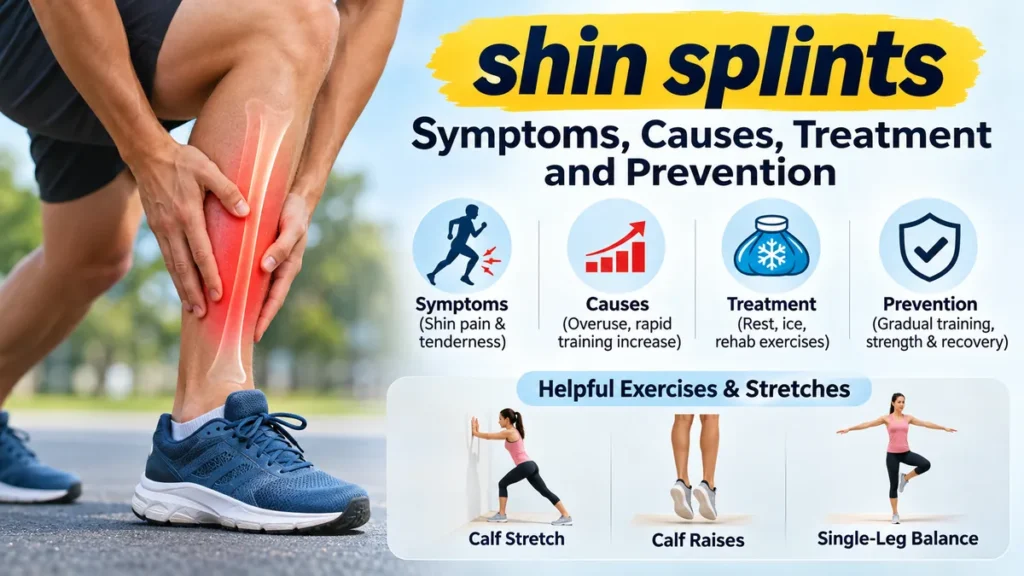
Pain along the front or inside of your lower leg can turn an ordinary run, workout, or even a brisk walk into an uncomfortable experience. If the discomfort starts after increasing your activity, shin splints may be the reason.
Shin splints, medically known as medial tibial stress syndrome (MTSS), are a common exercise-related condition involving pain along the shinbone (tibia). They usually develop when repeated physical stress exceeds the lower leg’s ability to recover. Treatment focuses on reducing painful activity, gradually rebuilding strength, and returning to exercise safely.
Although shin splints are especially common among runners, they can affect dancers, military recruits, athletes, and people who suddenly increase their walking or exercise routines.
Understanding the symptoms, causes, and recovery process helps distinguish ordinary exercise-related discomfort from injuries that need medical evaluation.
What Are shin splints?
Shin splints describe exercise-related pain along the tibia, the large bone at the front of the lower leg. The condition is associated with repetitive loading of the bone and surrounding tissues, particularly along the inner border of the tibia.
The medical term medial tibial stress syndrome is more specific than the everyday expression “shin splints.” Not every type of shin pain is MTSS.
Medial Tibial Stress Syndrome – WikiSM (Sports Medicine Wiki)
Grátis: Periostite fratura stress e mais – Material Claro e Objetivo em PDF para Estudo Rápido
Leg: Anatomy | Concise Medical Knowledge
6
Where does the pain occur?
MTSS usually causes tenderness along the inner edge of the tibia, often across a relatively broad area of the middle or lower shin.
People may experience:
- A dull, aching sensation along the inner shin.
- Tenderness when pressing the affected area.
- Discomfort during running, jumping, or prolonged walking.
- Pain that initially improves during a warm-up but returns later.
- Symptoms affecting one or both legs.
Pain directly over a small, specific point on the bone can indicate a different injury, including a tibial stress fracture.
Why are shin splints common in runners?
Running repeatedly exposes the tibia to impact and muscle-generated forces. Normally, bone adapts to training through a process called remodeling.
When training increases too quickly, the accumulated stress may exceed the bone’s capacity to adapt.
The result can be a painful bone stress response. Continued loading without adequate recovery may worsen the condition and, in some cases, contribute to a more serious bone stress injury.
shin splints Symptoms: How to Recognize the Pain
The most recognizable symptom is exercise-related pain along the shinbone. However, the location, intensity, and timing of discomfort provide important clues.
Early symptoms
During the initial stages, symptoms may be mild and appear only during activity.
Common early signs include:
- Aching near the inner border of the shin.
- Pain at the beginning of a run.
- Discomfort that decreases after warming up.
- Tenderness after exercise.
- A gradual increase in symptoms over several training sessions.
Some people continue exercising because the discomfort temporarily settles. Unfortunately, pain relief during a warm-up does not necessarily mean the underlying tissue has recovered.
Symptoms that suggest worsening injury
As the condition progresses, pain may occur earlier during exercise, last longer afterward, or begin affecting normal daily activities.
Warning signs include persistent pain while walking, increasingly severe tenderness, and discomfort that does not improve with reduced activity.
Pain at rest or during the night deserves medical assessment, particularly when accompanied by localized bone tenderness.
shin splints vs. stress fracture
Shin splints and tibial stress fractures can produce similar symptoms, but they require different levels of activity restriction and medical management.
| Feature | Shin splints (MTSS) | Tibial stress fracture |
|---|---|---|
| Pain location | Often spread along a broader section of the inner shin | Often more localized to one area |
| Onset | Usually gradual | Often develops progressively |
| Activity-related pain | Common | Common |
| Pain at rest | Less typical early on | More concerning when present |
| Tenderness | Frequently diffuse | May be sharply localized |
| Imaging | Often unnecessary for typical cases | MRI may be needed |
| Treatment | Activity modification and rehabilitation | More protective unloading and medical guidance |
These differences are helpful clues, not a reliable self-diagnosis. A stress fracture cannot be ruled out solely because the pain is spread out or improves during exercise.
What Causes shin splints?
The primary cause is repetitive loading of the tibia beyond its current ability to tolerate and recover from physical stress.
Several training, biomechanical, and individual factors can contribute.
1. Increasing training intensity too quickly
Suddenly running longer distances, increasing workout frequency, or adding sprint sessions can overwhelm tissues that have not adapted to the additional load.
For example, someone who normally runs twice weekly may develop symptoms after switching to daily running without a gradual transition.
2. Repetitive running and jumping
Activities involving frequent impact place repeated forces through the lower legs.
These include distance running, basketball, soccer, dance, gymnastics, and military training.
The problem is not necessarily the activity itself. It is often the relationship between training load, recovery, and individual tissue capacity.
3. Foot posture and biomechanics
Excessive or prolonged foot pronation, certain patterns of ankle movement, and differences in lower-limb mechanics may contribute to tibial loading.
Research has identified factors such as increased navicular drop and previous MTSS as possible risk factors.
However, foot posture alone does not determine whether someone develops shin splints. People with flat feet or high arches do not automatically have the condition.
4. Muscle strength and physical conditioning
The calf muscles, including the gastrocnemius and soleus, help manage forces during walking and running.
Weakness, reduced muscular endurance, or insufficient conditioning may affect how these forces are distributed.
The tibialis posterior and other muscles surrounding the lower leg also contribute to foot and ankle control.
Strengthening these structures can form part of rehabilitation, although no single exercise guarantees prevention.
5. Running surfaces and footwear
A sudden change from softer terrain to harder surfaces, frequent downhill running, or a significant change in footwear may alter loading patterns.
Worn-out or poorly fitting shoes can also affect comfort and movement.
There is limited evidence that one particular shoe type consistently prevents shin splints for everyone.
6. Inadequate recovery and bone health
Repeated training without sufficient rest can interfere with normal tissue adaptation.
Low energy availability, inadequate nutrition, and impaired bone health may also increase susceptibility to bone stress injuries.
Athletes with recurrent shin pain, a history of stress fractures, or signs of relative energy deficiency in sport (RED-S) may need a broader medical assessment.
How to Treat shin splints Effectively
Most uncomplicated cases improve with conservative treatment, meaning surgery is not required.
The central goal is to reduce painful loading while maintaining comfortable movement and gradually restoring the lower leg’s capacity for exercise.
Step 1: Reduce activities that trigger pain
Temporarily stop running, jumping, or other activities that reproduce shin pain.
Complete bed rest is generally unnecessary. Instead, choose activities that do not aggravate symptoms.
Swimming, stationary cycling, and gentle mobility exercises may help maintain fitness during recovery.
The American Academy of Orthopaedic Surgeons (AAOS) recommends avoiding the aggravating activity during recovery and returning gradually once symptoms have settled. AAOS+1
Step 2: Apply ice for pain relief
Cold therapy can help reduce discomfort after activity.
To apply ice safely:
- Wrap an ice pack in a thin towel.
- Place it over the painful area.
- Leave it in place for approximately 15–20 minutes.
- Repeat as needed, allowing the skin to return to normal temperature between applications.
Never apply ice directly to the skin.
Ice can provide temporary symptom relief, but it does not replace load management or rehabilitation.
Step 3: Consider appropriate pain relief
Over-the-counter medications such as acetaminophen (paracetamol) or ibuprofen may provide short-term relief.
Nonsteroidal anti-inflammatory drugs (NSAIDs) are not suitable for everyone, especially people with certain kidney conditions, stomach ulcers, bleeding risks, or medications that interact with them.
They should not be used to mask pain so that running or high-impact training can continue. If a bone stress injury is suspected, seek medical advice before using NSAIDs.
Step 4: Begin gentle rehabilitation
Once ordinary walking is comfortable, gentle mobility and strengthening exercises can help restore lower-leg function.
A physical therapist may recommend a combination of calf strengthening, ankle mobility, balance exercises, and gradual impact training.
The appropriate starting point depends on symptom severity and whether a stress fracture has been excluded.
Step 5: Address contributing factors
Recovery is also an opportunity to review recent changes in training.
Consider whether you have:
- Increased weekly running distance.
- Added hill workouts or speed sessions.
- Changed shoes or running surfaces.
- Reduced rest days.
- Returned to exercise after a long break.
Correcting these issues may reduce the likelihood of symptoms returning.
Best Exercises and Stretches for shin splints
Exercises can improve strength, mobility, and control around the lower leg. They should be introduced when symptoms allow, rather than performed through significant pain.
No single stretching routine has been proven to cure MTSS. Rehabilitation works best when exercises are combined with appropriate training modifications.
8 Proven Exercises for Plantar Fasciitis
1. Standing calf stretch
Face a wall and place one foot behind you. Keep the rear knee straight and heel on the floor while leaning forward gently.
Hold for 20–30 seconds, then switch legs. Repeat two or three times without forcing the stretch.
At-Home Exercises to Strengthen Foot Muscles – eMediHealth
2. Bent-knee soleus stretch
Place one leg behind the other and bend both knees slightly while keeping the rear heel down.
Hold for 20–30 seconds. This position emphasizes the deeper soleus muscle.
Tibialis Raise: Strengthen Your Shins for Better Performance | Blog | Papayya
3. Toe raises
Stand with your back supported against a wall. Keep your heels on the floor and slowly lift your toes upward.
Start with 8–12 controlled repetitions, provided the movement does not provoke shin pain.
Ejercicios para caderas, rodillas y pies: movilidad, fuerza y equilibrio
4. Calf raises
Stand with your feet hip-width apart and use a chair for balance. Slowly rise onto your toes, pause, and lower your heels.
Begin with a comfortable number of repetitions, gradually progressing toward two sets of 10–15.
Longevity Exercise Physiology and Personal Training – Drummoyne | Gymny
5. Single-leg balance
Stand near a stable support and balance on one foot for 15–30 seconds.
Repeat on both sides. As control improves, a therapist may introduce more challenging balance activities.
Should you foam roll your shins?
Foam rolling the surrounding calf muscles may temporarily improve comfort or reduce feelings of tightness.
However, applying intense pressure directly over a painful tibia is not recommended.
Foam rolling has not been established as a treatment that heals MTSS or prevents tibial stress fractures.
Are resistance-band exercises useful?
Resistance bands can be used for ankle dorsiflexion, plantarflexion, inversion, and eversion exercises.
These movements strengthen muscles involved in ankle stability and foot control.
They can be useful components of rehabilitation, although their effectiveness depends on the overall exercise program rather than the band itself.
How Long Do shin splints Take to Heal?
Recovery time varies depending on symptom severity, previous training load, general health, and how early the condition is addressed.
Mild cases may improve within a few weeks. More persistent symptoms can require several weeks or months of modified activity and rehabilitation.
The NHS notes that shin splints commonly improve within a few weeks, while AAOS recommends a cautious return to exercise after symptoms have resolved. NHS+1
Typical recovery progression
| Recovery phase | Main objective | Activity |
|---|---|---|
| Initial symptom management | Reduce painful loading | Avoid aggravating impact exercise |
| Early rehabilitation | Restore comfortable movement | Walking, mobility, low-impact cardio |
| Strength rebuilding | Improve load tolerance | Progressive calf and lower-limb strengthening |
| Return to impact | Reintroduce running forces | Short, controlled walk-run intervals |
| Return to normal training | Restore endurance and intensity | Gradual increases based on symptoms |
These phases are not fixed weekly milestones. Progress depends on how the leg responds.
Can you walk with shin splints?
Walking is generally acceptable if it does not cause pain or worsen symptoms afterward.
If walking becomes painful, reducing distance or temporarily limiting weight-bearing activity may be necessary.
Persistent pain during ordinary walking should prompt medical assessment to rule out a more significant bone stress injury.
Can you run through shin splints?
Running through persistent shin pain is not advisable.
Although discomfort may initially improve as muscles warm up, continued loading can prolong recovery.
If pain returns repeatedly, increases during a run, or affects walking afterward, stop running and reassess the injury.
How to Prevent shin splints From Coming Back
Prevention focuses on improving the body’s ability to tolerate repeated physical loading.
A 2025 systematic review of preventive interventions found evidence supporting neuromuscular training and certain insoles for reducing MTSS risk in studied populations. However, prevention strategies should still be individualized. PubMed
Increase running distance gradually
Avoid sudden increases in weekly mileage, running speed, and hill training.
The commonly mentioned 10% weekly mileage rule can be a rough planning guide, but it is not a scientifically guaranteed safe threshold.
Some runners need smaller increases, particularly after injury or prolonged inactivity.
Include strength training
Strengthening the calves, hips, and surrounding lower-limb muscles may improve overall movement capacity.
Useful exercises include calf raises, squats, step-ups, and balance training.
Start with manageable resistance and increase difficulty gradually.
Choose comfortable, supportive footwear
Running shoes should fit properly and feel comfortable during your usual activities.
Consider replacing footwear when cushioning or structural support has deteriorated.
People with recurrent symptoms or particular foot mechanics may benefit from a professional assessment.
Orthotic insoles can help selected individuals, but they are not necessary for every runner.
Review running technique
Running form influences how forces are distributed through the lower limbs.
In some cases, a physical therapist may recommend adjustments to cadence, stride length, or training surfaces.
Avoid making several major technique changes simultaneously, because unfamiliar movement patterns can shift stress to other tissues.
Schedule recovery days
Hard training sessions should be balanced with adequate recovery.
Sleep, nutrition, hydration, and appropriate energy intake all support physical adaptation.
Athletes with frequent bone stress injuries may need assessment of calcium intake, vitamin D status, and broader bone health.
When Should You See a Doctor for shin splints?
Most mild cases can initially be managed with activity modification. However, not all shin pain is caused by MTSS.
Seek medical assessment if:
- Pain is severe, worsening, or preventing normal walking.
- Tenderness is concentrated in one small area of bone.
- Symptoms persist despite reducing aggravating exercise.
- Pain occurs at rest or wakes you from sleep.
- You repeatedly develop shin pain after returning to activity.
- You have a history of stress fractures or concerns about bone health.
Seek urgent medical care for severe pain after an injury, rapidly increasing swelling, a cold or pale foot, marked weakness, or new numbness.
How are shin splints diagnosed?
Diagnosis usually begins with a medical history and physical examination.
A clinician may ask about recent training changes, symptom location, footwear, previous injuries, and activities that trigger pain.
They may examine the tibia for tenderness and assess walking mechanics, ankle mobility, and lower-limb function.
Typical MTSS involves tenderness along a relatively broad section of the inner tibial border, often extending at least 5 cm. NCBI
Do shin splints show up on an X-ray?
Uncomplicated MTSS may not produce visible abnormalities on standard X-rays.
X-rays are sometimes used to investigate alternative causes of pain, but early stress fractures may also be invisible.
If a tibial stress fracture is suspected, magnetic resonance imaging (MRI) is often more informative.
MRI can help identify bone marrow changes and assess the extent of a bone stress injury.
Could the pain be compartment syndrome?
Chronic exertional compartment syndrome (CECS) is another cause of exercise-related lower-leg pain.
Unlike typical MTSS, CECS may cause a predictable sensation of tightness, pressure, cramping, or burning during exercise.
Some people also experience tingling, numbness, or weakness that improves after stopping activity.
Because these conditions require different management, recurrent exertional leg pain with neurological symptoms warrants medical evaluation. PubMed Central (PMC)
Returning to Running After shin splints
Returning to running requires more than waiting for the pain to disappear during a single workout.
The goal is to restore enough strength and impact tolerance to handle running without provoking recurring symptoms.
Signs you may be ready to start
Before resuming running, look for:
- Comfortable walking during everyday activities.
- No significant tenderness or worsening pain.
- Good tolerance of basic strengthening exercises.
- No pain flare-up after low-impact exercise.
- Clearance from a clinician when a bone stress injury was suspected.
AAOS recommends being pain-free for at least two weeks before returning to exercise. Individual rehabilitation plans may use additional functional criteria. AAOS
A gradual walk-run approach
After meeting appropriate return-to-running criteria, a simple progression might begin with short running intervals separated by walking.
For example:
- Walk for five minutes to warm up.
- Jog gently for one minute.
- Walk for two minutes.
- Repeat several times if comfortable.
- Finish with an easy walking cooldown.
Allow recovery between sessions and monitor symptoms later that day and the following morning.
Only increase running duration when the current workload is consistently tolerated.
If pain returns, reduce the workload and consider professional guidance.
Common mistakes that delay recovery
One of the most frequent mistakes is returning directly to the same training volume that caused the injury.
Other problems include relying on pain medication to continue running, adding speed workouts too early, ignoring persistent bone tenderness, and treating stretching as a substitute for adequate recovery.
Progress should be based on function and symptom response rather than a fixed calendar deadline.
shin splints: Key Takeaways for Long-Term Recovery
shin splints are a common overuse condition, but they should not be dismissed as an unavoidable part of running or exercise.
Most uncomplicated cases improve with reduced impact activity, appropriate rehabilitation, and a gradual return to training. Strengthening the lower legs, managing training increases, and allowing adequate recovery can help reduce recurrence.
The most important distinction is between ordinary exercise-related shin discomfort and a potentially more serious bone stress injury.
If symptoms are persistent, sharply localized, worsening, or affecting normal walking, seek a medical assessment before resuming high-impact exercise.
With appropriate recovery and progressive training, many people can return to their preferred activities without ongoing shin pain.