Need to convert a measurement from meters into feet? The calculation is straightforward, but using the correct conversion factor matters, especially when working with building dimensions, height measurements, or technical specifications.
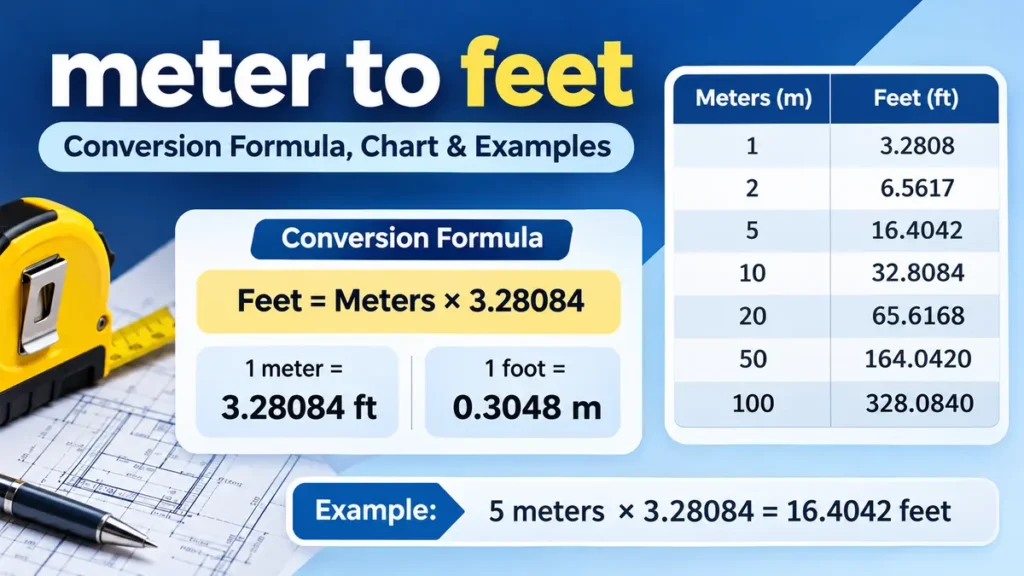
To convert meter to feet, multiply the length in meters by 3.28084. One meter equals approximately 3.28084 feet, while one foot equals exactly 0.3048 meters. This conversion works for any length, including height, distance, room dimensions, and construction measurements. For greater precision, use the exact factor of 1250/381.
For example, 5 meters equals approximately 16.4042 feet, while 10 meters equals 32.8084 feet.
How to Convert meter to feet
The standard meter to feet conversion uses a fixed mathematical relationship between the metric system and the imperial and US customary measurement systems.
CONVERSION FORMULA
\[ \text{Feet}=\text{Meters}\times 3.28084 \]
1 meter
3.28084 ft
1 foot
0.3048 m
The conversion factor comes from the internationally standardized definition of the foot. Since one foot is exactly 0.3048 meters, dividing a measurement in meters by 0.3048 gives its equivalent in feet.
Step-by-step conversion
- Identify the measurement in meters.
- Multiply the value by 3.28084.
- Round the result to the precision required.
- Write the answer using feet or the abbreviation ft.
For example, suppose a room measures 6 meters in length.
\[ 6\times3.28084=19.68504\text{ ft} \]
Therefore, a 6-meter room is approximately 19.69 feet long.
For everyday measurements, rounding to two decimal places is usually sufficient. Engineering drawings, surveying calculations, and technical documents may require additional precision.
Interactive meter to feet Calculator
Use this calculator to convert measurements instantly without performing the multiplication manually.
Meters to Feet Converter
LengthMeters (m)Decimal places
4 decimals
RESULT IN FEET
16.4042
ft
Copy
Approximately 16 ft 4.85 in
Calculated using the exact definition: 1 ft = 0.3048 m.
1 m2 m5 m10 m100 m
The calculator also displays the equivalent measurement in feet and inches, which is useful when comparing metric measurements with common height and construction measurements.
meter to feet Conversion Chart
A conversion chart provides a quick reference for frequently used measurements. The following values are calculated using the internationally defined conversion factor and rounded to four decimal places.
| Meters (m) | Feet (ft) |
|---|---|
| 0.1 | 0.3281 |
| 0.25 | 0.8202 |
| 0.5 | 1.6404 |
| 1 | 3.2808 |
| 1.5 | 4.9213 |
| 2 | 6.5617 |
| 2.5 | 8.2021 |
| 3 | 9.8425 |
| 4 | 13.1234 |
| 5 | 16.4042 |
| 6 | 19.6850 |
| 7 | 22.9659 |
| 8 | 26.2467 |
| 9 | 29.5276 |
| 10 | 32.8084 |
| 12 | 39.3701 |
| 15 | 49.2126 |
| 20 | 65.6168 |
| 25 | 82.0210 |
| 30 | 98.4252 |
| 50 | 164.0420 |
| 100 | 328.0840 |
| 500 | 1,640.4199 |
| 1,000 | 3,280.8399 |
The table is particularly helpful when comparing measurements in architectural plans, educational materials, sports facilities, or international product specifications.
How many feet are in 1 meter?
One meter equals approximately 3.28084 feet, or about 3 feet and 3.37 inches.
This is slightly longer than one yard, which equals exactly 3 feet or 0.9144 meters.
How many feet are in 2 meters?
Two meters equal approximately 6.56168 feet.
\[ 2\times3.28084=6.56168\text{ ft} \]
In feet-and-inches notation, that is approximately 6 feet 6.74 inches.
How many feet are in 10 meters?
Ten meters equal approximately 32.8084 feet, or 32 feet 9.70 inches.
This measurement is commonly encountered in construction layouts, sporting events, and outdoor distance calculations.
Understanding Meters, Feet, and Inches
Meters and feet both measure length, but they belong to different measurement systems.
What is a meter?
The meter, symbolized by m, is the SI base unit of length in the International System of Units.
The International Bureau of Weights and Measures (BIPM) defines the meter through the fixed numerical value of the speed of light in a vacuum, 299,792,458 meters per second, together with the definition of the second.
The metric system uses decimal relationships between units, making conversions between millimeters, centimeters, meters, and kilometers convenient.
For example:
- 1 meter = 100 centimeters
- 1 meter = 1,000 millimeters
- 1 kilometer = 1,000 meters
Meters are widely used in science, education, engineering, athletics, and everyday measurements across much of the world.
What is a foot?
The foot, abbreviated ft, is a unit of length used primarily in the United States and in certain applications in other countries.
The international foot is defined as exactly 0.3048 meters. This definition was established through the 1959 international yard and pound agreement.
One foot contains exactly 12 inches, while one yard contains 3 feet.
Feet are commonly used for human height, building dimensions, ceiling heights, and certain aviation measurements.
Difference between meters and feet
| Feature | Meter | Foot |
|---|---|---|
| Symbol | m | ft |
| Measurement type | Length | Length |
| System | SI / Metric | Imperial and US customary |
| Equivalent in centimeters | 100 cm | 30.48 cm |
| Equivalent in inches | 39.3701 in | 12 in |
| Common uses | Science, engineering, international measurements | Height, construction, aviation |
Neither unit is inherently more accurate. Measurement accuracy depends on the instrument, the original data, and how calculations are performed.
However, the metric system’s decimal structure makes calculations across different units simpler.
Convert meter to feet and Inches
Sometimes a measurement expressed in decimal feet is difficult to visualize. Converting the decimal portion into inches makes the result easier to understand, especially for human height, furniture dimensions, and construction projects.
The process involves separating the whole number of feet from the fractional portion.
Formula for feet and inches
First, calculate the total feet:
\[ \text{Feet}=\frac{\text{Meters}}{0.3048} \]
Next, take the decimal portion and multiply it by 12:
\[ \text{Inches}=\text{Decimal Feet}\times12 \]
For example, convert 1.8 meters into feet and inches.
Step 1: Convert meters into decimal feet.
\[ 1.8\div0.3048=5.90551\text{ ft} \]
Step 2: Separate the whole feet.
The result contains 5 whole feet and a fractional remainder of approximately 0.90551 feet.
Step 3: Convert the remainder into inches.
\[ 0.90551\times12=10.86612\text{ in} \]
The final result is approximately 5 feet 10.87 inches, commonly rounded to 5 feet 11 inches.
Common height conversions
| Height in Meters | Decimal Feet | Feet and Inches (Approx.) |
|---|---|---|
| 1.5 m | 4.9213 ft | 4 ft 11.06 in |
| 1.6 m | 5.2493 ft | 5 ft 2.99 in |
| 1.65 m | 5.4134 ft | 5 ft 4.96 in |
| 1.7 m | 5.5774 ft | 5 ft 6.93 in |
| 1.75 m | 5.7415 ft | 5 ft 8.90 in |
| 1.8 m | 5.9055 ft | 5 ft 10.87 in |
| 1.85 m | 6.0696 ft | 6 ft 0.83 in |
| 1.9 m | 6.2336 ft | 6 ft 2.80 in |
| 2 m | 6.5617 ft | 6 ft 6.74 in |
A frequent mistake is interpreting 5.9 feet as 5 feet 9 inches. In reality, 0.9 feet equals 10.8 inches, so 5.9 feet is approximately 5 feet 10.8 inches.
How to Convert Feet Back to Meters
Reverse conversion is equally straightforward. Instead of multiplying by 3.28084, multiply the measurement in feet by 0.3048.
\[ \text{Meters}=\text{Feet}\times0.3048 \]
For example, convert 20 feet into meters:
\[ 20\times0.3048=6.096\text{ m} \]
Therefore, 20 feet equals exactly 6.096 meters.
Converting feet and inches into meters
When a measurement contains both feet and inches, first convert the entire measurement into inches or decimal feet.
Suppose a person’s height is 5 feet 8 inches.
Convert feet to inches:
\[ 5\times12=60\text{ in} \]
Add the remaining 8 inches:
\[ 60+8=68\text{ in} \]
Since one inch equals exactly 0.0254 meters:
\[ 68\times0.0254=1.7272\text{ m} \]
Thus, 5 feet 8 inches equals 1.7272 meters, or approximately 172.72 centimeters.
This approach is useful for converting heights recorded in imperial units into metric measurements.
Practical Uses of meter to feet Conversion
Converting meters to feet is useful whenever measurements move between countries, industries, or documentation systems that use different units.
Construction and architecture
Architectural plans may specify room lengths, wall heights, and building dimensions in meters, while contractors or suppliers may work in feet.
Consider a room measuring 4 meters by 5 meters.
Its dimensions in feet are approximately:
- Length: 5 meters = 16.4042 feet
- Width: 4 meters = 13.1234 feet
However, calculating floor area requires special care.
The room’s area in square meters is:
\[ 4\times5=20\text{ m}^2 \]
To convert square meters into square feet, use the squared length conversion factor:
\[ 20\times10.76391=215.2782\text{ ft}^2 \]
The room therefore covers approximately 215.28 square feet.
Remember: Converting square meters into square feet is different from converting linear meters into feet. Area measurements require an area conversion factor.
Human height measurements
Healthcare records, sports profiles, and identification documents may record height in centimeters or meters.
For instance, someone who is 1.75 meters tall measures approximately 5 feet 8.90 inches.
This can be expressed as approximately 5 feet 9 inches when rounded to the nearest whole inch.
Sports and athletics
Track and field events commonly use metric distances.
A 100-meter sprint equals approximately 328.08 feet, while a 400-meter track distance equals approximately 1,312.34 feet.
These conversions help readers accustomed to feet visualize distances expressed in meters.
Aviation and navigation
Aviation frequently uses feet for altitude, even in regions that use metric measurements for most everyday purposes.
For example, an altitude of 3,000 meters is approximately 9,842.52 feet.
Altitude units should always be checked against the relevant aviation procedures, because the operational unit may vary by country and airspace.
Engineering and surveying
Engineering projects often involve drawings, geographic coordinates, and equipment specifications created using different measurement conventions.
For ordinary length conversion, the international foot is the appropriate unit.
However, historical US surveying records may use the older US survey foot, which differs slightly from the international foot.
According to the National Institute of Standards and Technology (NIST), the international foot equals exactly 0.3048 meters, while the US survey foot equals exactly 1200/3937 meters. The US survey foot was retired for most new US surveying applications after December 31, 2022, although it remains relevant to legacy records. NIST+1
This distinction is negligible for most household measurements but can matter when interpreting historical geospatial data.
Accuracy, Rounding, and Common Conversion Mistakes
The mathematical conversion between meters and international feet is fixed. The precision of the final answer, however, depends on how the calculation is performed and reported.
Use the correct conversion factor
For most everyday calculations, multiplying by 3.28084 provides sufficient accuracy.
For calculations that require greater precision, use:
\[ \text{Feet}=\frac{\text{Meters}}{0.3048} \]
The division formula uses the exact international definition of the foot, avoiding premature rounding of the multiplier.
NIST publishes this relationship in its official measurement conversion tables. 2025+1
Avoid rounding too early
Suppose you need to convert 250 meters.
Using the rough factor of 3.28:
\[ 250\times3.28=820\text{ ft} \]
Using the more precise factor:
\[ 250\div0.3048\approx820.20997\text{ ft} \]
The difference is approximately 0.21 feet, or 2.52 inches.
That may be acceptable for a quick estimate but could matter in detailed planning or fabrication.
Choose the appropriate number of decimal places
Different applications require different levels of precision.
| Application | Typical Display Precision |
|---|---|
| Quick mental estimates | 1–2 decimal places |
| Everyday room measurements | 2 decimal places |
| General technical calculations | 3–4 decimal places |
| Precision engineering | Based on specified tolerances |
| Scientific measurements | Based on significant figures and uncertainty |
Showing more decimal places does not automatically make a measurement more accurate.
For example, a distance measured to the nearest 0.1 meter should not be presented as though its converted value were known to the nearest millionth of a foot.
Avoid confusing decimal feet with inches
One of the most common conversion errors involves reading decimal feet as feet-and-inches notation.
For example:
- 5.5 feet means 5 feet 6 inches.
- 6.25 feet means 6 feet 3 inches.
- 7.75 feet means 7 feet 9 inches.
The decimal portion must be multiplied by 12 to obtain inches.
Do not confuse length, area, and volume
The factor 3.28084 applies to linear measurements only.
Different factors are needed for other dimensions.
| Measurement | Conversion |
|---|---|
| 1 meter | 3.28084 feet |
| 1 square meter | 10.76391 square feet |
| 1 cubic meter | 35.31467 cubic feet |
Applying the linear conversion factor to square meters or cubic meters produces incorrect results.
Quick Ways to Estimate Meters in Feet
When exact precision is unnecessary, a mental conversion can provide a useful estimate.
A simple approach is to remember that one meter is approximately 3.28 feet.
For an even faster calculation, multiply the number of meters by 3.3.
For example:
\[ 8\times3.3=26.4\text{ ft} \]
The more accurate value is approximately 26.25 feet, so the estimate is reasonably close.
Another useful reference is that 3 meters are approximately 10 feet.
This makes it easier to estimate larger distances without a calculator.
For example, 30 meters are approximately 100 feet, although the more accurate value is 98.43 feet.
These shortcuts are suitable for visualizing distances, estimating furniture sizes, or discussing approximate dimensions. They should not replace exact conversions when tolerances matter.
Conclusion
Understanding how to convert meter to feet makes it easier to compare measurements across metric and imperial systems.
The essential relationship is simple: one meter equals approximately 3.28084 feet, and one international foot equals exactly 0.3048 meters.
For quick calculations, multiply meters by 3.28084. For greater mathematical precision, divide by 0.3048. When measurements must be expressed in feet and inches, multiply the fractional part of the feet value by 12.
Use the conversion chart for common measurements or the calculator for custom values, and choose a rounding precision that matches the accuracy your task requires.