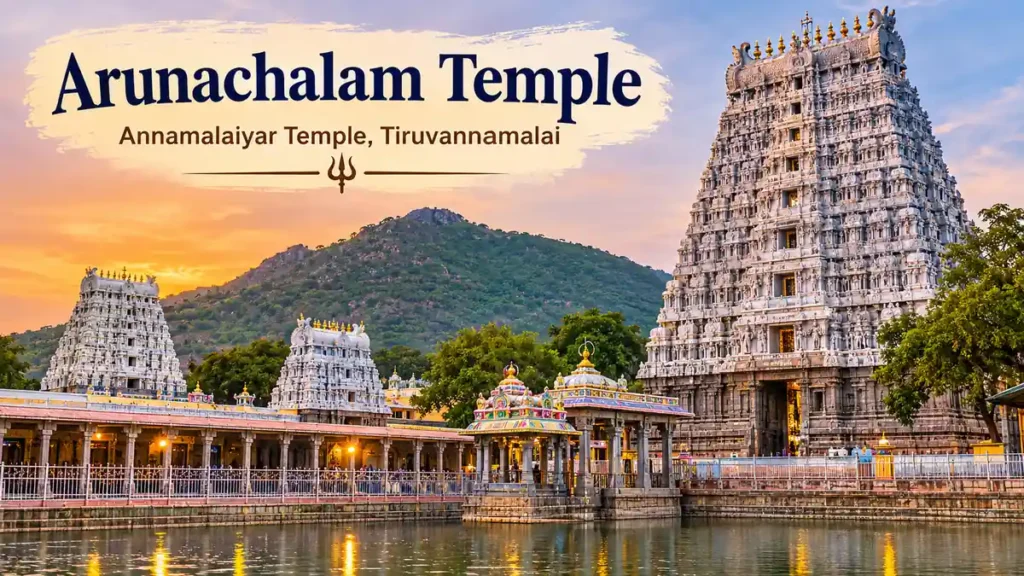
At the foot of a sacred mountain in Tamil Nadu stands one of India’s most remarkable Shiva temples. Every year, millions of devotees and visitors come to Tiruvannamalai to experience its ancient traditions, monumental architecture, and the spiritual significance of Arunachala Hill.
arunachalam temple, officially known as Arunachaleswarar Temple, is a historic Hindu temple dedicated to Lord Shiva in Tiruvannamalai, Tamil Nadu. Famous for its association with the fire element, the 14-kilometer Girivalam pilgrimage, and the Karthigai Deepam festival, it is among South India’s most important Shaivite pilgrimage destinations.
The temple is also called Annamalaiyar Temple or Arunachaleswara Temple. Its religious significance extends beyond the main shrine to the mountain behind it, which devotees revere as a manifestation of Shiva.
This guide explains the temple’s history, legends, architecture, worship practices, opening hours, festivals, and practical information for first-time visitors.
2013 Arunachala Deepam Festival Photographs – ARUNACHALA GRACE
7
What Is arunachalam temple and Why Is It Famous?
Arunachalam Temple is a major Hindu pilgrimage center dedicated to Shiva as Arunachaleswarar, also known as Annamalaiyar. His consort, Goddess Parvati, is worshipped here as Unnamulai Amman, or Apeethakuchambal.
The temple belongs to the Pancha Bhoota Sthalams, five sacred Shiva temples traditionally associated with the five fundamental elements of nature.
Arunachaleswarar Temple represents Agni, the element of fire.
Its distinctive religious identity comes from the belief that Shiva manifested at Arunachala as an infinite column of light, demonstrating the limitless nature of divine consciousness.
Key facts about Arunachalam Temple
| Feature | Details |
|---|---|
| Official name | Arulmigu Arunachaleswarar Temple |
| Other names | Annamalaiyar Temple, Arunachalam Temple |
| Location | Tiruvannamalai, Tamil Nadu, India |
| Main deity | Lord Shiva (Arunachaleswarar) |
| Goddess | Unnamulai Amman (Parvati) |
| Religious tradition | Hinduism, Shaivism |
| Sacred element | Fire (Agni) |
| Architectural style | Dravidian |
| Temple complex | Approximately 25 acres |
| Main entrance | Eastern Rajagopuram |
| Girivalam distance | Approximately 14 km |
| Major festival | Karthigai Deepam |
| General darshan | Free |
| Official darshan hours | 5:30 AM–8:00 PM |
The temple’s association with fire, its monumental gateways, and the tradition of walking around Arunachala Hill make it significant both religiously and culturally. Annamalaiyar Temple+2
History and Origin of arunachalam temple
The history of Arunachaleswarar Temple combines centuries of South Indian architecture, Tamil devotional literature, royal patronage, and Hindu religious tradition.
Although the site’s sacred importance is described in ancient religious texts, the surviving architectural complex developed through several historical periods.
Early religious history
Arunachala has been revered as a sacred place in Tamil Shaivism for many centuries.
The temple is celebrated in the Tamil devotional hymns known as the Tevaram, associated with the Nayanmars, the poet-saints who helped shape the Shaivite bhakti movement.
Saints such as Appar, Sambandar, and Sundarar are closely associated with this devotional tradition.
These hymns establish the temple’s importance well before the construction of many of its present monumental structures.
The mountain itself also appears in the Arunachala Mahatmyam, traditionally associated with the Skanda Purana.
Chola dynasty contributions
The Chola rulers played an important role in the development of stone temples across Tamil Nadu.
At Tiruvannamalai, Chola-period patronage contributed to the expansion of the sacred complex, its shrines, and its institutional importance.
Inscriptions associated with different periods of temple history provide evidence of donations, religious endowments, and royal involvement.
The Chola contribution forms an important part of the temple’s architectural history, although the entire present complex cannot be attributed to one dynasty.
Vijayanagara Empire and later expansion
The Vijayanagara period brought major additions to the temple.
Monumental gateways, pillared halls, and architectural embellishments helped create the impressive complex visible today.
The eastern Rajagopuram is particularly associated with the Vijayanagara-era expansion and later Nayak-period completion.
A Tamil Nadu government directory of monuments identifies significant surviving temple architecture with the 16th–17th centuries and Vijayanagara patronage. TeePublic
The temple therefore represents several centuries of construction rather than a single building project.
The legend of Shiva’s infinite column of fire
According to Hindu tradition, Brahma and Vishnu once disputed which of them was supreme.
Shiva appeared before them as an immense, endless column of fire.
Brahma attempted to discover its summit, while Vishnu searched for its base. Neither could establish the limits of the divine manifestation.
The legend symbolizes the infinite and immeasurable nature of Shiva.
Arunachala Hill is traditionally understood as the physical manifestation of that divine fire.
The annual Karthigai Deepam celebration commemorates this symbolism through the lighting of a great flame on the mountain.
This story is a sacred religious narrative, not a claim about the mountain’s geological formation.
Spiritual Significance of Arunachala Hill and the Five Elements
Arunachala – The Holy Mountain of Tiruvannamalai — Aga Guru
Arunachala Hill is central to the identity of the temple.
In Shaivite tradition, the mountain is not merely a backdrop to the shrine. It is revered as a manifestation of Shiva himself.
This belief explains why worship at Tiruvannamalai includes both temple darshan and circumambulation of the hill.
The five Pancha Bhoota Sthalams
The Pancha Bhoota temples associate Shiva with five elements:
| Element | Temple | Location |
|---|---|---|
| Earth (Prithvi) | Ekambareswarar Temple | Kanchipuram |
| Water (Jala) | Jambukeswarar Temple | Thiruvanaikaval |
| Fire (Agni) | Arunachaleswarar Temple | Tiruvannamalai |
| Air (Vayu) | Srikalahasti Temple | Srikalahasti |
| Space (Akasha) | Nataraja Temple | Chidambaram |
The fire element is understood spiritually as a symbol of illumination, transformation, and the destruction of ignorance.
At Arunachala, the symbolism of fire is especially prominent because the mountain itself is associated with Shiva’s radiant manifestation.
Why is Arunachala Hill considered sacred?
Devotees believe that worshipping Arunachala encourages inner purification, devotion, and spiritual awareness.
The mountain has also attracted saints, ascetics, and seekers interested in meditation and self-inquiry.
One of its most influential modern spiritual figures was Ramana Maharshi.
He lived in Tiruvannamalai for much of his life and taught self-inquiry, commonly expressed through the question, “Who am I?”
His teachings helped introduce Arunachala’s spiritual significance to an international audience.
Today, pilgrims visit both the temple and the surrounding ashrams to experience different aspects of the town’s religious heritage.
arunachalam temple Architecture and Important Shrines
Arunachaleswarar Temple is a major example of Dravidian temple architecture.
Its monumental gateways, enclosed courtyards, stone corridors, pillared halls, and sculptural details reflect the artistic traditions of Tamil Nadu.
The complex covers approximately 25 acres and contains multiple prakarams, or enclosed precincts.
The Rajagopuram and temple gateways
File:Thiruvannamalai Arunachaleswarar Temple Rajagopuram.jpg – Wikimedia Commons
The eastern Rajagopuram is the temple’s most recognizable architectural feature.
Standing approximately 66 meters (217 feet) high, this monumental gateway rises above the surrounding town.
It is traditionally described as having 11 tiers.
Its sculptural decoration includes numerous figures associated with Hindu mythology and religious symbolism.
The temple complex has nine gopurams in total, including four major gateways.
Visitors entering through the eastern gateway encounter an extensive series of courtyards, mandapams, and shrines.
The main sanctum of Arunachaleswarar
The central shrine houses the Shiva Lingam worshipped as Arunachaleswarar.
The Lingam is the principal focus of worship and represents Shiva’s divine presence.
Devotees approach the sanctum for darshan, offering prayers and receiving the experience of seeing the deity.
The interior atmosphere differs noticeably from the open courtyards outside, with ritual lamps, stone architecture, and the movement of worshippers forming part of the temple experience.
Unnamulai Amman shrine
Goddess Unnamulai Amman is worshipped in a separate important shrine within the temple complex.
She represents Parvati, the divine consort of Shiva.
Her shrine is an integral part of the temple’s religious life, and many devotees visit both sanctums.
Thousand Pillar Hall
The Thousand Pillar Hall, commonly called the Ayiram Kaal Mandapam, is among the complex’s notable architectural features.
Associated with Vijayanagara-era construction, it demonstrates the sophistication of stone carving and pillared-hall design.
Its pillars and decorative details are important examples of South Indian temple craftsmanship.
The hall’s name follows a traditional architectural convention and should not be treated as a guarantee of an exact present-day pillar count.
Sacred tanks and other features
The temple also contains the Brahma Theertham and Sivaganga Theertham, sacred water tanks associated with its religious traditions.
Other notable features include the Kambathu Ilayanar shrine, dedicated to Murugan, Nandi sculptures, and several subsidiary sanctums.
The temple’s corridors also contain representations associated with Shaivite saints and devotional traditions.
Together, these structures demonstrate that the complex is not simply a single shrine but a large religious institution shaped by centuries of worship.
arunachalam temple Timings, Darshan and Daily Poojas
Understanding the official darshan schedule is particularly useful because different travel websites publish conflicting opening hours.
The Tamil Nadu Hindu Religious and Charitable Endowments Department (HR&CE), which administers the temple, provides the most authoritative published schedule.
Current temple opening and closing times
| Activity | Timing |
|---|---|
| Temple opens | 5:30 AM |
| General darshan | 5:30 AM–8:00 PM |
| Last entry on crowded days | Approximately 7:30 PM |
| Temple closes | 8:00 PM |
| Special festival arrangements | Subject to official announcements |
The official HR&CE listing shows darshan from 5:30 AM to 8:00 PM. Its administrative schedule divides the day at 3:00 PM, but this should not automatically be interpreted as a public midday closure.
On weekends, full-moon days, and other crowded occasions, admission may end earlier than the normal closing time. Annamalaiyar Temple
Daily pooja schedule
The temple follows a traditional cycle of six daily worship services.
Commonly published approximate timings include:
| Pooja | Approximate time |
|---|---|
| Ushathkala Pooja | 5:30 AM |
| Kalasandhi Pooja | 8:00 AM |
| Uchikala Pooja | 11:30 AM |
| Sayarakshai Pooja | 5:30 PM |
| Irandam Kala Pooja | 7:30 PM |
| Arthajama Pooja | Late evening |
These are traditional published timings, not a guaranteed current ritual timetable. Actual ceremonies may vary, and the official public closing schedule takes precedence over older listings. Tamil Nadu Tourism
Is darshan free at Arunachalam Temple?
Yes. General darshan is free.
Separate paid special-entry arrangements may also be available through authorized temple counters.
Special-entry fees and arrangements can change, particularly during festivals, so visitors should rely on official temple notices rather than unofficial booking claims.
How long does darshan take?
Waiting time depends on the day, season, and number of visitors.
On an ordinary weekday, a visitor may complete the main darshan in considerably less time than on a festival day.
A practical planning allowance is:
- Ordinary weekdays: approximately 1–2 hours, allowing for queues and movement through the complex.
- Weekends: allow several hours if visitor numbers are high.
- Pournami and major festivals: queues may be substantially longer and unpredictable.
These are planning estimates, not official waiting-time guarantees.
Early mornings on non-festival weekdays are generally a more comfortable choice for visitors seeking a quieter experience.
Arunachalam Girivalam: The Sacred 14-Kilometer Walk
Bodinayakanur to Tiruvannamalai Drop Taxi | ₹6,034 onwards | Drop Cars
Girivalam, also called Giri Pradakshina or Arunachala Pradakshina, is the devotional practice of walking around Arunachala Hill.
The Tamil words giri and valam refer to a hill and the act of going around it.
The traditional route is approximately 14 kilometers (8.5 miles) long, as documented by the Tiruvannamalai district administration. India
Why do devotees perform Girivalam?
Devotees regard the walk as an act of worship directed toward Shiva in the form of Arunachala.
The practice is associated with prayer, contemplation, humility, and spiritual discipline.
Many pilgrims undertake Girivalam during Pournami, the full-moon period, which is considered especially auspicious.
Others complete the walk on ordinary days, during religious festivals, or as a personal devotional practice.
The traditional belief that Girivalam brings spiritual benefits should be understood as a matter of faith rather than a medically established outcome.
How to perform Girivalam
The customary approach follows these steps:
- Begin near Arunachaleswarar Temple, traditionally from the eastern side.
- Walk clockwise around Arunachala Hill, keeping the mountain to your right.
- Visit the Ashta Lingam shrines situated along the route.
- Maintain a respectful and contemplative attitude throughout the journey.
- Return to the starting area after completing the circuit.
Many devotees walk barefoot as an expression of devotion.
However, the road surface can become extremely hot, and footwear may be a sensible health and safety choice for visitors who cannot comfortably walk barefoot.
The eight Ashta Lingams
Eight Shiva Lingam shrines are traditionally associated with the cardinal and intermediate directions.
| Lingam | Direction | Traditional association |
|---|---|---|
| Indra Lingam | East | Indra |
| Agni Lingam | Southeast | Agni |
| Yama Lingam | South | Yama |
| Niruthi Lingam | Southwest | Nirriti |
| Varuna Lingam | West | Varuna |
| Vayu Lingam | Northwest | Vayu |
| Kubera Lingam | North | Kubera |
| Esanya Lingam | Northeast | Ishana |
These shrines are important stopping points along the Girivalam route and reflect the directional symbolism of Hindu religious tradition. Incredible India
How much time is needed for Girivalam?
A reasonably fit walker may complete the route in approximately three to four hours without lengthy stops.
For a more relaxed pilgrimage, four to six hours is a practical allowance.
Time requirements increase when pilgrims stop at shrines, encounter large crowds, or need frequent rest breaks.
The route is mostly level, but 14 kilometers remains a substantial walk, particularly in Tamil Nadu’s heat.
Can Girivalam be completed at night?
Yes. Nighttime Girivalam is a longstanding tradition, especially during full-moon periods.
Many devotees prefer the cooler evening or early-morning temperatures.
However, visitors should remain attentive to road traffic, crowd movement, lighting, and personal safety.
For first-time visitors, early morning is often easier for understanding the route and navigating the surroundings.
Karthigai Deepam Festival and Other Major Celebrations
Online tickets for Tiruvannamalai Maha deepam from November 21
Karthigai Deepam is the most important annual festival associated with Arunachaleswarar Temple.
Celebrated during the Tamil month of Karthigai, usually in November or December, the festival honors Shiva’s manifestation as an infinite column of fire.
It attracts large numbers of devotees from across India and abroad.
What happens during Karthigai Deepam?
The festival traditionally includes a ten-day Brahmotsavam with processions, special worship, and religious ceremonies.
Its central event is the lighting of the Maha Deepam, a great flame on the summit of Arunachala Hill.
The flame symbolizes Shiva’s limitless radiance.
Major festival observances include:
- Bharani Deepam: An early-morning lamp-lighting ceremony associated with the temple.
- Maha Deepam: The lighting of the great flame on Arunachala Hill, traditionally around 6 PM.
- Temple processions: Festival deities are carried through designated routes.
- Periya Ther: The important temple chariot procession.
- Special poojas: Ceremonies dedicated to Shiva and the festival’s religious significance.
The Tiruvannamalai district administration identifies the mountain flame and the chariot procession as defining features of the celebration. India
Karthigai Deepam 2026 date
Karthigai Deepam is scheduled for Tuesday, November 24, 2026, according to published festival calendars.
The Maha Deepam is expected to be lit at approximately 6 PM Indian Standard Time.
The district administration was actively reviewing arrangements for the 2026 celebration in November, reflecting the scale of preparation required. Arunachalam Temple+1
Visitors should confirm the final ceremony schedule, crowd restrictions, and entry arrangements through the temple administration.
Pournami and Maha Shivaratri
Pournami, or the full-moon period, is particularly significant for Girivalam.
Every month, pilgrims gather to walk around Arunachala Hill.
Maha Shivaratri is another important celebration dedicated to Shiva. Devotees observe the occasion through prayer, fasting, and special worship.
Pradosham, a recurring Shaivite observance associated with the lunar calendar, also brings devotees to the temple.
These occasions can produce significantly larger crowds than ordinary weekdays.
Best Time to Visit Arunachalam Temple
The best time depends on whether the priority is comfortable weather, quieter darshan, religious festivals, or the Girivalam pilgrimage.
For most first-time visitors, the cooler months are easier for exploring the extensive temple complex and walking outdoors.
Seasonal comparison
| Season | Typical conditions | Visitor considerations |
|---|---|---|
| November–February | Generally cooler | Comfortable for sightseeing and walking; major festivals can be crowded |
| March–May | Hot, particularly midday | Early-morning visits are preferable |
| June–September | Warm, with variable rainfall | Heat and occasional rain may affect outdoor activities |
| October–December | Northeast monsoon influence | Rain is possible; festival activity increases |
Tiruvannamalai has a tropical climate, and temperatures can become uncomfortable during the hotter months.
For visitors planning Girivalam, weather conditions matter more than they would for a short temple visit.
Is it better to visit during Pournami?
Pournami offers a particularly vibrant devotional atmosphere.
However, it also brings heavier crowds, longer queues, and greater pressure on local transport and accommodation.
A regular weekday may be preferable for someone interested primarily in the temple’s architecture, history, and peaceful worship.
Neither option is universally better. They offer different experiences.
How to Reach Arunachalam Temple in Tiruvannamalai
The temple is situated in Tiruvannamalai, a major pilgrimage town in northern Tamil Nadu.
It is accessible by road and rail from several important South Indian cities.
Approximate road distances
| Starting city | Distance to Tiruvannamalai |
|---|---|
| Chennai | 190–200 km |
| Bengaluru | 200–220 km |
| Vellore | 80–90 km |
| Puducherry | 100–110 km |
| Kanchipuram | 110–120 km |
| Tirupati | 180–200 km |
Distances vary according to the selected route and starting location.
By road
Tiruvannamalai has road connections with Chennai, Bengaluru, Vellore, Puducherry, and other towns.
Tamil Nadu State Transport Corporation (TNSTC) and other bus operators provide services to the region.
Travel conditions can change substantially during Karthigai Deepam and Pournami because of traffic restrictions and heavy pilgrimage movement.
By train
Tiruvannamalai has a railway station served by regional rail connections.
The station is approximately 2 kilometers from the main temple area.
Train availability and journey times depend on the departure station and current railway timetable.
By air
Visitors arriving by air commonly use Chennai International Airport or another suitable regional airport, followed by a road journey.
Chennai is a practical gateway for many domestic and international travelers.
Temple location
🛕
🧘
Use two fingers to move the map
Use ctrl + scroll to zoom the map
The temple’s official postal address is Tiruvannamalai, Tamil Nadu 606601, India.
The eastern Rajagopuram is an important landmark for approaching the complex.
Dress Code, Temple Rules and Practical Visitor Tips
Arunachaleswarar Temple is an active place of worship. Visitors should approach it with respect for local customs and religious practices.
What should visitors wear?
Modest clothing is expected.
Traditional Indian clothing is common, although visitors may also wear other respectful attire that adequately covers the shoulders and knees.
For men, dhotis, trousers, and appropriate shirts are generally suitable.
For women, sarees, salwar suits, and other modest clothing are commonly worn.
Avoid shorts, sleeveless clothing, and outfits unsuitable for a religious setting.
Are mobile phones and photography allowed?
Photography and mobile-phone restrictions can apply within the temple complex, particularly near sanctums and controlled areas.
Visitors should follow the instructions displayed at entrances and given by temple staff.
Do not assume that permission to photograph the outer architecture extends to the inner shrine.
Essential tips for first-time visitors
- Arrive early if you prefer a quieter visit.
- Carry drinking water, especially during hot weather.
- Be prepared to remove footwear before entering designated sacred areas.
- Keep personal belongings secure in crowded locations.
- Allow enough time to visit both the Shiva and Amman shrines.
- Follow official queue arrangements rather than informal shortcuts.
- Respect restrictions around rituals, photography, and access.
- Check festival-day traffic and entry notices before traveling.
For Girivalam, comfortable clothing, hydration, sun protection, and realistic walking expectations are especially important.
Visitors with mobility limitations should not assume the entire 14-kilometer pilgrimage is necessary to experience the temple’s religious and cultural significance.
Can children and elderly visitors visit?
Yes. The temple welcomes visitors of different ages.
However, its large courtyards, stone surfaces, queues, and potentially hot weather can make prolonged visits tiring.
Families should plan rest breaks and avoid peak heat where possible.
Elderly visitors and people with health limitations may prefer a shorter temple visit rather than attempting the complete Girivalam circuit.
Places to Visit Near Arunachalam Temple
Tiruvannamalai has several places of religious, historical, and cultural interest beyond the main temple.
Sri Ramanasramam
Sri Ramanasramam is one of the town’s best-known spiritual institutions.
Associated with Ramana Maharshi, the ashram is especially significant for visitors interested in meditation, Advaita Vedanta, and self-inquiry.
The complex includes prayer and meditation spaces, memorial shrines, and a library.
It offers a different experience from the large, busy Arunachaleswarar Temple, with greater emphasis on contemplation and spiritual study. Incredible India
Virupaksha Cave
Virupaksha Cave is located on Arunachala Hill and is associated with both earlier ascetic traditions and Ramana Maharshi.
It is an important destination for visitors interested in the mountain’s spiritual history.
Reaching the cave involves walking uphill, so suitable footwear and awareness of weather conditions are advisable.
Skandashram
Skandashram is another historically significant meditation site on Arunachala Hill.
Ramana Maharshi spent an important period of his life here.
The site is valued for its association with contemplative practice and its setting on the sacred mountain.
Visitors should check current access rules before attempting hill paths.
Adi Annamalai Temple
Adi Annamalai Temple is situated along the wider Girivalam circuit.
It is associated with the sacred landscape surrounding Arunachala and is frequently visited by pilgrims completing the circumambulation.
Its location also illustrates how the religious importance of Tiruvannamalai extends beyond the central Arunachaleswarar complex.
Other nearby attractions
Visitors interested in the wider region may also explore Seshadri Swamigal Ashram, Gingee Fort, Sathanur Dam, and the Jawadhu Hills.
These destinations provide additional perspectives on the area’s spiritual traditions, architecture, and natural landscape.
India’s Ministry of Tourism identifies Ramana Ashram, Gingee Fort, and the Jawadhu Hills among the notable attractions associated with the Tiruvannamalai region. Incredible India
Planning a One-Day Visit to Arunachalam Temple
A single day is sufficient for a meaningful introduction to the temple and some nearby attractions.
However, combining a complete Girivalam with extensive sightseeing can make the day physically demanding.
Suggested one-day schedule
| Time | Activity |
|---|---|
| 5:30–7:30 AM | Main temple darshan |
| 7:30–8:30 AM | Breakfast and rest |
| 8:30–10:00 AM | Explore temple architecture and accessible courtyards |
| 10:30 AM–12:00 PM | Visit Sri Ramanasramam, subject to its schedule |
| 12:00–3:30 PM | Lunch and rest during hotter hours |
| 4:00–6:00 PM | Visit nearby spiritual or historical sites |
| Evening | Return to the temple area or observe local devotional activity |
This is an illustrative itinerary rather than an official schedule.
Visitors planning the complete 14-kilometer Girivalam should reserve a separate four-to-six-hour period and consider reducing other activities.
Is one day enough?
One day is usually enough to see the main temple and experience some of Tiruvannamalai’s spiritual atmosphere.
Two days provide greater flexibility for Girivalam, meditation, and visits to nearby ashrams.
During major festivals, additional time may be needed because of crowd controls and transport delays.
Common Misconceptions About Arunachalam Temple
Several claims about the temple circulate online without sufficient context.
Understanding the difference between historical evidence, religious tradition, and practical visitor information helps prevent confusion.
Is Arunachalam Temple the same as Annamalaiyar Temple?
Yes.
Arunachalam Temple, Arunachaleswarar Temple, and Annamalaiyar Temple refer to the same principal Shiva temple in Tiruvannamalai.
Different spellings and names reflect Tamil religious terminology and transliteration into English.
Is Arunachala Hill an extinct volcano?
Arunachala Hill is composed of ancient geological formations, but describing it simply as an extinct volcano is not supported by the evidence presented in common pilgrimage guides.
Its association with fire is primarily a religious and symbolic one.
The sacred legend of Shiva appearing as a column of fire should not be confused with a geological explanation of the mountain’s formation.
Is Girivalam compulsory for temple darshan?
No.
Devotees can visit Arunachaleswarar Temple without completing the circumambulation.
Girivalam is an important devotional tradition, but it is not a requirement for entering the main shrine.
Can visitors climb Arunachala Hill?
Access to different parts of the hill is subject to local restrictions.
Some established paths lead to spiritual sites such as Virupaksha Cave and Skandashram, while access to the summit may be regulated.
Visitors should not assume that a festival, pilgrimage, or general temple visit automatically permits unrestricted climbing.
Forest protection, safety concerns, and festival crowd management can affect access.
Is the temple open throughout the year?
The temple normally operates throughout the year.
However, public entry schedules, ritual arrangements, and access restrictions can change during special religious occasions.
The current official HR&CE schedule is the best reference for regular darshan hours.
Conclusion: Understanding the Importance of arunachalam temple
Arunachalam Temple is more than an impressive example of South Indian architecture. It is a living center of Shaivite worship where religious tradition, Tamil history, sacred geography, and devotional practices have developed together over centuries.
Its association with Agni among the Pancha Bhoota Sthalams, the spiritual symbolism of Arunachala Hill, the monumental Rajagopuram, and the 14-kilometer Girivalam tradition distinguish it from many other Hindu temples.
The annual Karthigai Deepam festival adds another dimension to its importance, bringing the symbolism of Shiva’s infinite light into a public religious celebration.
For first-time visitors, understanding the temple’s history and customs makes the experience more meaningful. Allow time for the principal shrines, respect the active worship environment, and plan outdoor activities according to weather and physical ability.
Before visiting, check the official Arunachaleswarar Temple website for current darshan hours, entry arrangements, and festival notices.
A visit to arunachalam temple offers an opportunity to understand one of Tamil Nadu’s most enduring sacred traditions and the remarkable relationship between a temple, a mountain, and the communities that have revered them for generations.