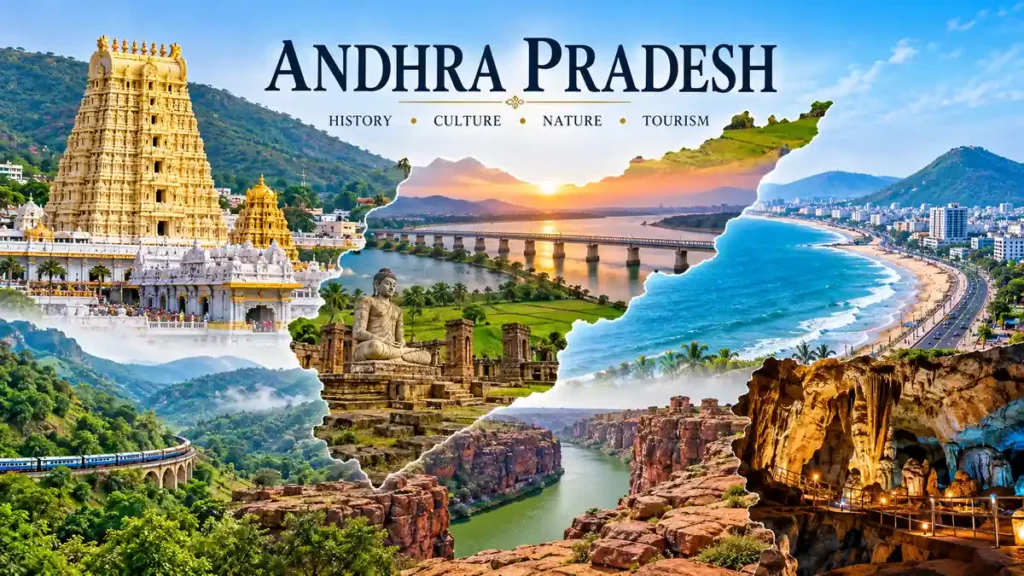
Andhra Pradesh stretches along India’s southeastern coast, where fertile river deltas, ancient temples, busy ports, farming communities, historic Buddhist sites, beaches, hills, and rapidly developing cities come together. Its identity is deeply connected with the Telugu language, the Krishna and Godavari rivers, and a long history of regional kingdoms and maritime trade.
Andhra Pradesh is a state in southeastern India with Amaravati as its capital and Visakhapatnam as its largest city. It is known for Telugu culture, the Tirumala Venkateswara Temple, Kuchipudi dance, agriculture, fisheries, a long Bay of Bengal coastline, historic Buddhist sites, major ports, and destinations such as Araku Valley and Borra Caves.
Andhra Pradesh at a Glance
Andhra Pradesh is one of India’s 28 states. It occupies an important position along the Bay of Bengal and connects several parts of southern and eastern India.
| Fact | Details |
|---|---|
| Country | India |
| Region | South India |
| Capital | Amaravati |
| Largest city | Visakhapatnam |
| Official language | Telugu |
| Additional official language | Urdu |
| Area | About 163,000 sq km |
| Coastline | About 974 km |
| Major rivers | Godavari, Krishna, Penna |
| Major cultural form | Kuchipudi |
| Major economic sectors | Agriculture, fisheries, manufacturing, pharmaceuticals, IT, ports and services |
| Famous destinations | Tirupati, Visakhapatnam, Araku Valley, Borra Caves, Amaravati |
The state covers roughly 163,275 square kilometres and has around 974 kilometres of coastline, one of the longest among Indian states.
Its coastal location has influenced almost every part of Andhra Pradesh’s development, from agriculture and fishing to trade, ports, food and tourism.
Where Is Andhra Pradesh Located?
Andhra Pradesh lies on India’s southeastern coast. The Bay of Bengal forms its eastern boundary, giving the state extensive coastal plains and access to maritime trade.
It shares boundaries with Telangana, Chhattisgarh, Odisha, Karnataka and Tamil Nadu. The Puducherry enclave of Yanam is also surrounded by Andhra Pradesh territory near the Godavari region.
The state’s geography can broadly be understood through three landscapes: the coastal plains, the Eastern Ghats and the interior plateau areas.
Coastal Andhra
Much of the eastern part of the state consists of coastal plains. The deltas created by the Krishna and Godavari rivers contain some of Andhra Pradesh’s most productive agricultural land.
Rice cultivation is especially important in these irrigated areas.
Aquaculture has also expanded substantially across parts of coastal Andhra, particularly shrimp and fish farming.
Eastern Ghats
The Eastern Ghats run through sections of Andhra Pradesh, separating portions of the coastal plains from inland landscapes.
Unlike a continuous mountain chain, these hills are broken into different ranges and sections.
Important hill systems include the Nallamala Hills, Seshachalam Hills, Papi Hills and Horsley Hills.
These landscapes support forests, wildlife habitats, tribal communities, waterfalls and tourism.
Rayalaseema
Rayalaseema forms the southwestern part of Andhra Pradesh.
The region has a comparatively drier climate than the fertile coastal deltas and historically faces greater water-management challenges.
Cities and districts across Rayalaseema have nevertheless developed important agricultural, industrial, educational and religious centres. Tirupati is the region’s best-known pilgrimage destination.
Major Rivers of Andhra Pradesh
Water has shaped Andhra Pradesh’s settlement patterns, agriculture and economy for centuries.
Godavari River
The Godavari is one of India’s great river systems.
Before reaching the Bay of Bengal, it spreads into a large delta in Andhra Pradesh. Its canals and distributaries support extensive cultivation, especially rice, coconut and other crops.
The river also creates striking scenery around the Papi Hills.
Krishna River
The Krishna is another major river flowing through Andhra Pradesh.
Its basin supports agriculture, reservoirs, irrigation projects and settlements across the state.
Vijayawada developed along the Krishna and remains one of Andhra Pradesh’s most important urban and commercial centres.
Penna River
The Penna, or Pennar, is particularly important to parts of southern Andhra Pradesh.
Although its water flow is more seasonal than that of the Krishna and Godavari, it remains significant for agriculture and regional water resources.
History of Andhra Pradesh
Understanding modern Andhra Pradesh requires looking much further back than the creation of the present state.
The region has been associated with powerful dynasties, Buddhist learning centres, Hindu kingdoms, maritime trade networks and Telugu literary traditions for more than two millennia.
Ancient Andhra
References to the Andhra people appear in ancient Indian traditions and historical sources.
One of the most influential early dynasties associated with the region was the Satavahana dynasty. The Satavahanas controlled substantial parts of the Deccan and helped connect inland India with coastal trade routes.
Amaravati became an important Buddhist centre.
The ancient Amaravati Stupa and surrounding archaeological remains demonstrate the area’s importance to Buddhism. Official Andhra Pradesh Capital Region Development Authority material describes ancient Amaravati as an important Buddhist centre with a history extending back more than two thousand years.
Medieval Kingdoms
Over the centuries, different dynasties controlled parts of present-day Andhra Pradesh.
Among them were the Eastern Chalukyas, Kakatiyas and Vijayanagara rulers.
The Vijayanagara period had a particularly significant influence on Telugu literature, temple architecture, art and regional culture.
Later, different areas came under the influence of regional kingdoms, the Nizams and European colonial powers.
Andhra State and Linguistic Reorganisation
The modern political geography of the region emerged largely during the twentieth century.
Andhra State was formed in 1953 from Telugu-speaking areas of the former Madras State.
In 1956, Andhra State was combined with the Telugu-speaking Telangana region of Hyderabad State to create the former unified Andhra Pradesh.
Hyderabad became its capital.
Formation of Telangana in 2014
The political geography changed again on June 2, 2014, when Telangana became a separate state under the Andhra Pradesh Reorganisation Act, 2014.
The remaining territory continued as Andhra Pradesh.
This reorganisation created the need to develop a capital for the reorganised Andhra Pradesh.
What Is the Capital of Andhra Pradesh?
Amaravati is the capital of Andhra Pradesh. Current state capital-development authorities describe it as the state’s planned greenfield capital.
The modern capital project is being developed in the Krishna River region between Vijayawada and Guntur.
Amaravati’s significance, however, is much older than the modern city plan.
Ancient Amaravati was associated with Buddhism and the Satavahana period. The area is known for the remains of the Amaravati Stupa and for the Amareswara Temple.
Development of Modern Amaravati
Following the 2014 state reorganisation, Andhra Pradesh planned a new capital at Amaravati.
A land-pooling system was adopted for assembling land required for development. APCRDA states that more than 25,000 landowners participated and more than 30,000 acres were pooled during the project’s initial development process.
Modern plans include government institutions, roads, public infrastructure, residential districts, commercial development and environmental planning.
Major Cities in Andhra Pradesh
Andhra Pradesh does not revolve around a single metropolitan area. Different cities perform different administrative, industrial, religious, educational and commercial functions.
Visakhapatnam
Visakhapatnam, commonly called Vizag, is the largest city in Andhra Pradesh.
It sits between hills and the Bay of Bengal, giving the city a distinctive coastal landscape.
Visakhapatnam is important for shipping, industry, tourism, education and defence-related activity. Its port infrastructure has helped establish it as a major commercial centre on India’s eastern coast.
Popular attractions include RK Beach, Rushikonda Beach, Kailasagiri and nearby hill and cave destinations.
Vijayawada
Vijayawada lies along the Krishna River.
Its central location and transport connections have made it a major commercial and transportation hub.
The Kanaka Durga Temple, situated on Indrakeeladri Hill, is among the city’s best-known religious landmarks.
Vijayawada also serves as an important gateway to the Amaravati capital region.
Guntur
Guntur is known for agriculture, trade and its famous chilli market.
The surrounding region produces several commercial crops, while Guntur chilli has become strongly associated with Andhra cuisine and agricultural exports.
Tirupati
Tirupati is one of India’s most important pilgrimage centres.
Its international reputation comes primarily from the Sri Venkateswara Temple at Tirumala, located in the hills above the city.
Millions of devotees visit the Tirumala-Tirupati region, supporting a large hospitality, transportation and service economy.
Kurnool
Kurnool is an important city in the Rayalaseema region.
It has historical significance and provides access to destinations including Orvakal Rock Garden, Belum Caves and several religious sites.
Nellore
Nellore is associated with agriculture and aquaculture.
Its proximity to the coast and productive agricultural areas has supported rice cultivation, shrimp farming and other food-related industries.
Kakinada and Rajamahendravaram
Kakinada is an important coastal commercial and industrial centre.
Rajamahendravaram, formerly widely known as Rajahmundry, lies on the Godavari River and has strong connections with Telugu literature and culture.
The surrounding Godavari region is particularly known for fertile agricultural landscapes.
Language and Telugu Identity
Telugu is central to the cultural identity of Andhra Pradesh and is its principal official language.
It belongs to the Dravidian language family and has a substantial literary tradition extending over many centuries.
Urdu also has official recognition in the state.
English is extensively used in higher education, business, technology and administration.
Regional accents and vocabulary vary across Coastal Andhra and Rayalaseema, adding further diversity to spoken Telugu.
Culture of Andhra Pradesh
Andhra culture combines classical traditions, village festivals, temple rituals, crafts, literature, music and regional customs.
Kuchipudi Dance
Kuchipudi is one of India’s major classical dance traditions and one of Andhra Pradesh’s most internationally recognised cultural contributions.
Its name comes from Kuchipudi village in present-day Andhra Pradesh.
Traditional performances combine dance, music, acting and storytelling. Many performances draw themes from Hindu epics and devotional traditions.
India’s official tourism portal highlights Kuchipudi among the cultural traditions strongly associated with the state.
Music and Literature
Telugu literature has produced poets, scholars, playwrights and modern writers across different historical periods.
Classical Carnatic music also has deep connections with Telugu compositions.
Religious poetry and devotional music remain visible during festivals and temple ceremonies.
Traditional Arts and Handicrafts
Different parts of Andhra Pradesh are known for distinctive crafts.
Kalamkari, for example, uses hand-painted or block-printed textile techniques. Machilipatnam and Srikalahasti developed different traditions of the craft.
Other notable traditions include Kondapalli toys, leather puppetry and handloom weaving.
Festivals Celebrated in Andhra Pradesh
Festivals provide some of the clearest examples of Andhra Pradesh’s cultural diversity.
Sankranti
Sankranti is among the most widely celebrated festivals in the state.
Closely associated with agriculture and the harvest season, celebrations commonly include decorated homes, rangoli or muggu, traditional foods, family gatherings and village events.
Ugadi
Ugadi marks the Telugu New Year.
Families traditionally prepare Ugadi Pachadi, a dish containing different flavours that symbolically represent the varied experiences of life.
Dasara
Dasara is celebrated across the state, with Vijayawada becoming an important pilgrimage centre during the festival because of the Kanaka Durga Temple.
Tirumala Brahmotsavam
The annual Brahmotsavam celebrations at Tirumala attract large numbers of devotees.
The festival includes processions and religious ceremonies connected with Lord Venkateswara.
Food of Andhra Pradesh
Andhra cuisine is famous for bold flavours, chilli, tamarind, pickles, lentils, rice and a wide range of vegetarian and non-vegetarian dishes.
Food varies considerably across the state.
Coastal regions make greater use of rice, fish, prawns and other seafood, while Rayalaseema cuisine is often associated with robust spices and meat dishes.
Popular Andhra Foods
Commonly associated dishes include:
- Pulihora, a tangy seasoned rice dish
- Pesarattu, a green gram dosa
- Gongura pachadi made from sorrel leaves
- Avakaya, a spicy mango pickle
- Andhra-style chicken and mutton preparations
- Fish and prawn curries in coastal districts
- Pootharekulu, a delicate sweet associated with the Godavari region
- Bobbatlu, a sweet stuffed flatbread
Guntur chillies are especially famous and help give many Andhra dishes their characteristic heat.
Economy of Andhra Pradesh
Andhra Pradesh has a diverse economy supported by agriculture, aquaculture, ports, manufacturing, pharmaceuticals, food processing, information technology and services.
Agriculture and fisheries remain particularly important, while industrial corridors and port infrastructure are intended to expand manufacturing and export activity.
IBEF’s April 2026 state profile projected Andhra Pradesh’s GSDP at current prices at approximately ₹19.75 trillion for FY2026-27. The same profile identifies engineering goods, marine products and pharmaceuticals among important export sectors.
Agriculture
Agriculture remains fundamental to rural Andhra Pradesh.
Major crops include rice, maize, groundnut, cotton, sugarcane, chillies and several horticultural products.
The Krishna-Godavari delta is particularly productive because of fertile alluvial soil and extensive irrigation.
Mangoes, bananas and citrus fruits are also cultivated in different districts.
Fisheries and Aquaculture
Andhra Pradesh has become a major centre for fisheries and aquaculture.
Its coastline, rivers, reservoirs and extensive aquaculture ponds support fish and shrimp production.
IBEF identifies the state as a major contributor to India’s fish production and notes the economic importance of marine-product exports.
Ports and Maritime Trade
The long coastline gives Andhra Pradesh considerable maritime importance.
Visakhapatnam, Gangavaram, Krishnapatnam and Kakinada are among the important port locations supporting trade and industry.
Ports help connect agricultural, mineral and manufactured products with domestic and international markets.
Manufacturing
Manufacturing activities include:
- Pharmaceuticals
- Food processing
- Electronics
- Automobiles and components
- Chemicals
- Textiles
- Engineering goods
- Cement
- Petroleum-related industries
Industrial corridors and specialised manufacturing clusters continue to influence the state’s development strategy.
Information Technology
Visakhapatnam, Vijayawada and other urban centres have developed IT and technology-service industries.
Digital infrastructure, data centres and electronics manufacturing have also become areas of investment and development.
Tourism in Andhra Pradesh
Tourism in Andhra Pradesh combines pilgrimage, beaches, caves, valleys, wildlife, archaeology and cultural heritage.
The variety makes it possible to experience dramatically different landscapes within the same state.
Tirumala Venkateswara Temple
The Sri Venkateswara Temple at Tirumala is the state’s most famous pilgrimage destination.
Located in the Seshachalam Hills near Tirupati, the temple is dedicated to Lord Venkateswara.
For many visitors, Tirupati is virtually synonymous with Andhra Pradesh religious tourism.
Because of the scale of pilgrimage traffic, visitors should plan accommodation, transport and darshan arrangements ahead of major festivals and holiday periods.
Visakhapatnam Beaches
Visakhapatnam provides one of Andhra Pradesh’s best combinations of urban attractions and coastal scenery.
RK Beach is conveniently located near central parts of the city, while Rushikonda offers a more recreational coastal environment.
Kailasagiri provides elevated views over the city and coastline.
Araku Valley
Araku Valley lies in the Eastern Ghats northwest of Visakhapatnam.
Its hills, forests, waterfalls and cooler climate contrast sharply with the coastal plains.
The region is also associated with tribal communities and coffee cultivation.
Travelling between Visakhapatnam and Araku by train is popular because the railway passes through tunnels, hills and scenic terrain.
Borra Caves
Borra Caves are among the best-known natural attractions in the Eastern Ghats.
The limestone cave system contains striking stalactite and stalagmite formations.
Araku Valley and Borra Caves are commonly combined into the same trip because of their relative proximity.
Gandikota
Gandikota is known for a dramatic gorge formed by the Penna River.
Historic fortifications overlook the rocky landscape, combining natural scenery with architectural remains.
The location has become increasingly popular among travellers interested in photography, camping and less conventional destinations.
Belum Caves
Belum Caves are an extensive underground cave system in southern Andhra Pradesh.
Visitors can explore developed sections containing long passages and unusual limestone formations.
The caves can be combined with other attractions across the Rayalaseema region.
Papikondalu
Papikondalu, or the Papi Hills, rise around the Godavari River.
River journeys through the surrounding landscape offer views of forested hills and waterways.
The destination is especially appealing to travellers interested in scenery rather than large urban attractions.
Lepakshi
Lepakshi is an important historical and religious destination known for the Veerabhadra Temple.
Its architecture, sculptures, murals and famous hanging pillar reflect the artistic traditions associated with the Vijayanagara period.
A large monolithic Nandi sculpture is another major landmark.
Amaravati’s Buddhist Heritage
Modern Amaravati should not overshadow the area’s ancient archaeological importance.
The remains associated with the Amaravati Stupa reflect the region’s historical role as a Buddhist centre. APCRDA records the area’s ancient Buddhist heritage alongside its later importance under regional dynasties.
The archaeological museum and surviving sculptures help visitors understand this earlier chapter of Andhra history.
Srisailam and the Nallamala Hills
Srisailam lies amid the Nallamala Hills and is best known for the Mallikarjuna Temple.
The surrounding landscape also contains forests, reservoirs and wildlife habitats.
Its combination of pilgrimage and natural scenery makes Srisailam different from primarily urban temple destinations.
Wildlife and Natural Landscapes
Andhra Pradesh contains coastal ecosystems, mangroves, dry forests, hill forests and wetlands.
The Nallamala forests form one of its most significant natural landscapes.
Other environmentally important areas include Pulicat Lake, Coringa’s mangrove ecosystem and forested sections of the Eastern Ghats.
These ecosystems provide habitat for birds, reptiles and numerous mammal species.
Responsible tourism is particularly important in ecologically sensitive and tribal areas. Visitors should follow local access rules rather than leaving designated roads or trails.
Sriharikota and India’s Space Programme
Sriharikota gives Andhra Pradesh a distinctive place in India’s space programme.
The island is home to the Satish Dhawan Space Centre, the country’s principal operational space-launch centre.
Its coastal location provides geographical advantages for rocket launches over the Bay of Bengal.
Access to operational space facilities is restricted, so travellers should not treat Sriharikota like a conventional tourist attraction without checking current visitor rules.
Education in Andhra Pradesh
Andhra Pradesh has a large network of schools, universities, engineering colleges, medical institutions and research centres.
Major higher-education institutions in the state include Andhra University in Visakhapatnam, Sri Venkateswara University in Tirupati and several national-level institutes established or expanded following state reorganisation.
Engineering, medicine, agriculture, technology and management are prominent areas of higher education.
Transport and Connectivity
The state’s geography has encouraged development of road, railway, airport and port networks.
Railways
The coastal corridor is particularly well connected by rail.
Visakhapatnam, Vijayawada, Guntur, Tirupati, Nellore and other cities are connected to major Indian metropolitan areas.
Vijayawada is an especially important railway junction.
Roads
National and state highways connect the major cities, ports, industrial areas and agricultural districts.
National Highway 16 forms a major north-south corridor along much of coastal Andhra Pradesh.
Airports
Important airports serving the state include Visakhapatnam, Vijayawada, Tirupati, Rajahmundry and Kadapa.
Flight availability varies considerably between airports, so travellers visiting smaller cities may need to connect through a larger regional hub.
Ports
Ports are economically important rather than simply transport facilities for passengers.
The coastal network strengthens Andhra Pradesh’s links with international shipping routes and supports industries located near the Bay of Bengal.
Best Time to Visit Andhra Pradesh
For general sightseeing, the cooler months from roughly October to February are usually the most comfortable.
Coastal areas can become hot and humid during summer, while interior districts may experience very high daytime temperatures.
Hill destinations such as Araku Valley are more comfortable during cooler periods.
Monsoon conditions can make waterfalls, hills and forests especially attractive, but heavy rain can also disrupt road travel.
Pilgrims visiting Tirupati should pay attention to festival calendars because accommodation and temple facilities can become extremely busy.
What Makes Andhra Pradesh Important?
Andhra Pradesh occupies an unusual position in India because several different strengths overlap within one state.
Its fertile deltas support intensive agriculture. Its long coastline supports fisheries, ports and maritime trade. Its temples make it a major pilgrimage destination. Telugu literature and Kuchipudi give it a distinctive cultural identity, while Visakhapatnam and other cities support manufacturing, technology and services.
The state also contains layers of history extending from ancient Buddhist Amaravati and regional dynasties to the creation of linguistic Andhra State, the unified Andhra Pradesh period and the reorganisation that followed Telangana’s formation in 2014.
At the same time, modern infrastructure development is reshaping urban and industrial centres. The Andhra Pradesh Finance Department’s current budget portal lists the state’s 2026-27 budget documents, reflecting the continuing role of infrastructure and public investment in the state’s development.
Final Thoughts on andhra pradesh
Andhra Pradesh is best understood not through one landmark but through its contrasts. Ancient Buddhist remains stand near a planned modern capital. Major ports share a coastline with fishing communities and beaches. Fertile river deltas give way to the Eastern Ghats, caves, forests and the drier landscapes of Rayalaseema.
For travellers, the state offers Tirumala’s spiritual importance, Visakhapatnam’s coastline, Araku Valley’s hills, Borra and Belum caves, Gandikota’s dramatic gorge and Amaravati’s historical legacy. For students and researchers, its Telugu heritage, political history, agricultural economy and maritime geography provide an equally rich subject.
Together, these features make andhra pradesh a significant part of southern India—shaped by the Krishna and Godavari rivers, the Bay of Bengal, Telugu culture and centuries of historical change.