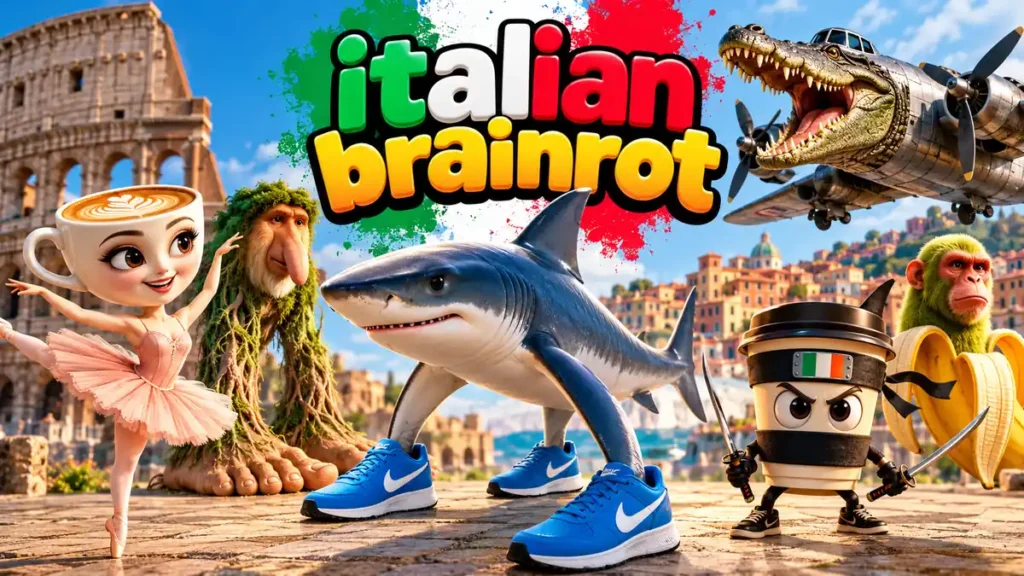
A shark walks on three legs while wearing sneakers. A crocodile becomes a military aircraft. A ballerina has a cappuccino cup for a head. None of this is supposed to make much sense—and that is exactly the point.
italian brainrot is an internet meme genre built around surreal AI-generated characters, absurd animal-object hybrids, rhythmic pseudo-Italian names, and synthetic voiceovers. The trend emerged on TikTok in early 2025, with Tralalero Tralala widely regarded as its foundational character, before expanding into dozens of characters, fan stories, remixes, games, and international variations. Know Your Meme
What initially looked like another disposable TikTok joke quickly developed into a recognizable style of internet culture. Its characters became memorable enough to exist beyond their original videos, while fans began inventing relationships, battles, family trees, rankings, and increasingly elaborate lore.
Understanding the phenomenon requires looking beyond the strange pictures. italian brainrot shows how generative AI, short-form video, repetition, remix culture, and deliberately nonsensical humor can combine to create memes at remarkable speed.
What Does italian brainrot Mean?
The name combines two ideas: Italian-style presentation and brainrot internet culture.
“Brain rot” was already established internet slang before these characters appeared. Oxford University Press named brain rot its 2024 Word of the Year after reporting that usage of the expression increased 230% between 2023 and 2024. Oxford describes it as either a perceived decline in mental or intellectual condition caused by consuming trivial material or the material believed to cause that effect. Oxford University Press
Interestingly, the expression itself is far older than TikTok. Oxford traces its first recorded use to Henry David Thoreau’s Walden in 1854. Its modern popularity, however, is strongly connected with social media and deliberately low-value or absurd online entertainment. Oxford University Press
In italian brainrot, the label is largely self-aware. Viewers know they are watching ridiculous content.
The “Italian” part comes mainly from the presentation. Characters often receive exaggerated Italian-sounding names featuring repeated syllables, rhymes, and endings such as -ini, -ino, -ila, or -ello. Many videos also use synthetic Italian narration.
That does not mean every character name is genuine Italian or that every character originated in Italy. The language is frequently intentionally distorted or completely invented.
The basic formula looks something like this:
| Element | Typical italian brainrot version |
|---|---|
| Visual | AI-generated animal/object hybrid |
| Name | Rhythmic or pseudo-Italian phrase |
| Voice | Synthetic narration |
| Story | Absurd miniature backstory |
| Format | Short vertical video |
| Logic | Intentionally inconsistent |
| Main appeal | Repetition, surprise and nonsense |
Once viewers understand that formula, they can recognize a new character almost immediately.
Where Did italian brainrot Come From?
The trend emerged in early 2025, although identifying one perfectly documented starting point is difficult because early TikTok posts were reposted, deleted, or uploaded by accounts that later disappeared.
The character most commonly treated as the beginning of the genre is Tralalero Tralala.
Know Your Meme traces early activity to January 2025 and reports that TikTok user @eZburger401 uploaded an early Tralalero Tralala video. The account was subsequently banned. Another account used the audio on January 8, while a January 13 post paired it with the now-famous AI image of a shark wearing blue sneakers and attracted millions of views. Know Your Meme
There is an additional wrinkle.
The phrase “Tralalero Tralala” existed in earlier internet content before the sneaker-wearing shark became famous. Sources tracing the meme’s history have identified versions of the phrase circulating in meme material as early as 2023. Wikipedia
So it is more accurate to say that the 2025 Tralalero Tralala character crystallized the italian brainrot format rather than claiming every element suddenly appeared in one original upload.
Once the shark became recognizable, creators could copy the structure without copying the exact character.
That opened the floodgates.
Tralalero Tralala and the First Viral Character
Tralalero Tralala established most of the visual and linguistic rules later associated with the trend.
The character is generally depicted as a three-legged shark wearing blue Nike sneakers. The combination is simple enough to understand instantly and strange enough to remember. Brainrotify
There is no logical explanation for why a shark needs sneakers.
There does not need to be one.
That absence of logic is fundamental to the joke.
The name is equally effective. “Tralalero Tralala” sounds musical and repetitive even to somebody who does not understand Italian. It functions more like a chant than a traditional character name.
The accompanying original audio, however, deserves some context. It included profanity and religiously offensive language, meaning people who encounter only sanitized remixes may not realize what appeared in some early versions. Later iterations of the meme frequently moved away from those elements. Know Your Meme
This distinction matters because much of the trend eventually became detached from the original narration. For many viewers, especially younger ones, Tralalero became simply “the shark with sneakers.”
The Most Recognizable italian brainrot Characters
There is no official company or author maintaining a definitive roster.
Anyone can generate another character, give it a memorable name, upload a video, and potentially have that creation absorbed into the broader meme universe.
Still, several characters became particularly recognizable.
Tralalero Tralala
The three-legged sneaker-wearing shark is the character most strongly associated with the beginning of italian brainrot.
Its importance comes from establishing the formula rather than possessing detailed official lore.
Bombardiro Crocodilo
Bombardiro Crocodilo typically appears as a crocodile fused with a military bomber aircraft.
The design illustrates one of the genre’s favorite tricks: merging two completely unrelated concepts into a single creature.
Its early audio also contained provocative material involving bombing and religion. That context is sometimes absent from later memes featuring the character, so simply seeing the crocodile-plane image does not reveal the full history of its original narration. archive.li
Lirili Larila
Lirili Larila is commonly represented as an elephant-cactus hybrid wandering through a desert while wearing oversized footwear.
It follows the same formula:
recognizable animal + unrelated object + strange accessories + musical name.
There is no requirement for biological or narrative consistency.
Brr Brr Patapim
Brr Brr Patapim became another prominent member of the expanding roster.
Descriptions vary somewhat because fan-generated imagery is not standardized, but it is commonly portrayed as a bizarre creature combining animal, tree, and human-like characteristics.
The repeated “Brr Brr” also demonstrates how sound itself can be more important than literal meaning.
Ballerina Cappuccina
Ballerina Cappuccina is one of the easiest characters to decode visually: a ballerina with a cappuccino cup for a head.
The character went viral on TikTok around March 2025. Know Your Meme traces a notable early video to TikTok user @aironic.fun, which paired the AI-generated dancer with Italian narration. Know Your Meme
Fans subsequently connected her romantically with another character, Cappuccino Assassino.
That relationship illustrates something important about brainrot lore: much of it is created by the community rather than established by an original creator.
Cappuccino Assassino
Cappuccino Assassino combines coffee imagery with an assassin or ninja-like character.
An early viral TikTok version appeared in March 2025 and portrayed an anthropomorphic coffee cup dressed like a ninja. Later fan-made stories connected the character with Ballerina Cappuccina and expanded their supposed relationship into elaborate fictional plots. Know Your Meme
Those stories should not be confused with official canon.
There really isn’t an official canon.
Chimpanzini Bananini
As its name suggests, Chimpanzini Bananini combines primate and banana imagery.
The name demonstrates another recurring naming technique: begin with recognizable words, alter them until they sound vaguely Italian, then use rhyme and repetition to make the result memorable.
Literal linguistic correctness is secondary.
Sound wins.
Bombombini Gusini
Bombombini Gusini is another animal-machine-style hybrid commonly associated with the broader character roster.
Like many examples, its exact appearance and story can change between uploads because different creators regenerate, redraw, animate, or reinterpret the character.
This fluid identity is normal within the genre.
Is Tung Tung Tung Sahur Actually Italian?
No—and this is one of the most useful examples of how loose the “italian brainrot” label became.
Tung Tung Tung Sahur originated from Indonesian internet culture, rather than the original Italian-style meme wave.
The character is typically depicted as a wooden humanoid carrying a bat. “Sahur” refers to the pre-dawn meal eaten before fasting during Ramadan, while the repeated “tung” imitates a striking or drumming sound associated with waking people for sahur. Wikipedia
As different absurd AI characters circulated together, audiences began grouping them into one larger “brainrot” universe regardless of their actual country of origin.
That is why lists of italian brainrot characters frequently contain creations that aren’t really Italian.
The label gradually changed from describing a specific origin to describing an internet aesthetic.
Why Do the Names Sound Italian?
Most of the names aren’t intended to function as normal Italian sentences.
They are designed to sound memorable.
Creators rely heavily on several patterns:
- rhyme and repeated syllables;
- exaggerated vowel endings;
- familiar food or animal words;
- alliteration;
- rhythmic chanting;
- deliberately incorrect or invented vocabulary.
Consider names such as Ballerina Cappuccina and Chimpanzini Bananini.
Even somebody seeing them for the first time can probably imagine how they are supposed to sound aloud.
That phonetic quality matters enormously in short-form video. A strange image may capture attention, but a repeated phrase gives viewers something they can imitate, quote, remix, and remember.
The names essentially behave like miniature jingles.
Why Did italian brainrot Become So Popular?
There isn’t one reason. Several characteristics of modern internet culture converged at the same time.
The Characters Are Instantly Understandable
You do not need a lengthy explanation to understand a crocodile fused with an airplane.
The visual contradiction is the entertainment.
That makes these memes particularly suitable for TikTok, Instagram Reels, YouTube Shorts, and other environments where creators have only seconds to capture attention.
Generative AI Makes Endless Variations Possible
Earlier meme formats generally required creators to find existing pictures, edit them manually, draw something, or record original footage.
Generative AI dramatically lowers that barrier.
A creator can imagine something like:
elephant + cactus + sandals
and produce multiple surreal interpretations quickly.
The resulting content does not have to look completely realistic. In fact, imperfections can make it stranger—and therefore more compatible with the brainrot aesthetic.
Repetition Makes the Names Stick
“Tralalero Tralala.”
“Brr Brr Patapim.”
“Tung Tung Tung Sahur.”
These names are structurally repetitive.
That matters because repetition improves recognizability. Someone might encounter a character once, hear the name several times during a short clip, and then recognize it immediately in another video.
There Is Almost No Barrier to Understanding the Joke
Traditional comedy often depends on language, cultural knowledge, timing, or context.
A shark wearing sneakers requires almost none.
Someone in Italy, Pakistan, Brazil, Indonesia, or the United States can see the same impossible image and recognize its absurdity.
The narration may be language-specific, but the visual joke travels easily.
Anyone Can Extend the Universe
There is no studio controlling the story.
Fans can create battles, romances, transformations, arrests, rankings, family trees, or entirely new creatures.
For example, an April 2025 spin-off showed various characters being arrested while an AI voice exclaimed “No, la Polizia.” The format itself then spread into additional videos. Know Your Meme
That participatory structure gives the meme remarkable flexibility.
Does italian brainrot Have Official Lore?
Not really.
This is one of the biggest sources of confusion when people first encounter character guides.
You may see claims that one character is married to another, somebody defeated another character in battle, or particular creatures belong to the same family.
Some of these stories are repeated so frequently that they begin to look official.
They usually aren’t.
Most italian brainrot lore is fan-created and decentralized.
A TikTok creator can invent a relationship today. Another account can repeat it tomorrow. A third can animate it. Eventually thousands of viewers may treat that version as established lore.
Then somebody else creates a contradictory version.
Both can circulate simultaneously.
That makes italian brainrot closer to collaborative meme mythology than a conventional fictional franchise.
Quick Takeaway
There is no single authoritative italian brainrot universe.
Character designs may be relatively recognizable, but their personalities, relationships, powers, histories, and conflicts can change depending on the creator.
How AI Shaped the Trend
AI is not merely a tool used to illustrate italian brainrot. It is central to the aesthetic.
The classic workflow can involve:
- imagining an absurd hybrid;
- generating an image with an AI image model;
- giving the creature a rhythmic name;
- creating synthetic narration;
- animating or adding motion to the image;
- placing captions, music, or sound effects over it;
- publishing it as a short-form video.
This creates an unusual feedback loop.
A successful meme inspires dozens of imitations. Generative tools make those imitations inexpensive and fast to produce. Those variations introduce more characters, which give audiences more material to remix.
The universe therefore expands extremely quickly.
It also explains why visual consistency is often poor.
One character might have three legs in one image and four in another. Clothing can change. Proportions can shift. A hybrid may even involve different animals depending on who generated the picture.
In traditional animation, those would be continuity errors.
In brainrot culture, viewers generally accept them as part of the experience.
italian brainrot vs. Traditional Memes
italian brainrot belongs to internet meme culture, but its production and spread differ from many older meme formats.
| Traditional internet memes | italian brainrot |
|---|---|
| Often remix an existing photo | Frequently uses AI-generated imagery |
| Usually starts with one template | Constantly generates new characters |
| Text carries much of the joke | Image, name and sound work together |
| Original image stays recognizable | Character appearance may change |
| Often needs contextual knowledge | Visual absurdity works immediately |
| Limited cast | Potentially unlimited characters |
The distinction isn’t absolute. Traditional memes can use AI, and italian brainrot frequently borrows normal meme-editing techniques.
What stands out is scalability.
Instead of repeatedly changing captions on one familiar image, creators can repeatedly generate entirely new creatures while preserving the underlying formula.
italian brainrot and Gen Alpha Culture
Brainrot language was already closely associated with younger internet communities before the Italian-style characters appeared.
Oxford noted that “brain rot” became especially associated with Gen Z and Gen Alpha and with self-aware discussions about consuming low-quality social media material. Oxford University Press
italian brainrot fits that environment remarkably well.
Its humor is deliberately anti-serious. The viewer does not need to uncover an intelligent punchline. Sometimes the absence of a sensible punchline is precisely what makes it funny.
The format also encourages social repetition.
Children and teenagers do not have to show someone the original TikTok to participate. They can simply repeat the names, imitate the sounds, draw the characters, argue about fictional battles, or invent new hybrids themselves.
At that point, an online meme begins functioning as playground culture.
Are the Original Audios Kid-Friendly?
Not necessarily.
The cartoonish creatures can make the trend appear automatically child-friendly, but some early viral narrations contained profanity, religious insults, violent imagery, or other provocative material.
Tralalero Tralala’s early audio included profanity and offensive religious references. Bombardiro Crocodilo’s narration also became controversial because of violent references involving Gaza and Palestine. Know Your Meme
Many later versions are harmless remixes that preserve only the characters, names, or melodies.
That distinction is useful for parents and teachers.
Seeing Ballerina Cappuccina on a child’s drawing does not necessarily mean the child encountered the original narration. Characters frequently circulate independently through games, edited clips, drawings, merchandise-style imagery, and cleaned-up videos.
At the same time, the cute or ridiculous appearance of an AI character is not reliable evidence that every associated audio is suitable for children.
Is italian brainrot Real Italian?
Only partly.
Some videos use actual Italian words or Italian-language narration. Others combine recognizable Italian vocabulary with invented expressions. Still others merely imitate what Italian sounds like to non-speakers.
Calling every name “Italian” would therefore be misleading.
For example, a name may use an Italian-associated food such as cappuccino while modifying another word to create a rhyme.
The objective is usually phonetic comedy rather than grammatical accuracy.
The phenomenon is better understood as pseudo-Italian internet wordplay mixed with genuine Italian elements, rather than a coherent form of Italian language.
And once Indonesian characters such as Tung Tung Tung Sahur were absorbed into the broader ecosystem, even the geographic part of the label became increasingly loose.
Why the Meme Is Difficult to Define
Trying to build a definitive italian brainrot encyclopedia produces an immediate problem:
the subject keeps changing.
There is no owner deciding what counts.
There is no official character database.
There is no fixed canon.
There is no required visual style.
There is not even a strict requirement that a character actually be Italian.
Instead, recognition happens socially.
If enough creators place a bizarre character alongside Tralalero Tralala, Bombardiro Crocodilo, Ballerina Cappuccina, or other familiar figures, audiences may start treating the newcomer as another member of the universe.
That is how many internet memes evolve, but generative AI accelerates the process dramatically.
What Makes a Character Feel Like italian brainrot?
Despite the lack of formal rules, recognizable examples usually share several characteristics.
First comes visual impossibility. Something familiar is combined with something that clearly does not belong.
Next comes phonetic absurdity. The name should be satisfying or funny to repeat even when it communicates little information.
Then comes synthetic presentation. AI-generated imagery and text-to-speech narration give many examples their distinctive artificial quality.
Finally comes repeatability.
A successful character must be simple enough for other people to recognize, imitate, remix, or place into a new story.
That final quality may be the most important.
Memes survive through imitation.
Is “Brainrot” a Medical Condition?
No.
The casual internet term should not be confused with a medical diagnosis or literal deterioration of brain tissue.
Oxford’s definition deliberately describes a perceived deterioration associated with consuming trivial or unchallenging content. Oxford also notes that although extended phone or social-media use may leave people feeling negatively, there is no evidence that the brain literally deteriorates simply from viewing this material. Oxford University Press
People commonly say things such as “this video gave me brainrot” humorously.
In that context, they usually mean the content is ridiculous, repetitive, strangely addictive, stuck in their head, or mentally exhausting—not that it has caused literal neurological damage.
That distinction matters when discussing the phenomenon seriously.
From Meme Format to Shared Internet Universe
The most interesting thing about italian brainrot may not be any individual character.
It is how rapidly unrelated creations became perceived as belonging together.
Tralalero Tralala supplied a recognizable template. Bombardiro Crocodilo reinforced it. Characters such as Brr Brr Patapim, Lirili Larila, Ballerina Cappuccina, Cappuccino Assassino, and Chimpanzini Bananini expanded the visual vocabulary.
Then characters from outside the original Italian-style trend, particularly Tung Tung Tung Sahur, began appearing alongside them.
Fans supplied the missing connective tissue.
They invented relationships.
They staged battles.
They created rankings.
They made family trees.
They generated alternate versions.
They turned disconnected AI images into something resembling a fictional universe.
Yet unlike Marvel, Pokémon, or another centrally controlled franchise, there is no authority deciding what happens next.
The audience effectively builds the universe while consuming it.
Why italian brainrot Matters in Internet Culture
It would be easy to dismiss the entire phenomenon as meaningless nonsense.
On one level, that’s fair. Meaninglessness is part of the joke.
But the way the trend developed says something larger about modern online culture.
Memes once depended heavily on finding and remixing existing media. Generative AI allows users to create the source material itself. Instead of waiting for a funny photograph to become a meme, creators can generate an impossible character specifically designed to become one.
Short-form platforms then provide distribution.
Text-to-speech gives characters voices.
Comments create lore.
Remixes establish relationships.
Algorithms repeatedly expose audiences to recognizable names and images.
The result is a form of internet folklore that can emerge extraordinarily quickly.
That may be the clearest explanation for why italian brainrot became bigger than the individual videos that created it.
Final Thoughts on italian brainrot
italian brainrot began as a chaotic 2025 meme style centered on surreal AI imagery, repetitive names, synthetic narration, and deliberately absurd humor. Tralalero Tralala—the three-legged shark in sneakers—is widely regarded as the character that established the recognizable formula before a rapidly expanding cast followed. Know Your Meme
What followed was less like the creation of a normal entertainment franchise and more like collaborative internet mythology.
There is no definitive storyline, no official roster, and no single creator controlling what belongs. Some characters are genuinely connected to Italian-language meme culture; others, such as Tung Tung Tung Sahur, come from elsewhere and were absorbed into the larger phenomenon.
That looseness is exactly why the trend could grow so quickly.
Anyone could understand the formula. Anyone could remix it. And with generative AI, practically anyone could create the next impossible creature.
That combination of AI-generated imagery, absurdist humor, memorable sounds, short-form video, and community-created lore is what turned italian brainrot from a strange shark in sneakers into one of the internet’s most recognizable surreal meme formats.