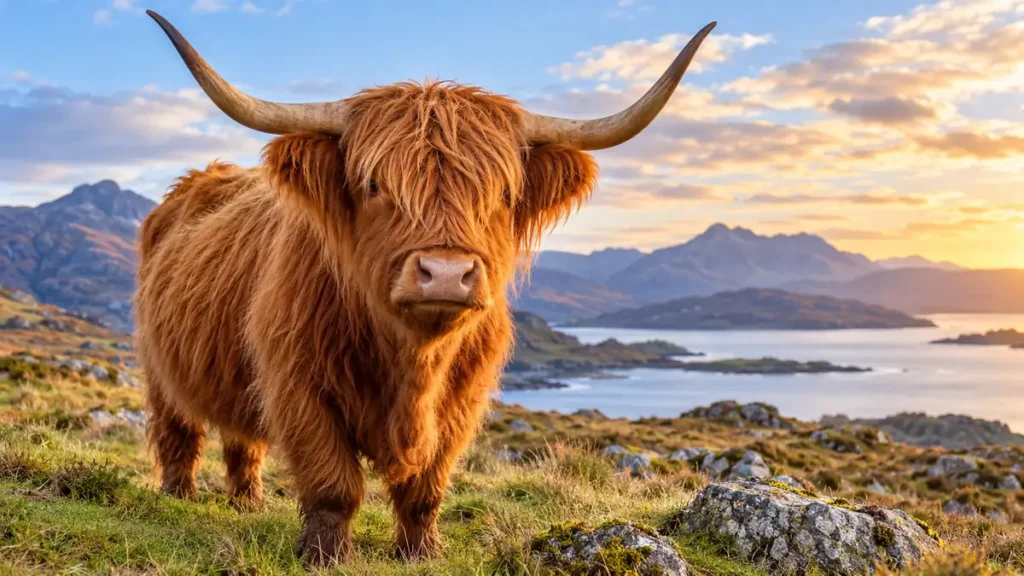
With sweeping horns, a shaggy coat, and a face hidden beneath a long fringe, the highland cow is one of the most recognizable cattle breeds in the world. Its unusual appearance is not simply decorative. Nearly every distinctive feature developed to help Highland cattle survive the cold, wet, windswept landscapes of Scotland.
A Highland cow is a female of the Highland cattle breed, an old Scottish beef breed known for its long horns, thick double coat, hardiness, efficient foraging, maternal ability, and longevity. Mature cows commonly weigh about 900–1,200 pounds, although size varies with genetics, nutrition, age, and management.
Highlands are now raised far beyond Scotland. They can be found in North America, Europe, Australia, New Zealand, and other regions where farmers value their adaptability, distinctive appearance, beef characteristics, and ability to make productive use of rough grazing.
What Is a Highland Cow?
A Highland cow is technically an adult female Highland bovine. In everyday conversation, however, people often use “Highland cow” to describe the entire breed, including bulls and calves.
Highland cattle are a traditional Scottish beef breed originating in the Highlands and western islands of Scotland. They are medium-sized cattle characterized by:
- Long, sweeping horns
- A long, shaggy outer coat
- A softer insulating undercoat
- A broad head and prominent fringe, known as the dossan
- Strong legs and feet
- Good foraging ability
- Hardiness in difficult weather
- Strong maternal instincts
- Relatively long productive lives
The American Highland Cattle Association describes Highlands as hardy, self-sufficient, long-lived cattle and notes that they are effective foragers capable of utilizing pastures and woodlots.
Their dramatic appearance sometimes makes them look like an ornamental breed, but Highlands were shaped by generations of practical agricultural use.
Where Do Highland Cows Come From?
The Highland breed developed in Scotland, particularly in the rugged Highlands and western islands.
For centuries, cattle living there faced challenging conditions: strong winds, heavy rainfall, cold winters, mountainous terrain, and vegetation that was often less productive than pasture available to cattle in lower, more fertile regions.
These environmental pressures favored animals capable of surviving efficiently.
The American Highland Cattle Association traces the breed’s history back many centuries and notes that the first Highland herd book was published in 1885 by the Highland Cattle Society in Scotland.
Historically, two types were recognized.
The Kyloe
The Kyloe was generally associated with the western islands of Scotland. It was typically smaller and commonly black.
Mainland Highland Cattle
Cattle from the mainland Highlands tended to be somewhat larger and were often reddish in color.
These populations eventually came to be treated as one Highland breed.
The Highland Cattle Society still maintains pedigree records, and the breed has since spread internationally. Highland cattle are now established in countries including the United States, Canada, Australia, New Zealand, and numerous European nations.
What Does a Highland Cow Look Like?
The easiest features to recognize are the coat and horns, but good Highland cattle have several characteristic structural traits.
Their heads are relatively broad, while the body should appear strong and balanced rather than excessively large. The legs are comparatively short and sturdy.
According to the American Highland Cattle Association breed standard, desirable animals have broad, deep bodies, strong legs, well-developed hindquarters, and long, prolific hair capable of providing protection in harsh conditions.
The Famous Shaggy Coat
A Highland’s hair is one of its defining adaptations.
Rather than relying solely on body fat for insulation, Highland cattle possess a double hair coat consisting of:
- A long, coarse outer layer
- A softer, woolly insulating undercoat
The outer hair helps protect the animal from rain, wind, and snow, while the undercoat provides insulation.
This combination is particularly useful in cold, wet environments.
Their coat also changes seasonally. Animals living in warmer conditions typically shed much of their heavy winter hair as temperatures rise.
The Dossan
The thick fringe of hair covering the forehead is traditionally called the dossan.
It contributes heavily to the characteristic Highland appearance. The hair around the head and eyes also provides some physical protection from weather and insects.
Highland Cow Colors
Red may be the color most strongly associated with Highland cattle, but it is far from the only one.
Recognized Highland colors include:
| Color | Description |
|---|---|
| Red | Classic reddish or ginger coat |
| Yellow | Light golden or cream-gold appearance |
| Black | Historically associated particularly with island cattle |
| Dun | Muted brownish or gray-brown coloration |
| Brindle | Mixture or striping of darker and lighter hairs |
| Silver | Pale gray or silvery appearance |
| White | Very light coat coloration |
The American Highland Cattle Association recognizes red, yellow, white, brindle, black, dun, and silver.
Color alone does not determine whether an animal is a good representative of the breed. Structure, health, genetics, temperament, reproductive ability, and functional traits matter considerably more.
How Big Is a Highland Cow?
Highlands are generally considered medium-framed cattle.
The American Highland Cattle Association states that mature cows average approximately 900–1,200 pounds, while mature bulls commonly average around 1,500–1,800 pounds, depending partly on forage conditions.
The Livestock Conservancy gives a somewhat broader range, listing cows around 900–1,300 pounds and bulls around 1,500–2,000 pounds.
That variation is normal.
Adult size depends on factors such as:
- Genetics
- Sex
- Age
- Nutrition
- Pasture quality
- Health
- Climate
- Breeding selection
- Overall management
A Highland raised on rich forage under intensive management may develop differently from an animal maintained primarily on marginal upland pasture.
Highland Cow vs. Highland Bull
Bulls are substantially heavier and more muscular than mature cows.
Their necks and shoulders tend to be more powerful, while cows usually have a more feminine, less heavily muscled profile.
Horn shape can also differ.
Breed standards describe bull horns as generally stronger and extending outward from the head before curving forward or upward. Cow horns are typically longer and often show a wider, more sweeping upward curve.
Why Do Highland Cows Have Horns?
Both male and female traditional Highland cattle can have horns.
The horns are one of the breed’s most recognizable characteristics, but their shape changes with sex, age, genetics, and individual development.
Historically, horns were a functional characteristic as well as part of the breed’s appearance.
For modern owners, however, horns introduce an important management consideration.
Even a calm animal can accidentally injure another cow or a handler simply by moving its head. Facilities, gates, feeders, trailers, and handling systems therefore need enough room for horned cattle.
Handlers should never assume that a docile animal’s horns are harmless.
Highland Cow Temperament
Highland cattle are commonly described as relatively docile and manageable when properly raised and handled.
The Livestock Conservancy lists the breed’s temperament as docile, while breed organizations also emphasize the Highland’s manageable nature.
That does not mean every Highland behaves the same way.
Temperament is influenced by:
- Genetics
- Early handling
- Human interaction
- Herd environment
- Stress
- Sex
- Maternal behavior
- Individual personality
A cow protecting a young calf may behave differently from the same animal at another time.
Bulls require particular caution. A quiet bull remains a large, powerful animal capable of causing serious injury.
Good cattle handling depends on understanding flight zones, avoiding unnecessary stress, maintaining suitable facilities, and respecting the animal’s space.
Why Are Highland Cattle So Hardy?
Hardiness is one of the characteristics most closely associated with the breed.
Highlands developed under environmental conditions that rewarded animals capable of coping with poor weather and variable forage.
Several features contribute to this resilience.
Double Hair Coat
The dense winter coat provides insulation against cold weather while the long outer hair helps shed moisture.
Efficient Foraging
Highlands can utilize a wide variety of vegetation and are known for browsing as well as grazing.
The Livestock Conservancy notes that the breed consumes grasses along with various other plants and can be useful in pasture management.
Strong Feet and Legs
Their sturdy structure helps them move across uneven ground.
Moderate Body Size
A moderate frame can be advantageous where forage resources are limited because maintenance requirements may be lower than those of very large cattle.
These characteristics explain why Highlands have historically performed well on hill and upland ground.
Hardiness, however, should never be confused with an absence of care requirements.
Highland cattle still need appropriate nutrition, clean water, minerals, veterinary attention, safe fencing, and protection from environmental extremes.
Can Highland Cows Live in Warm Climates?
Yes, Highland cattle are raised successfully outside cold northern climates, but heat management deserves attention.
Their heavy coat is exceptionally useful during winter. In warmer seasons, Highlands normally shed much of that winter hair.
The Australian Highland Cattle Society reports that Highland cattle have adapted to varying Australian climates and shed into a lighter summer coat, although access to shade remains valuable in hot conditions.
In hot environments, owners should provide:
- Reliable clean water
- Adequate shade
- Good airflow
- Appropriate stocking density
- Suitable handling times
- Observation for heat stress
Handling or transporting cattle during the hottest part of a summer day can unnecessarily increase stress.
Animals adapted to the local climate may also perform better than cattle abruptly moved from a dramatically different environment. The American Highland Cattle Association specifically advises considering cattle from climates similar to the buyer’s farm.
What Do Highland Cows Eat?
Highland cattle are ruminants, so forage forms the foundation of their diet.
Depending on the farm and season, this may include:
- Pasture grasses
- Hay
- Browsed vegetation
- Suitable forage crops
- Supplemental feed when required
- Mineral supplementation
Their reputation for surviving on rough forage should not be interpreted as meaning that poor-quality nutrition is always adequate.
Maintenance, pregnancy, lactation, growth, and cold weather can all change nutritional requirements.
A lactating cow raising a calf has different needs from a mature dry cow.
Similarly, rapidly growing young stock may require better-quality forage than mature animals maintained at a stable body condition.
Do Highland Cows Need Grain?
Not automatically.
Whether supplementation is appropriate depends on forage quality, production goals, animal condition, age, reproductive stage, and local management.
A well-managed pasture or forage program may meet much of an adult animal’s nutritional needs. When forage does not provide enough energy, protein, minerals, or other nutrients, supplementation may be necessary.
Body condition and forage analysis are much more useful guides than assuming every Highland needs the same ration.
How Much Land Does a Highland Cow Need?
There is no universally correct number of acres per Highland cow.
Stocking rate depends heavily on:
- Soil fertility
- Rainfall
- Pasture productivity
- Growing season
- Forage species
- Grazing management
- Supplemental feeding
- Terrain
- Drought conditions
One acre of productive irrigated pasture is completely different from one acre of dry, rocky land.
For that reason, prospective owners should calculate stocking rates using local agricultural guidance rather than relying on a generic online rule.
Rotational grazing can help distribute grazing pressure and allow pasture recovery, but it does not create forage where insufficient rainfall or soil productivity exists.
Highland Cattle and Conservation Grazing
One particularly interesting modern role for Highland cattle is conservation grazing.
Their browsing ability and capacity to use rough vegetation can make them useful for managing certain marginal landscapes.
The Livestock Conservancy highlights Highland cattle’s role in range management and conservation grazing, including their ability to utilize vegetation beyond conventional pasture grasses.
However, conservation grazing still requires planning.
Stocking density, season, sensitive plants, soil conditions, waterways, and habitat goals should all influence how cattle are introduced and managed.
Highland Cow Lifespan
Highland cattle have a reputation for longevity.
The Highland Cattle Society reports that some Highland cows remain reproductively productive beyond 18 years of age and may raise numerous calves over their lifetime.
That should not be interpreted as a guaranteed lifespan for every animal.
Longevity depends on:
- Genetics
- Nutrition
- Dental condition
- Reproductive health
- Injury
- Disease
- Parasite control
- Hoof and structural soundness
- Environmental conditions
- Overall management
Their potential for a long productive life is nevertheless one reason the breed has remained attractive to many breeders.
Highland Cow Pregnancy and Calves
Highland cows are well known for their maternal characteristics.
Breed organizations frequently describe them as attentive mothers with strong mothering instincts. The American Highland Cattle Association specifically includes maternal ability among important breed characteristics.
As with other cattle, pregnancy lasts roughly nine months.
Calving management should include observation for problems without unnecessary interference. Even breeds known for relatively straightforward calving can experience dystocia or other complications.
What Does a Highland Calf Look Like?
Highland calves have the same unmistakable fluffy appearance associated with adults, although their horns develop as they grow.
Calves may be born in any of the recognized breed colors.
Young animals need:
- Adequate colostrum shortly after birth
- Protection from severe weather
- Observation for nursing problems
- Appropriate nutrition as they grow
- Routine health management
- Safe fencing
The cow’s maternal behavior is valuable, but it also means handlers should use additional caution around newborn calves.
Are Highland Cows Miniature?
Standard Highland cattle are not miniature cattle.
This is an increasingly important distinction because small, fluffy cattle are popular on social media.
Highlands naturally have a moderate frame, but a healthy standard Highland cow should not automatically be described as a “mini Highland.”
Some breeders select specifically for smaller cattle, and Highland crosses may also be marketed using terms such as miniature, micro, or mini.
These marketing descriptions do not necessarily represent the traditional Highland breed standard.
Anyone buying cattle should therefore ask for actual information rather than relying on labels.
Useful questions include:
- What are the mature heights of the parents?
- What do mature animals from the same bloodline weigh?
- Is the animal purebred or crossbred?
- Is pedigree documentation available?
- Which registry, if any, recognizes the animal?
- Is the animal naturally small or simply young?
A young Highland calf may look tiny in a photograph but will continue growing for years.
Are Highland Cows Good Pets?
Highlands can become accustomed to people, but they remain livestock rather than oversized household pets.
A mature cow weighing around half a ton has enough strength to cause injury accidentally. Horns create another risk that should never be ignored.
Owners need proper:
- Fencing
- Handling facilities
- Feed storage
- Water systems
- Shelter or shade
- Veterinary access
- Pasture management
- Livestock experience
Friendly behavior can make routine management easier, but treating cattle as if they have no boundaries can create dangerous habits.
It is better to develop calm, respectful livestock than cattle that push, rub, crowd, or challenge people for food.
Are Highland Cows Good for Small Farms?
They can be.
Their moderate size, grazing ability, distinctive appearance, and adaptability make Highlands appealing to smaller livestock operations.
They may be used for:
- Beef production
- Breeding stock
- Conservation grazing
- Pasture management
- Agritourism
- Heritage breed programs
- Small-scale livestock farming
The breed’s visual appeal is particularly useful for farms involved in agritourism, but appearance should not overshadow practical management requirements.
Before buying Highlands, a smallholder needs to consider winter feed, fencing, handling equipment, veterinary access, pasture capacity, breeding plans, and what will happen to calves.
Owning two attractive cattle in summer is relatively simple compared with feeding and managing an expanding herd through several winters.
Highland Beef Characteristics
Highland cattle are fundamentally a beef breed.
Their coat provides substantial insulation, allowing them to remain productive without relying exclusively on a heavy layer of subcutaneous fat for protection from cold weather.
Breed organizations promote Highland beef for its eating quality, including tenderness, flavor, and comparatively lean characteristics.
Actual carcass composition and meat quality, however, depend on many variables, including:
- Genetics
- Age
- Diet
- Growth rate
- Finishing system
- Carcass weight
- Processing
- Aging
- Cooking method
The breed’s ability to utilize rough grazing is particularly relevant to producers interested in extensive beef systems.
Highlands generally mature more slowly than some highly specialized commercial beef breeds, so producers need realistic expectations about growth and finishing time.
Highland Cow vs. Other Cattle Breeds
The Highland’s strongest differences become clear when compared with conventional beef cattle.
| Feature | Highland Cattle | Many Conventional Beef Breeds |
|---|---|---|
| Coat | Long double coat | Usually shorter coat |
| Horns | Traditionally horned | Horned or polled depending on breed |
| Frame | Moderate | Varies from moderate to large |
| Cold-weather adaptation | Excellent | Breed dependent |
| Rough forage ability | Strong | Breed dependent |
| Maturity | Relatively slow | Often faster in commercial breeds |
| Maternal ability | Strong reputation | Varies |
| Appearance | Extremely distinctive | Varies widely |
| Typical use | Beef, grazing, breeding, agritourism | Primarily beef production |
No breed is automatically superior for every farm.
Highlands may be particularly attractive where hardiness, extensive grazing, maternal ability, longevity, or breed identity are priorities.
A commercial operation focused primarily on maximum growth rate or rapid finishing may choose cattle selected specifically for those objectives.
How to Care for Highland Cattle
The breed’s rugged reputation sometimes creates the misleading impression that Highlands can simply be placed in a field and forgotten.
They cannot.
Provide Reliable Water
Clean drinking water must remain available throughout the year.
Winter systems should be protected against freezing where necessary, while hot climates require enough water capacity to meet increased consumption.
Maintain Adequate Nutrition
Pasture should be monitored rather than assumed to be sufficient.
Hay or other stored forage is normally necessary when pasture growth slows or stops.
Supply Appropriate Minerals
Mineral requirements vary geographically because soil and forage mineral profiles differ.
A livestock veterinarian or local agricultural nutrition specialist can help determine an appropriate program.
Use Secure Fencing
Highlands are cattle, so fencing must be designed for livestock.
Electric fencing can be useful within a properly designed grazing system, but perimeter security remains important.
Design Facilities for Horns
Feeders, gates, alleys, head restraints, and trailers need sufficient space for horned animals.
A setup designed only for polled commercial cattle may not work safely for mature Highlands.
Watch Body Condition
The thick coat can conceal weight loss.
This is one of the most practical management lessons for new Highland owners.
Do not judge condition only by looking at the animal from a distance. Learn appropriate hands-on or structured body-condition assessment techniques for cattle.
Maintain a Herd Health Program
Vaccination, parasite management, reproductive care, disease prevention, and veterinary treatment should be based on local disease risks and professional veterinary guidance.
Hardiness does not make an animal immune to illness.
Common Mistakes New Highland Owners Make
The most frequent problems often come from misunderstanding what “low maintenance” really means.
Buying for Appearance Alone
A fluffy calf is appealing, but livestock ownership requires years of feed, land, fencing, veterinary care, and daily responsibility.
Underestimating Adult Size
That small calf can become a 1,000-pound adult cow or a much heavier bull.
Facilities should be designed for mature animals from the beginning.
Ignoring Horn Clearance
Standard cattle feeders or narrow gates can become problematic when mature horns develop.
Assuming Rough Forage Means No Nutrition Management
Highlands are efficient foragers, but inadequate nutrition still causes poor condition, reproductive problems, and reduced performance.
Overfeeding
The opposite mistake also occurs.
Cattle adapted to efficient forage utilization do not necessarily benefit from excessive energy supplementation. Feeding should match body condition and production requirements.
Ignoring Summer Heat
Cold tolerance receives most of the attention, but animals living in hot regions still require shade, water, airflow, and sensible handling.
Treating a Bull Like a Pet
This can create serious safety problems.
Bulls should be handled consistently and with appropriate facilities, regardless of breed or apparent temperament.
What Should You Look for When Buying a Highland Cow?
Start with your purpose.
An animal suitable for a family grazing property may not be the same animal a pedigree breeder wants for a registered herd.
Look for:
- Sound feet and legs
- Healthy body condition
- Clear eyes
- Normal movement
- Appropriate temperament
- Healthy coat and skin
- Suitable udder structure in breeding females
- Reproductive history when available
- Reliable identification
- Pedigree records when relevant
- Herd health information
For registered cattle, verify paperwork with the appropriate breed registry rather than relying only on the seller’s description.
In the United States, the American Highland Cattle Association maintains registration requirements for qualifying animals. Its 2026 rules distinguish fullblood Highland cattle from qualifying Highland crossbreds registered separately.
Why Are Highland Cows So Popular?
The obvious answer is appearance.
Few cattle breeds are as instantly recognizable. The combination of sweeping horns, long hair, broad muzzle, and calm-looking expression makes Highlands exceptionally photogenic.
But their popularity has deeper roots.
Farmers have continued to raise them because the breed combines visual appeal with functional characteristics:
- Hardiness
- Efficient forage use
- Maternal ability
- Longevity
- Adaptability
- Beef production
- Conservation grazing potential
Their history also gives them strong cultural associations with Scotland.
The Highland Cattle Society describes the breed as one of Britain’s oldest and best-known cattle breeds, with pedigree records extending back to the nineteenth century.
Interesting Highland Cow Facts
Several facts help explain why this breed attracts so much attention.
Highlands are an old registered breed. Their formal herd book dates to 1885.
Red isn’t the only Highland color. Black, yellow, dun, brindle, white, and silver are also recognized.
Both sexes traditionally have horns. Cow and bull horn shapes tend to develop differently.
Their coat has two layers. A long outer layer works with a softer insulating undercoat.
They are genuine beef cattle. Despite their popularity in photographs and agritourism, Highlands were developed and maintained as productive livestock.
They can have long reproductive lives. The Highland Cattle Society reports cows breeding beyond 18 years in some cases.
They are used in conservation grazing. Their ability to browse and utilize varied vegetation has created a modern role in landscape management.
Is a Highland Cow Right for Your Farm?
A Highland cow can be a good fit when the farm’s environment and management system suit the breed.
Highlands are particularly worth considering if you value hardy cattle, moderate mature size, maternal ability, forage efficiency, longevity, and a distinctive heritage breed.
They are not maintenance-free animals.
Owners still need suitable acreage, winter feed where required, secure fencing, cattle-handling facilities, veterinary care, mineral supplementation, and a plan for breeding and offspring.
The horns also require more thoughtful facility design than many new owners expect.
For someone prepared for normal cattle management, however, the Highland’s reputation is based on much more than its appearance.
Final Thoughts on the Highland Cow
The highland cow has survived as a recognizable breed because its famous features have practical roots. The shaggy double coat protects against difficult weather, its moderate frame and foraging ability suit challenging landscapes, and Highland cows have long been valued for maternal ability and productive longevity.
Modern Highlands can now be found far beyond their Scottish homeland, working as beef cattle, breeding stock, conservation grazers, and highly recognizable members of small farms and agritourism operations.
Their long hair and sweeping horns may be what people notice first. What makes the Highland breed genuinely interesting, though, is the combination of history, adaptation, resilience, and practical agricultural usefulness underneath that unmistakable coat.