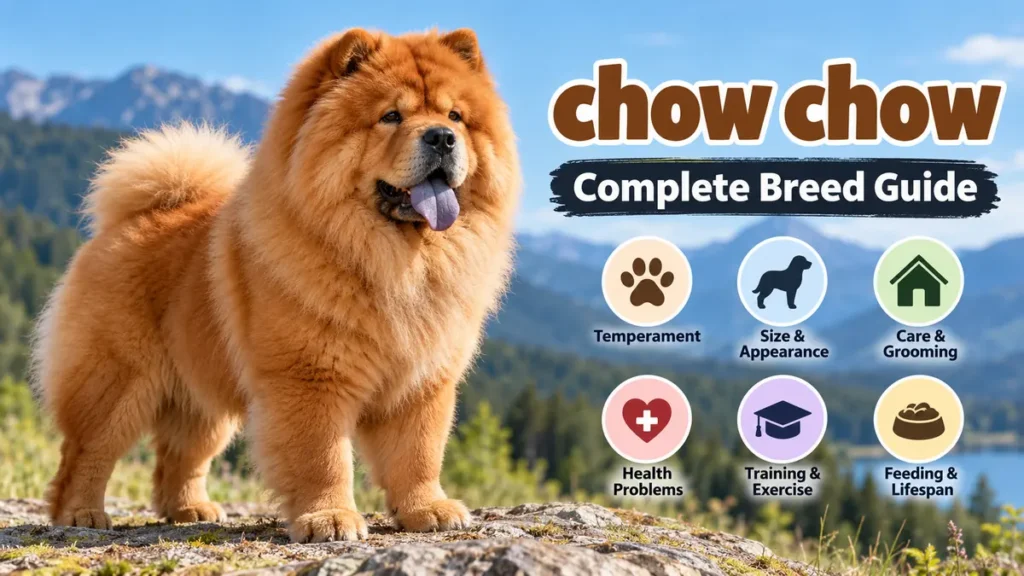
With its lion-like mane, compact build, and unmistakable blue-black tongue, the chow chow is one of the most distinctive dog breeds in the world. Behind that dramatic appearance is an independent, dignified dog that tends to form strong bonds with its family while remaining reserved around unfamiliar people.
The chow chow is an ancient Chinese dog breed known for its dense double coat, blue-black tongue, curled tail, and independent temperament. Adults generally stand 17–20 inches tall and weigh 45–70 pounds. They need early socialization, patient training, regular grooming, moderate exercise, and careful management in hot weather. American Kennel Club
| Chow Chow at a Glance | Typical Characteristics |
|---|---|
| Origin | China |
| Breed group | Non-Sporting Group |
| Height | 17–20 inches |
| Weight | 45–70 pounds |
| Life expectancy | 8–12 years |
| Coat | Rough or smooth double coat |
| Colors | Red, black, blue, cinnamon, cream |
| Temperament | Independent, loyal, reserved, dignified |
| Exercise needs | Moderate |
| Grooming needs | High |
| Distinctive feature | Blue-black tongue |
The breed’s independent personality means that choosing a Chow should be about more than its teddy-bear appearance. Understanding how these dogs think, interact, exercise, and respond to training is essential before bringing one home.
What Is a chow chow?
The chow chow, commonly shortened to “Chow,” is a sturdy, compact dog originating in China. The American Kennel Club places it in the Non-Sporting Group and describes the breed as dignified, bright, and serious-minded. American Kennel Club
Its physical appearance is unusually distinctive. A typical Chow has a broad head, small upright ears, deep-set almond-shaped eyes, substantial bone, and a tail carried over its back.
The dense coat around the neck and shoulders creates the famous lion-like ruff. Beneath that impressive coat is a muscular, almost square-bodied dog rather than an enormous one.
Another recognizable feature is the breed’s gait. Chows traditionally have a short, somewhat stilted movement associated with their relatively straight hind legs. American Kennel Club
Why Does a chow chow Have a Blue Tongue?
A solid blue-black tongue is one of the breed’s defining characteristics.
Interestingly, puppies are not born with fully blue-black tongues. They begin with pink tongues, and pigmentation develops as they mature. The exact historical reason the breed developed this characteristic remains uncertain. American Kennel Club
A dark spot on another dog’s tongue does not automatically indicate Chow ancestry. Pigmented tongue spots occur in several other breeds. The Chinese Shar-Pei is another breed particularly associated with blue-black oral pigmentation. American Kennel Club
chow chow History and Origin
The history of the Chow stretches far back into China.
Dogs resembling modern Chows appear in artifacts associated with China’s Han Dynasty, which lasted from 206 BCE to 220 CE. Over the centuries, these versatile dogs served several roles, including guarding, hunting, hauling, and companionship. PetMD
Genetic research also supports the breed’s deep East Asian roots. A genomic study described the Chow as one of the basal East Asian dog lineages and estimated its origin from Chinese indigenous dogs at roughly 8,300 years ago. PubMed Central (PMC)
The breed eventually attracted attention outside China. Chows were displayed at London’s zoological gardens during the 1820s as unusual dogs from China. Interest increased in Britain later in the nineteenth century, and the breed subsequently reached the United States.
The American Kennel Club registered its first Chow Chow in 1903. Purina
Despite its ancient Asian heritage, the familiar English name “Chow Chow” itself is generally associated with terminology used by Western traders for assorted goods imported from the East rather than an original Chinese breed name.
chow chow Size, Weight, and Appearance
A full-grown Chow is substantial without being exceptionally tall.
According to the American Kennel Club, adults generally measure 17–20 inches at the shoulder and weigh 45–70 pounds. American Kennel Club
Individual dogs can naturally fall at different points within that range depending on sex, frame, genetics, conditioning, and overall health.
Rough Coat vs. Smooth Coat
There are two coat varieties:
Rough-coated Chows have the abundant appearance most people associate with the breed. Their outer coat stands away from the body, while the particularly thick fur around the neck forms a prominent ruff.
Smooth-coated Chows have shorter outer hair but retain the dense double-coat structure and recognizable Chow body shape.
Both have an insulating undercoat and require regular maintenance.
chow chow Colors
The AKC recognizes five standard colors:
- Red
- Black
- Blue
- Cinnamon
- Cream
These colors can vary considerably in shade. For example, red dogs can range from lighter golden-red tones to much deeper coloration.
The combination of small ears, broad skull, dense coat, curled tail, dark tongue, and distinctive movement gives the breed an appearance that is difficult to confuse with most other dogs. American Kennel Club
chow chow Temperament and Personality
Understanding the chow chow temperament is arguably more important than understanding its grooming requirements.
These dogs are typically independent, intelligent, loyal, and reserved. They can develop a powerful attachment to their household without displaying affection as openly as many highly social breeds.
A Chow may enjoy being near its owner without constantly asking for physical attention.
That independence is sometimes described as “cat-like.” While the comparison is imperfect, it captures something important: many Chows prefer interaction on their own terms.
Are Chow Chows Friendly?
They can be affectionate with people they know well, but they are generally not naturally enthusiastic about meeting every stranger.
Reserved behavior should not automatically be confused with aggression. A properly socialized adult can calmly acknowledge unfamiliar people without wanting attention from them.
Early experiences matter greatly, however.
Puppies should gradually encounter different people, environments, surfaces, noises, handling situations, and appropriate dogs while they are young. Socialization should build confidence rather than force interaction.
The goal is not to transform an independent breed into an extremely outgoing one. It is to teach the dog how to respond calmly and appropriately to normal life.
Are Chow Chows Protective?
Their historical guarding background and natural wariness can make Chows alert to unfamiliar activity.
That characteristic makes training especially important. Owners need to teach appropriate responses rather than encouraging unnecessary suspicion or territorial behavior.
A well-managed Chow should be stable and controllable.
Are Chow Chows Good With Children?
They can live successfully with children, but household circumstances matter.
Chows generally appreciate predictable, respectful interactions and may be less tolerant of chaotic handling than exceptionally playful family breeds. AKC guidance emphasizes supervision around young children, while PetMD notes that the breed often does better in households with older children. American Kennel Club
Children should learn not to climb on a dog, pull its fur, disturb it while eating, or corner it when it wants space.
No young child should be left unsupervised with any dog.
Can Chow Chows Live With Other Dogs?
Some can, particularly when appropriately socialized from puppyhood, but the breed is not generally known for being highly social with unfamiliar dogs.
Individual temperament varies considerably.
Controlled introductions, adequate personal space, resource management, and early socialization become particularly important in multi-pet households.
Training a chow chow
Training a Chow requires a different approach from training a dog that constantly seeks approval.
Chows are intelligent, but intelligence does not necessarily equal automatic obedience. Their independent nature means they may question repetitive exercises or disengage when sessions become frustrating.
AKC guidance recommends patience, praise, regular practice, and positive, consistent reinforcement while avoiding harsh methods. American Kennel Club
Start Training Early
Begin with practical everyday behaviors:
- Responding to their name.
- Coming when called.
- Walking calmly on a leash.
- Sitting and waiting when asked.
- Allowing paws, ears, teeth, and coat to be handled.
- Settling quietly around visitors.
- Leaving objects when instructed.
Short sessions usually work better than repeatedly drilling the same exercise.
Consistency also matters. If one household member allows behavior that another person prohibits, an independent dog quickly learns where the boundaries are flexible.
Socialization Is Part of Training
Socialization does not mean letting every stranger touch your puppy.
Instead, create controlled positive exposure.
Let the puppy observe traffic, bicycles, children, veterinarians, grooming tools, friendly dogs, delivery workers, household appliances, and unfamiliar environments at a comfortable distance.
Handling exercises are particularly valuable because a heavily coated adult Chow will require regular brushing, veterinary examinations, nail trimming, and occasional professional grooming.
How Much Exercise Does a chow chow Need?
Chows usually have moderate rather than extreme exercise requirements.
Regular walks and controlled play can help maintain muscle, body condition, mental stimulation, and general health. The AKC recommends daily walks and moderate play and specifically cautions against exercising Chows during hot periods because they do not tolerate high heat and humidity particularly well. American Kennel Club
PetMD suggests that a couple of roughly 20-minute walks daily may suit many adult Chows. Individual requirements vary with age, fitness, health, temperature, and veterinary advice. PetMD
Heat Requires Extra Attention
That magnificent coat comes with a drawback.
Chows can struggle in hot conditions, making summer exercise management essential. Walk during cooler morning or evening periods, provide shade and fresh water, and avoid strenuous activity during extreme heat.
Watch for signs of overheating such as excessive panting, weakness, distress, abnormal drooling, or difficulty recovering after activity. Heat-related illness can become an emergency.
Mental exercise matters too. Short training sessions, sniffing opportunities, food puzzles, and structured exploration can provide stimulation without demanding intense physical activity.
chow chow Grooming and Shedding
Anyone considering this breed should be comfortable with regular grooming.
Both rough and smooth varieties have double coats, although the rough variety requires particularly careful maintenance. Shedding occurs throughout the year and can become substantially heavier seasonally. PetMD recommends frequent brushing to control shedding and prevent matting. PetMD
A Practical Grooming Routine
A useful routine includes:
Frequent brushing: Work through the entire coat rather than simply brushing the visible surface. Pay attention to dense areas where loose undercoat and tangles can accumulate.
Bathing when necessary: Use products formulated for dogs and thoroughly dry the dense coat afterward.
Nail trimming: Overgrown nails can affect comfort and movement.
Dental care: Regular tooth brushing and veterinary dental assessments support long-term oral health.
Eye checks: Watch for redness, discharge, swelling, excessive tearing, or squinting.
Ear checks: Look for unusual odor, discharge, redness, or irritation.
Starting these routines during puppyhood makes future grooming much easier.
Do Chow Chows Shed?
Yes.
The dense double coat means owners should expect hair around the home. Seasonal coat changes can produce particularly noticeable shedding.
Someone looking specifically for a low-shedding dog may find this breed difficult to manage.
Are Chow Chows Hypoallergenic?
No. Chows are not generally considered hypoallergenic, and their substantial shedding can be problematic for some people with dog allergies. PetMD
Anyone with significant allergies should spend time around the breed before making a long-term commitment.
chow chow Health Problems
Chows can live healthy lives, but the breed has predispositions to several medical conditions.
AKC lists concerns including entropion, hip dysplasia, elbow dysplasia, allergies, and thyroid problems. American Kennel Club
Knowing the warning signs helps owners seek veterinary care earlier.
Entropion and Other Eye Problems
Entropion occurs when an eyelid rolls inward, causing hair or eyelashes to rub against the eye.
Possible symptoms include:
- Squinting
- Excessive tearing
- Eye rubbing
- Redness
- Discharge
- Visible discomfort
Persistent eye symptoms deserve prompt veterinary evaluation because chronic irritation can damage the eye.
Hip and Elbow Dysplasia
Hip and elbow dysplasia involve abnormal joint development and can eventually contribute to pain, reduced mobility, or arthritis.
Signs can include stiffness, reluctance to jump, difficulty rising, limping, or changes in activity.
Maintaining appropriate body condition reduces unnecessary stress on joints, although weight management cannot eliminate inherited risk.
Thyroid Problems
Thyroid dysfunction can affect metabolism and produce varied symptoms. Changes in coat quality, activity, body weight, or skin can have many causes, so diagnosis requires veterinary evaluation rather than assumptions based on appearance.
Skin and Allergy Problems
A Chow’s dense coat can hide skin irritation surprisingly well.
During grooming, part the coat and check the skin for redness, sores, unusual odor, excessive flaking, hair loss, or persistent scratching.
Regular grooming therefore serves two purposes: maintaining the coat and creating opportunities to detect physical changes early.
Responsible Health Screening
When obtaining a puppy from a breeder, ask for documented health information rather than relying on statements that the parents “look healthy.”
The Orthopedic Foundation for Animals’ CHIC program works with breed clubs to establish breed-specific screening protocols and makes submitted results accessible. Importantly, receiving a CHIC number indicates that required tests were completed and made public; it does not automatically mean every result was normal. OFA
That distinction is useful when evaluating breeder health records.
Feeding and Weight Management
There is no single diet that is ideal for every Chow.
Food should be nutritionally complete and appropriate for the dog’s life stage, body condition, activity level, and medical needs. Puppies, adults, seniors, and dogs with particular health conditions may require different nutritional strategies.
Portion control matters because extra body weight places additional stress on joints.
Rather than judging weight through all that fur, regularly feel your dog’s body condition and discuss appropriate weight with your veterinarian.
Treats also count toward daily calorie intake. Training rewards can be kept small, especially when multiple sessions happen throughout the day.
Fresh water should always be available.
If a dog develops persistent digestive problems, itching, recurrent skin problems, or unexplained weight changes, consult a veterinarian rather than repeatedly changing diets without determining the underlying cause.
Is a chow chow a Good First Dog?
For many first-time owners, the breed can be challenging.
The difficulty is not necessarily excessive energy. Instead, it comes from the combination of independence, reserved social behavior, physical strength, grooming requirements, and the importance of early training.
PetMD notes that their strong-willed nature can make Chows less suitable for inexperienced owners. PetMD
A committed first-time owner can still succeed by learning about canine behavior, enrolling in appropriate puppy training, socializing carefully, and establishing a grooming routine immediately.
What tends not to work is choosing the breed solely because the puppy resembles a teddy bear.
That puppy will become a strong adult dog with definite preferences and boundaries.
Can a chow chow Live in an Apartment?
Potentially, yes.
Chows are not typically hyperactive dogs and can adapt to city living when their physical and mental needs are met. The AKC describes them as adaptable dogs without unusually demanding exercise requirements. American Kennel Club
Apartment success depends on more than square footage, though.
Owners still need to provide regular outdoor exercise, training, social exposure, enrichment, and comfortable indoor temperatures.
Climate may matter more than home size. A cool apartment with appropriate daily walks can be more suitable than a large property where the dog is expected to spend long periods outdoors in extreme heat.
What Is the chow chow Lifespan?
The AKC gives a typical chow chow lifespan of 8–12 years. American Kennel Club
That range is a general breed estimate rather than a prediction for an individual animal.
Genetics, responsible breeding, nutrition, body condition, preventive veterinary care, dental health, exercise, accident prevention, and early treatment of disease can all influence an individual dog’s health and longevity.
Routine veterinary visits become particularly valuable as the dog ages because subtle changes in movement, vision, skin, appetite, or activity may otherwise be difficult to notice.
Male vs. Female chow chow
Sex alone is not a reliable way to predict an individual dog’s personality.
Males and females share the fundamental characteristics of the breed: independence, loyalty, reserve, and the need for thoughtful socialization.
Size can differ somewhat between individual males and females, but genetics and family lines also influence adult dimensions.
When choosing a puppy, temperament, health history, responsible breeding, and compatibility with your household deserve more attention than assumptions based solely on sex.
Finding a Healthy chow chow Puppy
A responsible breeder should care about producing physically and behaviorally sound dogs rather than simply producing unusual colors or extremely fluffy puppies.
Ask about:
- Health testing of both parents
- Available OFA or equivalent records
- Eye and orthopedic evaluations
- Temperament of the parents
- How puppies are socialized
- Veterinary care and vaccination records
- The age puppies leave their mother
- What support is available after placement
OFA explains that screening information can help breeders and puppy buyers evaluate inherited health concerns, although screening cannot guarantee that a dog will never develop disease. OFA
Avoid choosing solely on appearance.
Extremely exaggerated features are not automatically signs of quality. Functional movement, breathing, eye health, temperament, and documented health history matter far more than creating the most dramatic-looking dog.
Adoption is another possibility. Breed-specific rescues and general shelters occasionally have adult Chows or Chow mixes needing homes. An adult dog may even offer the advantage of a more established temperament that can be evaluated before adoption.
Is a chow chow Right for Your Home?
The breed tends to suit people who appreciate an independent companion rather than a constantly attention-seeking dog.
A good owner should be prepared for regular coat maintenance, patient training, controlled socialization, daily walks, and careful management during hot weather.
The breed may be less suitable for someone wanting a highly outgoing dog that enthusiastically greets strangers, plays continuously with unfamiliar dogs, or responds automatically to repetitive training.
It can be a better match for a calm household that respects canine boundaries and enjoys building trust gradually.
Before choosing one, consider four practical questions: Can you maintain a heavy double coat? Can you commit to early socialization and consistent positive training? Can you manage an independent, sometimes reserved adult dog? And can you provide appropriate veterinary care throughout an expected lifespan of roughly 8–12 years?
If those requirements fit your lifestyle, the chow chow offers something genuinely distinctive: an ancient, dignified companion whose loyalty tends to be quiet rather than exuberant. Its impressive appearance attracts attention, but responsible ownership depends on understanding the independent temperament, substantial grooming needs, health considerations, and thoughtful training hidden beneath that famous lion-like coat.