If you search for scan manga, you will quickly encounter terms such as manga scans, raws, scanlation, fan translation, and simulpub. They are closely related, but they do not describe exactly the same thing.
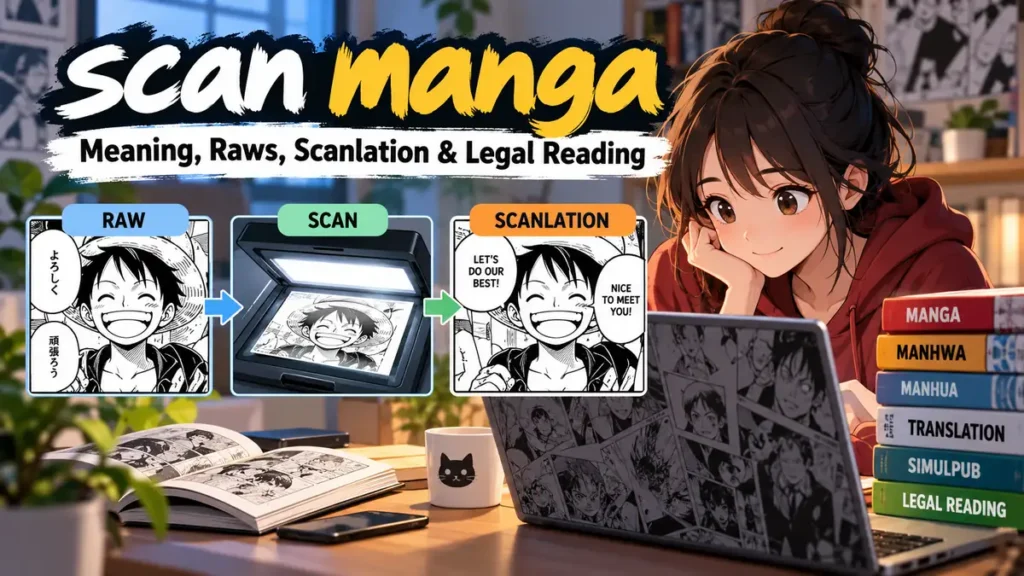
scan manga generally refers to manga pages or chapters reproduced as digital images, often from printed or digital source material. A raw is usually an untranslated original-language release, while a scanlation is a fan-made version in which manga pages are translated, cleaned, edited, and typeset into another language.
The terminology developed around online manga communities, where readers wanted access to Japanese releases before—or in cases where—official translations became available. Today, however, official digital publishing and simultaneous releases have changed how international readers access manga.
This guide explains what manga scans are, how scanlation works, what “raw” actually means, how digital releases differ from scanned pages, and what readers should know about copyright and official alternatives.
What Does scan manga Mean?
The simplest meaning of scan manga is a digital reproduction of manga pages.
Traditionally, this meant taking a physical manga magazine or tankōbon—a collected manga volume—and scanning its pages with a scanner. The resulting image files could then be viewed on a computer or edited for translation.
The meaning has become less precise in the digital era.
A page displayed online might originate from:
- a physical book or magazine that was scanned;
- an official digital manga edition;
- an ebook or publisher application;
- an unauthorized digital copy;
- a raw chapter;
- a translated scanlation;
- or an officially licensed digital translation.
Because of this, calling something a “manga scan” tells you relatively little about its copyright status or language.
The more useful question is where the material came from and whether the copyright holder authorized its distribution.
Manga Scan vs. Raw vs. Scanlation
These three terms are frequently mixed together.
| Term | Basic meaning | Typical language | Translation involved? |
|---|---|---|---|
| Manga scan | Digital reproduction of manga pages | Any language | Not necessarily |
| Raw manga | Original untranslated material | Usually Japanese | No |
| Scanlation | Fan-edited translation of manga | English or another target language | Yes |
| Official translation | Licensed translated edition | Target language | Yes |
| Simulpub | Official translated chapter released alongside or close to Japan | Target language | Yes |
The distinction between them becomes particularly important when discussing copyright.
What Is Raw Manga?
A raw is the original-language version before translation.
For Japanese manga, that normally means Japanese text remains in the speech bubbles, captions, and sound effects. The word can describe legitimate material bought from an authorized Japanese ebook service as well as unauthorized copies circulating online.
Therefore:
Raw does not automatically mean pirated.
It describes the language or processing state rather than whether the copy was legally distributed.
Someone purchasing a Japanese digital volume from an authorized store is reading raw manga even though no physical scanning occurred.
The term also appears around Korean manhwa and Chinese manhua, although their original languages are Korean and Chinese respectively.
What Is a Manga Scan?
A scan traditionally refers to an image produced by digitizing a physical page.
Older manga-sharing communities often depended on scanners because the original material existed primarily in print.
Today, people sometimes use “scan” loosely for almost any digital manga page. Technically, however, an official digital edition created by a publisher does not need to have been scanned from paper at all.
What Is Scanlation?
Scanlation combines the words scan and translation. It refers to fan-made scanning, translation, and editing of comics from one language into another. Wikipedia
For example, a group might obtain Japanese manga pages, translate the dialogue into English, remove the Japanese lettering, reconstruct artwork where necessary, and insert English text.
The result is a scanlation.
It is therefore useful to remember:
Raw → source material
Scanlation → fan-translated and edited version
Official translation → licensed translated version
How scan manga Becomes a Scanlation
Scanlation can involve considerably more work than simply running dialogue through translation software.
Traditional scanlation groups often divide the process among several people with specialized roles. The exact workflow differs, but it commonly looks something like this:
- Source the raw pages. A raw provider obtains the original-language chapter or volume.
- Prepare the images. Pages may be cropped, aligned, cleaned, and adjusted.
- Translate the text. A translator converts dialogue, narration, signs, and sometimes sound effects into the target language.
- Check the translation. A translation checker or proofreader reviews wording and context.
- Clean the page. Original text is removed where appropriate.
- Redraw hidden artwork. Artwork covered by Japanese text may need reconstruction.
- Typeset the translation. Translated dialogue is placed into speech bubbles and captions.
- Quality-check the chapter. Editors look for missing text, formatting problems, spelling errors, and inconsistent terminology.
Historical descriptions of scanlation likewise identify obtaining raws, translating, proofreading, cleaning, and inserting the translated material as key parts of the workflow. Wikipedia
Common Scanlation Terms
Once you understand the workflow, community terminology becomes much easier to follow.
A raw provider supplies original-language material. The translator, sometimes abbreviated as TL, translates it. A TLC, or translation checker, reviews the translation.
A cleaner removes unwanted marks or original text and improves page presentation. A redrawer reconstructs portions of artwork hidden underneath text. A typesetter places translated text onto the page.
You may also encounter SFX, meaning sound effects, which can be particularly challenging because Japanese sound-symbolic language does not always have a direct English equivalent.
Digital Raws vs. Physical Manga Scans
One of the biggest changes in manga distribution is that “raw” and “scan” no longer necessarily mean the same thing.
Physical Scans
Traditional raws could be produced by scanning printed manga magazines or books.
Their quality depends heavily on the source and scanning process. Common issues include:
- page curvature near the spine;
- shadows;
- uneven brightness;
- paper texture;
- bleed-through from the opposite page;
- dust or scanner artifacts;
- moiré patterns;
- low resolution.
Magazine paper can make these problems especially noticeable.
Digital Raws
A digital raw comes from an original digital publication rather than a physical page being scanned.
Legitimate digital manga can provide crisp linework, consistent page dimensions, clean text, and none of the physical distortions associated with scanning paper.
This explains why the phrases HQ raw and LQ raw sometimes appear in manga communities. They usually indicate high-quality and low-quality source material.
However, image quality alone tells you nothing about whether a copy was distributed legally.
Why Do Readers Search for scan manga?
The popularity of manga scans developed partly because international manga distribution once moved much more slowly than Japanese publication.
The World Intellectual Property Organization has described how overseas readers historically faced translation delays and how many Japanese titles never received international releases, helping drive fan scanning and translation. WIPO
Several motivations still appear today.
Reading New Chapters Quickly
For an ongoing series, Japanese publication may precede some international editions.
Readers following discussions on social media may therefore encounter references to “raw chapter,” “raw spoilers,” or “scans” before a translated edition becomes available in their region.
This gap has become much smaller for numerous popular titles because of simulpub and simulrelease publishing.
Reading Manga That Has No Translation
Not every Japanese series receives an international license.
Commercial publishers have to consider audience size, licensing rights, production costs, and regional demand. As a result, obscure, older, independent, or niche manga may never receive an official translation.
Historically, this gap was one of the major reasons scanlation communities developed.
Learning Japanese
Original manga can also be useful language-learning material.
Learners get vocabulary in visual context, conversational sentence structures, kanji, and natural dialogue. Some manga aimed at younger audiences includes furigana, small pronunciation guides that help readers identify kanji readings.
However, learners should distinguish between legitimately purchased Japanese manga and unauthorized uploads. Studying Japanese does not require using pirated scans.
Comparing a Translation With the Original
Translation involves interpretation.
Jokes, cultural references, dialects, honorifics, wordplay, character speech patterns, and sound effects may not map neatly from Japanese into English.
Readers who understand Japanese sometimes compare the original dialogue with an official translation or fan translation to see how particular expressions were localized.
Is scan manga Legal?
There is no universal yes-or-no answer simply because something is described as a manga scan.
The relevant issue is authorization.
Copyright gives creators and other rights holders legal control over important uses of their works. Scanning and publicly distributing an entire copyrighted manga without permission can infringe those rights. Translating the material does not automatically remove those copyright concerns.
WIPO has specifically discussed unauthorized online scanning, translation, editing, and distribution of manga as piracy affecting the industry. WIPO
Are Scanlations Legal?
Fan translations are often produced without express permission from the copyright holder. Scanlation references commonly describe the practice as unauthorized even when the people producing the translation are unpaid volunteers. Wikipedia
A common misunderstanding is:
“It is free, so it must be legal.”
Free distribution and authorized distribution are different things.
A fan group might make no money from a translated chapter, but the underlying manga artwork, characters, story, and text remain copyrighted.
Likewise, writing “no copyright infringement intended” does not itself grant permission to reproduce copyrighted material.
Are Manga Raws Illegal?
Not inherently.
“Raw” simply means original or untranslated material.
You can legally purchase an original Japanese manga volume or access an authorized Japanese digital edition. In that situation, you are still reading raw manga.
Problems arise when copyrighted pages are copied and redistributed without authorization.
That distinction is worth remembering:
Raw describes the content. Authorization describes its legal distribution status.
Scanlation vs. Official Manga Translation
Scanlations historically filled genuine availability gaps, but official digital manga has expanded significantly.
The two forms of translation also operate differently.
| Feature | Scanlation | Official translation |
|---|---|---|
| Translation | Fan-produced | Professional/licensed |
| Permission | Commonly unauthorized | Authorized |
| Quality | Highly variable | Editorially controlled |
| Release speed | Varies | Varies; simulpub can be immediate |
| Consistency | Depends on group | Usually standardized |
| Creator support | Usually indirect or none | Part of licensed ecosystem |
| Availability | Can disappear unexpectedly | More predictable |
| Localization | Depends on translator | Professional editorial process |
Neither translation method guarantees that every linguistic choice will satisfy every reader.
Fan translators sometimes preserve honorifics, translator notes, Japanese terminology, or cultural references that official localization may adapt for a broader audience. Conversely, professional releases generally have formal editing, licensing, proofreading, and quality-control processes.
Translation quality should therefore be evaluated independently from legal status.
What Is Simulpub Manga?
Simulpub means simultaneous publication, or publication close enough to the Japanese release that international readers do not have to wait months for translated chapters.
It represents one of the biggest changes to manga reading outside Japan.
MANGA Plus by SHUEISHA says it provides manga in multiple languages at the same time as Japan and is directly operated by Japanese publisher Shueisha. MANGA Plus by SHUEISHA
Its current documentation also describes eligible English simulpub titles as ongoing series published at the same time as Japan. MANGA Plus by SHUEISHA
Similarly, VIZ Shonen Jump provides official chapters for numerous manga titles, including current free chapters alongside subscriber-access chapters. Viz Media
For readers, simulpub releases address one of the original motivations behind scanlation: having to wait a long time for translated chapters.
How to Identify an Official Manga Source
A professional-looking website is not automatically licensed.
Instead of judging by design alone, check who operates the service and whether the publisher or copyright owner identifies it as authorized.
Useful signals include:
- the publisher clearly identifies itself;
- licensing information is provided;
- copyright ownership is displayed;
- the service links to official publisher properties;
- individual titles identify authors and publishers;
- subscription or chapter-access terms are transparent;
- the service is listed by the rights holder as an authorized distributor.
For example, MANGA Plus explicitly describes itself as an official service and states that it is operated by Shueisha. MANGA Plus by SHUEISHA
Its copyright information also displays the ABJ Mark, which identifies authorized electronic book distribution services that have permission from copyright holders. MANGA Plus by SHUEISHA
That type of publisher-level confirmation is much more meaningful than a website simply calling itself “official.”
Does “Free Manga” Automatically Mean Piracy?
No.
Another widespread misconception is that anything available without payment must be unauthorized.
Publishers can legally offer free chapters because they control or license the distribution rights.
MANGA Plus, for instance, provides official reading options and describes mechanisms through which eligible ongoing English simulpub chapters can be read free under specific conditions. MANGA Plus by SHUEISHA
VIZ also lists free chapters for numerous titles alongside chapters requiring membership. Viz Media
Therefore, price is not the determining factor.
The meaningful distinction is:
Official free manga = authorized by the rights holder.
Unauthorized free scan = redistributed without the necessary permission.
Common scan manga Misconceptions
A few myths persist because manga terminology developed informally across different online communities.
“Every Manga Scan Is a Scanlation”
No.
A scan can remain completely untranslated. A scanlation specifically involves translation and editing.
“Every Raw Is a Physical Scan”
No.
Modern raws may originate from legitimate digital editions. No scanner needs to be involved.
“Raw Means Illegal”
No.
An officially purchased Japanese ebook is raw manga and can be entirely legitimate. The legality question concerns how a particular copy was obtained and distributed.
“Scanlation Just Means Translation”
Not quite.
Translation is one stage. Traditional scanlation may also involve sourcing pages, cleaning images, redrawing artwork, proofreading, typesetting, and quality checking.
“Official Manga Always Comes Out Much Later”
This was historically common, but it is no longer universally true.
Simultaneous publishing allows some translated manga to appear at essentially the same time as the Japanese release. Shueisha explicitly describes MANGA Plus as offering titles simultaneously with Japan. MANGA Plus by SHUEISHA
“Fan Translation Is Automatically More Accurate”
Not necessarily.
Scanlation quality varies from highly skilled human translation to inaccurate or poorly edited work. Official localization can also make deliberate adaptations rather than literal translations.
A literal translation is not automatically the most accurate representation of meaning, especially when humor, dialect, cultural context, or wordplay is involved.
Manga, Manhwa, and Manhua Scans
The vocabulary surrounding scans extends beyond Japanese manga.
Manga generally refers to Japanese comics.
Manhwa commonly refers to Korean comics.
Manhua commonly refers to Chinese-language comics.
Scanlation can apply to all three. The scanlation definition itself is commonly associated with Japanese manga but is also used for translated Korean manhwa and Chinese manhua. Wikipedia
The word raw similarly means the untranslated original version, but the original language changes accordingly.
A Japanese manga raw will generally contain Japanese. A Korean manhwa raw contains Korean, while a Chinese manhua raw contains Chinese.
This distinction becomes useful when searching for original-language material for legitimate reading or language study.
Useful Manga Terminology for New Readers
Understanding a handful of terms makes manga discussions much easier.
Chapter: One installment of a manga series.
Volume: A collection of chapters published together.
Tankōbon (単行本): A Japanese collected book edition containing chapters previously serialized elsewhere.
Raw: Original untranslated content.
Scan: A digitized reproduction of a page, though the term is often used loosely online.
Scanlation: A fan-produced scanned and translated comic.
Simulpub: An official translated release published simultaneously or close to the Japanese release.
Typesetting: Placing translated text into speech bubbles, captions, and other parts of a comic page.
Redrawing: Reconstructing artwork that becomes exposed after original text is removed.
Furigana (振り仮名): Small kana showing the pronunciation of kanji.
SFX: Sound effects represented visually within manga artwork.
Doujinshi (同人誌): Self-published works, which can include original creations as well as derivative fan works.
Shōnen, shōjo, seinen, and josei: Publishing demographic classifications broadly associated with young male, young female, adult male, and adult female readerships respectively. They are not simply genre labels.
How Digital Publishing Changed Manga Scans
The historical scanlation ecosystem developed partly because international readers often lacked timely legal access to Japanese manga.
Digital distribution has changed that environment.
Publishers can now release chapters globally without waiting for physical printing and international shipping. Translation teams can work around Japanese publication schedules, and readers can access chapters through websites and mobile apps.
Shueisha has expanded simultaneous publication through MANGA Plus, including simultaneous English releases of Shonen Jump+ one-shots. MANGA Plus by SHUEISHA
The practical result is that readers of some major series no longer face the long international delays that helped make unofficial manga scans popular.
There are still limitations. Not every manga is internationally licensed, not every service operates in every country, older series may have incomplete digital catalogs, and language availability differs between titles.
Even so, the gap between Japanese publication and authorized international access is much narrower for many popular series than it once was.
How to Read Manga Online More Safely
For readers searching scan manga because they simply want digital chapters, the first step is to check whether an official edition exists.
Publisher-operated and licensed services generally provide clearer copyright status, reliable image quality, consistent translations, and a direct connection to the legitimate publishing ecosystem.
Before using an unfamiliar manga website, check its publisher information and avoid downloading unknown executable files or browser extensions merely to read images.
Aggressive pop-ups, forced redirects, fake download buttons, notification-permission requests, and requests to install unknown software are reasons to leave a site.
You do not need special software simply to view ordinary manga pages through a legitimate web reader.
The Quickest Way to Understand scan manga Terminology
When you encounter unfamiliar terminology, classify the material using three questions.
1. Is it translated?
If not, it may be described as a raw. If fans translated and edited it, it is likely a scanlation.
2. Where did it come from?
A physical scan, publisher ebook, official app, fan group, and unauthorized aggregator are very different sources even when their pages look similar.
3. Is its distribution authorized?
This is the important copyright distinction. “Raw,” “scan,” and “digital” do not themselves answer it.
Once those three questions are separated, most of the confusing terminology becomes straightforward.
Final Thoughts on scan manga
scan manga is best understood as a broad term surrounding digitized manga pages, but it overlaps with several more precise concepts.
A raw is original untranslated material. A manga scan traditionally means pages digitized from physical manga, although the term is now used more loosely. A scanlation is a fan-made translation and editing process, while an official translation is released with authorization from the relevant rights holders.
Modern simulpub platforms have also changed the landscape. Official services can now release some manga internationally at the same time as Japan, reducing the delays that historically encouraged readers to search for unofficial scans. MANGA Plus by SHUEISHA
For readers, the most useful habit is not simply asking whether something is a “scan.” Check the source, translation status, and authorization instead. Those three details tell you far more about what you are actually reading.