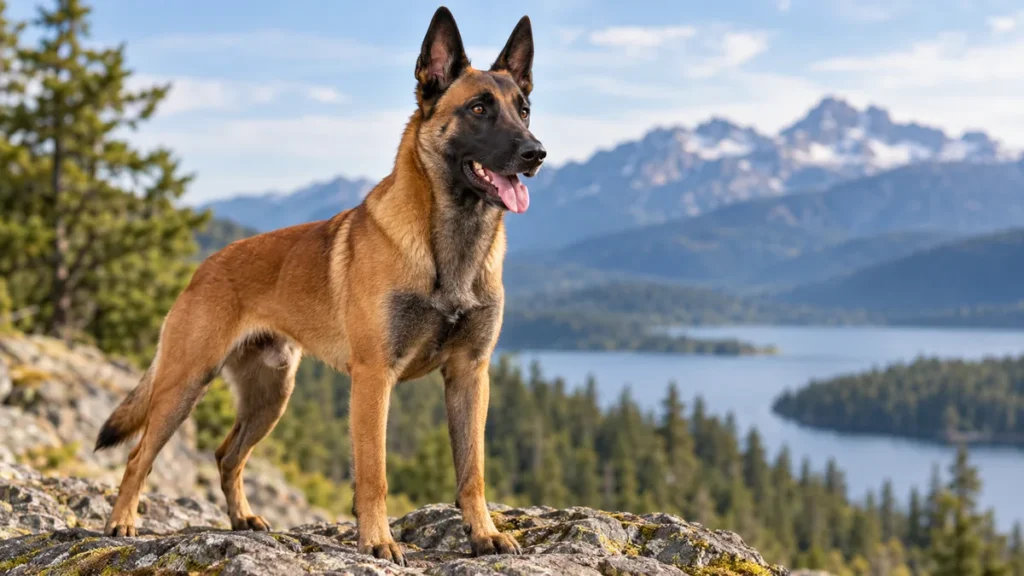
The belgian malinois is an athletic, intensely intelligent working dog developed in Belgium for herding livestock. Today, the breed is famous for police, military, detection, protection, search-and-rescue, and competitive dog-sport work. That impressive résumé can make the Malinois look like an ideal companion, but its drive and energy demand far more commitment than most household dogs.
A Belgian Malinois is a medium-to-large Belgian herding dog known for intelligence, athleticism, loyalty, trainability, and a strong desire to work. Adults generally stand about 22–26 inches tall and weigh roughly 40–80 pounds. They thrive on structured training, substantial daily activity, mental challenges, early socialization, and close interaction with their handlers.
Understanding the breed’s working heritage is the key to understanding almost everything else about it—from its intense focus to its exercise requirements.
Belgian Malinois Breed Overview
The Belgian Malinois combines a relatively light, agile body with considerable endurance and power. Unlike heavier guardian breeds, it was developed to move quickly, respond rapidly to a handler, and work for extended periods.
| Trait | Belgian Malinois |
|---|---|
| Breed group | Herding |
| Origin | Belgium |
| Adult height | About 22–26 inches |
| Adult weight | About 40–80 pounds |
| Coat | Short, dense double coat |
| Typical colors | Fawn to mahogany, usually with black mask and overlay |
| Energy level | Very high |
| Trainability | Very high |
| Grooming needs | Low to moderate |
| Shedding | Moderate, heavier seasonally |
| Temperament | Intelligent, alert, confident, loyal, work-driven |
| Common roles | Herding, police, military, detection, search and rescue, dog sports |
| Typical lifespan | Roughly 10–15 years, depending on source and individual health |
AKC describes adults as 22–26 inches tall and approximately 40–80 pounds, while veterinary and breed resources give somewhat different lifespan estimates. Individual longevity depends on genetics, veterinary care, body condition, lifestyle, and disease.
How do you pronounce Malinois?
Malinois is commonly pronounced approximately “mal-in-wah.”
The name is connected to Malines, the French name associated with Mechelen, Belgium, where the breed was developed.
Belgian Malinois History and Origin
The Belgian Malinois traces its development to Belgium in the late 19th century. Belgian farmers developed capable shepherd dogs that could control livestock while remaining responsive to their handlers.
The Malinois takes its name from Mechelen, known as Malines in French. Its original purpose was practical farm and herding work rather than the specialized police and military roles for which the breed later became famous.
The four Belgian herding varieties
The Malinois shares its heritage with other Belgian shepherd types. The four commonly recognized varieties are:
- Belgian Malinois
- Belgian Tervuren
- Belgian Laekenois
- Belgian Sheepdog/Groenendael
Recognition differs between kennel organizations and countries. In the United States, the American Kennel Club treats several of these as separate breeds, whereas other systems group Belgian Shepherd varieties differently.
The Malinois is particularly recognizable by its short coat, typically fawn to mahogany with dark-tipped hairs and a black facial mask.
From sheep herder to working K-9
The characteristics required for herding transferred remarkably well to modern working roles.
A useful livestock dog needed stamina, awareness, confidence, quick reactions, intelligence, responsiveness, and the willingness to work closely with a human. Those same qualities are valuable in modern K-9 programs.
Belgian Malinois now work in areas including:
- Police patrol
- Military operations
- Explosives detection
- Drug detection
- Search and rescue
- Tracking
- Protection work
- Competitive obedience
- Herding
- Agility
- Scent work
Their working success isn’t evidence that every Malinois should receive protection training. It shows how strongly the breed has retained its physical and mental working characteristics.
Belgian Malinois Appearance, Size, and Physical Characteristics
At first glance, someone unfamiliar with the breed may mistake a Belgian Malinois for a small German Shepherd. Looking more closely reveals significant differences.
A Malinois normally has a square, athletic outline rather than a heavy or bulky appearance. The dog should look ready to move.
Belgian Malinois height and weight
Adult males are generally around 24–26 inches tall, while females are approximately 22–24 inches. Veterinary sources commonly place males around 60–80 pounds and females around 40–60 pounds, though individual healthy dogs vary.
The body is muscular without excessive bulk.
That relatively lean construction contributes to the speed and agility that make the breed effective in demanding working environments.
Head and ears
The Malinois typically has:
- Erect triangular ears
- An alert expression
- A comparatively narrow head
- Dark eyes
- A black mask
- A tapered muzzle
Its ears naturally stand upright as the dog matures, although puppy ears can change considerably during development.
Belgian Malinois coat and colors
The coat is short, straight, and relatively easy to maintain.
Common coloring ranges from fawn to mahogany, generally accompanied by black-tipped hairs and the characteristic black mask. Small amounts of white may occur in limited areas depending on the individual and applicable breed standard.
The breed has an undercoat that provides protection in different weather conditions.
Belgian Malinois Temperament and Personality
The Belgian Malinois temperament is one of the most important things prospective owners need to understand.
These dogs aren’t simply energetic. A well-bred Malinois typically has a strong desire to interact with its environment and work with its handler.
The AKC breed-standard description emphasizes confidence rather than inappropriate shyness or aggression. Malinois may be reserved with strangers while remaining affectionate with their own people and naturally protective.
Intelligence
Belgian Malinois learn extremely quickly.
That sounds entirely positive until you realize they can learn unwanted behaviors just as efficiently as desirable ones.
A Malinois may quickly discover:
- Which doors aren’t properly closed
- How to obtain attention
- When household rules aren’t consistently enforced
- What triggers a game of chase
- Which objects produce interesting reactions
- How to predict a handler’s routine
Training therefore needs consistency rather than occasional intensive sessions.
Loyalty and attachment
Malinois commonly form exceptionally close relationships with their handlers.
Their historical work required cooperation with people, and modern working lines have continued emphasizing handler engagement.
Many want to participate in whatever their person is doing rather than entertain themselves independently for hours.
That attachment is valuable for training but means prolonged isolation can be a poor fit for many individuals.
Protective instincts
The breed can be naturally watchful and protective.
However, protectiveness and uncontrolled aggression are not the same thing.
A stable Belgian Malinois should not need to treat every unfamiliar person as a threat. Proper socialization teaches the dog how to remain composed around ordinary people, environments, sounds, dogs, vehicles, and everyday situations.
Prey and chase drive
Many Malinois have substantial chase or prey drive.
Moving animals, bicycles, running children, wildlife, or vehicles can attract attention, particularly in poorly trained dogs.
This is one reason impulse-control work and early training matter so much.
Is a Belgian Malinois a Good Family Dog?
A Belgian Malinois can live successfully with a family, but household suitability depends much more on lifestyle and management than on affection alone.
The breed tends to form strong family bonds. The challenge is meeting its need for structure, training, physical activity, and mental engagement every day.
AKC notes that active families prepared for the breed’s demanding exercise and training requirements are better suited to it and that older, responsible children may be easier matches than very young children. Herding and chase tendencies can otherwise become problematic.
Belgian Malinois and children
A properly socialized individual may live well with children, but supervision remains essential.
Young Malinois can be fast, physical, mouthy, and excitable. Herding instincts can also result in chasing or attempting to control movement.
Children should learn not to:
- Climb on the dog
- Disturb it while eating or sleeping
- Take toys from its mouth
- Encourage chasing games
- Tease or corner it
- Interfere during training
Adults should supervise interactions rather than expecting either the child or dog to manage the situation.
Belgian Malinois and other dogs
Compatibility varies considerably between individuals.
Early positive exposure can help, but socialization doesn’t guarantee that every adult Malinois will enjoy interacting with unfamiliar dogs.
The goal should be calm, controllable behavior—not forcing a dog to greet every animal it encounters.
What about cats?
Some Malinois successfully share homes with cats, particularly when raised and carefully managed around them.
Others have prey drive that makes the combination difficult or unsafe. Hill’s specifically notes that compatibility with cats depends on the individual dog.
Belgian Malinois Exercise Needs
Exercise is where many prospective owners underestimate the breed.
A short walk around the neighborhood is unlikely to satisfy a healthy adult working-bred Malinois.
These dogs were developed for prolonged physical and mental work. PetMD notes that ordinary walks alone may be insufficient, while AKC emphasizes substantial daily exercise beyond a single walk or play session.
Physical exercise isn’t enough
Trying to exhaust a Malinois purely through running can backfire.
The dog becomes fitter.
Then you own an even more athletic Malinois that still needs something meaningful to do.
A better routine combines physical activity with thinking and controlled behavior.
Useful activities include:
- Structured walks
- Hiking
- Running after physical maturity and veterinary clearance
- Tracking
- Nose work
- Obedience
- Agility
- Herding
- Retrieval games
- Controlled tug
- Search games
- Rally
- Task-oriented training
Malinois also compete successfully in sports such as obedience, tracking, agility, herding, diving, and other working disciplines.
Mental stimulation matters just as much
Five or ten focused minutes of challenging training can sometimes provide more useful enrichment than uncontrolled activity.
Teach skills that require the dog to think.
For example, hide an object and ask the dog to locate it. Practice position changes at a distance. Teach place training. Introduce scent discrimination. Work on calm behavior around distractions.
The objective isn’t constant excitement.
A good training program also teaches the dog how to settle.
Exercise needs change with age
A puppy shouldn’t simply receive a miniature version of an adult working dog’s exercise program.
Growing joints need consideration. AKC advises against long-distance running with developing puppies; running programs should begin only when physical development and veterinary guidance make them appropriate.
Senior dogs may also require shorter sessions, lower-impact activities, and adjustments for joint or medical conditions.
Belgian Malinois Training: What Actually Works
A Malinois’ intelligence makes training rewarding, but intelligence doesn’t automatically produce an easy dog.
Training should start early and continue throughout life.
1. Begin with engagement
Before expecting advanced obedience, teach the puppy that interacting with you is rewarding.
Reward voluntary attention, name response, eye contact, following, and checking in.
This creates the foundation for everything that follows.
2. Establish essential everyday behaviors
Useful early skills include:
- Recall
- Loose-leash walking
- Sit
- Down
- Stay
- Place
- Leave it
- Drop it
- Handling tolerance
- Calm crate behavior
Reliability around distractions matters more than performing dozens of tricks indoors.
3. Use positive reinforcement
Current breed guidance recommends structured, consistent training built around positive reinforcement rather than harsh punishment.
Food, toys, play, access to activities, and praise can all function as rewards.
The best reward depends on the individual dog.
4. Train impulse control
High-drive dogs need to learn that excitement doesn’t automatically mean action.
Practice waiting before:
- Going through doors
- Leaving a vehicle
- Chasing a toy
- Greeting people
- Starting a game
- Eating
- Being released from a position
Impulse control turns drive into something manageable.
5. Keep training purposeful
Endlessly repeating easy commands can bore a highly trainable dog.
Increase complexity gradually through distractions, duration, distance, scent work, environmental challenges, and chained behaviors.
6. Don’t create unnecessary aggression
A pet Malinois does not require bite or protection training simply because police dogs perform that work.
Specialized protection work requires appropriate genetics, temperament assessment, experienced handling, professional instruction, and careful control.
For an ordinary household, excellent obedience, neutrality, recall, confidence, and impulse control are far more useful priorities.
Socializing a Belgian Malinois Puppy
Socialization is frequently misunderstood as allowing a puppy to interact with as many dogs and strangers as possible.
A better objective is teaching the puppy that unfamiliar experiences are normal and manageable.
Introduce the puppy gradually to:
- Different people
- Calm dogs
- Traffic
- Household sounds
- Veterinary handling
- Grooming
- Different surfaces
- Vehicles
- Urban environments
- Rural environments
- Children at controlled distances
- New buildings and locations
The puppy doesn’t need to greet everyone.
Neutrality is valuable.
A confident adult dog that can notice a stranger, bicycle, child, or another dog without losing control is often more practical than one conditioned to expect interaction every time something appears.
Belgian Malinois vs German Shepherd
The Belgian Malinois vs German Shepherd comparison is common because the breeds can look similar and frequently perform similar working roles.
They aren’t the same breed.
| Feature | Belgian Malinois | German Shepherd |
|---|---|---|
| Origin | Belgium | Germany |
| General build | Leaner, lighter, square and agile | Usually heavier and more substantial |
| Coat | Usually short | Short/medium to longer varieties |
| Energy | Very high | High |
| Working drive | Often extremely intense | High, varies considerably by line |
| Training needs | Very demanding | Demanding |
| Common work | Police, military, detection, sport, herding | Police, military, service, detection, herding |
| Typical household fit | Experienced, highly active homes | Broader range depending on individual and line |
AKC notes that Malinois are generally lighter in build than German Shepherd Dogs, while their shorter coat and athletic proportions help distinguish them visually.
Neither breed should be selected purely for appearance.
Working line, breeder selection, early development, individual temperament, and training can create major differences even among dogs of the same breed.
Belgian Malinois Health Problems
The Belgian Malinois is generally considered a comparatively robust working breed, but it can still develop inherited and acquired health conditions.
Hip dysplasia
Hip dysplasia involves abnormal development of the hip joint and can eventually contribute to pain and arthritis.
Genetics matter, but body weight, development, activity, and other environmental factors can also influence joint health.
Elbow dysplasia
Elbow dysplasia is another orthopedic concern.
The American Belgian Malinois Club health statement recommends evaluation for both hip and elbow dysplasia in breeding dogs.
Eye disorders
Inherited eye conditions are another reason health screening matters.
Progressive retinal atrophy (PRA), for example, can progressively damage vision. PetMD and Hill’s identify PRA among conditions relevant to the breed.
The breed club’s health guidance includes examination by a qualified veterinary ophthalmologist.
Epilepsy
Epilepsy also occurs within the breed.
A dog experiencing a suspected seizure should receive veterinary assessment rather than having the episode attributed automatically to a breed tendency. Seizures can have multiple causes.
Other health considerations
Breed-club guidance recommends discussing family history involving conditions such as epilepsy, hemangiosarcoma, thyroid disease, and cardiac issues when evaluating a breeder.
That distinction matters: a condition being worth discussing does not mean every Malinois is likely to develop it.
Recommended breeder health testing
When evaluating responsibly bred puppies, ask for verifiable health-screening results rather than accepting statements such as “our dogs have always been healthy.”
The American Belgian Malinois Club’s published health statement identifies evaluations involving:
- Hips
- Elbows
- Eyes
It also encourages discussion of broader family health and temperament history.
Health testing reduces avoidable risk; it cannot guarantee that a puppy will never become ill.
Belgian Malinois Lifespan
A commonly reported Belgian Malinois lifespan is roughly 10–15 years, although estimates differ among veterinary and breed resources.
PetMD gives approximately 10–14 years, while Hill’s lists 12–15 years.
Those ranges shouldn’t be interpreted as an expiration date.
Genetics, preventive veterinary care, injuries, nutrition, dental health, body condition, environment, and individual disease all influence longevity.
Maintaining a lean, healthy body condition is particularly valuable for an athletic dog whose joints experience substantial physical demand.
Feeding and Nutrition
A Belgian Malinois needs a nutritionally complete and balanced diet appropriate for its age, body condition, health, and activity level.
A working police dog training intensely each day may have very different energy requirements from a companion Malinois receiving moderate exercise.
Monitor the dog rather than feeding according to reputation.
Watch body condition
You should generally be able to feel the ribs without pressing through a thick layer of fat, while the dog should have a visible waist and abdominal tuck appropriate to its build.
Unexpected weight gain or loss deserves attention.
Keeping the dog at a healthy weight also reduces unnecessary stress on joints, which is especially relevant when hip or elbow disease is a concern.
Puppies require appropriate growth nutrition
Malinois puppies need food formulated for growth.
Avoid trying to make a puppy grow as quickly or heavily as possible. A lean, controlled growth pattern is preferable to encouraging excessive body weight.
For individual calorie needs, medical diets, supplements, or feeding problems, consult a veterinarian.
Belgian Malinois Grooming and Shedding
Compared with its exercise and training requirements, grooming a Belgian Malinois is relatively straightforward.
The short, dense coat generally requires regular brushing rather than complicated trimming.
Does a Belgian Malinois shed?
Yes.
Malinois shed throughout the year and can shed considerably more during seasonal coat changes.
AKC notes that occasional brushing is normally sufficient outside heavier shedding periods, when more frequent or daily brushing can help control loose hair.
A basic grooming routine includes:
- Weekly brushing
- More frequent brushing during heavy shedding
- Nail trimming as needed
- Dental care
- Ear checks
- Occasional bathing
Bathing too frequently isn’t necessary for most healthy dogs unless lifestyle or veterinary treatment requires it.
Nail and dental care
Active dogs don’t necessarily wear their nails evenly.
Check them regularly, including dewclaws where present.
Dental care should also be part of routine health maintenance rather than something started only when bad breath or visible tartar appears.
Can a Belgian Malinois Live in an Apartment?
Apartment size alone doesn’t determine whether a dog receives an appropriate lifestyle.
A Malinois living in a house with a large yard can still be bored if nobody trains or interacts with it. Conversely, a highly committed handler may provide substantial structured activity outside a smaller home.
Still, apartment living presents additional challenges.
A Malinois can be vocal, intensely active, alert to environmental movement, and difficult to satisfy without frequent outings. Hill’s considers apartment living generally less suitable for the breed.
A backyard isn’t a substitute for training either.
Putting a Malinois outside and expecting it to exercise itself rarely addresses the breed’s desire for purposeful interaction.
Are Belgian Malinois Aggressive?
The breed should not automatically be described as aggressive.
The desired temperament is confident, responsive, protective, and potentially reserved with strangers—not indiscriminately aggressive. The AKC temperament description specifically states that the breed should exhibit neither shyness nor aggression in new situations.
However, Malinois are powerful, fast, intensely driven dogs.
Poor breeding, inadequate socialization, fear, pain, inappropriate training, chronic frustration, or weak management can create serious behavioral problems.
That’s why responsible ownership matters more with this breed than relying on stereotypes in either direction.
A well-trained Malinois should be controllable.
Why Do Police and Military Units Use Belgian Malinois?
Police and military organizations value characteristics the breed was already selected for as a working shepherd.
Malinois commonly combine:
- Athleticism
- Speed
- Stamina
- Trainability
- Strong motivation
- Scenting ability
- Handler focus
- Confidence
- Compact working build
Those qualities can make suitable individuals effective for detection, patrol, tracking, search, and specialized military work.
One widely known military working dog was Cairo, a Belgian Malinois associated with the U.S. Navy SEAL operation against Osama bin Laden in 2011. AKC’s breed-history coverage cites Cairo as an example of the breed’s specialized military role.
But police-dog success shouldn’t be confused with household suitability.
The exact intensity that makes a dog valuable professionally can make it overwhelming in an inexperienced home.
Is the Belgian Malinois Good for First-Time Owners?
For most first-time dog owners, the Belgian Malinois is an unusually demanding choice.
AKC specifically notes that its high prey drive and energy mean it generally isn’t well suited to inexperienced owners.
The challenge isn’t that Malinois cannot learn.
It’s almost the opposite.
They learn quickly, react quickly, move quickly, and frequently require the handler to recognize developing behaviors before they become established habits.
A better question to ask
Instead of asking, “Do I like Belgian Malinois?” ask:
“Do I want the daily lifestyle required by a Belgian Malinois for the next decade or more?”
Think about ordinary Tuesdays—not exciting weekend hikes.
Can you consistently provide structured exercise, training, enrichment, supervision, veterinary care, and meaningful interaction when you’re busy, tired, working, or the weather is unpleasant?
That’s the more useful test.
Common Belgian Malinois Ownership Mistakes
Many problems arise because owners admire the breed’s working ability without planning for what produces that ability.
Choosing the breed for its appearance
A Malinois looks athletic, alert, and impressive.
Appearance tells you very little about whether its lifestyle requirements suit your household.
Assuming a large yard is enough
Space helps, but a yard doesn’t provide a job.
A bored Malinois can turn an ordinary yard into its own entertainment project.
Providing exercise without training
More exercise isn’t always the solution.
Physical conditioning without impulse control can produce a fitter dog that’s still difficult to manage.
Combine activity with obedience, scent work, problem-solving, calmness, and engagement.
Encouraging constant excitement
Owners sometimes believe a high-drive breed should always be “on.”
It shouldn’t.
Teaching relaxation is a genuine training goal. Dogs need adequate sleep, recovery, and the ability to exist calmly without constant stimulation.
Skipping socialization
A naturally watchful dog needs carefully planned exposure to normal life.
Waiting until territorial, fearful, or reactive behavior appears makes the problem considerably harder.
Expecting maturity to solve training problems
Age doesn’t automatically teach recall, leash manners, neutrality, or impulse control.
Repeated behavior becomes practiced behavior.
Train the habits you want early.
Choosing a Belgian Malinois Puppy or Adult Dog
Temperament and health deserve more attention than coat shade, size, or dramatic working-dog appearance.
If obtaining a puppy from a breeder, research how the breeder selects dogs and what traits the breeding program prioritizes.
Working lines can differ substantially from dogs bred primarily for conformation or companionship.
Ask about:
- Health-testing documentation
- Hip and elbow evaluations
- Eye examinations
- Temperament
- Parents and relatives
- Previous litters
- Working characteristics
- Socialization practices
- Puppy-raising environment
A responsible breeder should be willing to discuss weaknesses as well as strengths.
Consider an adult dog realistically
An adult Belgian Malinois may offer one advantage: some important characteristics are already visible.
Energy, sociability, environmental confidence, prey drive, dog compatibility, and basic temperament can sometimes be evaluated more clearly than in a very young puppy.
Rescue organizations and breed-specific rescues may also have adults needing suitable experienced homes.
Who Is the Belgian Malinois Best Suited For?
The belgian malinois tends to fit people who genuinely enjoy training dogs rather than simply tolerating training as a requirement.
A suitable owner is usually prepared for:
- Daily structured activity
- Lifelong obedience work
- Mental enrichment
- Early and ongoing socialization
- Managing prey and chase drive
- Significant interaction with the dog
- Consistent household rules
- Continuing education as a handler
Activities such as obedience, tracking, agility, scent work, hiking, herding, and other structured dog sports can provide productive outlets.
The breed is less suited to someone seeking a low-maintenance companion that will remain content with occasional walks and largely entertain itself.
Final Thoughts on the Belgian Malinois
The belgian malinois is an extraordinary working breed precisely because it isn’t an ordinary pet. Its intelligence, speed, confidence, loyalty, stamina, and trainability have taken it from Belgian livestock fields to modern police units, military programs, search teams, and competitive dog sports.
Those same qualities come with responsibility.
A well-matched Malinois needs much more than physical exercise. It needs thoughtful training, mental work, socialization, boundaries, companionship, recovery, and something constructive to do with its drive.
For anyone seriously considering the breed, the next useful step is to spend time around mature Belgian Malinois—not just puppies or highly edited working-dog videos—and speak with experienced owners, trainers, breed-club members, and a veterinarian. Seeing how these dogs live day to day provides a much clearer picture of what owning one actually involves.