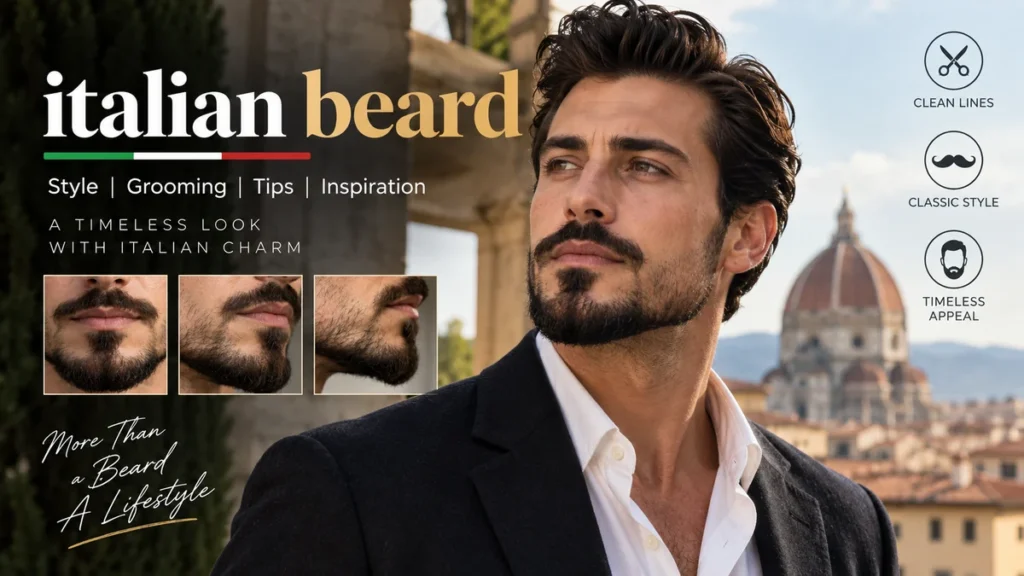
A good beard can add structure to your face. A badly shaped one can do the opposite. The italian beard sits firmly on the structured side of facial-hair styling, using controlled length, clean contours, careful transitions, and deliberate shaping around the jaw and chin.
The term does not describe one universally standardized beard pattern. Current grooming guides use it for several related looks, from short designer stubble and boxed beards to faded styles, goatees, the Balbo, and fuller Verdi-inspired beards. What connects them is precision: the beard is intentionally shaped rather than simply allowed to grow.
Quick answer: An italian beard is generally a neatly sculpted short-to-medium beard characterized by controlled sides, a defined cheek line and neckline, and carefully balanced length around the jaw and chin. Modern versions often incorporate tapered sideburns or a beard fade, while classic interpretations include the Balbo and Verdi.
What Is an italian beard?
Search for pictures of this style and you will quickly notice something confusing: they do not all show the same beard.
That is because “Italian beard” is better understood as a grooming aesthetic or family of styles, rather than a technical haircut with one mandatory outline. Current barbering sources specifically caution that the label can refer to short outlined beards, faded full beards, moustache-and-chin combinations, or other carefully sculpted facial-hair designs.
The modern interpretation commonly has several recognizable characteristics:
- Shorter or tapered hair near the sideburns
- Increasing length toward the jaw or chin
- A deliberately shaped cheek line
- A clean, controlled neckline
- Balanced facial proportions
- A neatly maintained moustache
- Smooth length transitions
- Limited stray or protruding hairs
GQ Italia’s 2026 coverage of the trend similarly describes discharged or faded sideburns, lengths that increase toward the moustache and chin, defined cheek and neck contours, and shaping intended to make the jaw more visually distinct.
That last point matters. The effect comes from geometry, not nationality.
Where the barber leaves volume—and where hair is removed—changes how the eye reads the face.
Why the Modern italian beard Looks Different
The contemporary italian beard seen in barber videos and social media tends to be more architectural than many traditional full beards.
Instead of maintaining roughly equal length everywhere, the barber manipulates different zones.
Controlled sideburns
Hair around the sideburns is often shorter than the chin area.
A gradual transition prevents the beard from looking bulky beside the ears and can integrate naturally with a fade or taper haircut.
More weight toward the chin
Leaving slightly greater density or length around the lower face draws attention downward.
This can visually lengthen a rounder face or emphasize the chin.
Defined cheek lines
The upper boundary should look deliberate.
That does not mean carving the cheek line unnecessarily low. Removing too much hair can make an otherwise dense beard look thinner.
A structured neckline
The lower edge creates much of the beard’s visual structure.
Too much neck growth makes a sculpted beard appear unfinished, while taking the neckline excessively high can create an unnatural chin-strap effect.
Controlled moustache
Depending on the variation, the moustache may connect to the beard or remain separate.
There is no universal rule requiring one configuration.
Popular italian beard Styles
There is more than one way to achieve the Italian-inspired aesthetic. Your natural facial-hair density, face shape, preferred maintenance level, and hairstyle should determine which version makes sense.
| Style | Main Characteristic | Typical Maintenance | Useful For |
|---|---|---|---|
| Modern faded beard | Tapered sides, fuller chin | High | Defined contemporary look |
| Short boxed beard | Compact, structured coverage | Medium | Everyday grooming |
| Designer stubble | Very short uniform growth | Medium | Minimal length |
| Goatee | Hair concentrated around mouth/chin | Medium | Sparse cheeks |
| Balbo | Separate moustache and lower beard | High | Distinct facial structure |
| Verdi | Fuller rounded beard and prominent moustache | Medium-high | Classic fuller appearance |
| Ducktail | Beard narrows toward chin | Medium-high | Adding visual length |
| Full sculpted beard | Full coverage with controlled outline | Medium | Naturally dense growth |
Modern Faded italian beard
This is arguably the version most people now associate with contemporary barbering.
The sideburn region begins short and progressively gains length toward the lower face. The transition should be gradual rather than looking like separate blocks of facial hair.
GQ Italia specifically highlights faded sideburns and increasing length toward the moustache and chin as features of the current trend.
A successful fade is subtle.
You should notice the overall facial structure before noticing individual guard lengths.
Short Boxed Beard
A short boxed beard maintains coverage across the cheeks, jaw, chin, and usually the moustache while keeping everything relatively close to the face.
It is useful when you want definition without considerable beard length.
The important details are the rear edge, cheek boundary, neckline, and transition into the sideburns. Keeping those areas controlled gives an ordinary short beard a much more intentional finish.
Italian Designer Stubble
Designer stubble sounds simple because very little length is involved.
In practice, short facial hair can expose mistakes quickly.
Uneven density, missed hairs, crooked cheek boundaries, and a poorly positioned neckline become visible because there is no longer hair to disguise them.
Around 3–5 mm is commonly described by grooming sources as designer-stubble territory, although your ideal setting depends on hair texture and density.
Italian Goatee
A goatee concentrates facial hair around the mouth and chin instead of relying on dense cheek coverage.
That makes it especially useful for men whose moustache and chin grow strongly but whose cheeks remain sparse.
The exact outline can vary. Some versions connect the moustache and chin hair into a circle-beard shape, while others create separation between individual components.
Balbo Beard
The Balbo is one of the genuinely Italian-associated historical beard styles.
It is linked to Italian aviator and political figure Italo Balbo. In grooming terminology, it generally combines a separate moustache with facial hair across the chin and portions of the jaw, without continuous sideburn connections.
That negative space is essential.
If the sideburns grow continuously into the lower beard, the silhouette starts becoming a different style.
Verdi Beard
The Verdi takes its name from the 19th-century Italian composer Giuseppe Verdi.
It represents a considerably fuller interpretation of Italian facial hair.
The classic look combines a rounded full beard with a substantial, deliberately styled moustache. Modern grooming references generally distinguish it from the aggressively tapered beard fades seen in contemporary social-media styles.
The beard provides volume; the moustache provides character.
Italian Ducktail Beard
A ducktail maintains fuller facial hair but directs the lower silhouette toward a tapered or pointed chin.
This changes facial proportions substantially.
Compared with a rounded beard, the descending point creates more vertical emphasis, making it an option worth considering when you want your beard to visually lengthen the face.
Full Italian Beard
You do not need a fade or exposed cheeks to adopt this grooming approach.
A full beard can retain cheek, jaw, and chin coverage while still emphasizing clean proportions. The difference from unmanaged growth is the finish: excessive bulk is removed, the moustache is maintained, boundaries remain controlled, and the overall silhouette is intentionally shaped.
italian beard vs Verdi vs Balbo vs Van Dyke
These names are sometimes treated as interchangeable online, but they describe different things.
| Feature | Modern italian beard | Verdi | Balbo | Van Dyke |
|---|---|---|---|---|
| Cheek coverage | Variable | Full | Limited | Usually minimal |
| Sideburn connection | Often faded | Usually natural/full | No | No |
| Moustache | Connected or separate | Prominent, usually distinct | Separate | Separate |
| Chin emphasis | Medium-high | Moderate | High | High |
| Overall length | Short-medium | Medium-full | Short-medium | Short-medium |
| Main impression | Sculpted/tapered | Rounded/classic | Structured lower beard | Pointed/artistic |
The key distinction is that italian beard is currently an umbrella-like style reference, whereas Verdi, Balbo, and Van Dyke describe more recognizable facial-hair configurations.
If you are visiting a barber, a photograph is therefore more useful than the words “Italian beard.”
Which italian beard Works for Your Face Shape?
Face-shape recommendations should be treated as visual guidelines rather than rigid rules.
Your beard density, jaw structure, chin projection, hair texture, and haircut can matter just as much.
Round Face
The objective is usually to avoid adding unnecessary width.
Try:
- Shorter sides
- Gradual sideburn taper
- Additional chin length
- A slightly angular lower outline
- Ducktail-inspired shaping
Keeping volume toward the center can create a more elongated impression.
Square Face
A square face already has considerable jaw definition.
Rather than making every line aggressively angular, consider balancing the existing structure with a softly rounded chin or controlled full beard.
Short boxed beards and moderate fades both work well.
Oval Face
Oval faces can accommodate many beard silhouettes because the proportions are already relatively balanced.
That gives you freedom to experiment with designer stubble, boxed beards, the Balbo, Verdi-inspired growth, or a fuller beard.
Avoid changing the apparent proportions unnecessarily simply because a trend calls for extreme chin length.
Oblong or Rectangular Face
An already long face usually does not need considerable additional vertical emphasis.
Keep some width around the sides and avoid an excessively long pointed chin.
A compact full beard or boxed shape often preserves better visual balance than an extreme ducktail.
Heart-Shaped Face
A narrower chin can benefit from strategic fullness around the lower jaw and chin.
Instead of an extremely thin goatee, moderate lower-face volume can help balance a broader forehead.
Quick Takeaway: Do not choose a beard solely because someone with a completely different facial structure looks good wearing it. Use the style’s length distribution to complement your own proportions.
How to Grow an italian beard
You cannot shape hair that has not grown yet.
One of the most common mistakes is attempting the final outline too early.
1. Let the beard reveal its natural pattern
Allow enough growth to see where your facial hair is naturally dense and where coverage is weaker.
Do not repeatedly redraw the cheek line during this stage.
Natural growth tells you whether a full beard, faded beard, Balbo, goatee, or stubble design is realistically achievable.
2. Evaluate density by zone
Look separately at your:
- Sideburns
- Upper cheeks
- Lower cheeks
- Moustache
- Connectors beside the mouth
- Chin
- Jaw
- Area below the jaw
Few people have perfectly uniform density.
Good beard styling works with that variation.
3. Choose the shape before removing bulk
Decide whether you want a full beard, tapered beard, stubble, Balbo, or another variation before aggressively trimming.
Once a section has been cut too short, the only solution is waiting for regrowth.
4. Establish the main length
Trim the beard to its approximate overall size.
If creating a fade, leave the chin longer and work progressively shorter toward the sideburns.
5. Refine the boundaries last
Only after the volume is balanced should you finalize the cheek line, neckline, moustache, and stray hairs.
This sequence reduces the risk of carving boundaries that no longer suit the final beard shape.
How to Trim an italian beard Step by Step
For a modern tapered version, think in zones rather than one guard setting.
Step 1: Start with a dry, clean beard
Hair behaves differently when wet.
Wash it, let it dry completely, then comb or brush the hairs into their normal direction before evaluating length.
Step 2: Remove excess bulk
Start conservatively with a longer trimmer guard.
Trim the largest areas first rather than immediately attacking the outline.
You can always shorten the beard again.
Step 3: Establish chin length
Decide how much visual weight you want around the chin.
This becomes the reference length for the rest of the taper.
Step 4: Shorten the sides progressively
Move upward toward the sideburns using progressively shorter settings.
Avoid creating a visible horizontal “step.”
A successful beard fade should transition smoothly from one length to another.
Step 5: Blend the sideburns
This is where many DIY fades fail.
The beard should transition naturally into your hairstyle. Hard, disconnected bands can make even an otherwise accurate trim look unfinished.
Step 6: Shape the cheek line
Follow your natural upper beard boundary unless there is a clear reason to lower it.
Remove isolated hairs above the main line first.
Then assess the result before taking off more.
Step 7: Define the neckline
A clean neckline separates intentional facial hair from neck growth.
Avoid shaving directly against the visible jaw edge. Leaving appropriate beard depth beneath the jaw helps maintain a natural three-dimensional shape.
Step 8: Detail the moustache
Comb the moustache downward and remove hairs that repeatedly cross the lip.
Whether it connects to the beard depends on your chosen variation.
Step 9: Check symmetry from several angles
Do not judge only from directly in front of the mirror.
Check:
- Front
- Left profile
- Right profile
- Slightly underneath
The lower silhouette can look symmetrical from the front while being uneven from the side.
How High Should the Neckline Be?
There is no single measurement suitable for every face.
The neckline should support the beard’s shape while preventing neck growth from visually merging into it.
A useful practical approach is to identify where the underside of the jaw transitions toward the neck and create a gentle curved boundary beneath it.
Do not automatically trace the jawbone itself.
An excessively high neckline exposes the underside of the chin and can make a full beard look artificially thin. Too low, and the clean sculpted effect disappears.
The correct boundary looks natural when viewed from both the front and profile.
Should the Cheek Line Be Natural or Sharp?
For most men, the best answer is natural but cleaned up.
If you naturally have a strong upper cheek boundary, preserve as much density as possible and remove obvious stray hairs above it.
A deliberately lower line can work when the natural growth is irregular, but there is a tradeoff: every millimeter removed from the top also reduces visible beard coverage.
Sharp does not have to mean low.
How to Ask Your Barber for an italian beard
Do not rely on the name alone.
Different barbers—and different websites—use “Italian beard” to describe different silhouettes. Barbering guides explicitly recommend discussing actual features such as cheek coverage, moustache connection, chin length, and fade rather than assuming the label represents one standardized cut.
Bring clear front and side reference images and explain:
- How much chin length you want
- Whether you want cheek coverage
- How short the sideburns should become
- Whether you want a beard fade
- Whether the moustache should connect
- How natural or sharp you want the cheek line
- Whether the bottom should be rounded, squared, or tapered
“Keep the chin fuller, gradually taper toward the sideburns, clean the neckline, and preserve my natural cheek line” gives a barber far more useful information than simply saying “give me an Italian beard.”
Can You Wear an italian beard With Patchy Growth?
Yes, but the right variation matters.
Trying to force sparse cheeks into a dense full beard usually makes the missing coverage more obvious.
Instead, identify where you grow strongly.
If your moustache and chin are dense but your cheeks are sparse, consider a:
- Goatee
- Circle beard
- Balbo
- Van Dyke
- Short designer stubble
The Balbo is particularly useful because the design intentionally removes some of the connections that a conventional full beard requires.
If growth is inconsistent everywhere, keeping facial hair shorter can sometimes make density differences less obvious.
There is also no trimming technique that creates new follicles. Shaping can redistribute visual weight, but it cannot turn naturally sparse growth into genuinely dense growth.
Maintaining the Fade and Shape
The sharper the beard, the faster normal growth makes it appear less precise.
That is the hidden cost of this style.
Touch up the boundaries
Cheek and neck hairs quickly soften freshly created lines.
You do not necessarily need a complete trim every time. Removing obvious regrowth outside the intended outline can restore much of the shape.
Maintain transitions carefully
Repeatedly using the shortest guard over too large an area causes the fade to creep downward.
Instead, remember where each length zone begins and ends.
Brush before judging shape
A beard can look uneven simply because hairs are pointing in different directions.
Brush or comb everything into position before reaching for the trimmer.
Keep the moustache functional
A moustache should complement the beard without becoming uncomfortable.
Trim persistent hairs away from the mouth and use a small amount of moustache wax when wearing a more prominent Verdi-inspired shape.
Beard Oil, Balm, Brushes and Trimmers
Products do not create the style—the haircut does.
But a few basic tools make maintenance easier.
Adjustable beard trimmer: Multiple guard lengths are especially valuable for creating tapered transitions.
Detail trimmer or razor: Useful for cleaning the cheek line, neckline, and areas around the moustache.
Beard comb: Helps reveal uneven length and guides moustache trimming.
Beard brush: Useful on fuller facial hair for arranging the beard into its intended silhouette.
Beard oil: Primarily conditions facial hair and the skin underneath. A few drops are generally enough for shorter beards.
Beard balm: Provides more control than oil and can help longer hairs remain in position.
Moustache wax: Most relevant to prominent or styled moustaches, including Verdi-inspired looks.
Do not compensate for poor shaping with excessive product. A precisely trimmed beard generally needs surprisingly little styling.
Common italian beard Mistakes
Making the fade too aggressive
A fade should transition.
If one section is nearly bare and the next is suddenly dense, you have created a hard step rather than a blend. GQ Italia similarly warns that poorly copying the style can produce hard lines and an interrupted fade instead of one that follows the face.
Taking the cheek line too low
This is difficult to reverse quickly.
Clean obvious strays before deciding that the entire upper boundary needs lowering.
Shaving the neckline too high
Removing too much underneath the chin destroys depth.
Check the profile before continuing.
Chasing perfect symmetry
Faces themselves are not perfectly symmetrical.
The goal is visual balance, not mathematically identical lines.
Choosing a beard your growth cannot support
A dense Verdi requires substantially different growth from a small goatee.
Choose the architecture according to your natural coverage.
Copying guard numbers exactly
Someone else’s 5 mm beard will not necessarily look like yours at 5 mm.
Hair thickness, curl pattern, density, color, and contrast with the skin all change how length appears.
Use measurements as starting points rather than guarantees.
italian beard With Different Hairstyles
The beard and haircut should be treated as one visual composition.
With a Skin Fade
A faded haircut creates an obvious opportunity to continue the transition through the sideburns.
Ask the barber to blend the two rather than treating hair and beard as completely separate cuts.
With a Taper
A taper creates a softer transition and works particularly well when you want the beard to remain polished without making the sides extremely short.
With a Side Part
A classic side part paired with a short boxed or full sculpted beard produces a more traditional appearance.
The structured hairstyle complements the beard’s controlled outline.
With Longer Hair
Long hair can work with a fuller beard, but balance becomes more important.
Large amounts of hair around both the head and lower face can overwhelm facial features. Strategic beard tapering can prevent that.
With a Buzz Cut
A buzz cut leaves the beard responsible for much of the face’s visual framing.
Defined sideburn transitions and a carefully balanced chin become particularly noticeable.
Is an italian beard High Maintenance?
A short beard is not automatically a low-maintenance beard.
In fact, highly sculpted short styles often require more frequent detailing than relaxed full beards because tiny amounts of regrowth alter the clean boundaries.
Maintenance depends on the variation:
| Style | Trimming Need | Lineup Need | Styling Need |
|---|---|---|---|
| Designer stubble | Frequent | Frequent | Low |
| Faded beard | Frequent | Frequent | Low-medium |
| Short boxed beard | Regular | Regular | Low |
| Balbo | Regular | Frequent | Medium |
| Ducktail | Regular | Regular | Medium |
| Verdi | Regular | Moderate | High |
| Natural full beard | Moderate | Moderate | Medium |
If you dislike frequent lineups, choose a softer interpretation rather than an extremely sharp fade.
What Actually Makes the Style Work?
The most successful Italian-inspired beards share one quality: intentional proportion.
The beard does not need to be exceptionally thick, dark, long, or dramatic.
Instead, pay attention to four things:
Density: Work with the areas where facial hair naturally grows strongest.
Length: Decide where the face needs visual width or height.
Transitions: Blend neighboring sections instead of creating accidental steps.
Boundaries: Keep cheek and neck edges controlled without carving away useful density.
That approach explains why two men can wear completely different beard lengths and both achieve the same polished aesthetic.
Final Thoughts on the italian beard
The italian beard is best understood as a precise grooming approach rather than one rigid facial-hair template. Modern versions emphasize tapered sideburns, clean cheek and neck boundaries, controlled sides, and stronger visual weight around the jaw or chin, while classic Italian-associated styles such as the Balbo and Verdi offer distinctly different silhouettes.
Start with your natural growth pattern and face proportions rather than copying a beard guard-for-guard. Choose the amount of cheek coverage, chin length, moustache connection, and sideburn taper that suits your face, then maintain those proportions consistently.
That is what turns ordinary facial hair into a deliberately shaped italian beard.