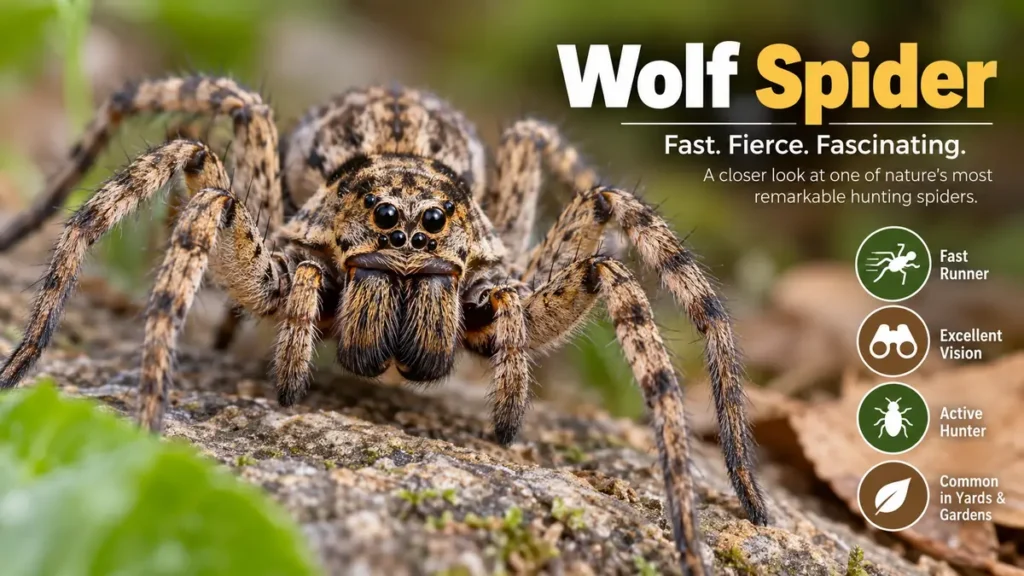
A wolf spider can be startling when it races across a floor, patio, lawn, or garage. Its large body, hairy legs, and speed make it look threatening, but appearances tell only part of the story.
Wolf spiders belong to the family Lycosidae, a widespread group of ground-hunting spiders. Unlike typical web-building spiders, most actively chase or ambush insects rather than trapping them in a capture web. They have eight eyes arranged in three distinctive rows, and females famously carry their egg sacs and later their spiderlings. Wolf spiders can bite when trapped or handled, but bites generally cause only temporary local symptoms in humans.
What Is a Wolf Spider?
A wolf spider is a member of the spider family Lycosidae within the order Araneae and class Arachnida. The family includes numerous genera and species that vary considerably in size, coloration, habitat, and behavior.
The name comes from the old idea that these spiders hunted prey somewhat like wolves. Modern observations give us a more accurate picture: they are primarily solitary predators that rely heavily on movement, vision, vibration, and rapid attacks.
Rather than constructing an elaborate sticky web and waiting for dinner to arrive, most wolf spiders hunt on the ground. Some wander through vegetation or leaf litter, while others remain near burrows or protected retreats.
Their prey consists mainly of insects and other small arthropods. This predatory role is one reason finding a wolf spider in a garden isn’t necessarily bad news.
Wolf Spider Classification
| Classification | Group |
|---|---|
| Kingdom | Animalia |
| Phylum | Arthropoda |
| Subphylum | Chelicerata |
| Class | Arachnida |
| Order | Araneae |
| Family | Lycosidae |
| Common name | Wolf spider |
The family is remarkably diverse. In North America north of Mexico alone, BugGuide lists approximately 240 species in 21 genera, although classifications and recognized species can change as taxonomic research progresses.
What Does a Wolf Spider Look Like?
Wolf spiders are commonly brown, gray, tan, or combinations of these colors. Their mottled patterns provide excellent camouflage against soil, rocks, dead leaves, and vegetation.
Many appear hairy and robust, with strong legs designed for running rather than sitting permanently in a web.
Depending on the species, body size varies substantially. BugGuide reports North American species ranging from only a few millimeters to roughly 35 mm in body length. The legs make a large individual appear considerably bigger.
Color alone isn’t a reliable identification method because several unrelated spiders share similar brown or gray patterns.
Look at the Eyes
The eyes provide one of the strongest clues.
A wolf spider has eight eyes arranged in three rows:
- four relatively small eyes in the bottom row
- two large, prominent eyes in the middle row
- two additional eyes positioned farther back
The two conspicuously large middle eyes give the spider excellent vision and create a distinctive facial appearance when viewed closely.
University of Minnesota Extension specifically recommends the eye arrangement as one of the best features for recognizing members of this family.
At night, their eyes may also reflect light. Someone searching a lawn with a flashlight can sometimes notice tiny points of reflected light before seeing the spiders themselves.
Body Shape and Markings
A typical wolf spider has a relatively sturdy body divided into the cephalothorax and abdomen, along with eight walking legs.
Common characteristics include:
- brown, gray, black, or tan coloration
- darker stripes or mottled markings
- noticeable body hair
- long, powerful legs
- a robust rather than delicate appearance
- prominent central eyes
There isn’t one universal stripe or marking shared by every species. Eye arrangement and overall anatomy are therefore more dependable than color alone.
How Big Can a Wolf Spider Get?
Size depends heavily on species.
Some are small enough to go unnoticed in grass or leaf litter. Others are among the larger spiders people regularly encounter around homes.
For example, Penn State Extension reports female Hogna carolinensis at approximately 22–35 mm in body length, while males are around 18–20 mm. Female Tigrosa aspersa are reported at approximately 18–25 mm.
These measurements refer primarily to body length rather than the entire leg span.
That distinction matters. A spider with its legs extended across a wall can look dramatically larger than its actual body measurement suggests.
Where Do Wolf Spiders Live?
Wolf spiders have an enormous geographic and ecological range.
Members of Lycosidae occur in environments ranging from relatively cold regions to subtropical areas. Depending on the species, suitable habitat can include:
- grasslands
- forests and woodlands
- meadows
- gardens
- agricultural fields
- deserts
- sandy areas
- coastal dunes
- shorelines
- marshes
- lawns
- areas beneath stones and logs
Some species live primarily on the surface. Others dig or occupy burrows.
BugGuide describes wolf spiders as widespread from Arctic regions into the subtropics, while University of Minnesota Extension notes their presence in habitats including fields, forests, and shorelines.
This adaptability explains why encounters are so common.
Where Do Wolf Spiders Hide?
During inactive periods, they seek places offering protection from predators, weather, and disturbance.
Common retreats include:
- underneath rocks
- beneath logs and boards
- among dead leaves
- inside cracks
- underneath firewood
- within soil burrows
- beneath siding
- around dense vegetation
Some species construct burrows and spend considerable time near them. Others wander extensively while hunting.
A hole in the ground isn’t automatically a wolf spider burrow, however. Many insects and arachnids use similar shelters.
Why Is There a Wolf Spider in My House?
Finding one indoors doesn’t necessarily mean wolf spiders are breeding throughout the building.
Because many species are active hunters, individuals occasionally wander inside through openings around doors, foundations, windows, garages, or utility penetrations.
Protected spaces can also provide shelter.
Penn State Extension notes that some wolf spiders use protected areas beneath siding, boards, stones, and firewood, and that certain females can overwinter in sheltered locations, including human-made structures.
You may encounter one in:
- basements
- garages
- sheds
- ground-level rooms
- closets
- entryways
- around doors
- storage spaces
Their sudden appearance is especially noticeable because they can move rapidly.
Does Seeing One Mean You Have an Infestation?
Not necessarily.
Wolf spiders don’t normally establish communal colonies. They are generally solitary predators.
An occasional individual may simply have wandered inside.
Frequent sightings, however, can indicate favorable conditions around the property—such as numerous insects, cluttered hiding places, vegetation against the building, or accessible cracks and gaps.
Addressing those conditions is usually more useful than assuming every sighting represents an infestation.
How Does a Wolf Spider Hunt?
This is where wolf spiders differ dramatically from the stereotypical spider sitting in the middle of a sticky web.
Most are active hunters.
They may walk through vegetation and leaf litter searching for prey, wait near a retreat for something edible to approach, or rapidly pursue a nearby insect.
Their well-developed eyesight helps them detect prey and navigate their surroundings.
The Smithsonian describes wolf spiders as solitary hunters that use their strong vision while hunting, particularly at night.
Do Wolf Spiders Make Webs?
Wolf spiders produce silk, but most don’t build the familiar aerial prey-catching webs associated with orb weavers.
Silk still serves important purposes.
It can be involved in:
- lining or protecting retreats
- reproductive behavior
- constructing egg sacs
- leaving chemical and physical cues
- dispersal by young spiders
There are exceptions to the simple “wolf spiders don’t make webs” rule. BugGuide notes that members of the genus Sosippus differ from most wolf spiders in their web-building behavior.
So the more accurate statement is that most wolf spiders don’t depend on sticky capture webs for hunting.
What Do Wolf Spiders Eat?
Wolf spiders are predators.
Their diet primarily consists of insects and other arthropods small enough for them to overpower.
Common prey can include:
- crickets
- ants
- grasshoppers
- beetles
- flies
- other spiders
- various crawling insects
The Smithsonian notes that larger individuals can sometimes capture unusually large prey, including small vertebrates, although insects and other arthropods make up the more typical diet.
Once prey is captured, the spider uses its chelicerae, or fang-bearing mouthparts, to immobilize it and begin feeding.
Are Wolf Spiders Good for Gardens?
Generally, yes.
They prey on insects naturally occurring around gardens, lawns, agricultural areas, and landscapes.
University of Minnesota Extension describes wolf spiders as beneficial insect predators.
They won’t distinguish between an insect humans consider a pest and every other arthropod, so they aren’t precision biological-control tools. Still, they form part of the natural predator community that helps regulate insect populations.
Quick takeaway: A wolf spider in the garden is usually performing a normal ecological role rather than damaging plants.
Are Wolf Spiders Dangerous?
For most people, wolf spiders are much more frightening than dangerous.
They aren’t naturally aggressive toward humans and generally try to escape when disturbed. A bite is most likely when a spider is trapped against skin, handled, squeezed, or otherwise unable to retreat.
Penn State Extension reports that wolf spider bites can cause initial pain, redness, and sometimes localized swelling, with symptoms generally subsiding within about 24 hours in the cases described. It notes no serious medical consequences from these bites.
Like many spiders, wolf spiders possess venom because it helps them subdue prey. The presence of venom doesn’t automatically mean an animal presents a serious medical threat to people.
Do Wolf Spiders Bite Humans?
They can.
But biting people isn’t how they obtain food or normally interact with humans.
A defensive bite may occur if someone:
- grabs the spider
- presses it against the skin
- reaches into its hiding place
- traps it inside clothing
- handles it directly
Leaving the spider alone greatly reduces the chance of being bitten.
What Does a Wolf Spider Bite Look Like?
A suspected wolf spider bite may produce localized:
- pain
- redness
- swelling
- itching
The difficulty is that appearance alone usually cannot prove which spider caused a skin lesion.
Many insect bites, irritated follicles, allergic reactions, and skin infections can produce similar red or swollen areas.
Without actually observing and reliably identifying the spider responsible for the bite, confidently labeling a skin lesion a “wolf spider bite” can be misleading.
What Should You Do After a Suspected Bite?
For a mild local reaction, basic wound care is generally appropriate:
- Wash the affected area gently with soap and water.
- Avoid scratching or repeatedly irritating the site.
- Apply a cool compress for discomfort or swelling.
- Keep the area clean while it heals.
- Monitor symptoms for unexpected changes.
Seek medical attention for severe or rapidly worsening pain, significant swelling, spreading redness, signs of infection, breathing difficulty, facial or mouth swelling, dizziness, fainting, or other serious symptoms.
Those symptoms shouldn’t simply be assumed to represent a normal wolf spider bite.
Wolf Spider vs. Brown Recluse
Wolf spiders are sometimes confused with the brown recluse, especially when someone sees a brown spider moving through a house.
They are very different spiders.
| Feature | Wolf spider | Brown recluse |
|---|---|---|
| Family | Lycosidae | Sicariidae |
| Typical appearance | Robust, often hairy and patterned | More uniformly brown |
| Eyes | 8 eyes | 6 eyes |
| Hunting | Active ground hunter | Wandering/retreat-based hunter |
| Distinctive clue | Large central eyes | Characteristic eye pattern; violin-like marking may help |
| Human medical significance | Usually mild local bite effects | Bites can occasionally cause medically significant injury |
The eye count is particularly useful: wolf spiders have eight eyes, whereas recluse spiders have six.
Don’t rely solely on the supposed “violin” marking when identifying an unknown spider. Color and markings vary, photographs can distort them, and many harmless brown spiders are mistakenly labeled recluses.
Wolf Spider vs. Grass Spider
Another common source of confusion is the grass spider, a funnel weaver often encountered around lawns.
Grass spiders make conspicuous horizontal sheet-like webs with a funnel retreat. Wolf spiders usually hunt without that type of prey-catching web.
Grass spiders also tend to have more conspicuous elongated spinnerets at the rear of the abdomen.
University of Minnesota Extension distinguishes grass spiders as funnel-web builders, while wolf spiders are categorized as hunting spiders.
If the spider consistently sits inside a funnel attached to a broad sheet of silk, you’re probably looking at something other than a typical wolf spider.
Wolf Spider vs. Tarantula
Large, hairy wolf spiders are occasionally mistaken for small tarantulas.
Both belong to the order Araneae, but they occupy different branches of spider diversity.
Tarantulas belong to the family Theraphosidae, while wolf spiders belong to Lycosidae.
Wolf spiders usually have a more running-oriented build and their characteristic three-row eye arrangement. Tarantulas generally have heavier bodies and thicker-looking legs.
Interestingly, the word “tarantula” has historical connections to a wolf spider associated with Taranto, Italy, even though modern tarantulas belong to a completely different family. The Smithsonian notes this historical origin of the name.
How Do Wolf Spiders Reproduce?
Wolf spider reproduction includes some of the family’s most fascinating behavior.
A male doesn’t simply approach a female without warning. Courtship can involve combinations of visual displays and vibrations.
Depending on species, males may:
- wave their front appendages
- move their pedipalps
- vibrate their abdomen
- create substrate vibrations
- follow silk or chemical cues associated with females
BugGuide notes that males can use visual and seismic signals during courtship, including rhythmic movements involving the pedipalps or abdomen.
These signals help the female distinguish a potential mate from prey or another disturbance.
Why Do Female Wolf Spiders Carry an Egg Sac?
One of the easiest ways to recognize a female wolf spider is to see a round egg sac attached behind her abdomen.
The female produces a silk egg sac and attaches it to her spinnerets.
Instead of leaving the sac permanently attached to vegetation or hidden in a web, she carries it as she moves.
That arrangement allows the female to continue walking and hunting while keeping the developing eggs close.
If you see a spider running around with what looks like a small pale ball attached to the end of its abdomen, there’s a good chance you’re observing a female wolf spider.
Why Do Baby Wolf Spiders Ride on Their Mother’s Back?
The parental care becomes even more remarkable after hatching.
The tiny spiderlings climb onto their mother’s abdomen and gather on her back.
She then carries them until they’re ready to disperse.
University of Minnesota Extension and Penn State Extension both identify this behavior as characteristic of wolf spiders.
A female carrying dozens of young can initially look as though her abdomen has an unusual rough texture. On closer inspection, that “texture” may be a moving mass of tiny spiders.
This behavior is an especially useful identification clue because relatively few familiar spiders carry newly hatched young in such a conspicuous way.
What Happens If the Spiderlings Are Disturbed?
Young spiders can scatter from the mother’s abdomen when strongly disturbed.
This sometimes happens when someone tries to crush or capture a female carrying spiderlings indoors, producing the alarming appearance of many tiny spiders suddenly running in different directions.
The spectacle may look like an infestation appearing instantly, but the young were already being transported together on the female.
Wolf Spider Life Cycle
The precise timing varies with species and climate, but the general life cycle follows four broad stages:
- Egg: The female protects developing eggs within a silk sac.
- Spiderling: Young emerge and initially ride on the female.
- Juvenile: They disperse, hunt independently, and grow through successive molts.
- Adult: Mature spiders reproduce and continue the cycle.
Like other spiders, they have an external skeleton, or exoskeleton. Growth therefore requires molting.
Penn State’s account of large wolf spiders in Pennsylvania shows how seasonal timing can work in temperate climates: mating can occur in autumn, protected females may overwinter, and egg sacs may be produced during the following warmer months. The exact schedule should not be generalized to every wolf spider worldwide.
Some females can survive beyond their first reproductive season.
Are Wolf Spiders Nocturnal?
Many species are active at night, but “all wolf spiders are nocturnal” is too broad.
Activity patterns depend on species, temperature, habitat, prey availability, and environmental conditions.
University of Minnesota Extension notes that wolf spiders may hunt during the day or night when conditions are warm.
Their large eyes are particularly useful under lower-light conditions.
This also explains why people frequently encounter them unexpectedly after dark on patios, sidewalks, lawns, or garage floors.
Can Wolf Spiders Jump?
Wolf spiders are excellent runners and can make sudden short movements that may look like jumping.
However, they shouldn’t be confused with true jumping spiders in the family Salticidae, which are specialized for controlled jumps and use jumping extensively during hunting and movement.
The wolf spider’s signature ability is rapid ground movement.
That speed is useful for both catching prey and escaping larger animals—including humans.
What Eats Wolf Spiders?
Being an effective predator doesn’t put the wolf spider at the top of every food chain.
Potential predators include:
- birds
- reptiles
- amphibians
- larger spiders
- predatory insects
- parasitic or hunting wasps
Some hunting wasps have particularly dramatic relationships with spiders. A female wasp may paralyze a spider and use it as food for a developing larva.
The Smithsonian specifically notes hunting wasps among wolf spider predators.
Their brown and gray camouflage therefore isn’t useful only for hunting. It also helps wolf spiders avoid becoming prey themselves.
How to Deal With a Wolf Spider Indoors
If you find a single wolf spider indoors, killing it isn’t necessary.
Avoid picking it up with bare hands.
For someone comfortable doing so, a simple capture-and-release method works:
- Place a container over the spider.
- Carefully slide stiff paper or thin cardboard underneath.
- Keep the container and paper together.
- Carry the spider outside.
- Release it away from frequently used entrances.
The more effective long-term strategy is preventing spiders and their prey from entering.
How to Reduce Wolf Spiders Around the House
Focus on habitat and access rather than repeatedly treating individual spiders.
Useful measures include:
- sealing cracks around foundations
- repairing damaged screens
- improving weather stripping around doors
- closing gaps around pipes and utilities
- moving firewood away from exterior walls
- removing unnecessary ground-level clutter
- reducing insect prey indoors
- vacuuming spiders found inside
- keeping storage areas organized
Outdoor lighting can attract flying insects, and those insects can attract predators. Where practical, reducing unnecessary nighttime lighting immediately beside entrances may make those areas less attractive to prey and consequently to hunting spiders.
A spider-friendly garden and a spider-free living room aren’t contradictory goals. Wolf spiders can remain useful outdoor predators without needing unrestricted access to your house.
Common Myths About Wolf Spiders
Their intimidating appearance has created several misconceptions.
“Wolf spiders chase people.”
They chase prey, not humans.
A frightened spider may run in a direction that happens to be toward someone, particularly when trying to reach cover. That shouldn’t be interpreted as deliberate pursuit.
“A large wolf spider must be dangerous.”
Size is a poor measure of medical importance.
Some comparatively large spiders pose little threat to people, while identification and venom effects matter far more than body size.
“Every brown spider indoors is a brown recluse.”
Brown coloration is extremely common among spiders.
Eye arrangement, anatomy, geographic range, markings, and other features should all be considered before identifying an unknown spider.
“Wolf spiders don’t produce silk.”
They absolutely do.
What distinguishes most species is that they don’t rely on a traditional prey-catching web. Silk remains essential for egg sacs and other aspects of their biology.
“A female carrying babies is covered in parasites.”
Usually not.
If dozens of tiny spider-like shapes are clustered across the abdomen of a wolf spider, they may simply be her spiderlings.
Why Wolf Spiders Matter
A wolf spider isn’t just another creepy animal hiding underneath a rock.
It occupies an important middle position in terrestrial food webs.
As a predator, it consumes insects and other arthropods. As prey, it provides food for larger spiders, birds, amphibians, reptiles, and predatory wasps.
That makes wolf spiders both hunters and hunted.
Their reproductive behavior also makes Lycosidae particularly interesting scientifically. Carrying an egg sac from the spinnerets and transporting newly hatched spiderlings on the mother’s back represent conspicuous forms of parental investment.
For homeowners and gardeners, the practical message is simpler: an outdoor wolf spider is generally beneficial and doesn’t need to be eliminated simply because it looks intimidating.
Key Facts About the Wolf Spider
| Feature | Wolf Spider Facts |
|---|---|
| Scientific family | Lycosidae |
| Animal group | Arachnid |
| Number of legs | 8 |
| Number of eyes | 8 |
| Eye arrangement | Three rows |
| Main hunting style | Active hunting/ambush |
| Typical food | Insects and other arthropods |
| Capture web | Usually no |
| Common colors | Brown, gray, tan, dark mottling |
| Habitat | Grasslands, forests, gardens, fields, deserts, wetlands and other ground habitats |
| Egg care | Female carries egg sac on spinnerets |
| Young | Spiderlings ride on female’s back |
| Human aggression | Low |
| Bite | Possible when trapped or handled |
| Typical bite effects | Local pain, redness and possible swelling |
| Garden role | Beneficial predator |
Living Alongside Wolf Spiders
The easiest way to understand a wolf spider is to stop thinking of it as a web spider that has wandered away from its web. It follows a different strategy entirely.
Its strong legs, excellent eyesight, camouflage, and rapid movement are adaptations for an active predatory lifestyle. Instead of waiting for insects to become tangled in silk, it goes hunting.
That lifestyle occasionally brings wolf spiders into garages, basements, gardens, and homes, where their size can make an encounter memorable. Yet they are generally reluctant to interact with people, and documented bites typically involve temporary localized symptoms rather than serious medical consequences.
If you find one outdoors, leaving it alone is usually the simplest response. If one gets inside, capture and release is an option, while sealing entry points and reducing insect prey can help prevent repeat visitors.
Perhaps the most remarkable thing about Lycosidae isn’t its speed or appearance at all. It’s the female carrying her silk egg sac behind her and later transporting an entire generation of spiderlings on her back—a distinctive piece of parental behavior hiding inside one of the most commonly misunderstood spiders around us.