A child’s education should involve more than memorizing facts and passing examinations. The International Baccalaureate Primary Years Programme encourages children to ask meaningful questions, investigate ideas and apply their knowledge to everyday situations.
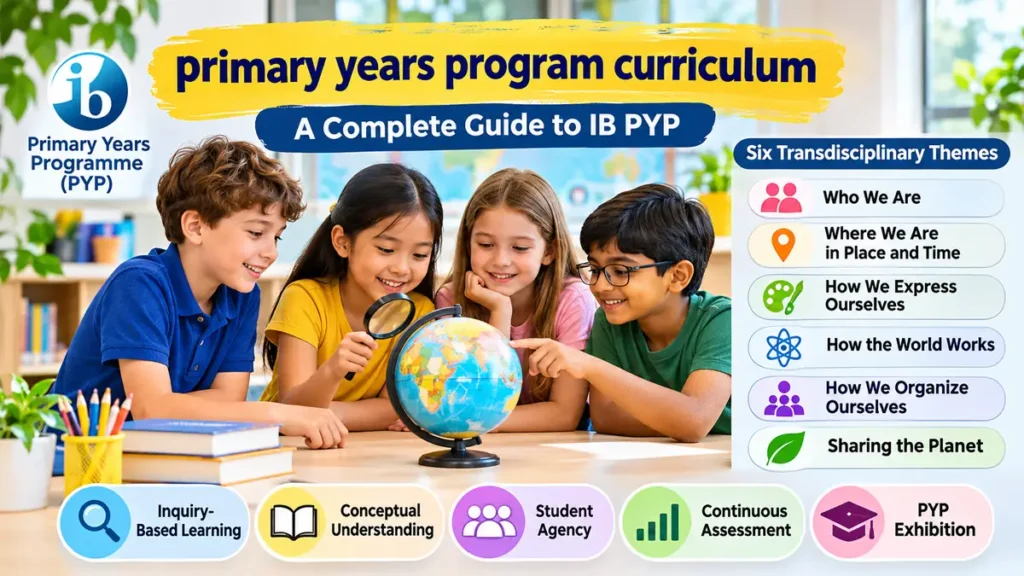
The primary years program curriculum is an inquiry-based educational framework developed by the International Baccalaureate (IB) for children aged 3 to 12. It combines academic subjects, six transdisciplinary themes, conceptual understanding, independent learning and personal development to help students become confident, responsible and internationally minded learners.
Unlike a rigid syllabus, the PYP allows schools to adapt learning experiences to their students’ needs, cultural backgrounds and educational requirements.
What Is the primary years program curriculum?
The Primary Years Programme (PYP) is an international educational framework introduced in 1997 by the International Baccalaureate. It provides an educational foundation for children during their early childhood and primary school years.
The programme focuses on developing the whole child academically, socially, emotionally and physically.
Rather than studying every subject in isolation, students explore significant ideas that connect multiple academic disciplines.
For example, a classroom investigation into water conservation might incorporate mathematics, environmental science, geography, communication and social responsibility.
The PYP curriculum is designed around three interconnected pillars:
- The learner: Individual development, independence and learning outcomes.
- Learning and teaching: Educational strategies that support meaningful understanding.
- The learning community: Collaboration between students, educators, families and the wider community.
These pillars support a student-centered approach in which children actively participate in their education. International Baccalaureate®+1
IB PYP Curriculum at a Glance
| Feature | Description |
|---|---|
| Full name | Primary Years Programme |
| Abbreviation | PYP |
| Organization | International Baccalaureate |
| Age range | 3–12 years |
| Introduced | 1997 |
| Learning approach | Inquiry-based learning |
| Curriculum structure | Transdisciplinary |
| Main themes | Six |
| Assessment | Continuous, school-based assessment |
| Final project | PYP Exhibition |
| Next IB programme | Middle Years Programme (MYP) |
Six Transdisciplinary Themes of the primary years program curriculum
The six transdisciplinary themes provide the foundation for organizing educational experiences across the PYP.
Each theme addresses a significant aspect of human life, encouraging students to connect classroom learning with wider global issues.
1. Who We Are
This theme explores personal identity, relationships, health, values and human development.
Students investigate how their experiences influence who they become and how they interact with others.
Example topics include physical wellbeing, family relationships, cultural identity, emotional development and personal responsibilities.
2. Where We Are in Place and Time
This theme examines history, geography, migration and the relationship between people and their surroundings.
Children learn how past events and human experiences influence present-day communities.
A classroom project might involve researching local history, comparing historical maps or investigating how transportation has changed over time.
3. How We Express Ourselves
Children explore the different ways people communicate ideas, emotions, beliefs and cultural identities.
Learning opportunities may include storytelling, music, visual arts, drama, literature and digital communication.
The theme encourages creative thinking while helping children appreciate different forms of expression.
4. How the World Works
This theme introduces students to scientific principles, natural phenomena, technology and the relationship between human activity and the natural environment.
Students may conduct experiments, investigate forces and energy, study weather patterns or explore technological developments.
The emphasis is on understanding how and why things happen.
5. How We Organize Ourselves
Students investigate how human communities function through rules, organizations, economic activities and shared responsibilities.
Topics can include transportation systems, governments, businesses, community services and decision-making.
A practical classroom activity might involve creating a simulated marketplace to understand production, distribution and consumption.
6. Sharing the Planet
This theme explores environmental sustainability, natural resources, equality, human responsibilities and relationships between living organisms.
Children examine issues such as biodiversity, pollution, climate change, access to resources and conflict resolution.
They are encouraged to consider how their individual decisions affect other people and the environment.
These six themes help schools develop a connected Programme of Inquiry rather than relying exclusively on traditional subject boundaries. International Baccalaureate®+1
IB PYP Curriculum Subjects and Core Learning Elements
Although the programme emphasizes transdisciplinary education, traditional academic subjects remain essential.
Students develop subject-specific knowledge while applying their understanding in broader learning contexts.
Six Main Subject Areas
| Subject | Main Learning Areas |
|---|---|
| Language | Reading, writing, speaking and listening |
| Mathematics | Numbers, measurement, geometry and data |
| Science | Living organisms, materials, energy and scientific investigation |
| Social studies | History, geography, society and culture |
| Arts | Music, visual arts, drama and creativity |
| Personal, social and physical education | Health, fitness, relationships and wellbeing |
Schools determine detailed learning objectives and subject content within the IB framework. This allows them to incorporate national curriculum standards and local educational requirements. IB教育推進コンソーシアム+1
Seven Key Concepts in the PYP
Concept-based learning encourages students to understand ideas that remain relevant across different subjects and situations.
| Concept | Guiding Question |
|---|---|
| Form | What is it like? |
| Function | How does it work? |
| Causation | Why is it like this? |
| Change | How is it changing? |
| Connection | How is it connected to other things? |
| Perspective | What are the different points of view? |
| Responsibility | What are our obligations? |
For instance, when studying ecosystems, children can explore how habitats function, why environmental changes occur and what responsibilities humans have toward wildlife.
This approach helps students move beyond remembering individual facts toward understanding relationships and applying knowledge.
Approaches to Learning (ATL) Skills
The IB PYP develops five broad categories of learning skills that children can use throughout their education:
- Thinking skills: Critical reasoning, creativity and problem-solving.
- Research skills: Gathering, evaluating and interpreting information.
- Communication skills: Expressing ideas and listening effectively.
- Social skills: Collaboration, empathy and conflict resolution.
- Self-management skills: Organization, time management and emotional regulation.
These abilities are developed gradually through classroom activities, collaborative projects, independent investigations and reflection.
How Inquiry-Based Learning Works in PYP Schools
Inquiry-based learning begins with curiosity. Instead of immediately providing every answer, teachers create opportunities for students to investigate meaningful questions.
However, inquiry does not mean that children teach themselves without guidance. Teachers provide structured instruction, explanations, resources and feedback when needed.
What Is a Unit of Inquiry?
A Unit of Inquiry (UOI) is a structured learning experience organized around a central idea.
A typical unit includes a central idea, lines of inquiry, relevant concepts, academic learning objectives, opportunities for reflection and assessment.
The Programme of Inquiry brings these individual units together across different age groups to support educational progression.
Example of a PYP Unit of Inquiry
Consider a unit based on environmental sustainability.
| Curriculum Component | Example |
|---|---|
| Transdisciplinary theme | Sharing the Planet |
| Central idea | Human choices influence environmental sustainability |
| Science | Investigating pollution and decomposition |
| Mathematics | Measuring and recording waste |
| Language | Writing persuasive environmental messages |
| Social studies | Exploring community responsibilities |
| Arts | Designing recycling posters |
| Student action | Introducing a classroom recycling system |
Through this single unit, students develop knowledge and skills across multiple disciplines while investigating a real-world problem.
Student Agency, Voice and Choice
Student agency refers to children’s ability to influence their learning and take responsibility for their educational development.
In a PYP classroom, students might select research questions, choose presentation methods, suggest classroom activities or establish personal learning goals.
Teachers guide these decisions to ensure students continue meeting appropriate academic expectations.
The combination of agency, reflection and meaningful action is central to the modern PYP framework. International Baccalaureate®+1
The IB Learner Profile
The IB Learner Profile describes ten attributes that the programme aims to develop.
| Attribute | Meaning |
|---|---|
| Inquirers | Demonstrate curiosity and investigate questions |
| Knowledgeable | Develop understanding across disciplines |
| Thinkers | Apply critical and creative thinking |
| Communicators | Express ideas effectively |
| Principled | Act honestly and responsibly |
| Open-minded | Respect different beliefs and perspectives |
| Caring | Demonstrate empathy and compassion |
| Risk-takers | Approach unfamiliar challenges with courage |
| Balanced | Maintain physical, intellectual and emotional wellbeing |
| Reflective | Evaluate experiences and identify improvements |
These attributes support international-mindedness, encouraging children to understand cultural differences and recognize their responsibilities within a global community.
IB PYP Assessment Methods and the PYP Exhibition
Assessment in the Primary Years Programme is designed to support learning rather than simply measure how many facts children can remember.
Teachers gather evidence of student progress throughout the academic year and use it to identify strengths, difficulties and future learning needs.
How Are PYP Students Assessed?
| Assessment Method | Purpose |
|---|---|
| Diagnostic assessment | Identifies existing knowledge and misconceptions |
| Formative assessment | Monitors progress during learning |
| Summative assessment | Evaluates understanding after a learning experience |
| Self-assessment | Encourages students to evaluate their own work |
| Peer assessment | Develops constructive feedback skills |
| Student portfolios | Documents progress over time |
| Performance tasks | Demonstrates practical application of knowledge |
Teachers may use classroom observations, written assignments, presentations, quizzes, projects and individual discussions.
Assessment practices and reporting formats vary between schools.
Are There Examinations in the IB PYP?
The IB does not require a standardized external final examination for PYP students.
However, individual schools may administer internal tests, standardized assessments or examinations required by national education authorities.
The main objective is to understand student development and provide constructive feedback rather than relying on a single examination result. TDS+1
What Is the PYP Exhibition?
The PYP Exhibition is a culminating learning experience undertaken during the final year of the programme.
Students investigate a significant issue, apply their research and communication skills, reflect on their findings and share their learning with the school community.
An exhibition project might address food waste, renewable energy, accessibility, water scarcity or animal conservation.
Students demonstrate their ability to undertake meaningful inquiry, collaborate with others and translate their understanding into responsible action.
The exhibition brings together many of the knowledge areas, skills and learner attributes developed throughout the programme.
IB PYP vs. Traditional Primary School Curriculum
The primary difference between the PYP and many conventional education systems is how learning is organized and delivered.
The PYP emphasizes connections between disciplines, while conventional curricula often organize learning around separate subjects and predetermined content sequences.
| Feature | IB PYP Curriculum | Traditional Curriculum |
|---|---|---|
| Learning approach | Guided inquiry | Often direct instruction |
| Curriculum structure | Connected subject areas | Often separate subjects |
| Student involvement | Emphasis on agency | Varies by teaching model |
| Assessment | Continuous and varied | May emphasize formal tests |
| Learning objectives | Knowledge, concepts and skills | Subject-specific academic outcomes |
| Curriculum flexibility | Adaptable framework | Often prescribed syllabus |
| Global awareness | Explicit programme objective | Varies by curriculum |
| Final experience | PYP Exhibition | School-specific assessment |
These differences represent general tendencies rather than universal rules. Many traditional schools also use project-based learning, continuous assessment and student-centered instruction.
IB PYP vs. Cambridge Primary
Cambridge Primary generally provides subject-specific curriculum frameworks and structured learning objectives. The IB PYP organizes educational experiences around conceptual inquiry and connections between disciplines.
Both approaches can provide a strong foundation in mathematics, literacy and science.
Their suitability depends on the child’s learning needs, the school’s teaching quality and the family’s educational priorities.
What Comes After the IB PYP?
The IB educational pathway consists of four programmes.
| IB Programme | Typical Age Range |
|---|---|
| Primary Years Programme (PYP) | 3–12 years |
| Middle Years Programme (MYP) | 11–16 years |
| Diploma Programme (DP) | 16–19 years |
| Career-related Programme (CP) | 16–19 years |
Students completing the PYP can transition to the MYP or another secondary education system.
Completing the PYP is not a mandatory prerequisite for entering the other IB programmes.
Benefits and Challenges of the IB PYP Curriculum
The PYP offers several potential educational advantages, particularly when implemented by experienced teachers within a supportive school environment.
Benefits of the Primary Years Programme
- Critical thinking: Students learn to evaluate information and consider alternative explanations.
- Independent learning: Children gradually take greater responsibility for their education.
- Academic connections: Students understand how different subjects relate to everyday life.
- Global awareness: Children explore different cultures, perspectives and international issues.
- Communication development: Research, discussion and presentations strengthen communication skills.
- Personal development: The curriculum addresses social, emotional and physical wellbeing alongside academic achievement.
- Adaptability: Schools can accommodate local requirements and diverse educational contexts.
Potential Challenges of the PYP
The flexibility of the framework means that implementation quality can differ considerably between schools.
Teachers need appropriate training, planning time and resources to deliver effective inquiry-based education.
Some children may require additional structure when working independently. Parents accustomed to traditional marks and examinations may also find qualitative assessment unfamiliar.
Another potential difficulty arises when students transfer between schools with different curriculum content or learning sequences.
The IB framework alone does not guarantee stronger academic outcomes. Teaching quality, curriculum planning and individual student support remain essential.
How Parents Can Support PYP Learning at Home
Parents can reinforce classroom learning through simple everyday activities.
Encourage children to explain their reasoning, ask open-ended questions and investigate topics that interest them. Activities such as cooking, gardening, reading, budgeting and visiting museums can create meaningful connections with classroom concepts.
Parents should also ask teachers about grade-level expectations, literacy development, mathematics progression and assessment criteria.
When evaluating a PYP school, consider its IB authorization status, teacher qualifications, Programme of Inquiry, academic standards and support for individual learning needs.
Schools must complete the IB authorization process before identifying themselves as authorized IB World Schools. Parents can verify this through the official IB World School directory.
Conclusion
The primary years program curriculum provides a flexible educational framework that combines academic knowledge, conceptual understanding, inquiry-based learning and personal development.
Through six transdisciplinary themes, subject-specific instruction, continuous assessment and the PYP Exhibition, students develop skills that can support their future education and everyday lives.
Its greatest value lies in connecting what children learn with how they understand and experience the world. Parents and educators should evaluate not only the curriculum framework but also how effectively individual schools deliver academic instruction, encourage curiosity and support each child’s development.