Building credit can be challenging when you have a limited credit history or an average credit score. Many credit cards require good credit, charge annual fees or demand an upfront security deposit.
The capital one platinum credit card offers a simpler approach to establishing and improving credit without unnecessary membership costs.
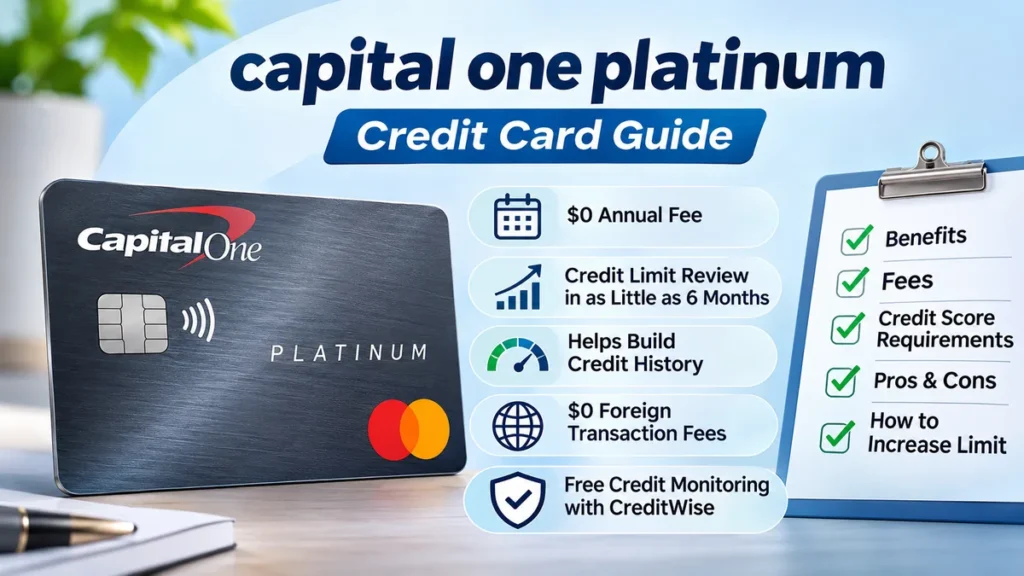
The Capital One Platinum Credit Card is an unsecured credit card designed primarily for people with fair or limited credit. It has a $0 annual fee, no security deposit requirement and automatic consideration for a higher credit limit in as little as six months. However, it does not offer standard purchase rewards.
Understanding its interest rates, eligibility requirements and credit-building features can help you avoid costly mistakes while developing better financial habits.
What Is the capital one platinum Credit Card?
The Capital One Platinum Credit Card is a consumer credit card issued by Capital One in the United States. Unlike premium rewards cards, its primary purpose is to help consumers establish or rebuild their credit profiles through responsible financial management.
Because it is an unsecured credit card, approved applicants do not need to provide a refundable security deposit.
Capital One Platinum Card Overview
| Feature | Details |
|---|---|
| Card issuer | Capital One |
| Card type | Unsecured credit card |
| Annual fee | $0 |
| Purchase APR | 29.24% variable |
| Recommended credit | Fair or limited credit |
| Security deposit | Not required |
| Cash back rewards | None |
| Welcome bonus | None |
| Foreign transaction fee | $0 |
| Credit limit review | As little as six months |
| Introductory APR | None |
| Credit monitoring | CreditWise |
| Fraud liability | $0 for qualifying unauthorized charges |
The purchase APR shown reflects the issuer’s published information as of November 2026. Interest rates and individual account terms may change. Capital One+2
The card is particularly relevant for consumers who want access to revolving credit without paying an annual membership fee or committing money to a secured credit card deposit.
Capital One Platinum Credit Score and Approval Requirements
Capital One primarily markets the Platinum card to consumers with fair credit. However, the issuer also states that applicants do not necessarily need an existing credit score to apply.
A FICO score between 580 and 669 is generally classified as fair credit, although lenders may use different eligibility standards.
| FICO Credit Score | Credit Classification |
|---|---|
| 300–579 | Poor |
| 580–669 | Fair |
| 670–739 | Good |
| 740–799 | Very good |
| 800–850 | Exceptional |
Having a credit score within the recommended range does not guarantee approval.
What Does Capital One Consider When Reviewing Applications?
Credit card issuers typically evaluate several financial factors, including:
- Existing credit history and payment behavior.
- Annual income and employment information.
- Outstanding debt and financial obligations.
- Recent credit applications.
- Ability to make required monthly payments.
- Existing credit account balances.
Someone with a relatively short but positive credit history may have a different approval outcome from someone with the same credit score and several recent missed payments.
Does Capital One Platinum Offer Preapproval?
Capital One offers an online eligibility checking process that does not initially affect your credit score.
This generally involves a soft credit inquiry, allowing consumers to explore potential offers before submitting a formal application.
A formal credit card application may result in a hard credit inquiry, which can temporarily affect your credit score.
Preapproval should not be confused with guaranteed acceptance. The final decision depends on the issuer’s complete application review.
capital one platinum Benefits and Credit-Building Features
Although the Platinum card does not provide conventional cashback or travel rewards, it includes several features that support everyday credit management.
No Annual Fee
The $0 annual fee allows cardholders to maintain an open credit account without paying a recurring membership charge.
This can be helpful when building a longer credit history because keeping an older account open may support certain credit scoring factors.
However, having no annual fee does not mean that every transaction or account activity is free.
Automatic Credit Limit Reviews
Capital One automatically considers eligible cardholders for a higher credit line in as little as six months.
This review does not guarantee an increase. Account activity, repayment history and overall creditworthiness can influence the outcome.
A higher credit limit may make it easier to maintain a lower credit utilization ratio without changing spending habits.
Free Credit Monitoring With CreditWise
CreditWise from Capital One provides tools for monitoring credit information and identifying changes to your credit profile.
Features include access to your FICO Score 8, credit report alerts and notifications associated with changes to Experian or TransUnion credit information.
CreditWise is also available to people who do not hold a Capital One credit card.
No Foreign Transaction Fees
The Platinum card does not charge foreign transaction fees on international purchases.
For example, a different credit card charging a 3% foreign transaction fee would add $30 in fees to $1,000 of eligible international spending.
Currency conversion rates and merchant-imposed charges may still apply.
Security and Account Management
Capital One provides several security and digital banking features, including:
- Protection against qualifying unauthorized transactions.
- Virtual card numbers for eligible online purchases.
- Account locking through the mobile application.
- Suspicious transaction notifications.
- Automatic monthly payments.
- Eno digital account assistance.
- Access to customer support around the clock.
Cardholders can also manage payments, check balances and review transactions using the Capital One mobile application. Capital One+2
Capital One Platinum Credit Limit and How to Increase It
One of the most common questions surrounding this credit card concerns its starting credit limit.
Capital One does not publicly guarantee a universal starting limit for the Platinum card. Approved applicants receive an individualized credit line based on their financial circumstances and credit profile.
Consumers with fair or limited credit should generally be prepared for a modest initial spending limit.
How Credit Utilization Affects Your Credit Score
Credit utilization measures how much of your available revolving credit you are using.
The calculation is:
Credit utilization = (Outstanding balance ÷ Credit limit) × 100
For example, if someone has a $500 credit limit and a $100 reported balance, their utilization ratio is 20%.
| Credit Limit | Reported Balance | Credit Utilization |
|---|---|---|
| $500 | $50 | 10% |
| $500 | $100 | 20% |
| $500 | $150 | 30% |
| $500 | $250 | 50% |
| $500 | $500 | 100% |
Keeping utilization below 30% is a common guideline, but lower utilization may be more favorable. There is no universal percentage that guarantees a particular credit score improvement.
How to Qualify for a Higher Credit Limit
Several responsible credit management habits may improve your chances of receiving a credit line increase:
- Pay every monthly bill on time.
- Maintain manageable outstanding balances.
- Use the card for purchases you can afford.
- Keep your income information accurate.
- Avoid exceeding your available credit limit.
- Limit unnecessary credit applications.
Capital One may also allow eligible account holders to request a credit limit increase directly through their online account.
A larger credit line should be treated as additional financial flexibility rather than a reason to increase spending.
Capital One Platinum Interest Rates, APR and Fees
The most significant drawback of the Platinum card is its relatively high variable interest rate.
As of November 2026, Capital One lists a purchase APR of 29.24%. Because the rate is variable, it can change in response to fluctuations in its underlying benchmark rate.
Credit Card Fees Explained
| Fee Type | Amount |
|---|---|
| Annual fee | $0 |
| Purchase APR | 29.24% variable |
| Foreign transaction fee | $0 |
| Late payment fee | Up to $40 |
| Cash advance fee | $5 or 5%, whichever is greater |
| Balance transfer fee | Depends on applicable offer terms |
| Introductory APR | Not available |
Consumers should review their individual cardholder agreement for applicable fees and repayment terms. Capital One+1
How Much Interest Could You Pay?
Suppose you maintain an average outstanding balance of $1,000 for approximately one month at a 29.24% APR.
Your approximate monthly interest would be:
| Outstanding Balance | Estimated Monthly Interest |
|---|---|
| $100 | $2.44 |
| $500 | $12.18 |
| $1,000 | $24.37 |
| $2,000 | $48.73 |
| $5,000 | $121.83 |
These figures are simplified estimates calculated by dividing the annual percentage rate by 12. Actual interest depends on daily balances, billing cycle length and applicable account terms.
How to Avoid Paying Credit Card Interest
When an eligible purchase grace period applies, paying your entire statement balance by the payment due date can help you avoid purchase interest.
Making only the minimum payment generally prevents the account from becoming overdue, but it does not eliminate interest on an outstanding balance.
Cash advances typically begin accumulating interest immediately and may involve additional fees.
A common misconception is that carrying an interest-bearing balance helps build credit. You do not need to pay credit card interest to establish a positive repayment history.
Capital One Platinum vs. Other Credit Cards
The Platinum card is not the only option for consumers working to establish credit. Secured cards and entry-level cashback cards provide alternative features.
Capital One Platinum vs. Platinum Secured
Despite their similar names, these cards differ in one major area: security deposits.
| Feature | Platinum | Platinum Secured |
|---|---|---|
| Card type | Unsecured | Secured |
| Annual fee | $0 | $0 |
| Security deposit | Not required | Required |
| Standard cashback | No | No |
| Primary audience | Fair or limited credit | Consumers establishing or rebuilding credit |
| Credit-building potential | Yes | Yes |
With a secured credit card, the issuer requires a deposit as collateral. An unsecured card does not require this upfront payment.
Consumers who struggle to qualify for unsecured credit may find secured cards more accessible.
Capital One Platinum vs. QuicksilverOne
The Capital One QuicksilverOne Cash Rewards Credit Card combines credit-building opportunities with cashback rewards, but it charges an annual fee.
| Feature | Platinum | QuicksilverOne |
|---|---|---|
| Annual fee | $0 | $39 |
| Everyday cashback | None | 1.5% |
| Security deposit | Not required | Not required |
| Primary purpose | Credit building | Credit building and rewards |
| Foreign transaction fee | $0 | $0 |
At a 1.5% cashback rate, a cardholder would need to spend $2,600 annually on eligible purchases to earn enough cashback to offset a $39 annual fee.
Spending more merely to earn rewards can undermine the financial benefit.
Can You Upgrade Capital One Platinum to Quicksilver?
Capital One may offer eligible customers the opportunity to change their existing credit card to another product.
A product change could provide access to cashback rewards without necessarily requiring an entirely new credit account.
However, upgrade availability depends on individual eligibility and issuer policies. Cardholders should not assume that an upgrade will become available after a particular period.
Capital One Platinum Pros, Cons and Responsible Credit Management
The Platinum card provides a straightforward credit-building experience, but its benefits and limitations should be considered together.
| Pros | Cons |
|---|---|
| No annual membership fee | High variable APR |
| No upfront security deposit | No standard purchase rewards |
| Potential credit limit increases | No welcome bonus |
| Accessible to some consumers with fair credit | No introductory 0% APR |
| Free credit monitoring | Potentially modest starting credit limit |
| No foreign transaction fees | Limited premium benefits |
Who Is the Capital One Platinum Card Suitable For?
The card’s structure may be appropriate for consumers establishing their first unsecured credit account, transitioning from secured credit cards or improving an average credit profile.
It may be less suitable for people seeking premium travel benefits, cashback rewards, introductory balance transfer offers or affordable long-term borrowing.
Does Capital One Platinum Report to Credit Bureaus?
Capital One Platinum account activity is reported to the three major U.S. consumer credit bureaus: Experian, Equifax and TransUnion.
These organizations maintain credit reports that lenders may use to evaluate borrowing risk.
Consistent repayment and manageable credit utilization can support a healthier credit profile. Conversely, missed payments and excessive borrowing may negatively affect credit scores. NerdWallet+1
How Long Does It Take to Build Credit?
Credit improvement does not follow a fixed timeline. Someone establishing credit for the first time may see different results from someone recovering from previous financial difficulties.
The outcome depends on payment history, account age, existing debt, credit utilization and other information appearing on credit reports.
Reviewing your credit reports periodically can also help identify inaccurate information that may require correction.
Practical Example of Responsible Card Use
Consider a consumer who receives a Platinum card with a hypothetical $500 credit limit.
They use the card for $50 in recurring monthly expenses, enable automatic payments for the entire statement balance and review their account regularly.
Their reported utilization would be 10% if the $50 balance were reported before repayment.
Over time, this approach can contribute to a positive credit history without unnecessary borrowing or purchase interest when the grace period applies.
The objective is not to maximize credit card spending. It is to demonstrate consistent and affordable financial management.
Conclusion
The capital one platinum credit card is designed primarily for consumers who want to establish or improve their credit without an annual fee or upfront security deposit.
Its automatic credit limit reviews, credit monitoring tools, security features and straightforward account management make it a practical credit-building option. However, its high variable APR, absence of cashback rewards and potentially modest starting credit limit are meaningful disadvantages.
The most effective way to use this card is to maintain manageable balances, make consistent on-time payments and avoid unnecessary interest charges. Always review the latest rates, fees and eligibility disclosures before making a financial decision.