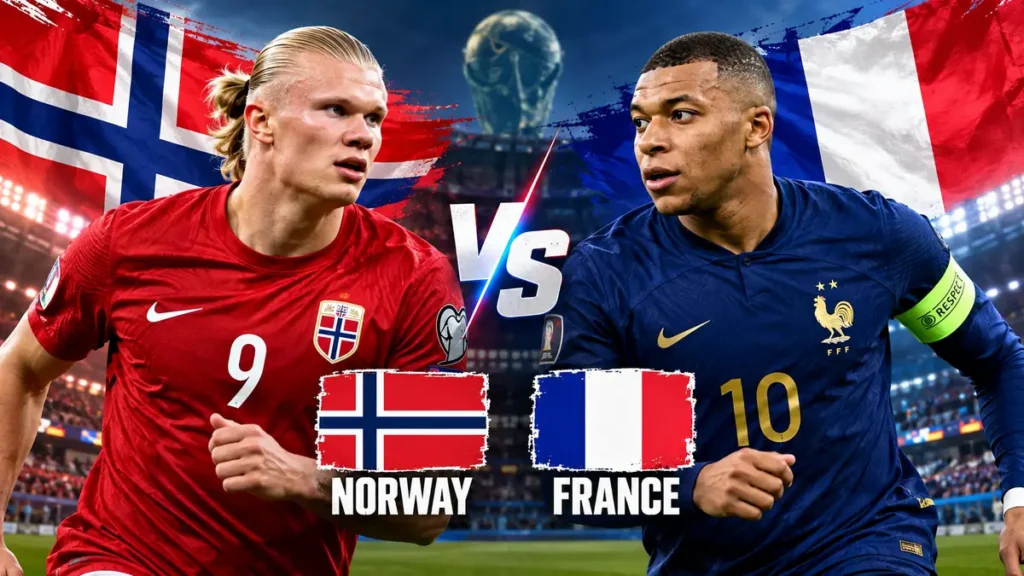
Norway and France represent two fascinating sides of European international football. France has a history of World Cup victories, world-class talent, and success in major tournaments. Norway, meanwhile, has developed an exciting generation of players capable of challenging established football powers.
The search term norwegia vs prancis refers to Norway versus France, particularly their national football teams. France has historically achieved greater international success, winning the FIFA World Cup twice, while Norway has built its modern attacking identity around Erling Haaland and Martin Ødegaard. Their contrasting football styles make this an interesting matchup.
Although these nations do not share one of Europe’s most famous football rivalries, comparing them reveals how different approaches to player development, tactics, and international competition shape national-team performance.
norwegia vs prancis: Overview of Both National Teams
Norway and France compete within UEFA, European football’s governing body. Both participate in international competitions such as FIFA World Cup qualification, UEFA European Championship qualification, and the UEFA Nations League.
However, their historical achievements and competitive expectations differ considerably.
| Category | Norway | France |
|---|---|---|
| Country | Norway | France |
| Football confederation | UEFA | UEFA |
| Governing association | Norwegian Football Federation | French Football Federation |
| FIFA World Cup titles | 0 | 2 |
| World Cup appearances through 2022 | 3 | 16 |
| Best World Cup finish through 2022 | Round of 16 | Champions |
| UEFA European Championship titles | 0 | 2 |
| Famous modern players | Erling Haaland, Martin Ødegaard | Kylian Mbappé, Ousmane Dembélé |
| Traditional strengths | Physicality, direct attacking, transitions | Technical ability, pace, squad depth |
| Historical international status | Competitive European nation | Established global football power |
France’s success reflects decades of strong international performances, while Norway’s football ambitions have increasingly centered on maximizing the potential of its leading attacking players.
History of Norway vs France Football Matches
The historical relationship between the two national teams is shaped by friendly matches and international competition.
Unlike rivalries involving neighboring countries or frequent tournament opponents, Norway and France have not regularly met in the knockout stages of major championships.
Historical head-to-head results
One notable result occurred on August 11, 2010, when Norway defeated France 2–1 in an international friendly in Oslo.
France took the lead through Hatem Ben Arfa, but Erik Huseklepp scored twice to secure Norway’s comeback victory.
That result demonstrated how a well-organized Norwegian team could defeat an opponent with greater individual reputation.
| Match detail | Information |
|---|---|
| Date | August 11, 2010 |
| Fixture | Norway vs France |
| Competition | International friendly |
| Venue | Ullevaal Stadion, Oslo |
| Final score | Norway 2–1 France |
| Norway goalscorer | Erik Huseklepp, 2 goals |
| France goalscorer | Hatem Ben Arfa, 1 goal |
This is a historical example rather than a current form indicator. Players, managers, and tactical systems have changed substantially since 2010.
Why historical records need context
Head-to-head statistics can be useful, but they do not always predict future results.
International teams may meet only occasionally, meaning historical matches can involve entirely different generations.
When comparing Norway and France, it is therefore useful to consider both historical results and more recent team development.
France National Football Team: Achievements and Strengths
France is one of international football’s most successful national teams.
Its achievements span multiple generations, including the teams associated with Michel Platini, Zinedine Zidane, Thierry Henry, Antoine Griezmann, and Kylian Mbappé.
FIFA World Cup achievements
France has won the FIFA World Cup twice.
Its first title came in 1998, when it hosted the tournament and defeated Brazil 3–0 in the final.
Zinedine Zidane scored twice, and Emmanuel Petit added the third goal.
France won its second World Cup in 2018, defeating Croatia 4–2 in the final in Moscow.
The team combined disciplined defending, quick transitions, and outstanding individual attacking quality.
France also reached the 2006 and 2022 World Cup finals, finishing as runner-up on both occasions.
In the 2022 final against Argentina, Kylian Mbappé scored a hat-trick, but France lost on penalties following a 3–3 draw after extra time.
UEFA European Championship success
France has also won the European Championship twice.
Its first title came in 1984, led by Michel Platini, who scored nine goals during the tournament.
The second followed in 2000, when France defeated Italy 2–1 in the final through David Trezeguet’s golden goal.
These accomplishments demonstrate France’s ability to compete successfully across different football eras.
France’s greatest strengths
France traditionally benefits from several competitive advantages:
- A large pool of technically gifted professional players.
- Strong youth development and academy systems.
- Experience competing in major international tournaments.
- Athletic defenders and versatile midfielders.
- Explosive attacking players capable of changing matches individually.
The French football development system, including the national training center at Clairefontaine, has contributed to the country’s long-term success.
However, having outstanding individual players does not automatically guarantee victory. Team balance, tactical discipline, and finishing efficiency remain essential.
Norway National Football Team: History and Development
Norway has a smaller international football record than France, but its national team has produced memorable performances.
The country has participated in three FIFA World Cup tournaments through 2022: 1938, 1994, and 1998.
Norway’s 1998 World Cup achievement
One of Norway’s most famous football victories came during the 1998 FIFA World Cup.
Norway defeated Brazil 2–1 in the group stage, with Tore André Flo and Kjetil Rekdal scoring the goals.
The victory helped Norway advance to the Round of 16, where it lost 1–0 to Italy.
This remains an important achievement in Norwegian football history.
Norway’s modern football generation
Norway’s modern identity is strongly associated with two internationally recognized players.
Erling Haaland is a powerful striker known for his finishing, movement, acceleration, and ability to score inside the penalty area.
His club performances have established him among Europe’s leading goalscorers.
Martin Ødegaard is a technically gifted midfielder recognized for his vision, passing combinations, creativity, and ability to control attacking play.
Together, they provide Norway with a combination of creativity and finishing ability.
Other important players in Norway’s recent development include Alexander Sørloth, Sander Berge, and Antonio Nusa.
Norway’s main challenges
Despite its attacking talent, Norway has historically faced challenges involving:
- Consistency against higher-ranked European opponents.
- Defensive organization against technically strong teams.
- Maintaining midfield control under pressure.
- Building sufficient squad depth.
- Converting individual talent into sustained tournament success.
Norway’s long-term progress depends on developing a balanced team rather than relying exclusively on its most recognizable stars.
norwegia vs prancis: 2026 FIFA World Cup Match Result

Norway
1 – 4
France

June 26, 2026 · FIFA World Cup · Group I · Boston Stadium
The most significant recent meeting between Norway and France took place on June 26, 2026, during the FIFA World Cup in the United States.
France defeated Norway 4–1 in their final Group I match. The result highlighted France’s attacking quality, particularly its ability to create chances through quick passing, movement, and individual skill.
UEFA.com
+1
How the 2026 match unfolded
Ousmane Dembélé scored three first-half goals for France, including goals in the 7th, 20th, and 32nd minutes.
Norway responded through Thelo Aasgaard in the 21st minute, assisted by Andreas Schjelderup, but France ultimately secured a convincing victory.
Kylian Mbappé contributed to France’s attacking combinations, providing assists for Dembélé’s early goals.
National Football Teams
The match illustrated the challenge Norway faces against elite opponents: even when Norway creates opportunities, controlling France’s attacking players for 90 minutes is difficult.
What happened to Norway at the 2026 World Cup?
Despite losing to France, Norway advanced from the group stage.
Norway defeated Côte d’Ivoire 2–1 in the Round of 32 and Brazil 2–1 in the Round of 16.
Its campaign ended in the quarter-finals with a 2–1 extra-time defeat against England.
That quarter-final appearance became Norway’s best FIFA World Cup finish to date.
UEFA.com
Norway vs France Head-to-Head Statistics
Historical records provide a broader perspective than one match.
According to 11v11’s record of 16 senior men’s international meetings through June 2026, France has the advantage.
4
Norway wins
4
Draws
8
France wins
16 recorded matches · Men’s senior international football
11v11
Selected historical results
| Date | Match | Result |
|---|---|---|
| June 26, 2026 | Norway vs France | 1–4 |
| May 27, 2014 | France vs Norway | 4–0 |
| August 11, 2010 | Norway vs France | 2–1 |
| February 25, 1998 | France vs Norway | 3–3 |
| July 22, 1995 | Norway vs France | 0–0 |
| June 16, 1987 | Norway vs France | 2–0 |
| November 6, 1968 | France vs Norway | 0–1 |
These results show that Norway has occasionally defeated France, although France leads the overall series.
11v11
+1
Tactical Comparison: How Norway and France Play
Understanding the tactical differences between these teams helps explain why their matches can be unpredictable.
Norway’s attacking approach
Norway’s strengths often come from direct attacking movements, physical forwards, and rapid transitions.
With Haaland operating as a central striker, Norway can threaten opponents through crosses, through balls, and counterattacks.
Ødegaard provides the creativity needed to connect midfield possession with forward movement.
A typical successful Norwegian attacking sequence might involve winning possession in midfield, quickly finding Ødegaard, and releasing a forward into space behind the defensive line.
This approach can be particularly dangerous when opponents commit too many players forward.
However, Norway may struggle when opponents dominate possession and prevent its midfielders from delivering accurate passes.
France’s attacking approach
France generally has greater flexibility because of its wider selection of high-level players.
Its attacking strengths include explosive acceleration, technical dribbling, coordinated movement, and the ability to create opportunities from different positions.
Mbappé is particularly dangerous when attacking space behind defenders or receiving possession in wide areas.
Dembélé adds another dimension through dribbling, movement, and creative passing.
France can also vary its approach depending on the opposition, using possession-based combinations or rapid counterattacks.
Midfield and defensive differences
Midfield control is a crucial factor in international matches.
France has traditionally benefited from athletic, technically accomplished midfielders capable of recovering possession and progressing the ball.
Players such as Aurélien Tchouaméni and Eduardo Camavinga illustrate the country’s midfield depth.
Norway often needs compact positioning, coordinated pressing, and effective defensive transitions to compete against similarly talented opponents.
When Norway’s midfield maintains its structure, the team becomes harder to break down. When spaces open between the defensive and midfield lines, France’s attackers can exploit them.
Key Players in norwegia vs prancis
Individual matchups can strongly influence the outcome of Norway versus France.

Erling Haaland — Norway
Haaland is known for powerful finishing, intelligent positioning, aerial strength, and explosive movement. His ability to convert limited chances makes him particularly valuable when Norway faces stronger opponents.

Martin Ødegaard — Norway
Ødegaard contributes creativity, ball progression, passing accuracy, and leadership. His ability to find attacking spaces is essential to Norway’s offensive structure.

Kylian Mbappé — France
Mbappé combines exceptional acceleration with close control, finishing, and intelligent off-ball movement. His presence can force defenders to retreat, creating space for teammates.

Ousmane Dembélé — France
Dembélé provides two-footed attacking ability, dribbling, and unpredictable movement. His performance against Norway in June 2026 demonstrated how dangerous he can be in front of goal.
Haaland vs Mbappé: Different attacking profiles
Comparisons between Haaland and Mbappé are particularly popular because both have been among the leading forwards of their generation.
Haaland is primarily a central striker whose strengths revolve around scoring, positioning, and finishing.
Mbappé offers greater positional flexibility, often attacking from wide areas before moving centrally.
Neither player’s effectiveness can be judged solely by individual goals in one match. Their impact also depends on the opportunities created by teammates and the defensive systems they face.
What Determines the Outcome of Norway vs France?
Several factors influence how a match between these teams develops.
Midfield possession: France can become particularly dangerous when it controls the central areas and dictates the tempo.
Defensive organization: Norway needs compact defensive lines to prevent France’s forwards from exploiting open spaces.
Finishing efficiency: Haaland’s ability to convert limited chances can help Norway remain competitive even when it has less possession.
Transitions: Both teams possess players capable of attacking quickly after winning the ball.
Set pieces: Norway’s physical forwards and aerial presence can create opportunities from corners and free kicks.
Squad depth: France’s wider selection of experienced international players can provide an advantage when substitutions become important.
No single factor guarantees victory. Football results depend on how effectively each team executes its plan during the match.
Why France Has Historically Been More Successful
France’s international achievements are supported by a combination of player development, competitive experience, and football infrastructure.
The country has produced elite players across several generations and maintained a strong presence in major international tournaments.
Its professional club structure, academy networks, and talent identification systems provide opportunities for young footballers to develop at a high level.
Norway has a smaller population and a narrower pool of professional players, but its modern generation demonstrates that countries with fewer resources can still develop world-class talent.
The difference between the nations is therefore not simply about individual ability.
It also involves the number of high-level players available across different positions, the experience of competing in major tournaments, and the ability to maintain performance across multiple matches.
Future Outlook for Norway and France
Norway’s 2026 World Cup quarter-final appearance provides an important foundation for its future development.
The country’s challenge is to maintain its progress by strengthening defensive consistency, developing additional midfield options, and improving squad depth.
France remains one of the world’s established football powers, with a strong record of producing talented players and competing for international trophies.
Future meetings between the nations could become more competitive as Norway continues developing its younger players.
However, France’s historical success and depth mean it remains a formidable opponent.
Final Thoughts on norwegia vs prancis
The comparison between Norway and France highlights two different football journeys.
France has established itself as an international powerhouse through World Cup victories, European Championship titles, and generations of outstanding players.
Norway has experienced fewer major tournament successes but has demonstrated its potential through memorable victories, elite attacking talent, and its 2026 World Cup quarter-final run.
France’s 4–1 victory over Norway in June 2026 reinforced its advantage in their recent head-to-head record. Yet Norway’s wider tournament performance showed that it can compete with strong international opposition.
Ultimately, norwegia vs prancis is an interesting matchup because it combines Norway’s physical attacking strengths with France’s technical quality, speed, and international experience.