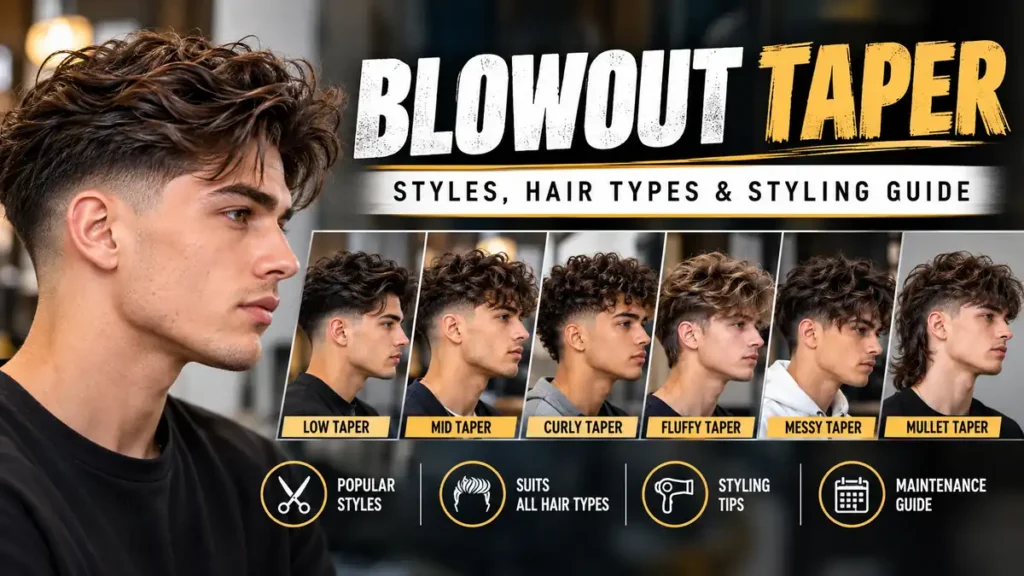
The blowout taper has become a popular men’s haircut because it combines natural volume, textured hair, and a clean finish around the ears and neckline. It creates a bold silhouette without requiring a dramatic fade across the entire sides of the head.
A blowout taper is a men’s hairstyle that combines a voluminous, lifted top with a gradual taper around the temples, sideburns, and neckline. The haircut preserves fullness through the upper sides while creating clean edges. It works with straight, wavy, curly, and coily hair when the cutting and styling techniques suit the hair’s natural texture.
The defining feature is contrast: the top looks full and airy, while the edges appear neat and controlled. Depending on how it is cut, the result can look relaxed, fluffy, curly, messy, or sharply sculpted.
What Is a blowout taper Haircut?
A blowout taper combines two distinct hairstyling techniques: a blowout and a taper.
The blowout refers to the lifted, expanded appearance of the hair, usually achieved through natural texture, blow-drying, or both. The taper refers to the gradual shortening of hair near the sideburns and neckline.
Unlike a traditional high fade, which removes considerable length from the sides, a blowout taper typically preserves more hair around the upper sides and back.
Key characteristics
- Voluminous top: Hair has visible height, movement, or natural fullness.
- Gradual taper: Hair becomes progressively shorter around the temples and neckline.
- Textured finish: Layers, curls, or styling techniques create separation and movement.
- Fuller sides: Much of the side hair remains longer than in a high skin fade.
- Flexible styling: The haircut can be worn fluffy, messy, curly, or controlled.
The exact silhouette varies by barber, hair type, and regional styling preferences. Some versions feature a subtle taper, while others use a more pronounced low or mid fade.
Popular blowout taper Styles

1. Low blowout taper
The low variation concentrates the shortest hair around the lower sideburns and nape. It maintains fullness through the sides, making it suitable for people who prefer a subtle transition rather than a dramatic fade.

2. Mid blowout taper
A mid taper begins its visible transition slightly higher around the temples. It creates stronger contrast between the voluminous top and shorter edges, giving the haircut a more defined appearance.

3. Curly blowout taper
Natural curls provide much of the height and texture. The barber shapes the top while cleaning up the perimeter, allowing curls to remain expressive without making the sides appear overly bulky.

4. Fluffy blowout taper
This version emphasizes soft, airy movement. A blow dryer, lightweight mousse, and appropriate layering help create a lifted appearance without a stiff or glossy finish.

5. Messy blowout taper
A messy version uses irregular texture and loose separation rather than a perfectly structured shape. Matte clay or texture powder can help create a deliberately undone finish.

6. Blowout taper mullet
The mullet variation combines a lifted top and tapered temples with additional length at the back. It creates a more expressive silhouette while preserving the recognizable blowout texture.
Other variations worth knowing
A high blowout taper creates a stronger transition around the temples, although barbers may interpret the term differently. A textured fringe variation brings hair forward over the forehead, while a brushed-back version directs the volume away from the face.
For coily hair, a rounded or shaped afro blowout with tapered edges can provide a similar overall effect without requiring heat-straightened hair.
blowout taper vs. Other Popular Haircuts
The blowout taper is frequently confused with the taper fade, burst fade, and traditional blowout hairstyle. These cuts share certain features but produce different silhouettes.
| Haircut | Main feature | Overall appearance |
|---|---|---|
| Blowout taper | Lifted top with tapered edges | Full and textured |
| Taper fade | Gradual shortening near edges | Clean and versatile |
| Burst fade | Curved fade around the ear | Rounded side contrast |
| Low fade | Short transition across lower sides | More uniformly faded |
| Traditional blowout | Hair styled outward or upward | Volume-focused |
| Textured crop | Short layered top, often forward | Compact and structured |
Is a blowout taper the same as a taper fade?
Not exactly.
A taper fade describes the gradual change in hair length, whereas a blowout taper describes a fuller hairstyle that incorporates tapering.
A person can have a taper fade without a voluminous top. Similarly, a blowout hairstyle can exist without a clearly defined taper.
Blowout taper vs. burst fade
A burst fade forms a curved or semicircular transition around the ear, often leaving more hair toward the back of the head.
A blowout taper generally focuses on shortening the temples and neckline while maintaining volume above them.
Some modern haircuts combine both approaches, so terminology may overlap between barbershops.
Which Hair Types Work Best for a blowout taper?
The haircut is adaptable, but different textures require different cutting and styling methods.
Straight hair
Straight hair can achieve a fluffy blowout appearance through layered cutting, blow-drying, and lightweight styling products.
Fine straight hair may require root-lifting mousse or texture powder because it can naturally lie flat.
Thick straight hair often benefits from controlled internal layering to reduce excessive bulk without removing the fullness that defines the haircut.
Wavy hair
Wavy hair is particularly well suited to this style because its natural bends provide movement and texture.
A diffuser, lightweight cream, or sea salt spray can emphasize waves. Salt sprays may feel drying on some hair types, so they should be used according to the hair’s condition.
Curly hair
Curly hair naturally creates volume, reducing the need for intensive blow-drying.
A barber should account for curl shrinkage when determining the final length. Cutting curls too short can significantly change the intended shape once the hair dries.
Curl cream, leave-in conditioner, and gentle diffusing help preserve definition.
Coily hair
Coily hair can create a rounded, sculptural blowout with excellent natural height.
The barber may use clippers around the perimeter and scissors or other suitable techniques to shape the top.
Moisture retention, gentle detangling, and avoiding excessive heat are especially useful for maintaining the hair’s condition.
How to Ask Your Barber for a blowout taper
Clear communication matters because the term can describe several different variations.
Rather than relying on the haircut name alone, explain the amount of volume, taper placement, and overall silhouette you want.
What to tell your barber
- Specify the taper height. Choose a low, mid, or higher taper based on how much contrast you prefer.
- Describe the top. Explain whether you want fluffy, curly, messy, or controlled volume.
- Discuss the length. Ask to preserve enough hair for your intended styling technique.
- Clarify the neckline. Decide whether you prefer a natural, rounded, or more sharply defined finish.
- Show reference photographs. Use examples with a hair texture and density similar to yours.
A useful description is:
I’d like a low blowout taper with a full, textured top. Keep the upper sides relatively long, taper the sideburns and neckline, and avoid taking the fade too high.
What guard number should a barber use?
There is no universal clipper guard combination for this haircut.
A barber might use a zero or very short setting at the bottom of the taper and transition into longer guards above it. However, the exact numbers depend on hair density, head shape, desired contrast, and the barber’s blending technique.
A skin-level finish is optional, not a requirement.
For the top, scissors are commonly used to shape and texture the hair while retaining sufficient length for volume.
How to Style a blowout taper at Home
Styling determines whether the haircut looks airy and structured or flat and unbalanced.
The most effective method depends on hair texture, but the basic process is straightforward.

Step 1: Start with slightly damp hair
Wash or lightly dampen your hair, then remove excess water with a towel. Avoid aggressive rubbing, which can create frizz and tangles.

Step 2: Apply a suitable product
Use a small amount of volumizing mousse for fine hair, curl cream for curls, or a lightweight styling cream for thicker textures. Apply heat protectant if using heated tools.

Step 3: Create lift
Direct airflow toward the roots while lifting the hair with your fingers or a suitable brush. Use moderate heat and keep the dryer moving rather than holding it against one area.

Step 4: Shape and finish
Work a small amount of matte styling product through the hair, focusing on movement and separation. Use your fingers to refine the shape without flattening the roots.
Styling curly and coily hair
Curly and coily hair may not need the same upward brushing technique used for straight hair.
For defined curls, apply leave-in conditioner and curl cream while damp, then allow the hair to air-dry or use a diffuser on a low setting.
For a more expanded, rounded blowout, gentle stretching or a carefully controlled blow-drying technique can create additional volume.
Avoid repeated high-temperature styling, particularly on fragile or chemically treated hair.
How to get a fluffy finish
Fluffy hair requires lift and separation rather than excessive product.
Start with clean, lightweight hair products, create root volume while drying, and finish with a minimal amount of matte product.
Heavy waxes, oils, and gels can weigh down fine hair and make it appear flat.
Best Styling Products for a blowout taper
Different products create different finishes. Choosing based on texture and hair condition is more useful than choosing solely by popularity.
| Product type | Main purpose | Suitable hair |
|---|---|---|
| Volumizing mousse | Adds body and lift | Fine or straight |
| Texture powder | Creates dry texture and grip | Fine to medium |
| Matte clay | Adds separation and hold | Short to medium |
| Curl cream | Defines curls and reduces frizz | Curly |
| Leave-in conditioner | Adds moisture and manageability | Dry, curly, coily |
| Sea salt spray | Enhances tousled texture | Some straight or wavy hair |
| Heat protectant | Helps reduce heat-related damage | Heat-styled hair |
Product quantities should be adjusted to hair length and density. Beginning with a small amount is usually easier than trying to remove excess product.
A blowout taper does not require every product in the table. In many cases, one preparation product and one finishing product are sufficient.
How Often Should You Maintain a blowout taper?
The haircut’s appearance changes as the short tapered areas grow out. Although the longer top may retain its shape, the clean transition around the temples and neckline gradually becomes less visible.
A typical maintenance schedule depends on taper height, hair growth, and how sharp you want the edges to remain.
Taper Empire
+2
| Taper variation | Approximate touch-up interval |
|---|---|
| Low taper | Every 2–4 weeks |
| Mid taper | Every 2–3 weeks |
| High taper | Every 1–2 weeks |
| Curly blowout | Every 2–4 weeks |
| Longer textured blowout | Every 3–5 weeks |
These are practical estimates rather than strict rules. Some people prefer frequent line-ups, while others are comfortable with a softer, grown-out appearance.
Daily maintenance
Refresh the top with water or a light styling product when necessary. Avoid repeatedly applying heavy products without washing them out.
For curly hair, a satin pillowcase or suitable nighttime protection may help reduce friction, tangles, and frizz.
Weekly maintenance
Wash according to your scalp condition, activity level, and product buildup. Conditioning helps maintain softness and manageability, particularly for textured or dry hair.
Clean styling brushes and combs regularly, and avoid excessive heat exposure.
When should you trim the top?
The top generally requires less frequent cutting than the tapered edges.
However, when hair becomes too long or heavy, it may lose the lifted silhouette. A shape-up or carefully placed layers can restore movement without sacrificing too much length.
Choosing a blowout taper for Your Face Shape
Face shape can influence how a haircut looks, but it should not be treated as a rigid rule.
Hair density, growth direction, forehead proportions, and personal preference are equally relevant.
Round face
A blowout with moderate vertical height and controlled side volume can create the appearance of a longer face.
A mid taper may provide more definition, but an excessively wide top can make the silhouette appear rounder.
Oval face
Oval faces generally accommodate several versions of the haircut.
Low, mid, curly, and fluffy variations can all work. The main consideration is balancing the height of the top with the person’s natural hair density.
Square face
A square face has a pronounced jawline and relatively angular proportions.
Soft texture on top can contrast with those features, while a clean taper provides definition around the temples.
Long or rectangular face
Excessive vertical height may visually lengthen an already long face.
A lower, wider blowout or a textured fringe can create a more balanced appearance.
Heart-shaped face
A heart-shaped face is typically wider near the forehead and narrower toward the chin.
Maintaining some fullness around the sides and avoiding extreme height can help create a balanced silhouette.
The most useful approach is to evaluate the finished haircut from the front, side, and back rather than selecting a variation based only on a face-shape category.
Common blowout taper Mistakes and How to Avoid Them
Even a technically clean taper can look disappointing when the shape or styling does not suit the hair.
Cutting the sides too high
A taper that extends too far upward may remove the fullness that gives the blowout its distinctive silhouette.
Better approach: Explain how much side volume you want preserved and show a reference photograph.
Removing too much weight from the top
Aggressive thinning or excessive layering can leave thick hair looking uneven and fine hair appearing sparse.
Better approach: Ask for controlled texture that supports the desired shape.
Ignoring curl shrinkage
Curly and coily hair can appear substantially shorter after drying.
Better approach: Discuss the intended dry length before cutting. Dry cutting or checking the natural curl pattern during the process may improve predictability.
Using excessive styling product
Too much clay, cream, or wax can make the hair heavy, greasy, or difficult to reshape.
Better approach: Start with a small amount and add more only when needed.
Using high heat every day
Frequent exposure to excessive heat can damage the hair cuticle and contribute to dryness and breakage.
Better approach: Use moderate heat, appropriate heat protection, and lower-heat styling methods whenever possible.
Expecting identical results from every hair texture
A straight-haired fluffy blowout will not behave like a naturally curly or coily version.
Better approach: Choose reference images that resemble your own hair texture, density, and growth pattern.
Is a blowout taper Easy to Maintain?
A blowout taper is generally a moderate-maintenance haircut.
The tapered edges need periodic trimming, while the top may require daily styling to maintain its intended volume.
A naturally curly or coily version may hold its shape with minimal heat styling, although curl definition and moisture management can take additional effort.
Straight hair often requires more deliberate root lifting to achieve the same degree of fullness.
Advantages
- Works with multiple hair textures and lengths.
- Maintains fullness without requiring uniformly short sides.
- Offers low, mid, and higher-contrast variations.
- Can be adapted for casual or polished appearances.
- Allows natural curls and waves to remain visible.
Disadvantages
- Sharp tapered edges require regular maintenance.
- Some hair textures need frequent blow-drying.
- Excessive heat or product use can affect hair condition.
- Results vary depending on cutting technique and natural density.
- The term is interpreted differently by individual barbers.
For someone who prefers very little daily styling, a shorter textured taper or natural curly taper may be easier to manage.
Final Thoughts on the blowout taper
The blowout taper combines the structure of a clean taper with the personality of a full, textured hairstyle. Its versatility comes from the ability to adjust taper height, top length, volume, and styling technique without losing the defining silhouette.
A low variation provides a subtle finish, a mid taper creates stronger contrast, and curly or fluffy versions emphasize natural texture and movement.
The most reliable way to achieve the right result is to understand your hair type, choose a realistic reference style, and communicate clearly with your barber about the length and shape you want to preserve.
With appropriate cutting, lightweight styling products, and periodic maintenance, a blowout taper can remain balanced, comfortable, and easy to adapt as your hair grows.