Receiving a digital gift is often as simple as entering a few letters and numbers. Behind that simple process is a system that connects gifts, rewards, monetary value, and recipient information.
The concept of gift coding extends beyond digital gift cards. It also includes personalized messages, QR codes, promotional rewards, and organized gifting systems.
Gift coding is the practice of using digital codes, identifiers, symbols, or personalized messages to assign, deliver, organize, or redeem gifts. It allows recipients to access monetary credits, digital products, exclusive rewards, and personalized experiences through a specific code or identification system.
What Does gift coding Mean?
Gift coding describes how codes and identifiers are associated with physical or digital gifts. These identifiers may represent monetary value, access permissions, recipient information, or a hidden message.
A common example is purchasing a $50 digital gift card for someone. Instead of receiving physical cash, the recipient receives a unique redemption code that can be applied to an eligible account or purchase.
However, gift coding does not always involve money. A QR code attached to a birthday present could open a personalized video, while a numbered label could help identify presents at a family celebration.
The term also has a specialized meaning in nonprofit fundraising, where organizations categorize donations using campaign, fund, and appeal identifiers. WP Captcha+2
Why Is Gift Coding Used?
Gift coding serves several practical purposes:
- Simplifying digital gift delivery and redemption.
- Organizing presents and identifying recipients.
- Providing access to digital products and services.
- Creating personalized gifting experiences.
- Distributing employee and customer rewards.
- Tracking charitable donations and fundraising campaigns.
- Reducing unauthorized or duplicate redemptions.
Its purpose ultimately depends on the type of gift and the system used to manage it.
How Does gift coding Work?
Digital gift coding typically operates through a system that generates, validates, and processes unique identifiers.
When a business issues a gift code, its system associates that identifier with a specific reward, balance, or entitlement. The recipient submits the code through an authorized platform, where its validity is checked.
The Gift Code Generation Process
A typical digital gifting system involves the following stages:
- Code generation: The platform creates a unique numerical or alphanumeric identifier.
- Value assignment: A monetary balance, product, subscription, or reward is associated with the identifier.
- Distribution: The code is delivered through email, a physical card, an application, or another authorized channel.
- Validation: The platform checks the code’s authenticity, eligibility, and redemption status.
- Redemption: The recipient receives the associated benefit.
- Record update: The system adjusts the remaining balance or marks the code as redeemed.
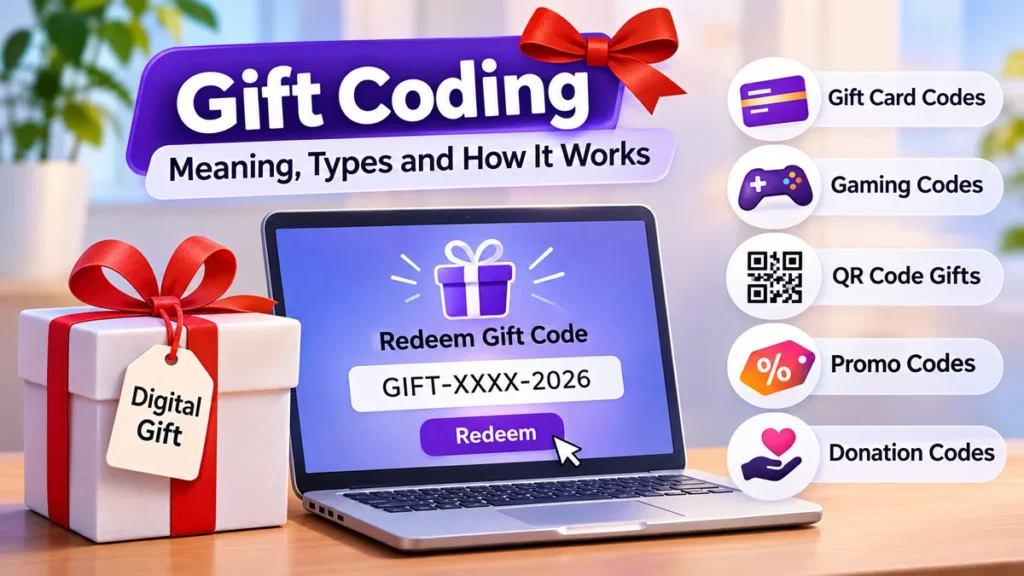
For example, an illustrative gift code might look like GIFT-XXXX-2026. The characters themselves do not necessarily contain the monetary value. That information is usually maintained within the issuer’s system.
Single-Use and Multiple-Use Codes
Some digital codes can only be redeemed once. Others provide access to a stored balance that can be spent across multiple transactions.
A single-use promotional voucher might provide one complimentary product. A digital gift card containing $100 could allow several purchases until its available balance reaches zero.
The exact rules depend on the issuing platform.
Different Types of Gift Coding With Examples
Gift coding appears in retail, entertainment, education, corporate rewards, and everyday celebrations. Understanding the different formats makes it easier to identify their intended purpose.
| Type | Primary purpose | Example |
|---|---|---|
| Gift card code | Store monetary value | Amazon gift card |
| Gaming code | Access virtual rewards | In-game currency |
| QR code | Deliver digital content | Personalized video |
| Promotional code | Provide an incentive | 20% discount |
| Activation code | Unlock digital products | Software license |
| Personalized code | Communicate hidden meaning | Birthday puzzle |
| Donation code | Categorize contributions | Fundraising campaign |
Digital Gift Card Codes
Digital gift cards allow recipients to access prepaid purchasing credit without carrying a physical card.
Common examples include Amazon, Google Play, Apple, Steam, and Roblox gift cards.
These cards generally have redemption instructions specifying where the code should be entered and which products or services are eligible.
Some are restricted to specific countries, currencies, or account regions.
Gaming and Entertainment Codes
Game publishers and entertainment platforms distribute codes that provide access to digital items and additional content.
Depending on the platform, recipients may receive virtual currency, character customization items, downloadable content, premium features, or subscription access.
A gaming reward code is not necessarily equivalent to an app store gift card. One provides a predetermined reward, while the other typically adds purchasing credit to an account. SmallWebG…+1
QR Code Gifts
A Quick Response (QR) code connects a physical gift with an online destination.
Scanning the code using a compatible smartphone can provide access to a photo album, recorded message, digital greeting card, music playlist, or event invitation.
QR codes are particularly useful when the intended gift cannot easily be packaged as a physical object.
Personalized and Secret Gift Codes
Gift coding can also make traditional celebrations more interactive.
For example, a birthday present may contain a handwritten puzzle that reveals the location of another surprise. Family members might use colored stickers to identify their Christmas presents without displaying names.
These approaches require no programming knowledge or specialized technology.
Corporate Gift and Employee Reward Codes
Businesses use digital vouchers to distribute incentives to employees, customers, and business partners.
An organization might issue individual reward codes following an employee recognition program. Each recipient receives a predefined benefit, while the organization maintains records of its distribution.
Unique identifiers can also help businesses understand which rewards have been claimed and which remain unused.
Gift Codes vs. Promo Codes vs. Gift Cards
Gift codes, promotional codes, and gift cards are frequently mentioned together, but their functions can differ significantly.
| Feature | Gift code | Promo code | Gift card |
|---|---|---|---|
| Main purpose | Access a reward | Reduce purchase cost | Store prepaid value |
| Monetary value | Sometimes | Usually a discount | Generally yes |
| Usage | Often single-use | Depends on campaign | May support several purchases |
| Expiration | Issuer-dependent | Often time-limited | Depends on applicable terms |
| Purchase required | Not always | Often | Usually prepaid |
| Typical example | Free digital item | 15% off an order | $50 store credit |
A promotional code generally changes the price of a transaction. A gift code can provide an independent reward or entitlement, while a gift card usually represents prepaid purchasing value.
However, retailers and gaming platforms do not always use these names consistently. Reading the redemption conditions is more reliable than relying on the label alone. Uniqodo+1
How to Create and Redeem Gift Codes
Creating a gift code can involve anything from writing a personalized clue to using an established digital gifting platform.
The appropriate method depends on whether the gift is symbolic, monetary, or connected to a digital service.
Creating a Personalized Gift Code
Begin by deciding what the code should accomplish. It might reveal a private message, organize presents, provide access to a video, or guide someone toward a surprise.
Choose a suitable identifier, such as a combination of letters, a QR code, a meaningful date, or a numbered clue.
Keep the instructions straightforward. A recipient should be able to understand what to do without considerable technical knowledge.
If the code connects to online content, test the destination and its access permissions before sharing it.
Creating a personalized identifier does not generate real gift card credit. Monetary gift codes must originate from an authorized issuer or legitimate gifting system.
How to Redeem a Digital Gift Code
Although redemption procedures vary between platforms, the general process is straightforward:
- Visit the issuer’s official website or application.
- Sign in to the appropriate account.
- Locate the gift card, voucher, or redemption section.
- Enter the code exactly as provided.
- Review the associated value or reward.
- Confirm the redemption and check your account balance or inventory.
Always confirm that the account and country settings are compatible with the gift code before completing redemption.
Why Is My Gift Code Not Working?
A valid-looking code can fail for several reasons.
Common causes include typing errors, incorrect redemption platforms, expired promotional offers, inactive gift cards, previous redemption, and geographical restrictions.
Characters such as the letter O and number 0 can also be easily confused.
If the problem continues, contact the official issuer and retain your original purchase receipt. Avoid submitting the code to unofficial verification websites.
Gift Coding in Nonprofit Organizations
In nonprofit management, gift coding refers to classifying charitable contributions using structured identifiers.
Rather than simply recording how much money a donor contributed, an organization assigns information explaining the purpose, source, and circumstances of the donation.
This helps fundraising teams understand donor behavior, measure campaign performance, and prepare more meaningful reports.
Donor management platforms such as Little Green Light support structured gift classifications. Little Green Light+1
Common Donation Coding Categories
| Category | What it identifies |
|---|---|
| Gift type | Nature of the contribution |
| Campaign | Overall fundraising objective |
| Fund | Intended allocation of the money |
| Appeal | Solicitation that encouraged the donation |
| Event | Associated fundraising activity |
| Payment type | Method used to transfer money |
| Custom category | Additional organization-specific information |
For example, a nonprofit could record a $100 contribution under the following classifications:
- Campaign: Annual Education Fundraiser
- Fund: Student Scholarships
- Appeal: November Email Campaign
- Payment Type: Credit Card
Using consistent classifications helps organizations compare fundraising channels, acknowledge donations appropriately, and evaluate how contributions support their objectives.
Unlike retail gift card coding, nonprofit gift coding focuses on data organization rather than reward redemption.
Is Gift Coding Safe? Risks and Common Mistakes
Legitimate gift coding systems provide a convenient way to distribute and redeem gifts. However, redeemable codes can contain real monetary value, making them attractive targets for fraud.
Anyone who obtains an unredeemed, transferable gift card code may be able to claim its balance.
Are Free Gift Code Generators Real?
Websites promising unlimited free gift cards through automated generators should be treated with caution.
Legitimate monetary gift codes are issued and recorded by authorized platforms. Randomly generating letters and numbers does not create a valid prepaid balance.
Fraudulent websites may request personal information, account credentials, survey participation, software downloads, or advance payments in exchange for nonexistent rewards.
Genuine promotional codes may be distributed through official brand campaigns, publisher announcements, and authorized loyalty programs.
Common Warning Signs
Be cautious when someone requests gift card codes as payment for taxes, government fees, technical support, employment applications, or emergency financial assistance.
Other warning signs include unrealistic rewards, suspicious redemption links, requests for verification codes, and pressure to act immediately.
How to Protect Your Gift Codes
Keep redeemable codes private until they are used. Avoid sharing photographs of gift cards that display their code or security PIN.
Use official websites and applications for redemption, check the issuer’s terms, retain purchase receipts, and inspect physical cards for signs of tampering.
If a code has been stolen or redeemed without authorization, contact the issuer promptly. Recovery may not always be possible.
For personalized QR code gifts, check that the linked content does not expose sensitive information or require unnecessary application permissions.
Advantages and Limitations
Gift coding offers convenience, flexible delivery, personalization, and improved record management. Digital gifts can often be delivered remotely without packaging or shipping.
However, region restrictions, expiration conditions, technical errors, unauthorized redemption, and limited merchant acceptance can reduce their usefulness.
Understanding these limitations before choosing a gift format helps prevent unnecessary problems.
Final Thoughts
Gift coding connects traditional gifting with digital identification, personalization, and automated reward systems. Its applications range from prepaid gift cards and gaming rewards to QR code surprises and nonprofit donation management.
The most effective approach is to choose a coding method that matches the intended purpose. Use authorized platforms for monetary gifts, accessible links for personalized digital experiences, and consistent classifications for organizational records.
By understanding how gift coding works, recipients and gift providers can make gifting more convenient, meaningful, organized, and secure.