Need to know the date 60 days from today for a deadline, appointment, travel plan, or important event? Calculating future dates can be confusing when months have different lengths or when weekends and holidays are involved.
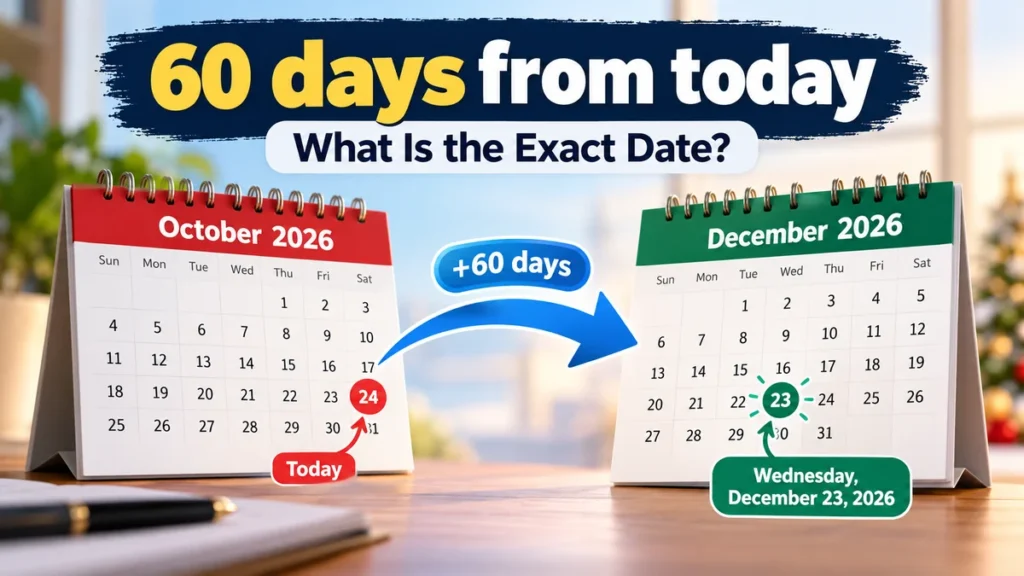
60 days from today, October 24, 2026, is Wednesday, December 23, 2026. This calculation uses 60 calendar days, including weekends and holidays, and excludes today as day zero. If you count October 24 as day one instead, the 60th day is Tuesday, December 22, 2026.
60 DAYS FROM TODAY
Wednesday, December 23, 2026
Starting date
October 24, 2026
Days added
60 calendar days
Resulting month
December 2026
Day of the week
Wednesday
How to Calculate 60 days from today
The easiest way to calculate a future date is to add the required number of calendar days to the starting date. You can do this manually using a calendar, with a date calculator, or through a spreadsheet.
For October 24, 2026, the calculation works as follows:
| Calculation step | Number of days |
|---|---|
| October 25–31 | 7 |
| November 1–30 | 30 |
| December 1–23 | 23 |
| Total | 60 |
The final date is December 23, 2026.
This method works because the starting date is excluded from the count. October 25 is day one, November 23 is day 30, and December 23 is day 60.
Interactive 60-Day Date Calculator
Use the calculator below to find a date 60 days after any selected starting date. You can also change the number of days to calculate another future date.Starting date
10/24/26Number of days to add
60
Count the starting date as day one
Calculated future date
Wednesday, December 23, 2026
Standard date addition · Calendar days
Reset Copy date
Why Does the Starting Date Matter?
Date calculations depend on the date from which you begin counting. A 60-day period starting in January will produce a different result from one beginning in October.
The exact calendar date also determines how many weekends, public holidays, and month boundaries fall within the period.
For most everyday calculations, adding 60 days means moving forward 60 complete calendar days without counting the starting day.
However, some legal notices, employment policies, contracts, and administrative procedures use inclusive counting or special deadline rules. Always check the applicable instructions when the date has legal or financial consequences.
Is 60 Days the Same as Two Months?
Not necessarily. Sixty days and two calendar months are different measurements of time.
A day represents a fixed calendar unit, while a month may contain 28, 29, 30, or 31 days.
For example:
| Starting date | 60 days later | Two calendar months later |
|---|---|---|
| January 1, 2026 | March 2, 2026 | March 1, 2026 |
| March 1, 2026 | April 30, 2026 | May 1, 2026 |
| June 1, 2026 | July 31, 2026 | August 1, 2026 |
| October 24, 2026 | December 23, 2026 | December 24, 2026 |
These examples demonstrate why using months as a substitute for days can produce an incorrect deadline.
If an agreement specifies 60 days, calculate 60 actual days unless the document defines the period differently.
How Many Weeks Are in 60 Days?
Sixty days equals eight full weeks and four additional days.
\[ 60\div7=8\text{ weeks and }4\text{ days} \]
This is approximately 8.57 weeks.
In hours, 60 ordinary 24-hour days equal 1,440 hours, or 86,400 minutes. Calendar-day calculations and exact elapsed-hour calculations can differ around daylight saving time changes.
60 days from today: Calendar Days vs. Business Days
One of the most common date-calculation mistakes is confusing calendar days with business days.
Calendar days include every day of the week, including Saturdays, Sundays, and holidays.
Business days generally exclude weekends and may also exclude recognized public holidays.
| Feature | Calendar days | Business days |
|---|---|---|
| Monday through Friday | Included | Usually included |
| Saturday | Included | Usually excluded |
| Sunday | Included | Usually excluded |
| Public holidays | Included | Often excluded |
| Common uses | General date calculations | Processing and administrative deadlines |
For example, 60 calendar days after October 24, 2026, is December 23, 2026. Sixty weekdays after that same starting date, excluding Saturdays and Sundays but not public holidays, is Friday, January 15, 2027.
Business-day definitions vary by country, organization, and industry. Some businesses operate on Saturdays, while others use different working-week schedules.
Do Weekends Count When Calculating 60 Days?
Yes, weekends count when a deadline is expressed in calendar days.
If you are calculating 60 days for a personal schedule, birthday countdown, subscription period, or ordinary event, you generally include Saturdays and Sundays.
If the requirement specifically says 60 working days or 60 business days, you must use the applicable working-day calendar instead.
Do Public Holidays Affect the Result?
Public holidays do not change a standard 60-calendar-day calculation.
They may, however, affect the practical deadline for completing a task. A government office, bank, or business might be closed on the calculated date.
Some laws and contracts extend deadlines that fall on nonworking days. Others do not. The relevant rule determines whether an extension applies.
Important Dates Within the Next 60 Days
Understanding the milestones between today and the final date can make scheduling easier.
Starting from October 24, 2026, the following dates mark common intervals:
| Days from today | Date | Day |
|---|---|---|
| 7 days | October 31, 2026 | Saturday |
| 14 days | November 7, 2026 | Saturday |
| 21 days | November 14, 2026 | Saturday |
| 30 days | November 23, 2026 | Monday |
| 45 days | December 8, 2026 | Tuesday |
| 50 days | December 13, 2026 | Sunday |
| 59 days | December 22, 2026 | Tuesday |
| 60 days | December 23, 2026 | Wednesday |
| 90 days | January 22, 2027 | Friday |
These dates can serve as checkpoints for personal projects, assignments, appointments, and other time-sensitive activities.
How to Find a Date 60 Days From Any Starting Date
The same calculation works regardless of the starting month or year.
Using a Calendar
A traditional calendar is useful when you want to see how the days are distributed across months.
Begin at your starting date, move to the following day, and count forward until you reach day 60.
If the count crosses into a new month, continue counting without restarting. When crossing into a new year, make sure the calendar reflects the correct year.
Using Google Search
Google can answer common date-related queries directly.
For example, you can search for “60 days from October 24, 2026” to find the corresponding future date.
This approach is convenient for straightforward calculations, but it is worth verifying the result when a deadline is particularly important.
Using Microsoft Excel or Google Sheets
Spreadsheets provide an efficient method for calculating future dates, especially when you need to work with multiple deadlines.
In Microsoft Excel or Google Sheets, enter:
=DATE(2026,10,24)+60The result is December 23, 2026.
To calculate 60 days from the current date automatically, use:
=TODAY()+60The TODAY() function updates according to the spreadsheet’s date settings.
For 60 weekdays excluding Saturdays and Sundays, use:
=WORKDAY(DATE(2026,10,24),60)This returns January 15, 2027, without excluding public holidays.
To exclude applicable holidays, provide a holiday-date range as the third argument of WORKDAY.
Using an Online Date Calculator
An online date calculator is helpful when you need to add or subtract days, exclude weekends, or account for holidays.
Tools such as timeanddate.com provide options for calculating future dates and working days. Their business-date calculator can also account for holidays in different countries and regions.
Time and Date
+1
For accurate results, always check the starting date, number of days, and whether the tool includes or excludes the first day.
Common Uses for a 60-Day Date Calculation
A 60-day period is frequently used in planning because it provides a clear time horizon without requiring a full calendar quarter.
Project Planning and Work Deadlines
Project managers often divide a 60-day timeline into smaller milestones.
For example, a project beginning October 24, 2026, could use November 23 as a 30-day checkpoint and December 23 as its 60-day completion target.
This makes it easier to monitor progress, assign responsibilities, and identify delays before the final deadline.
Employment Notices and Administrative Procedures
Some employment agreements, resignation policies, and administrative processes specify a 60-day notice or response period.
However, the exact calculation may depend on the agreement’s wording, the date a notice is received, and applicable law.
A 60-day notice should not automatically be treated as two calendar months or 60 business days.
Travel and Event Planning
A 60-day countdown can help organize accommodation arrangements, event preparations, travel documents, and appointment scheduling.
When planning international travel, remember that visa processing periods and document validity requirements may use different counting rules.
Personal Goals and Habits
A 60-day timeline can also be useful for tracking learning goals, exercise routines, reading plans, or personal projects.
Breaking the period into weekly milestones makes progress easier to measure.
Common Mistakes When Counting 60 Days
Even simple date calculations can produce different answers if the counting method is unclear.
The most frequent mistakes involve including the starting date, treating months as equal lengths, and confusing working days with calendar days.
Counting Today as Day One
Standard date addition treats the starting date as day zero.
For October 24, 2026:
- Excluding the starting date gives December 23, 2026.
- Including the starting date as day one gives December 22, 2026.
Both methods can be appropriate in different contexts, but they answer slightly different questions.
Ignoring Leap Years
Leap years contain 366 days rather than 365, with February having 29 days.
For example, 60 days after January 1, 2028, is March 1, 2028, because 2028 is a leap year.
By comparison, 60 days after January 1, 2026, is March 2, 2026.
A reliable date calculator automatically accounts for leap years.
Confusing Date Calculations With Exact Time Durations
Adding 60 calendar days to a date is not always identical to adding exactly 1,440 elapsed hours to a timestamp.
In regions that observe daylight saving time, clocks may move forward or backward during the period.
If your deadline is defined by a precise time, such as 5:00 PM in a particular time zone, calculate using the specified time zone rather than the date alone.
Forgetting the Year Change
A 60-day period beginning near the end of November or during December will cross into the following year.
For instance, 60 days after December 1, 2026, is January 30, 2027.
Using a date calculator helps prevent mistakes involving month and year boundaries.
What Date Was 60 Days Ago?
Calculating backward uses the same principle as calculating forward, except that you subtract days instead of adding them.
Sixty days before October 24, 2026, was Tuesday, August 25, 2026.
In a spreadsheet, the formula is:
=DATE(2026,10,24)-60Or, for a calculation that updates automatically:
=TODAY()-60Backward calculations are useful for reviewing previous deadlines, identifying historical periods, and checking how much time has passed since an event.
Final Answer: 60 days from today
60 days from today, Saturday, October 24, 2026, is Wednesday, December 23, 2026.
That is eight weeks and four days into the future. The calculation includes all calendar days and excludes the starting date.
For a standard date calculation, December 23 is the correct result. If you are working with business days, legal deadlines, public holidays, or inclusive counting rules, verify those requirements before relying on the date.
You can use the calculator above to change the starting date, adjust the number of days, and calculate future dates whenever needed.