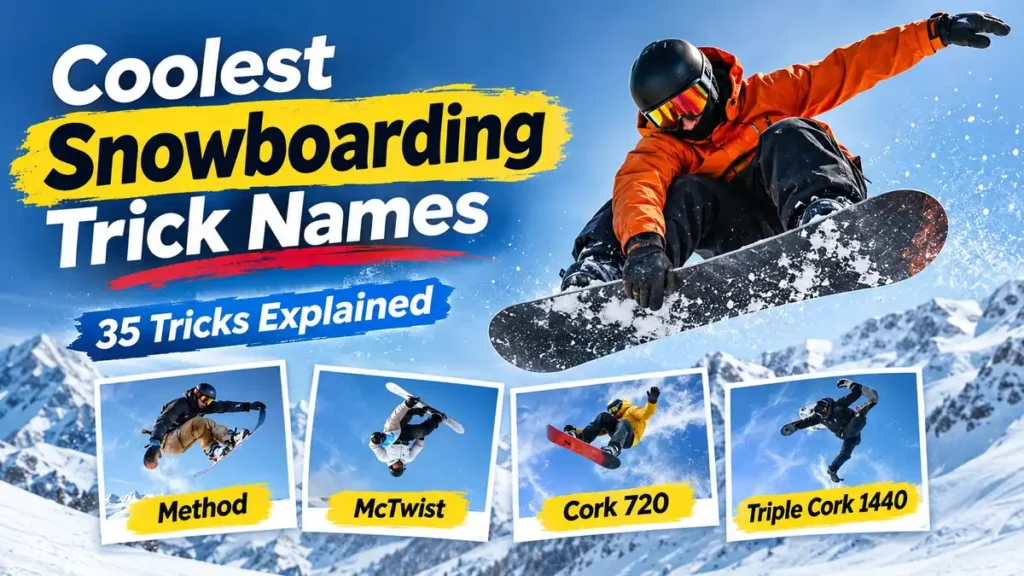
Snowboarding has a language of its own. From the laid-back style of a Method grab to the jaw-dropping rotation of a 1440, trick names can sound mysterious until you understand what happens in the air.
The coolest snowboarding trick names include Method, Stalefish, Japan Air, McTwist, Rodeo, Cork 720, Double Cork 1080, Triple Cork 1440, and Switch Backside 180. These names describe grabs, spins, flips, and combinations performed on jumps, rails, and halfpipes. Each trick has its own technique, difficulty, and visual style.
Some tricks are famous because they look effortless. Others earned legendary status through competition history or the sheer technical skill required to land them.
This guide explains 35 memorable snowboard tricks, how their names work, and what makes each one stand out.
What Makes Snowboarding Trick Names So Cool?
Snowboard trick names combine technical information with the creative culture of freestyle riding.
Some names describe exactly what the rider does. A Frontside 360, for example, involves a complete rotation in the frontside direction. Others, such as Stalefish and Chicken Salad, come from the sport’s playful naming traditions.
Most freestyle tricks fall into several overlapping categories:
- Grabs: Holding part of the snowboard while airborne.
- Spins: Rotating around the body’s vertical axis.
- Flips: Rotating forward or backward around a horizontal axis.
- Off-axis rotations: Combining spins with a tilted or inverted body position.
- Rail tricks: Sliding or pressing along rails and boxes.
- Halfpipe tricks: Performing aerial maneuvers above the walls of a halfpipe.
A single trick can combine multiple elements. A rider might perform a switch takeoff, complete two rotations, and add a grab before landing.
Understanding these building blocks makes even the most complicated snowboard trick names easier to decode.
Coolest Snowboarding Trick Names for Grabs
Grabs are among the most recognizable freestyle snowboard tricks. They can make an ordinary jump look stylish without requiring several rotations.
How to Perform the Perfect Method Air on a Snowboard – Snowboarder
1. Method Grab
The Method is one of snowboarding’s most iconic grabs. The rider reaches behind to grab the heel edge of the board between the bindings while bending the knees and extending the body into a distinctive arched position.
A well-executed Method emphasizes style, extension, and control rather than rotation.
A SLIPPERY SLOPE – Ski injuries decline, but fatalities hold steady > Torch > Display
2. Indy Grab
An Indy involves grabbing the toe edge between the bindings with the rear hand. It is one of the fundamental grabs riders learn when progressing from straight airs to freestyle tricks.
Indy grabs are common in slopestyle, big air, and halfpipe riding.
LOW ANGLE VIEW: Male snowboarder in blue jacket makes a melon grab in snowpark
3. Melon Grab
The Melon uses the front hand to grab the heel edge between the bindings. It creates a clean silhouette and pairs naturally with straight airs and spins.
Riders often extend their legs or tweak their body position to make the grab more expressive.
How to do a Stalefish Grab on a Snowboard – Snowboarder
4. Stalefish Grab
The Stalefish involves reaching the rear hand behind the back leg to grab the heel edge of the snowboard.
Its unusual name is almost as memorable as the trick itself. A strong Stalefish features a deliberate grab and stylish extension.
狙うは7回転!? 荻原大翔が見据えるネクストステップ.スノーボード・ビッグエア
5. Japan Air
A Japan Air is a tweaked Mute-style grab, typically involving the front hand on the toe edge between the bindings, with the board pulled up and the knees angled into a distinctive position.
The trick stands out because of its dramatic shape in the air.
6. Mute Grab
A Mute grab uses the front hand to hold the toe edge between the bindings. It is a foundational freestyle maneuver and can be combined with frontside or backside spins.
Some riders and organizations use the alternative name Weddle grab, honoring skateboarder Chris Weddle.
7. Nose Grab
A Nose grab involves reaching for the front tip of the snowboard while airborne.
The trick looks especially stylish when the rider extends the rear leg and pulls the nose toward the body. Nose grabs can also be incorporated into spinning tricks.
8. Tail Grab
A Tail grab is performed by grabbing the rear tip of the snowboard, usually with the rear hand.
It is a classic trick for learning aerial balance and creating an extended snowboard position.
9. Chicken Salad
Chicken Salad is one of the funniest snowboarding trick names.
The rider reaches the rear hand between the legs and grabs the heel edge, with the arm and hand positioned differently from a conventional grab.
The name reflects the creative, sometimes absurd naming traditions of freestyle snowboarding.
10. Roast Beef
A Roast Beef grab involves reaching between the legs with the rear hand to grab the heel edge of the board.
The hand approaches the edge from the opposite orientation used in a Chicken Salad. These details make the tricks visually similar but technically distinct.
11. Seatbelt Grab
A Seatbelt involves reaching the front hand across the body to grab the tail of the snowboard.
The crossed-arm position gives the maneuver its name. It can create an especially striking silhouette when held through a large jump.
12. Crail Grab
A Crail involves reaching the rear hand across the body to grab the nose of the board.
Because the rider reaches toward the opposite end of the snowboard, the trick requires flexibility and precise timing.
Coolest Snowboarding Trick Names for Spins
Spins are central to freestyle snowboarding. Their names usually describe the direction and amount of rotation.
360 degree snowboard jump on a beautiful clear day
13. Frontside 360
A Frontside 360 is a complete 360-degree rotation in the frontside direction.
It is a major progression milestone because the rider must coordinate takeoff, rotation, spotting the landing, and board control.
How to Do a Backside 540 on a Snowboard: Step-by-Step Guide – Snowboarder
14. Backside 540
A Backside 540 involves one and a half rotations, totaling 540 degrees.
The rider takes off in the backside direction and lands facing the opposite direction from takeoff, making landing control essential.
15. Frontside 720
A Frontside 720 consists of two complete rotations.
It is a recognized advanced freestyle maneuver and can be made more stylish with grabs such as Indy, Melon, or Mute.
16. Backside 900
A Backside 900 involves two and a half rotations, or 900 degrees.
Landing a 900 requires sufficient airtime, rotational control, and accurate landing awareness. Riders may add grabs to increase the trick’s technical and stylistic complexity.
17. Switch Backside 180
A Switch Backside 180 begins with the rider traveling in the opposite stance from their usual riding position.
The rider then completes a backside half-rotation before landing.
Although the rotation is smaller than a 900 or 1080, a clean switch backside 180 can be particularly stylish because of its takeoff mechanics.
18. Cab 540
A Cab 540 is a switch-frontside 540, meaning the rider takes off switch and rotates one and a half turns in the frontside direction.
The term Cab comes from the Caballerial, a skateboarding trick associated with Steve Caballero.
In snowboarding, the shorthand is widely used for switch-frontside rotations.
19. Frontside 1080
A Frontside 1080 involves three complete rotations.
The rider must generate substantial rotation while remaining balanced enough to control the landing. The trick is commonly seen in advanced big air and slopestyle riding.
20. Backside 1260
A Backside 1260 consists of three and a half rotations.
At this level, riders need precise control of takeoff direction, body position, and rotational speed. Grabs can further increase the difficulty.
Legendary Snowboarding Flip and Cork Trick Names
Inverted and off-axis maneuvers produce some of the most spectacular moments in snowboarding.
From snow to beach, discover this holiday seasons’ most rakish getaways
21. Backflip
A Backflip is a full backward rotation around a horizontal axis.
Unlike a conventional spin, the rider rotates upside down before returning to an upright landing position.
Backflips require a suitable jump, advanced air awareness, and controlled training.
Video: Rider Nails Jaw-Dropping Rodeo 720 – Snowboarder
22. Rodeo 540
A Rodeo 540 combines an off-axis, inverted-style rotation with 540 degrees of overall spin.
The maneuver has a flowing, looping appearance that distinguishes it from a straightforward upright rotation.
Snowsports: Stewart qualifies for open semifinals | Otago Daily Times Online News
23. McTwist
The McTwist is an inverted 540-degree trick closely associated with halfpipe riding.
Its name originates from skateboarder Mike McGill, who pioneered the maneuver in skateboarding.
Snowboarders adapted the trick to the halfpipe, where it became a freestyle classic.
24. Cork 720
A Cork 720 involves two complete rotations performed with the rider’s body tilted off the conventional upright spinning axis.
The word cork describes the off-axis nature of the rotation. Corks can vary in how inverted the rider becomes.
25. Double Cork 1080
A Double Cork 1080 combines three full rotations with two distinct off-axis or inverted movements.
It is a technically demanding trick associated with elite-level freestyle snowboarding.
The rider must control several rotational components while preparing for a precise landing.
26. Triple Cork 1440
A Triple Cork 1440 combines four complete rotations with three off-axis or inverted elements.
It is one of the most recognizable names in modern high-difficulty snowboarding.
Triple Corks became prominent in elite competition as athletes pushed the boundaries of big air and slopestyle.
27. Quad Cork 1800
A Quad Cork 1800 involves five full rotations and four off-axis or inverted elements.
It represents an extreme level of technical difficulty, requiring exceptional airtime, rotational precision, and body awareness.
The trick is associated with the highest levels of competitive freestyle riding rather than ordinary recreational terrain parks.
28. Double Backflip
A Double Backflip involves two complete backward flips in one jump.
It differs from a Double Cork because the primary movement is backward flipping rather than a combination of spinning and off-axis rotations.
The trick demands considerable jump height and accurate landing control.
Coolest Snowboarding Trick Names for Rails and Boxes
Rail tricks are different from aerial spins because the rider must balance on a narrow feature while controlling the board’s direction and position.
29. Boardslide
A Boardslide involves sliding across a rail or box with the snowboard positioned approximately perpendicular to the feature.
It is one of the foundational rail tricks in freestyle snowboarding.
A successful boardslide requires controlled entry, centered balance, and a clean exit.
30. Lipslide
A Lipslide resembles a boardslide, but the rider brings the tail of the board over the rail during the entry.
This changes the approach and makes the maneuver more technically demanding than a basic boardslide.
31. Frontside 270 On
A Frontside 270 On involves rotating 270 degrees in the frontside direction before landing onto a rail or box.
The trick combines aerial rotation with precise feature alignment.
Riders may continue into a boardslide or another rail position, depending on the intended combination.
32. Nose Press
A Nose Press is performed by shifting weight toward the front of the snowboard while sliding along a box or suitable rail feature.
The rider lifts or lightens the tail while maintaining balance.
It is a classic jibbing maneuver that emphasizes board control rather than airtime.
33. Tail Press
A Tail Press shifts weight toward the rear of the snowboard, raising or lightening the nose.
The trick is popular on boxes and other park features, where riders can combine it with rotations and stylish exits.
34. 50-50
A 50-50 involves sliding straight along a rail or box with the snowboard aligned lengthwise with the feature.
Although the name sounds simple, maintaining stability on a narrow rail requires good balance and edge awareness.
35. Blunt Slide
A Blunt Slide is a rail maneuver in which the rider slides with the board turned across the feature and weight biased toward the tail.
Snowboarders use the term in different jibbing contexts, so the exact entry and board position may vary.
The name comes from freestyle skateboarding terminology.
Snowboarding Trick Names and Their Difficulty Levels
Not every trick with a complicated name is necessarily harder than one with a simple name. Difficulty depends on the feature, takeoff, speed, rotation, grab, and landing conditions.
The following table provides a general comparison.
| Snowboarding trick | Category | Typical skill level |
|---|---|---|
| Indy Grab | Grab | Beginner freestyle |
| Nose Grab | Grab | Beginner freestyle |
| Tail Grab | Grab | Beginner freestyle |
| Method Grab | Grab | Intermediate |
| Stalefish | Grab | Intermediate |
| Frontside 360 | Spin | Intermediate |
| Backside 540 | Spin | Advanced |
| Cab 540 | Switch spin | Advanced |
| Frontside 720 | Spin | Advanced |
| McTwist | Inverted halfpipe | Expert |
| Rodeo 540 | Inverted spin | Expert |
| Double Cork 1080 | Off-axis spin | Elite |
| Triple Cork 1440 | Off-axis spin | Elite |
| Quad Cork 1800 | Off-axis spin | Elite |
These levels are approximate. A trick performed on a small, appropriate feature can have a very different risk profile from the same trick on a competition-sized jump.
How to Understand the Coolest Snowboarding Trick Names
Snowboard trick terminology becomes much easier once you understand how riders combine different elements into a single name.
Understanding rotation numbers
The number in a trick name represents the total amount of rotation in degrees.
| Rotation | Number of turns | Landing orientation on a straight jump |
|---|---|---|
| 180 | Half turn | Switch |
| 360 | One full turn | Same orientation |
| 540 | One and a half turns | Switch |
| 720 | Two full turns | Same orientation |
| 900 | Two and a half turns | Switch |
| 1080 | Three full turns | Same orientation |
| 1260 | Three and a half turns | Switch |
| 1440 | Four full turns | Same orientation |
| 1620 | Four and a half turns | Switch |
| 1800 | Five full turns | Same orientation |
| 2160 | Six full turns | Same orientation |
Here, same orientation means the same forward-or-switch relationship as takeoff, not necessarily the rider’s preferred stance.
For example, a rider who starts in their normal stance and performs a 540 generally lands switch. A rider who starts switch and completes a 540 generally lands in their normal stance.
Frontside vs. backside rotations
Frontside and backside describe the direction of rotation relative to the rider’s stance and takeoff.
For a regular-footed snowboarder, frontside spins typically rotate counterclockwise on a straight jump, while backside spins rotate clockwise. The directions reverse for goofy-footed riders.
However, halfpipe and rail terminology also depends on the feature and approach, so the same words can describe different spatial relationships.
What does switch mean in snowboarding?
Switch means riding with the opposite foot forward from the rider’s preferred stance.
A regular-footed snowboarder normally rides with the left foot forward. When riding switch, the right foot leads.
Switch tricks are often harder because takeoff and landing mechanics are less familiar.
What does cork mean?
A cork is an off-axis spin in which the rider tilts away from the normal upright rotational axis.
A Double Cork includes two off-axis movements, while a Triple Cork includes three.
These terms are used in competition commentary to communicate the structure of technically complex tricks. WSF Terms & Organizations+1
What does a grab add to a trick?
A grab adds a recognizable hand position and often increases the technical or stylistic demands of a jump.
For example, a Backside 720 Melon combines a backside two-turn rotation with a front-hand heel-edge grab.
A well-held grab demonstrates control. A brief touch of the board generally does not look as deliberate as a properly extended and sustained grab.
Famous Snowboarders Behind Legendary Trick Names
Some of snowboarding’s most memorable tricks are associated with athletes who introduced, popularized, or redefined them.
Shaun White and the Double McTwist 1260
How Olympic Athletes Fare in Freezing Cold | Live Science
Shaun White helped bring complex halfpipe rotations to mainstream audiences.
His Double McTwist 1260, nicknamed the Tomahawk, became one of his signature maneuvers. The trick combines a double-flipping movement with a 1260-degree rotation. NBC Olympics
Ayumu Hirano and the Triple Cork
Snowboard – Winter Olympics Day 7
Ayumu Hirano made history at the 2022 Beijing Winter Olympics by landing a Triple Cork 1440 in Olympic halfpipe competition.
His performance demonstrated how far competitive halfpipe snowboarding had progressed, combining major airtime with multiple inverted rotations. NBC Olympics
Terje Haakonsen and the Haakon Flip
Snøbrett VM 2012 » TERJE HÅKONSEN OF NORWAY TWISTS IN THE AIR IN SWITZERLAND
Norwegian snowboarder Terje Haakonsen is closely associated with the Haakon Flip, an inverted switch-takeoff halfpipe trick involving a 720-degree rotation.
His influence extends beyond one maneuver. He helped establish style and creative expression as essential parts of freestyle snowboarding. NBC Olympics+1
How to Start Learning Snowboarding Tricks Safely
The most exciting snowboard tricks are usually built on basic skills. A rider who can control takeoffs, stay balanced in the air, and land consistently has a stronger foundation for progressing.
A sensible learning progression looks like this:
- Master basic riding: Develop reliable edge control, turns, speed management, and stopping.
- Practice switch riding: Become comfortable riding with either foot forward.
- Learn flat-ground movements: Try controlled ollies, nollies, and small 180-degree movements.
- Progress to straight airs: Use appropriately sized beginner park features and learn to maintain balance in flight.
- Introduce simple grabs: Add an Indy or Nose grab only when straight jumps feel consistent.
- Develop rotations with coaching: Progress through basic spins on suitable terrain with a qualified instructor.
- Reserve inversions for specialized training: Backflips, corks, and other inverted tricks require professional supervision and purpose-built progression environments.
A helmet and appropriate protective equipment are essential, but they do not eliminate the risks of freestyle riding. Never attempt advanced aerial maneuvers simply because their names sound impressive.
Which Snowboarding Tricks Have the Coolest Names?
There is no official ranking because the appeal of a trick name is subjective.
However, a few names stand out for different reasons.
| Trick name | Why it stands out |
|---|---|
| Stalefish | Unusual and instantly memorable |
| Chicken Salad | Playful freestyle terminology |
| Roast Beef | Another classic food-inspired grab |
| McTwist | A legendary named inverted trick |
| Japan Air | Recognizable aerial style |
| Rodeo 540 | Suggests a dynamic flipping motion |
| Triple Cork 1440 | Communicates extreme technical complexity |
| Seatbelt | Describes its distinctive cross-body reach |
| Haakon Flip | Connected to snowboarding history |
| Tomahawk | Memorable nickname for an elite halfpipe trick |
For pure style, the Method and Japan Air are hard to beat. For unusual names, Chicken Salad and Stalefish stand out. For technical spectacle, Triple Corks and Quad Corks are among the most impressive.
Final Thoughts on the Coolest Snowboarding Trick Names
The coolest snowboarding trick names reflect the sport’s combination of athletic skill, creativity, and history.
Classic grabs such as Method, Indy, and Stalefish celebrate individual style. Spins such as Frontside 720 and Cab 540 demonstrate rotational control. Advanced maneuvers such as McTwist, Double Cork 1080, and Triple Cork 1440 showcase the technical possibilities of modern freestyle snowboarding.
Learning the terminology makes it easier to understand competition commentary, recognize tricks in videos, and appreciate the differences between riders’ styles.
The next time you watch a snowboarding competition, pay attention to the takeoff stance, rotation direction, number of turns, and grab. Those four details can help you identify many of the sport’s most spectacular tricks.