A boiled egg can change dramatically in just a minute. At six minutes, the yolk may still be soft and flowing; a few minutes later, it can be completely firm.
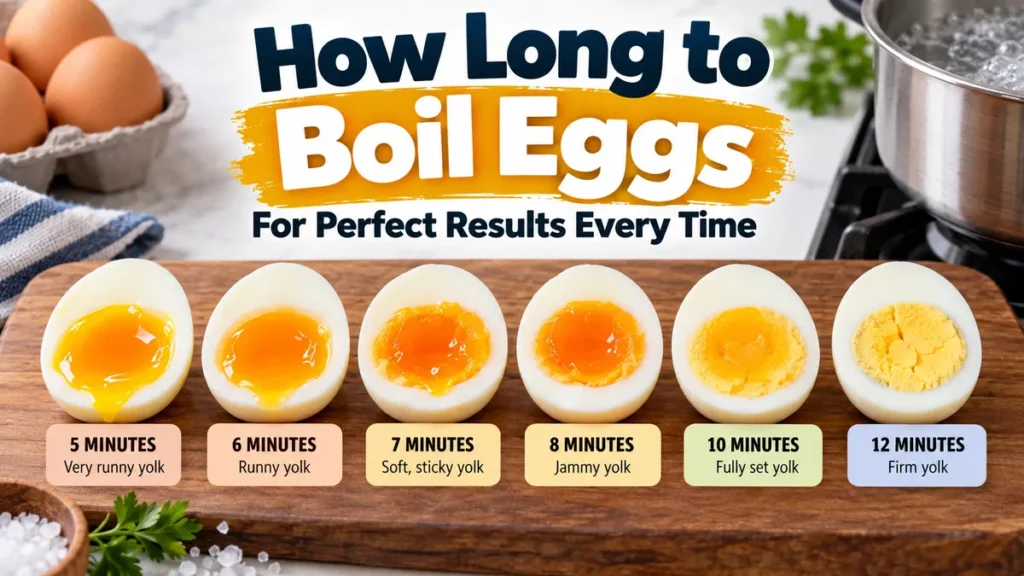
So, how long to boil eggs? For large eggs lowered into already-boiling water, aim for about 5–6 minutes for a runny yolk, 7–8 minutes for a jammy or softly set yolk, and 10–12 minutes for a fully hard-boiled egg. Exact results vary with egg size, starting temperature, altitude, and cooking method. BBC Good Food
The key isn’t simply boiling eggs longer. Consistent timing, a gentle simmer, and immediate cooling give you far more control over the final texture.
How Long to Boil Eggs: Quick Timing Chart
If you want a simple answer, use this chart for large eggs added carefully to boiling water.
| Cooking Time | Egg White | Yolk | Best For |
|---|---|---|---|
| 5 minutes | Just set | Very runny | Dipping, toast soldiers |
| 6 minutes | Set | Runny and creamy | Breakfast, ramen |
| 7 minutes | Firm | Sticky, soft center | Toast, grain bowls |
| 8 minutes | Firm | Jammy, softly set | Salads, Scotch eggs |
| 9 minutes | Firm | Mostly set | Sandwiches, snacking |
| 10 minutes | Firm | Fully set but tender | Classic hard-boiled eggs |
| 11–12 minutes | Firm | Firm throughout | Deviled eggs, egg salad |
Good Food recommends about five minutes for a set white with a runny yolk, seven minutes for an almost-set sticky yolk, eight minutes for a softly set center, and ten minutes for a classic hard-boiled result when large eggs are lowered into boiling water. BBC Good Food
Treat these times as starting points rather than universal laws. A cold extra-large egg will not cook exactly like a room-temperature medium egg.
How Long to Boil Eggs for Soft-Boiled Eggs
A good soft-boiled egg has a completely or nearly completely set white surrounding a warm, liquid or creamy yolk.
For large eggs, 5–7 minutes is the useful soft-boiled range.
5-minute eggs
At around five minutes, expect the white to be just set while the yolk remains very fluid.
This texture works especially well when you plan to eat the egg straight from its shell with toast. Because the yolk remains loose, peeling the whole egg neatly can be more difficult.
6-minute eggs
Six minutes gives the white more structure while keeping the center liquid and rich.
This is a popular texture for:
- Ramen
- Toast
- Rice bowls
- Noodle dishes
- Breakfast plates
Good Food describes six-minute eggs as having a liquid yolk, while noting that exact results depend on factors such as egg temperature and size. BBC Good Food
7-minute eggs
At seven minutes, the yolk begins moving from runny toward sticky or jammy.
This is a useful middle ground when you want the richness of a soft yolk without having liquid yolk spill across the plate.
Quick takeaway: Start at five minutes for a very runny center, six minutes for a creamy liquid yolk, and seven minutes for a thicker, almost-set center.
How Long to Boil Eggs for a Jammy Yolk
For many people, the sweet spot isn’t technically soft-boiled or hard-boiled. It’s the jammy egg.
A jammy yolk is thick, creamy, and spoonable rather than liquid. It should hold its shape when you cut the egg but still look glossy in the center.
For large eggs placed in boiling water, about 7–8 minutes usually produces this texture. Good Food specifically describes an eight-minute egg as softly set or “jammy.” BBC Good Food
Jammy eggs work particularly well in:
- Ramen
- Salads
- Avocado toast
- Rice bowls
- Noodle bowls
- Grain bowls
- Scotch eggs
Cooling becomes particularly important here. If an eight-minute egg remains hot after you remove it from the saucepan, residual heat continues cooking the yolk. Moving it immediately into very cold or ice water helps preserve that soft center.
How Long to Boil Eggs for Hard-Boiled Eggs
For a traditional hard-boiled egg, you want both the egg white and yolk set without turning the yolk dry or chalky.
Using the boiling-water method, around 10 minutes is a good target for large eggs. Good Food lists ten minutes for a classic hard-boiled egg that is fully cooked but not dry. BBC Good Food
Other established methods use slightly different timings. For example, the American Egg Board’s cold-start method brings eggs and water to a boil, removes the saucepan from the burner, covers it, and lets large eggs stand for about 12 minutes. American Egg Board
That difference highlights an important point: cooking time depends on when you start the timer.
Ten minutes of simmering in already-hot water is not equivalent to twelve minutes resting in water after the pan has been removed from the heat.
What happens if you boil eggs too long?
An overcooked egg usually develops:
- A dry or chalky yolk
- A rubbery white
- A less pleasant texture
- Sometimes a greenish-gray ring around the yolk
That green ring isn’t necessarily a sign that the egg has spoiled. USDA explains that it can develop when sulfur and iron compounds react at the yolk’s surface, particularly when eggs are overcooked. The discoloration is safe to eat. Food Safety and Inspection Service
How to Boil Eggs Step by Step
There are several legitimate ways to cook boiled eggs. If precise yolk consistency is your main goal, starting with boiling water makes the timing easy to repeat.
1. Bring the water to a boil
Fill a saucepan with enough water to cover the eggs completely.
Bring it to a boil before adding the eggs.
2. Lower the eggs in gently
Use a spoon or slotted spoon to lower each egg into the hot water.
Don’t drop eggs directly into the saucepan. Hitting the bottom can crack the shell.
3. Reduce to a controlled boil or simmer
You don’t need the eggs bouncing violently around the pan.
Once they’re submerged, maintain enough heat to keep the water hot and gently bubbling.
4. Start your timer
Choose your preferred texture:
- 5–6 minutes: runny yolk
- 7–8 minutes: jammy yolk
- 10 minutes: hard-boiled but tender
- 11–12 minutes: firmer hard-boiled yolk
The timer matters. A difference of only one or two minutes can noticeably change the yolk.
5. Transfer the eggs to cold water
As soon as your timer ends, remove the eggs with a slotted spoon and transfer them into a bowl of very cold water or an ice bath.
This rapidly cools the eggs and limits carryover cooking.
6. Cool before peeling
Allow hard-boiled eggs to cool sufficiently before peeling.
For a warm soft-boiled egg that will be served immediately, you only need enough cooling to make it comfortable to handle.
Should You Start Eggs in Cold or Boiling Water?
Both methods work, which is one reason boiled-egg recipes sometimes give apparently contradictory instructions.
Boiling-water method
Bring the water to a boil first and carefully lower the eggs into it.
Advantages:
- Easy to time consistently
- Good control over yolk texture
- Excellent for soft and jammy eggs
Disadvantages:
- Cold eggs can crack when they meet hot water
- Eggs need to be lowered gently
Cold-water method
Put the eggs in a saucepan first, cover them with cold or room-temperature water, and then heat everything together.
Some recipes turn off the heat when the water reaches a boil and allow the eggs to finish cooking in the covered pan.
The American Egg Board recommends placing eggs in a single layer, covering them with about an inch of cold water, heating just to boiling, removing the pan from the burner, covering it, and letting large eggs stand for approximately 12 minutes. American Egg Board
Food Network also uses variations of the cold-start technique for hard-boiled eggs. Food Network
The important thing is consistency. Pick one method and learn the timing that works with your eggs, saucepan, stove, and preferred yolk texture.
Do You Boil Water Before Adding Eggs?
You can, especially when precise timing matters.
Adding eggs to already-boiling water gives you a clearly defined starting point. That makes it easier to repeat a six-, seven-, or eight-minute egg.
However, eggs straight from the refrigerator experience a sudden temperature change when they enter boiling water, which can increase the chance of cracking. Lowering them gently with a spoon helps.
Good Food notes that egg temperature can affect timing and suggests adding roughly 30 seconds when using fridge-cold eggs in its boiling-water method. BBC Good Food
There’s no need to obsess over getting every egg exactly to room temperature. More important is using the same approach each time so your results become predictable.
Does Egg Size Change Boiling Time?
Yes.
Most standard boiling guides assume large chicken eggs. Smaller eggs generally cook slightly faster, while extra-large eggs take a little longer.
Good Food suggests using about 30 seconds less for medium eggs and 30 seconds more for extra-large eggs compared with its timings for large eggs. BBC Good Food
This matters most with soft-boiled eggs. If you’re aiming for a liquid or jammy yolk, 30–60 seconds can noticeably affect the center.
For fully hard-boiled eggs, there’s a little more flexibility because you’re deliberately cooking the yolk through.
Should You Use an Ice Bath After Boiling Eggs?
An ice bath is one of the simplest ways to improve consistency.
Once an egg leaves boiling water, its exterior remains extremely hot. That stored heat continues traveling toward the center, so the yolk keeps cooking even though the egg is no longer in the saucepan.
Cold water slows that process.
This matters when you’re trying to preserve an exact yolk texture. A perfectly jammy egg can become substantially firmer if left sitting hot for several minutes.
Cooling also makes eggs easier to handle. The American Egg Board notes that cooling causes the cooked egg to contract slightly inside the shell, which can assist peeling. American Egg Board
For hard-boiled eggs, prepare your ice water before the cooking timer finishes. That way, you can transfer the eggs immediately rather than searching for ice while they continue cooking.
How to Make Hard-Boiled Eggs Easier to Peel
Few kitchen frustrations compare with peeling away half an egg white along with the shell.
Freshness can make a difference.
USDA explains that freshly laid eggs have an albumen, or egg white, with a pH around 7.4. As the egg ages, its pH rises, reducing the attraction between the white and inner shell membrane. This is why somewhat older eggs often peel more easily after hard cooking. Food Safety and Inspection Service
For easier peeling:
- Cool the eggs promptly after cooking.
- Gently tap the shell all over.
- Roll the egg lightly on the counter to create small cracks.
- Start peeling near the wider end.
- Peel under cool running water if pieces of shell stick.
The American Egg Board similarly recommends cracking the shell, rolling the egg to loosen it, and starting at the large end. American Egg Board
If you’re making deviled eggs for a party, using eggs that aren’t exceptionally fresh can save a surprising amount of frustration.
Why Do Eggs Crack While Boiling?
A cracked shell doesn’t automatically mean you’ve done something seriously wrong.
Common causes include:
- Dropping the egg into the saucepan
- Eggs hitting each other during a violent rolling boil
- Sudden temperature changes
- An existing hairline crack in the shell
Lowering eggs gently with a spoon and avoiding excessively aggressive boiling can help.
If an egg cracks during hard cooking, USDA states that it remains safe to eat when properly cooked. Food Safety and Inspection Service
You may see some white leak through the crack and cook in the water, but that is mainly a presentation issue.
One popular tip is to pierce the shell before boiling. However, the American Egg Board advises against piercing because a nonsterile needle or piercer could introduce bacteria and may create small cracks through which bacteria can enter. American Egg Board
Does Altitude Affect How Long to Boil Eggs?
Yes. This is one factor many basic timing charts overlook.
At higher elevations, atmospheric pressure is lower, so water boils at a lower temperature. The water may be visibly boiling while still being cooler than boiling water at sea level.
As a result, eggs can require more cooking time.
If you live at significant elevation and a standard ten-minute hard-boiled egg consistently comes out softer than expected, extend the cooking time gradually rather than assuming something is wrong with your stove or eggs.
Altitude is another reason to think of boiling charts as a reliable starting point rather than an absolute rule.
How to Tell When a Boiled Egg Is Done
Unlike fried or scrambled eggs, you can’t see the yolk while an egg is cooking inside its shell.
That makes a timer the most dependable tool.
Avoid repeatedly removing eggs and trying to judge doneness from the outside. Shell color, floating behavior, and appearance won’t reliably tell you whether the yolk is runny, jammy, or firm.
If you’re using unfamiliar eggs or cooking at a different altitude, test one egg first. Cook it for your target time, cool it briefly, cut it open, and adjust subsequent eggs by 30–60 seconds.
Once you know that, for example, seven and a half minutes gives you the exact yolk you want on your stove, repeating the result becomes straightforward.
Are Soft-Boiled Eggs Safe to Eat?
Soft-boiled eggs contain yolks that may not be fully cooked, so they carry more food-safety risk than fully cooked eggs.
USDA advises cooking eggs until both the white and yolk are firm. For dishes intended to contain raw or undercooked eggs, pasteurized eggs or pasteurized egg products provide a safer option. Food Safety and Inspection Service
This consideration is particularly relevant for people at greater risk from foodborne illness.
Always start with clean, uncracked eggs and follow appropriate refrigeration practices.
How Long Do Hard-Boiled Eggs Last?
Hard-boiled eggs are useful for meal preparation because you can cook several at once.
According to the FDA, hard-cooked eggs can be refrigerated for up to one week, whether they’re stored in the shell or peeled. U.S. Food and Drug Administration
USDA likewise advises refrigerating hard-cooked eggs within two hours of cooking and using them within seven days. They should not remain at room temperature for more than two hours. Ask USDA
Keep your refrigerator at 40°F (4°C) or below. U.S. Food and Drug Administration
If you’re batch-cooking eggs for lunches or breakfasts, write the cooking date on the storage container. It’s much easier than trying to remember which day you boiled them.
Common Mistakes When Boiling Eggs
Knowing how long to boil eggs solves only part of the problem. Technique determines whether those minutes produce the result you’re expecting.
Guessing instead of using a timer
A minute makes a meaningful difference, especially between soft and jammy eggs.
Start the timer consistently and don’t rely on intuition.
Using a violent rolling boil
Hard bubbling can knock eggs against the saucepan or each other.
Use controlled heat once the eggs are cooking.
Skipping the cold-water bath
Leaving freshly cooked eggs hot allows carryover cooking to continue.
That’s particularly noticeable with six- to eight-minute eggs.
Cooking every egg for 12 minutes
If you enjoy fully firm yolks, that’s fine. But longer isn’t automatically better.
Excessive cooking can produce rubbery whites, dry yolks, and the familiar green-gray ring around the yolk.
Ignoring egg size and temperature
A medium room-temperature egg and an extra-large refrigerator-cold egg won’t necessarily reach the same doneness simultaneously.
Make small timing adjustments when needed.
Using ultra-fresh eggs when appearance matters
Very fresh eggs may be harder to peel cleanly. If you’re preparing deviled eggs where smooth whites matter, slightly older refrigerated eggs can be easier to work with. Food Safety and Inspection Service
The Best Boiling Time Depends on the Yolk You Want
There isn’t one perfect cooking time because there isn’t one perfect boiled egg.
If you want toast soldiers and a flowing center, aim for roughly 5–6 minutes. For ramen, salads, or grain bowls where a creamy jammy center works best, try 7–8 minutes. For a classic fully cooked egg, around 10 minutes is an excellent starting point when lowering large eggs into boiling water. BBC Good Food
If you use a cold-start, covered-rest method instead, the timing changes; the American Egg Board uses about 12 minutes of standing time for large eggs after bringing the water to a boil. American Egg Board
Ultimately, the easiest way to master how long to boil eggs is to choose one method, use a timer, cool the eggs immediately, and adjust by 30–60 seconds until you find your favorite texture. Once you’ve found that number, perfectly cooked eggs become remarkably repeatable.