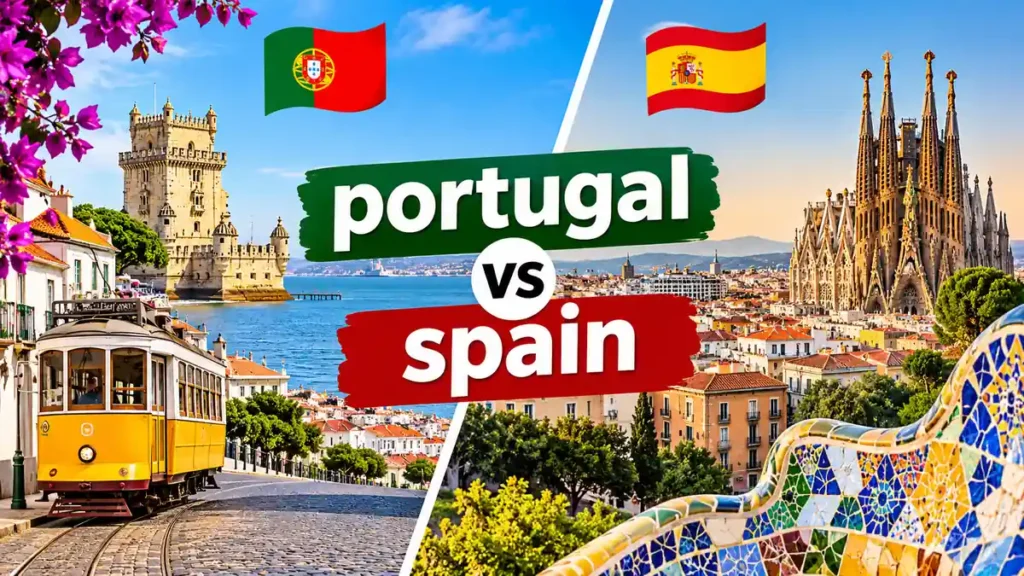
Portugal and Spain share the Iberian Peninsula, beautiful coastlines, centuries of history, and some of Europe’s most celebrated food traditions. Yet visiting these neighboring countries can feel surprisingly different.
If you’re comparing portugal vs spain for a vacation, extended stay, or possible relocation, the best choice depends on what you value most: affordability, beaches, climate, culture, transportation, or everyday lifestyle.
Portugal is generally better for travelers seeking a compact destination, dramatic Atlantic scenery, and a relaxed atmosphere. Spain offers greater regional diversity, larger cities, extensive high-speed rail connections, and a wider variety of cultural experiences. Both countries have excellent food, historic landmarks, and attractive coastlines, but neither is automatically better for everyone.
This guide compares their major differences using travel-cost estimates, geographic characteristics, cultural distinctions, and practical considerations for 2026.
portugal vs spain: Key Differences at a Glance
Portugal and Spain are neighboring European countries with shared historical influences, but they differ significantly in size, population, language, geography, and lifestyle.
| Feature | Portugal | Spain |
|---|---|---|
| Capital | Lisbon | Madrid |
| Official national language | Portuguese | Spanish (Castilian) |
| Currency | Euro (€) | Euro (€) |
| Population | Approximately 10.7 million | Approximately 49 million |
| Geographic size | About 92,000 km² | About 506,000 km² |
| Main coastal influence | Atlantic Ocean | Atlantic Ocean and Mediterranean Sea |
| Popular cities | Lisbon, Porto, Coimbra, Faro | Madrid, Barcelona, Seville, Valencia |
| Famous coastal regions | Algarve, Costa Vicentina | Costa del Sol, Costa Brava |
| Typical atmosphere | Relaxed, coastal, intimate | Diverse, energetic, regionally varied |
| Transportation | Rail, buses, metro, roads | Extensive high-speed rail and regional networks |
| Traditional cuisine | Seafood, bacalhau, pastel de nata | Tapas, paella, tortilla española |
| Best known for | Atlantic scenery, historic towns, wine | Architecture, regional cultures, festivals |
Spain is approximately five and a half times larger than Portugal, giving it substantially more geographic and regional variety.
Portugal’s smaller size can make it easier to explore several major destinations during a relatively short holiday.
Both belong to the European Union and the Schengen Area, making cross-border travel relatively straightforward for eligible visitors.
portugal vs spain: Which Country Is Cheaper?
Travel expenses are among the most common considerations when comparing these countries.
Portugal has traditionally been regarded as the more affordable destination, although rising accommodation costs in Lisbon, Porto, and popular coastal towns have narrowed the difference.
Spain can also offer excellent value, particularly outside Madrid, Barcelona, and its busiest resort areas.
Accommodation and Daily Travel Costs
According to traveler-spending estimates published by Budget Your Trip, average daily expenses are approximately:
| Expense | Portugal | Spain |
|---|---|---|
| Average daily spending per person | €165 | €185 |
| Accommodation per person | €62 | €69 |
| Local transportation per day | €27 | €29 |
| Food per day | €67 | €69 |
| Entertainment per day | €22 | €26 |
Source: Budget Your Trip country comparison. These are historical traveler averages, not fixed prices or a recommended budget. Expense categories may overlap and should not be added together.
Based on these estimates, Portugal costs approximately 11% less per day than Spain.
However, the actual difference depends heavily on your itinerary. A stay in central Lisbon may cost more than visiting a smaller Spanish city such as Salamanca or Granada.
Which Country Offers Better Budget Travel?
Portugal is particularly appealing for visitors who want to explore historic cities, coastal villages, local markets, and scenic landscapes without covering enormous distances.
Spain provides more choices across different price levels. Smaller cities and inland regions can be considerably less expensive than its international tourism centers.
For either destination, traveling outside July and August, staying away from major tourist squares, and using regional public transportation can help reduce costs.
Quick takeaway: Portugal has a modest overall cost advantage in broad travel averages, but choosing the right city and season matters more than the national average.
Beaches, Coastlines, and Natural Landscapes
Algarve, Portugal
Burgen, Buchten und Leuchttürme – 10 zauberhafte Orte an der Costa Brava
Costa Brava, Spain
Both countries have remarkable coastlines, but their beach experiences are different.
Portugal is strongly associated with the Atlantic Ocean, while Spain offers both Atlantic and Mediterranean destinations.
Portugal’s Best Beaches
Portugal’s coastline features golden cliffs, wide sandy beaches, dramatic rock formations, and some of Europe’s most famous surfing locations.
Notable coastal destinations include:
- Algarve: Known for limestone cliffs, sheltered coves, and beaches around Lagos, Albufeira, and Tavira.
- Nazaré: Internationally famous for enormous winter waves and big-wave surfing.
- Ericeira: A recognized surfing destination with a distinctive coastal-town atmosphere.
- Costa Vicentina: A rugged southwestern coastline featuring quieter beaches and natural landscapes.
- Cascais: A convenient seaside destination near Lisbon.
Portugal is particularly attractive for coastal walking, photography, surfing, and dramatic ocean scenery.
However, Atlantic water temperatures can be surprisingly cool, even during summer.
Spain’s Best Beaches
Spain offers more variety in beach conditions and coastal environments.
Its Mediterranean destinations often provide warmer summer water and calmer swimming conditions than Portugal’s exposed Atlantic beaches.
Popular regions include:
- Costa del Sol: Beaches, resorts, and coastal cities around Málaga.
- Costa Brava: Rocky coves, Mediterranean villages, and clear water in Catalonia.
- Balearic Islands: Mallorca, Menorca, Ibiza, and Formentera.
- Canary Islands: Volcanic scenery, beaches, and mild conditions throughout much of the year.
- Costa Blanca: Sandy beaches and coastal destinations around Alicante.
- Galicia: Atlantic beaches, green landscapes, and rugged coastal scenery.
Spain’s island destinations significantly expand its beach and nature options.
Which Has Better Beaches?
For surfing, Atlantic landscapes, and spectacular cliffs, Portugal has a particularly strong appeal.
For warmer Mediterranean swimming, island holidays, and a greater variety of coastal environments, Spain offers more choices.
Neither country’s beaches are uniformly warm or calm. Local geography, wind, currents, and season determine swimming conditions.
Weather and Climate: Is Portugal Warmer Than Spain?
It is tempting to assume that Spain is always hotter than Portugal, but the climate comparison is more complicated.
Both countries experience considerable regional variation.
Portugal has a strong Atlantic influence, while Spain includes Mediterranean, oceanic, continental, mountainous, and subtropical climates.
Portugal’s Climate
Portugal generally experiences mild coastal winters and warm summers.
Lisbon has a Mediterranean-style climate moderated by Atlantic conditions. Porto is usually cooler and wetter, particularly during winter.
Southern Portugal, especially the Algarve, is known for relatively mild winters and sunny summers.
Interior regions can become much hotter than the coast.
Spain’s Climate
Spain’s climate varies dramatically by region.
Madrid experiences hot, dry summers and comparatively cold winters because of its inland elevation.
Barcelona has a Mediterranean climate, while Seville regularly experiences intense summer heat.
Northern Spain, including Galicia, Asturias, and the Basque Country, is greener and wetter than much of the south.
The Canary Islands have a subtropical climate, making them attractive for winter sunshine.
Best Time to Visit
| Season | Portugal | Spain |
|---|---|---|
| Spring (March–May) | Excellent for cities and coastal walks | Excellent for sightseeing and cultural travel |
| Summer (June–August) | Popular beach season; cooler Atlantic water | Ideal for many beach areas; inland heat can be intense |
| Autumn (September–November) | Pleasant early-autumn conditions | Excellent for cities and many coastal regions |
| Winter (December–February) | Mild southern coast; wetter north | Mild southern and island destinations; colder inland areas |
For sightseeing, April to June and September to October are generally appealing in both countries.
Travelers sensitive to extreme heat may prefer Portugal’s Atlantic coast or northern Spain during midsummer.
Those seeking winter sunshine should compare the Algarve, Andalusia, and Canary Islands rather than assuming either entire country has one climate.
Culture, Language, and Everyday Traditions
Portugal and Spain share centuries of Iberian history, but each has developed a distinct national identity.
Their languages, musical traditions, dining customs, architecture, and social rhythms offer noticeably different experiences.
Portuguese Culture
Famous vintage tram in the street of Alfama, Lisbon, Portugal
Portugal’s cultural identity is closely connected to maritime history, Atlantic exploration, and regional traditions.
Lisbon’s historic neighborhoods, Porto’s riverside architecture, and smaller towns such as Évora and Óbidos reflect different periods of Portuguese history.
Fado, a traditional musical genre associated with expressive singing and emotional storytelling, is one of Portugal’s most recognizable cultural traditions.
Portuguese azulejos, the decorative ceramic tiles found on buildings, churches, and railway stations, are another distinctive feature.
The concept of saudade, often associated with longing and nostalgia, also occupies an important place in Portuguese cultural expression.
Spanish Culture
Spain’s cultural landscape is exceptionally diverse because of its regional identities.
Andalusia is associated with flamenco, Moorish architectural influences, and traditional festivals.
Catalonia has its own language and cultural traditions, while the Basque Country and Galicia maintain distinct linguistic and regional identities.
Spanish cultural landmarks include the Alhambra in Granada, the Sagrada Família in Barcelona, and the Prado Museum in Madrid.
The country’s festivals range from Seville’s Feria de Abril to Valencia’s Las Fallas and Pamplona’s San Fermín.
Portuguese vs Spanish Language
Portuguese and Spanish are Romance languages derived from Latin, so they share substantial vocabulary and grammatical similarities.
However, they are separate languages with meaningful differences in pronunciation, spelling, and everyday expression.
Spanish is the principal official language throughout Spain, while Catalan, Basque, Galician, and other regional languages have official or protected status in particular territories.
Portuguese is Portugal’s dominant official language.
English proficiency varies by location, age, and tourism exposure in both countries. Visitors should not assume that everyone in either country speaks English.
Learning basic greetings and polite expressions in the local language can improve everyday interactions.
Food and Cuisine: Portugal vs Spain
Food is a major attraction in both countries, but their culinary traditions have different strengths.
Portugal is particularly celebrated for seafood, cod dishes, pastries, and wine.
Spain is famous for tapas culture, regional rice dishes, cured meats, and a highly varied restaurant scene.
Bacalhau à Brás | En mi cocina
Portuguese bacalhau
Spanish paella
Traditional Portuguese Food
Portuguese cuisine frequently emphasizes straightforward preparation and high-quality ingredients.
Well-known dishes include:
- Bacalhau: Salt cod prepared in numerous traditional ways.
- Pastel de nata: A custard tart with flaky pastry.
- Caldo verde: A soup traditionally made with potatoes and leafy greens.
- Sardinhas assadas: Grilled sardines, particularly popular during summer festivals.
- Francesinha: A rich sandwich associated with Porto.
- Polvo à lagareiro: Octopus prepared with olive oil and potatoes.
Portugal is also known for Port wine, Madeira wine, and wines from the Douro and Alentejo regions.
Traditional Spanish Food
Spanish cuisine varies considerably across regions.
Popular dishes include:
- Paella: A Valencian rice dish with multiple regional variations.
- Tortilla española: A traditional potato omelet.
- Gazpacho: A chilled vegetable soup associated with Andalusia.
- Jamón ibérico: A highly regarded cured ham.
- Patatas bravas: Fried potatoes served with sauce.
- Pulpo a la gallega: A Galician octopus dish.
- Churros: Fried dough commonly enjoyed with hot chocolate.
Spain’s tapas tradition encourages sharing small dishes, although the meaning and serving style of tapas differ by region.
Spanish wine regions such as Rioja, Ribera del Duero, and Priorat also have international reputations.
Which Country Has Better Food?
Portugal is an excellent choice for travelers who enjoy seafood, traditional bakeries, and regional wines.
Spain offers an exceptionally broad culinary landscape, from simple neighborhood tapas bars to internationally recognized fine dining.
The better choice depends on personal taste rather than an objective ranking.
Cities, Attractions, and Things to Do
Portugal is relatively compact, making it practical to combine multiple destinations.
Spain requires more careful itinerary planning because its major attractions are spread across a much larger territory.
Best Places to Visit in Portugal
aerial views of the roofs of the city of Lisbon
Lisbon
Portugal’s capital combines historic neighborhoods, viewpoints, trams, museums, and waterfront scenery. Belém and Alfama are especially popular.
Porto, Portugal old town view and Luis I bridge
Porto
Famous for the Douro River, Port wine, historic Ribeira district, and the Dom Luís I Bridge.
Sintra
Known for romantic palaces, wooded hills, and landmarks such as Pena Palace and Quinta da Regaleira.
Ponta da Piedade in Algarve, Portogallo – easyViaggio
Algarve
A southern coastal region with dramatic cliffs, beaches, fishing towns, and popular holiday resorts.
Madeira and the Azores offer additional options for hiking, volcanic scenery, gardens, and nature-focused travel.
Best Places to Visit in Spain
Ciudades españolas más caras y baratas para vivir en 2024
Madrid
Spain’s capital offers major art museums, royal landmarks, parks, restaurants, and an energetic urban atmosphere.
Barcelona
Known for Antoni Gaudí’s architecture, Mediterranean beaches, cultural institutions, and distinctive Catalan identity.
Secretos de Viaje – Alameda de Hércules
Seville
Famous for its cathedral, Royal Alcázar, flamenco traditions, and historic Andalusian architecture.
Spain Tours, Trips & Travel Packages 2026/2027 | Goway Travel
Granada
Home to the Alhambra, historic neighborhoods, and spectacular views of the Sierra Nevada mountains.
Valencia, Bilbao, Córdoba, Toledo, and Santiago de Compostela offer further cultural and historical experiences.
Which Country Is Better for Sightseeing?
Portugal is particularly convenient for travelers with limited time who want to combine cities, historical landmarks, and coastal scenery.
Spain provides more variety for longer trips, particularly those involving art museums, architecture, regional festivals, and contrasting landscapes.
For a first European trip, either country can provide a rich cultural experience without requiring an unusually complicated itinerary.
Transportation and Getting Around
Transportation can significantly influence the quality of a trip, especially when visiting multiple cities.
Spain has one of Europe’s most extensive high-speed railway networks, while Portugal relies more heavily on conventional intercity rail, regional trains, and buses.
Public Transportation in Portugal
Portugal’s main rail operator, Comboios de Portugal (CP), connects important cities including Lisbon, Porto, Coimbra, and Faro.
The Alfa Pendular provides faster intercity services on major routes, while Intercidades trains serve additional destinations.
Lisbon and Porto have metro systems, suburban trains, buses, and other local transportation options.
However, reaching remote coastal villages, rural areas, and some natural attractions may require a car.
Public Transportation in Spain
Spain’s transportation network includes high-speed services operated by Renfe and other railway companies.
Major connections include Madrid to Barcelona, Seville, Valencia, Málaga, and other destinations.
Spain’s AVE high-speed trains can make long-distance city travel practical without renting a vehicle.
Madrid and Barcelona also have extensive metro and bus networks.
Regional transportation quality varies, particularly in smaller towns and rural areas.
Traveling Between Portugal and Spain
Although the two countries share a long land border, cross-border rail connections are less developed than many visitors expect.
There is no direct high-speed rail service between Lisbon and Madrid as of November 2026.
Flights, long-distance buses, and road travel are common alternatives.
Travelers combining both countries should consider the geographic relationship between destinations rather than assuming neighboring capitals are conveniently connected by train.
For example, southern Portugal and western Andalusia can work well together on a road-based itinerary.
Quick takeaway: Spain is generally stronger for extensive multi-city train travel. Portugal’s smaller geography can make a compact itinerary easier to manage.
Safety, Healthcare, and Quality of Life
Both Portugal and Spain are generally considered safe European destinations, with established healthcare systems and modern infrastructure.
However, daily living conditions and visitor experiences differ by city, neighborhood, and individual circumstances.
Is Portugal Safer Than Spain?
Both countries are suitable for ordinary tourism when standard precautions are followed.
Petty theft, particularly pickpocketing, can occur in crowded tourist areas, busy railway stations, and popular public transportation routes.
Visitors should take reasonable precautions in destinations such as Lisbon, Porto, Madrid, and Barcelona.
These include keeping valuables secure, avoiding unattended bags, and checking official local guidance before traveling.
A country’s overall safety ranking does not necessarily predict the risk on a particular street or at a specific attraction.
Healthcare in Portugal and Spain
Portugal operates the Serviço Nacional de Saúde (SNS), its public healthcare system.
Spain operates the Sistema Nacional de Salud, with healthcare services administered substantially through its autonomous communities.
Both countries also have private healthcare providers.
Access to publicly funded services depends on residency status, eligibility, and applicable healthcare arrangements.
Travelers should understand their medical coverage before departure. A European Health Insurance Card may help eligible European visitors access medically necessary public healthcare, but it does not replace comprehensive travel insurance.
Everyday Lifestyle
Portugal is often associated with a relatively relaxed pace, smaller urban centers, and a strong coastal lifestyle.
Spain offers a broader range of urban environments, from Madrid’s metropolitan atmosphere to smaller towns in Galicia, Andalusia, and Castilla y León.
Both countries have active café cultures, public squares, local markets, and strong social traditions.
Daily schedules can differ. In many Spanish cities, dinner begins later than visitors from northern Europe or North America may expect.
Portugal also has a lively evening culture, but restaurant hours and social customs vary by region.
Cost of Living: Is Portugal or Spain Better for Expats?
Comparing vacation expenses is different from comparing the cost of permanent residence.
Long-term affordability depends on rent, local salaries, taxes, transportation, healthcare, and household requirements.
According to Livingcost’s June 2026 estimates, the average monthly cost of living for one person was approximately $1,452 in Portugal and $1,627 in Spain, including rent.
The same dataset estimated average monthly after-tax salaries of $1,387 in Portugal and $2,076 in Spain. Livingcost+1
These figures illustrate an important distinction: a country can have lower living costs without offering stronger local purchasing power.
Housing and Rental Costs
Lisbon and Porto have experienced substantial housing demand, particularly in central and popular neighborhoods.
Madrid and Barcelona also have competitive rental markets.
Smaller cities can provide better value in both countries.
In Portugal, Braga, Coimbra, and parts of central Portugal may offer alternatives to the most expensive metropolitan areas.
In Spain, cities such as Zaragoza, Valladolid, and Murcia may provide different affordability and lifestyle combinations.
Rental comparisons should consider property size, location, utility costs, transportation, and local income rather than advertised rent alone.
Employment Opportunities and Salaries
Spain has a larger economy and labor market, with opportunities across tourism, manufacturing, logistics, technology, finance, and professional services.
Portugal has growing technology and international business sectors, particularly around Lisbon and Porto, alongside tourism, manufacturing, and renewable energy.
However, salaries, unemployment, and job availability vary significantly by occupation.
Remote workers earning income from abroad may assess affordability differently from residents relying on local wages.
Taxes and Residency
Both countries have specific tax and immigration rules for foreign residents.
Portugal offers residence pathways for qualifying workers, entrepreneurs, and people with eligible income.
Spain has employment-based residence options and specific pathways for qualifying international remote workers.
Neither country’s visa or tax arrangements should be treated as universally more favorable.
Eligibility, income requirements, social security obligations, tax residence, and nationality rules can change.
Anyone considering relocation should verify current requirements with official immigration and tax authorities before making financial commitments.
Portugal vs Spain for Families, Couples, and Solo Travelers
The better destination also depends on who is traveling and what kind of experience they want.
Families With Children
Portugal can be appealing for families seeking shorter travel distances, coastal towns, and relatively manageable itineraries.
The Algarve offers family-oriented beaches and resort facilities, although ocean conditions vary.
Spain provides a wider range of family attractions, including museums, theme parks, Mediterranean resorts, and island destinations.
Families should compare accommodation, swimming conditions, transport accessibility, and summer temperatures when planning.
Couples and Romantic Trips
Portugal’s historic streets, riverfront neighborhoods, coastal viewpoints, and wine regions make it attractive for romantic travel.
Lisbon, Porto, Sintra, and the Douro Valley are popular choices.
Spain offers romantic settings in Seville, Granada, Barcelona, Mallorca, and numerous smaller historic towns.
Couples interested in nightlife and varied dining may prefer larger Spanish cities, while those seeking quiet coastal scenery may favor Portugal.
Solo Travelers
Both countries offer established tourist infrastructure, hostels, walking tours, and opportunities to meet other travelers.
Portugal’s compact geography can simplify planning for a first solo trip.
Spain’s larger cities and extensive transportation network provide more choices for longer journeys.
Solo travelers should prioritize accommodation location, late-night transportation, and realistic daily itineraries rather than relying solely on national safety comparisons.
How to Plan a Trip to Portugal or Spain
A successful itinerary should balance travel time with sightseeing.
Trying to visit too many destinations can reduce the enjoyment of either country.
Seven Days in Portugal
A practical first-time itinerary might include:
- Days 1–3: Lisbon — Explore Alfama, Belém, viewpoints, and historic neighborhoods.
- Day 4: Sintra — Visit palaces and gardens on a day trip.
- Days 5–6: Porto — Discover Ribeira, the Douro waterfront, and local cuisine.
- Day 7: Porto or nearby Douro Valley — Enjoy a slower final day before departure.
This itinerary works particularly well for travelers interested in history, architecture, and food.
Visitors prioritizing beaches could replace Porto with the Algarve, although travel logistics would change.
Seven Days in Spain
A first-time Spanish itinerary could include:
- Days 1–3: Madrid — Explore major museums, parks, historic squares, and neighborhoods.
- Day 4: Toledo — Take a day trip to this historic city.
- Days 5–7: Seville — Visit the cathedral, Royal Alcázar, Plaza de España, and traditional neighborhoods.
This itinerary concentrates on central and southern Spain rather than attempting to cover the entire country.
Alternatively, travelers particularly interested in modernist architecture and Mediterranean scenery could spend several days in Barcelona and nearby Catalan destinations.
Can You Visit Portugal and Spain in One Trip?
Yes. Combining both countries is possible, particularly with 10 to 14 days or longer.
However, transportation between selected destinations requires planning.
A Lisbon–Porto–Madrid–Barcelona itinerary involves significant travel, while an Algarve–Seville combination can be geographically more practical.
For shorter holidays, focusing on one country usually provides more time for meaningful experiences.
4.2
5.0
3.7
4.8
4.8
Use two fingers to move the map
Use ctrl + scroll to zoom the map
All groups
Which Country Is Better for Different Travel Preferences?
The choice becomes easier when comparing specific travel priorities.
| Travel preference | Better fit | Main reason |
|---|---|---|
| Lower average travel expenses | Portugal | Modest advantage in traveler spending estimates |
| High-speed train travel | Spain | More extensive network |
| Surfing and Atlantic scenery | Portugal | Famous surf locations and rugged coastline |
| Mediterranean swimming | Spain | Extensive Mediterranean coastline and islands |
| Large cities and museums | Spain | Greater number of major metropolitan destinations |
| Compact sightseeing itinerary | Portugal | Shorter distances between many major attractions |
| Regional food diversity | Spain | Extensive range of distinctive regional cuisines |
| Seafood and Atlantic cuisine | Portugal | Strong seafood traditions |
| Island variety | Spain | Balearic and Canary Islands |
| Nature and hiking | Both | Different mountain, coastal, and island landscapes |
| Winter sunshine | Depends on region | Canary Islands and southern Iberian destinations offer different conditions |
| Long-term affordability | Depends on city and income | Housing, salaries, and taxes determine actual costs |
These comparisons describe general strengths, not guarantees.
For example, northern Spain can be quieter than Lisbon, and central Portugal can experience higher summer temperatures than coastal northern Spain.
The most useful comparison is often between specific regions rather than entire countries.
Common Mistakes When Comparing Portugal and Spain
One common mistake is assuming that the two countries offer nearly identical travel experiences because they share a border.
Their coastlines, regional identities, languages, and transportation networks differ substantially.
Another mistake is treating average national prices as reliable estimates for individual cities. Lisbon and Madrid, for example, should be compared using current accommodation prices for the same dates and similar neighborhoods.
Travelers also sometimes underestimate summer heat. Inland Spanish cities and parts of Portugal can experience very high temperatures, making midday sightseeing uncomfortable.
Finally, attempting to cover both countries during a short holiday can result in excessive travel time.
A better approach is to identify the experiences that matter most, choose geographically compatible destinations, and allow enough time to enjoy them.
Final Verdict: portugal vs spain — Which Should You Choose?
The portugal vs spain comparison does not have a universal winner.
Portugal is an excellent choice for travelers who prefer dramatic Atlantic coastlines, historic towns, seafood, wine, and a relatively compact itinerary. Its average travel costs are also somewhat lower in several comparison datasets.
Spain is especially attractive for visitors seeking extensive cultural diversity, major museums, energetic cities, Mediterranean beaches, island destinations, and convenient high-speed rail connections.
For a first trip focused on relaxation, scenic coastal experiences, and a manageable itinerary, Portugal may be the stronger fit.
For a longer holiday involving multiple cities, regional cuisines, architectural landmarks, and varied landscapes, Spain offers exceptional possibilities.
Both countries reward travelers who look beyond the busiest attractions and explore their distinctive regional cultures.
The best next step is to compare specific cities, travel dates, and experiences rather than choosing solely on national reputation. That approach will give you a much clearer answer about which destination suits your interests and budget.