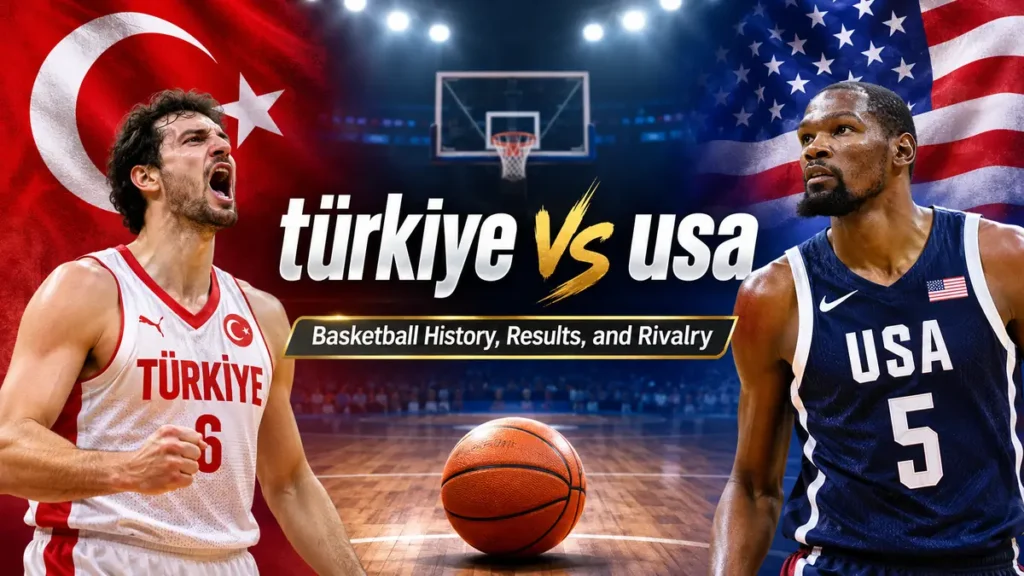
When Türkiye and the United States meet on a basketball court, the matchup brings together two nations with distinct basketball traditions. The United States has historically dominated international men’s basketball, while Türkiye has produced competitive teams capable of challenging elite opponents.
The most memorable chapter of türkiye vs usa came at the 2010 FIBA World Championship, when Türkiye reached the final on home soil but lost to a powerful American team.
The türkiye vs usa basketball rivalry is best known for the 2010 FIBA World Championship final, which the United States won 81–64 in Istanbul. Kevin Durant led the Americans with 28 points, while Türkiye finished as runners-up in front of its home supporters. Their history also includes a dramatic overtime meeting at the 2019 FIBA Basketball World Cup.
türkiye vs usa: Head-to-Head Basketball History
The United States and Türkiye have competed in major international basketball tournaments, including the FIBA World Cup and Olympic Games. Their encounters have often highlighted the contrast between American athleticism and Türkiye’s organized, team-oriented approach.
The American national team has traditionally benefited from a deep talent pool of NBA players, while Türkiye has developed its basketball identity through domestic leagues, European competitions, and international tournaments.
Notable Türkiye vs USA results
| Tournament | Year | Result | Significance |
|---|---|---|---|
| FIBA World Championship | 2010 | USA 81–64 Türkiye | Championship final in Istanbul |
| FIBA Basketball World Cup | 2019 | USA 93–92 Türkiye (OT) | Dramatic overtime group-stage game |
These games illustrate two different aspects of the matchup. The 2010 final demonstrated the United States’ ability to control a championship game, while the 2019 encounter showed how close Türkiye could come to defeating a highly regarded American squad.
The teams have not developed a rivalry comparable to longstanding international basketball rivalries such as USA versus Spain or Serbia. Nevertheless, their major tournament meetings remain important moments in Turkish basketball history.
The 2010 FIBA World Championship Final
sport / basket. Les Etats-Unis remportent la finale de la coupe du monde face à la Turquie
El maravilloso Mundial 2010 de Kevin Durant, su primera consagración | Sporting News
TOPSHOT-BASKET-WC2010-TUR-MEN-TUR-USA
7
The 2010 FIBA World Championship was a landmark tournament for Turkish basketball. Türkiye hosted the competition and reached the championship game for the first time.
Playing in Istanbul, the Turkish national team enjoyed strong home support throughout the tournament. Its disciplined defense, physical presence, and experienced roster helped it advance through difficult knockout matches.
How Türkiye reached the final
Türkiye completed an impressive tournament run, defeating opponents such as France, Greece, Russia, Slovenia, and Serbia.
The semifinal against Serbia was particularly memorable. Türkiye secured an 83–82 victory after a tense finish, with Kerem Tunçeri scoring the decisive basket in the closing seconds.
That victory sent the hosts into the final against the United States.
How the United States won the championship
The American team entered the final with a roster featuring several emerging NBA stars. Although many established Olympic veterans were absent, the squad combined speed, defensive pressure, and excellent individual scoring ability.
Kevin Durant delivered one of the tournament’s defining performances.
USA
81
Türkiye
64
Durant points
28
2010 FIBA World Championship final, September 12, Istanbul.
Durant’s perimeter shooting created serious problems for Türkiye’s defense. The Americans also benefited from effective transition offense and defensive pressure that disrupted the Turkish team’s rhythm.
The United States won 81–64, claiming its first men’s world championship since 1994.
For Türkiye, the defeat did not diminish the significance of reaching the final. The silver medal represented the country’s best finish at the men’s FIBA World Championship.
Key players from the 2010 final
The United States featured Kevin Durant, Derrick Rose, Russell Westbrook, Stephen Curry, Lamar Odom, and Chauncey Billups.
Türkiye relied on players such as Hidayet Türkoğlu, Ersan İlyasova, Ömer Aşık, Kerem Tunçeri, and Sinan Güler.
Hidayet Türkoğlu, who had extensive NBA experience, was one of Türkiye’s most recognizable players. His ability to handle the ball and create scoring opportunities was central to the team’s offense.
The Dramatic 2019 FIBA World Cup Encounter
The 2019 FIBA Basketball World Cup produced one of the closest meetings between the two countries.
On September 3, 2019, the United States defeated Türkiye 93–92 after overtime in Shanghai, China.
Unlike the 2010 championship final, this contest remained competitive until the final seconds.
Why Türkiye nearly defeated the USA
Türkiye used physical defense, controlled possessions, and timely outside shooting to challenge the Americans.
Ersan İlyasova, Cedi Osman, and Furkan Korkmaz were among the important figures in the Turkish squad.
The American roster included Kemba Walker, Jayson Tatum, Donovan Mitchell, Khris Middleton, and Harrison Barnes.
The United States struggled to establish consistent offensive control, allowing Türkiye to remain within striking distance throughout the game.
The crucial overtime free throws
The defining moment came late in overtime.
With Türkiye leading 92–91, the Turkish team had an opportunity to extend its advantage at the free-throw line.
However, Türkiye missed four consecutive free throws in the closing seconds.
Khris Middleton subsequently made two free throws to put the United States ahead 93–92.
Türkiye could not respond on its final possession, and the Americans escaped with a narrow victory.
The result became a painful missed opportunity for Türkiye and a reminder that even talented American teams can be vulnerable in international competition.
Comparing Türkiye and USA Basketball Strengths
The two national teams have different strengths shaped by their player-development systems, domestic competitions, and international experience.
| Category | Türkiye | United States |
|---|---|---|
| Basketball tradition | Strong European and international influence | Long-established global basketball powerhouse |
| Player development | Domestic clubs, academies, European competitions | Schools, NCAA, professional development, NBA |
| Typical strengths | Structured offense, physicality, tactical discipline | Athleticism, individual creation, depth |
| Professional leagues | Turkish Basketball Super League | National Basketball Association |
| International achievements | 2010 World Championship silver medal | Multiple Olympic gold medals and world titles |
| Common challenge | Maintaining offensive consistency against elite opponents | Adapting quickly to international styles and team chemistry |
These comparisons describe broad historical tendencies rather than permanent characteristics. Both countries have evolved tactically, and individual tournament rosters can play very differently.
Offensive playing styles
American teams often rely on transition opportunities, isolation scoring, perimeter shooting, and defensive pressure.
Türkiye has traditionally emphasized half-court organization, ball movement, and coordinated defensive schemes.
However, modern Turkish basketball increasingly features players comfortable with NBA-style spacing, pick-and-roll actions, and three-point shooting.
The tactical difference between the countries has therefore become less rigid over time.
Defensive approaches
The United States frequently uses athletic defenders to pressure ball handlers, disrupt passing lanes, and create turnovers.
Türkiye has often used compact defensive structures to limit penetration and force difficult shots.
International basketball’s different rules and court dimensions also influence how both teams defend.
For example, FIBA rules allow defensive players to operate around the basket differently from NBA regulations, affecting rim protection and offensive spacing.
Major Update: türkiye vs usa at the 2026 FIFA World Cup
Although the basketball encounters are historically significant, the latest major türkiye vs usa meeting took place in men’s international football at the 2026 FIFA World Cup.
Türkiye defeated the United States 3–2 in their Group D encounter on June 25, 2026, in Inglewood, California (June 26 in Türkiye). The result followed Türkiye’s 2–1 friendly victory over the USA in June 2025. FIFA World Cup 2026+1
Türkiye vs USA 2026 match summary
| Match detail | Information |
|---|---|
| Competition | FIFA World Cup 2026 |
| Date | June 25, 2026, local time |
| Venue | Los Angeles Stadium, Inglewood |
| Final score | Türkiye 3–2 USA |
| USA scorers | Auston Trusty, Sebastian Berhalter |
| Türkiye scorers | Arda Güler, Barış Alper Yılmaz, Kaan Ayhan |
| Group | Group D |
The United States scored early through Auston Trusty, but Türkiye responded with goals from Arda Güler and Barış Alper Yılmaz. Sebastian Berhalter equalized for the Americans before Kaan Ayhan scored the late winner in stoppage time.
Despite the defeat, the United States advanced to the knockout rounds as Group D winners, while Türkiye finished fourth and was eliminated. Arama Sonuç Sayfası TFF+1
What made the 2026 match significant?
The result showed Türkiye’s ability to compete against the United States in a major football tournament, even after its hopes of advancing had ended.
For the American team, the defeat highlighted the importance of defensive concentration, especially against opponents with technically gifted attackers such as Arda Güler and Kenan Yıldız.
For Türkiye, it was a memorable World Cup victory against a host nation.
Final Assessment of türkiye vs usa
The meaning of türkiye vs usa depends on the sport and competition being discussed.
In basketball, the United States has historically enjoyed the advantage, including victories in the 2010, 2014, and 2019 FIBA World Cups. Türkiye’s 2010 silver medal and near-upset in 2019 remain important achievements. fiba.basketball+2
In football, Türkiye won both the June 2025 international friendly and the 2026 FIFA World Cup group-stage encounter, demonstrating the competitive nature of this matchup.
Together, these results show why comparisons between the two countries should consider the specific sport, tournament, players, and historical context rather than treating their international sporting records as a single rivalry.