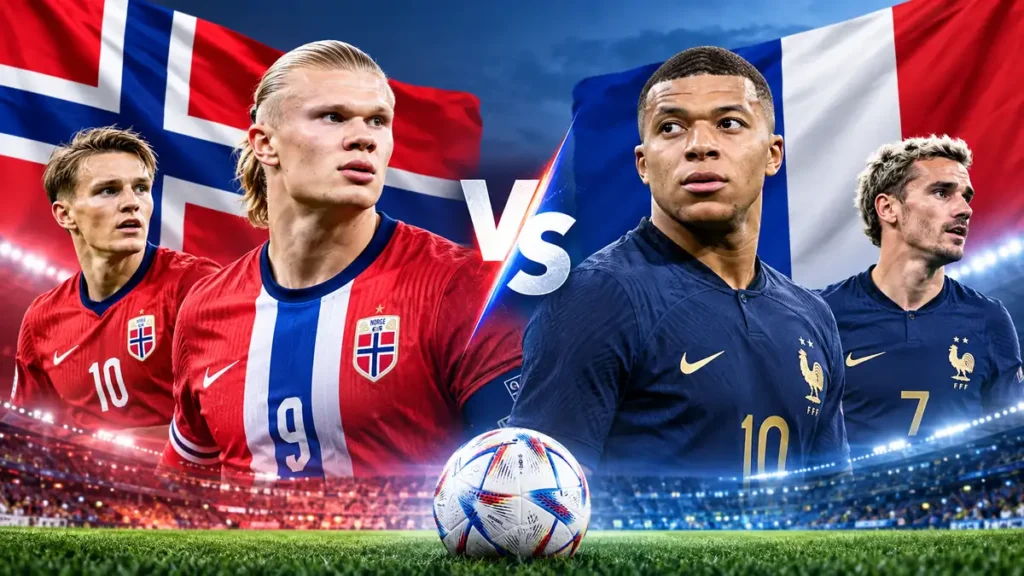
Norway and France represent two fascinating sides of European football. France has built a reputation as one of the world’s most successful national teams, while Norway has produced outstanding individual talents and is working to establish itself among Europe’s leading football nations.
The norway vs france comparison brings together two different footballing traditions: France’s tournament-winning experience, exceptional squad depth, and technical quality against Norway’s physical strength, direct attacking approach, and emerging generation of international stars.
France has historically been the more successful national football team, winning two FIFA World Cups and two UEFA European Championships. Norway, although less decorated internationally, has a notable football history and a modern attack featuring Erling Haaland and Martin Ødegaard. Their differences make this an interesting European football comparison.
norway vs france: National Team Overview
Both countries compete under UEFA, the governing body for European football, but their international achievements and competitive histories differ considerably.
| Category | Norway | France |
|---|---|---|
| Governing body | Norwegian Football Federation (NFF) | French Football Federation (FFF) |
| Confederation | UEFA | UEFA |
| FIFA World Cup titles | 0 | 2 |
| UEFA European Championship titles | 0 | 2 |
| First World Cup appearance | 1938 | 1930 |
| World Cup appearances through 2022 | 3 | 16 |
| Best World Cup finish through 2022 | Round of 16 (1998) | Champions (1998, 2018) |
| Notable modern players | Erling Haaland, Martin Ødegaard, Alexander Sørloth | Kylian Mbappé, Antoine Griezmann, Ousmane Dembélé |
| Traditional playing strengths | Physicality, transitions, direct attacks | Technical quality, pace, tactical flexibility |
France’s success reflects decades of investment in player development, elite coaching, and competitive international experience.
Norway has a smaller footballing population but has repeatedly demonstrated that it can challenge more established national teams.
norway vs france Head-to-Head History
The historical meetings between Norway and France provide an interesting perspective on the difference between international reputation and actual match performance.
Although France has enjoyed substantially greater success in major tournaments, Norway has achieved memorable results against the French national team.
Notable Historical Encounters
Selected senior men’s international matches
| Date | Match | Result | Competition |
|---|---|---|---|
| June 22, 1998 | France vs Norway | 0–0 | FIFA World Cup |
| August 11, 2010 | Norway vs France | 2–1 | International friendly |
| May 27, 2014 | France vs Norway | 4–0 | International friendly |
These results illustrate how different generations and tactical approaches have shaped the rivalry.
France vs Norway at the 1998 FIFA World Cup
The 1998 FIFA World Cup in France remains particularly significant in the history of both national teams.
France went on to win the tournament, defeating Brazil 3–0 in the final. Zinedine Zidane scored twice, while Emmanuel Petit added the third goal.
Norway also enjoyed a memorable campaign, defeating Brazil 2–1 during the group stage before losing to Italy in the Round of 16.
One historical distinction matters: Norway and France did not play each other at the 1998 World Cup. Any account listing a France–Norway match at that tournament is incorrect.
Norway’s performance nevertheless demonstrated that a disciplined, physically competitive team could challenge world-class opponents.
Norway’s 2–1 Victory in 2010
On August 11, 2010, Norway defeated France 2–1 in an international friendly.
Erik Huseklepp scored both Norwegian goals after France had taken the lead through Hatem Ben Arfa.
The result was notable because it showed Norway’s ability to capitalize on defensive weaknesses against technically superior opponents.
France was also going through a difficult transitional period following its disappointing 2010 World Cup campaign.
France’s 4–0 Victory in 2014
France produced a convincing performance against Norway in a friendly on May 27, 2014.
Paul Pogba, Olivier Giroud, and Loïc Rémy were among the goalscorers, with Giroud scoring twice.
The result demonstrated France’s attacking variety and technical superiority during preparations for the 2014 World Cup.
These historical encounters should not be confused with a complete head-to-head record. A comprehensive record must also account for earlier internationals.
France National Football Team: International Success
France is among the most decorated national teams in European football.
Its international reputation rests on a combination of major tournament victories, world-class players, and a strong domestic development system.
FIFA World Cup Achievements
France has won the FIFA World Cup twice.
1998 FIFA World Cup
France hosted the tournament and secured its first world championship under manager Aimé Jacquet.
The squad featured influential players including Zinedine Zidane, Didier Deschamps, Laurent Blanc, Marcel Desailly, and Thierry Henry.
France’s defensive organization, midfield control, and individual brilliance helped it defeat Brazil in the final.
2018 FIFA World Cup
Twenty years later, France won its second world championship in Russia.
Under Didier Deschamps, the team defeated Croatia 4–2 in the final.
Kylian Mbappé, Antoine Griezmann, Paul Pogba, and N’Golo Kanté were central figures in the championship campaign.
France combined disciplined defensive structures with rapid attacking transitions.
UEFA European Championship Record
France has also won the UEFA European Championship twice.
Its first title came in 1984, when Michel Platini delivered one of the competition’s most celebrated individual performances.
The second followed in 2000, when a generation featuring Zidane, Henry, and David Trezeguet secured another major trophy.
These achievements established France as a consistent force in international football.
France’s Player Development System
A major reason for France’s sustained competitiveness is its talent development infrastructure.
The country benefits from professional academies, extensive youth scouting, competitive domestic football, and established pathways into elite European leagues.
The French national training center at Clairefontaine has played an influential role in developing young players.
Ligue 1 clubs, including Paris Saint-Germain, Lyon, Monaco, and Rennes, have also contributed to the national talent pool.
France’s ability to produce technically skilled players across multiple positions gives it an advantage when managing injuries, tactical changes, and demanding tournament schedules.
Norway National Football Team: History and Development
Norway’s international history is less decorated, but the country has produced several impressive performances and influential players.
Its football identity has traditionally emphasized organization, physical strength, teamwork, and direct attacking play.
Norway’s World Cup History
Norway appeared at the FIFA World Cup in 1938, 1994, and 1998.
The 1998 tournament remains its strongest World Cup campaign through 2022.
Under manager Egil Olsen, Norway built a reputation for disciplined defensive organization and efficient attacking transitions.
The team defeated Brazil 2–1 in a famous group-stage match.
Tore André Flo and Kjetil Rekdal scored Norway’s goals, with Rekdal converting the winning penalty.
Although Norway was eliminated by Italy in the Round of 16, the campaign remains a landmark achievement.
Norway’s UEFA European Championship History
Norway qualified for UEFA Euro 2000, its first appearance at the European Championship.
The team defeated Spain 1–0 in its opening group match, with Steffen Iversen scoring the winning goal.
Norway subsequently drew with Slovenia and lost to Yugoslavia, narrowly missing qualification for the knockout stage.
The tournament highlighted the effectiveness of Norway’s structured defensive approach.
Norway’s Modern Football Generation
Norwegian football has attracted greater international attention because of players performing at leading European clubs.
Erling Haaland has become one of the world’s most recognizable strikers through his exceptional scoring record and physical attributes.
Martin Ødegaard provides technical creativity, intelligent passing, and leadership in midfield.
Alexander Sørloth offers additional attacking presence through his movement, finishing, and aerial ability.
Together, these players have helped raise expectations surrounding Norway’s international prospects.
However, individual talent does not automatically guarantee tournament success.
International teams also require defensive stability, midfield balance, squad depth, and consistent performances across qualifying campaigns.
norway vs france: 2026 FIFA World Cup Match
The most significant recent encounter between Norway and France took place on June 26, 2026, during the FIFA World Cup in the United States, Canada, and Mexico.
The two European teams met in Group I at Boston Stadium in Foxborough, Massachusetts.
FIFA World Cup 2026 · Group I · June 26, 2026

Norway
1–4
Full time

France
France secured an impressive 4–1 victory to finish at the top of Group I. Ousmane Dembélé scored a first-half hat-trick, while Désiré Doué added another goal in stoppage time.
Norway’s goal came from Thelo Aasgaard in the 21st minute.
Temps forts, résumé
+1
Match Goals and Timeline
| Minute | Goalscorer | Team |
|---|---|---|
| 7′ | Ousmane Dembélé | France |
| 20′ | Ousmane Dembélé | France |
| 21′ | Thelo Aasgaard | Norway |
| 32′ | Ousmane Dembélé | France |
| 90+4′ | Désiré Doué | France |
What Decided the Match?
France’s attacking efficiency was the decisive factor.
Dembélé scored three times inside the opening 32 minutes, giving France a commanding advantage before halftime.
Norway briefly responded through Aasgaard, but France continued to create dangerous opportunities and maintained control of the match.
Kylian Mbappé contributed two assists, highlighting his ability to influence games even without scoring.
The victory demonstrated France’s ability to convert individual attacking quality into a convincing team performance.
For Norway, the match exposed the difficulty of containing elite attackers when defensive positioning and transition protection break down.
norway vs france: Complete Head-to-Head Record
As of October 2026, the two national teams have played 16 recognized senior men’s international matches.
8
France wins
4
Draws
4
Norway wins
Draws
France wins
Norway wins
Source: 11v11 historical head-to-head records
France leads the overall series with eight victories, while Norway has four wins and four matches have ended in draws.
11v11
+1
Historical Results
| Date | Fixture | Score |
|---|---|---|
| October 28, 1923 | France vs Norway | 0–2 |
| November 6, 1968 | France vs Norway | 0–1 |
| June 16, 1987 | Norway vs France | 2–0 |
| February 25, 1998 | France vs Norway | 3–3 |
| August 11, 2010 | Norway vs France | 2–1 |
| May 27, 2014 | France vs Norway | 4–0 |
| June 26, 2026 | Norway vs France | 1–4 |
These selected results illustrate that Norway has occasionally defeated France despite the French team’s stronger overall international record.
The 2026 World Cup match was also the first meeting between the countries at a men’s World Cup finals tournament.
Key Players: Haaland vs Mbappé

Erling Haaland
Norway · Striker

Kylian Mbappé
France · Forward
One of the most compelling aspects of modern Norway–France encounters is the contrast between Erling Haaland and Kylian Mbappé.
Both are elite attacking players, but their strengths differ.
Erling Haaland: Norway’s Finishing Threat
Haaland is known for explosive acceleration, powerful finishing, intelligent penalty-area movement, and exceptional physical strength.
His attacking qualities make him especially dangerous when Norway creates opportunities through direct passes, crosses, or counterattacks.
Haaland’s effectiveness depends partly on the service he receives from midfield and wide areas.
Against defensively organized opponents, Norway must create enough space and quality chances for him to influence the match.
Kylian Mbappé: France’s Dynamic Attacker
Mbappé offers a different attacking profile.
His outstanding acceleration, close control, movement between defensive lines, and ability to attack from wide positions make him particularly difficult to defend.
He can create opportunities independently, combine with teammates, or finish attacks himself.
His versatility also gives France greater tactical flexibility in how it structures its forward line.
Haaland vs Mbappé Comparison
| Attribute | Erling Haaland | Kylian Mbappé |
|---|---|---|
| Primary role | Central striker | Forward / winger |
| Main strength | Finishing and positioning | Pace and dribbling |
| Aerial threat | Strong | Less central to his game |
| Preferred attacking situations | Penalty-area chances | Open space and transitions |
| Ball-carrying ability | Direct and powerful | Agile and technically refined |
| International team | Norway | France |
Neither player should be judged exclusively through international trophies.
National-team success depends on the quality of the wider squad, the coaching system, and the team’s ability to perform consistently in major competitions.
Midfield Comparison: Ødegaard and France’s Playmakers
Martin Ødegaard plays a particularly important role in Norway’s attacking development.
His vision, passing accuracy, technical control, and ability to find space between opposition lines help Norway connect midfield possession with its forwards.
He can create scoring opportunities through precise passes, set-piece delivery, and combinations around the penalty area.
France has traditionally benefited from a wider selection of technically accomplished midfielders.
Players such as Aurélien Tchouaméni, Eduardo Camavinga, and Warren Zaïre-Emery illustrate the country’s depth in central midfield positions.
These players offer different combinations of defensive awareness, ball recovery, progressive passing, and positional versatility.
Why Midfield Control Matters
When Norway faces France, midfield organization can influence the entire match.
If Norway’s midfielders receive the ball under pressure, they may struggle to supply Haaland and the other forwards.
If Norway can bypass France’s pressure and release Ødegaard into space, it can create dangerous attacking situations.
France generally benefits from having several midfield profiles available, allowing tactical adjustments depending on the opponent.
Tactical Comparison: How Norway and France Play
The tactical contrast between the teams helps explain why their meetings can produce different results.
Norway has historically relied on compact defensive structures, direct attacking play, and physical competitiveness.
France has frequently combined technical midfield quality with fast, powerful attacking transitions.
However, neither national team uses one permanent formation or tactical identity. Approaches change according to coaching decisions, available players, and opposition strengths.
Norway’s Tactical Strengths
Norway can be dangerous through:
- Direct passes into attacking spaces.
- Quick transitions after winning possession.
- Physical battles and aerial duels.
- Crosses toward central forwards.
- Creative passing from Martin Ødegaard.
- Set pieces and second-ball opportunities.
A well-organized Norway side can reduce the space available to opponents and force them into less productive attacking areas.
Its main challenge against elite teams is maintaining defensive concentration while still providing enough attacking support.
France’s Tactical Strengths
France’s greatest advantage is its ability to threaten opponents in several different ways.
The team can attack through wide players, central combinations, quick transitions, or sustained possession.
France also has a history of producing physically strong defenders who can compete against powerful forwards.
Its attacking flexibility allows players to switch positions and exploit defensive mismatches.
Tactical Comparison Table
| Tactical element | Norway | France |
|---|---|---|
| Attacking approach | Direct play and creative combinations | Flexible positional attacks and transitions |
| Defensive approach | Compact organization | Adaptable pressing and defensive blocks |
| Counterattacking | Important attacking weapon | Major attacking strength |
| Midfield creativity | Ødegaard-led progression | Multiple creative and ball-winning options |
| Physical presence | Strong central forwards | Strength across several positions |
| Squad depth | More dependent on key players | Generally deeper player pool |
How Norway Can Challenge France
Norway’s best opportunities against France are likely to come from disciplined defending and efficient use of attacking transitions.
Rather than allowing France to attack into large open spaces, Norway can benefit from maintaining a compact shape and restricting passes between its defensive lines.
When possession is recovered, quick forward movement can create opportunities before France reorganizes.
Set pieces can also provide scoring chances, especially when Norway uses its height and physical presence effectively.
France, meanwhile, can limit these threats by controlling midfield possession, maintaining defensive cover, and preventing Norway’s forwards from receiving the ball in dangerous positions.
World Cup and European Championship Comparison
Major tournament history provides the clearest evidence of the difference in international achievements.
| Competition | Norway | France |
|---|---|---|
| FIFA World Cup victories | 0 | 2 |
| World Cup titles | None | 1998, 2018 |
| World Cup finals reached | 0 | 4 through 2022 |
| UEFA European Championship victories | 0 | 2 |
| European Championship titles | None | 1984, 2000 |
| World Cup participation | Limited appearances | Regular tournament presence |
| Historic World Cup highlight | Defeating Brazil in 1998 | Winning in 1998 and 2018 |
France has demonstrated its ability to succeed across different generations.
Its 1998 and 2018 World Cup victories came with distinct playing styles and squads, showing that success was not dependent on a single group of players.
Norway’s strongest international achievements have involved disciplined performances against higher-ranked opponents.
Its modern generation offers considerable potential, but translating that potential into sustained tournament success remains an important measure of progress.
Which Team Is Better: Norway or France?
Based on historical achievements, squad depth, and major tournament success, France is the stronger national football team overall.
Its two World Cup titles, two European Championship titles, and record of reaching major finals place it among the most accomplished international teams.
Norway’s strengths are more concentrated around several outstanding players and a competitive collective approach.
The presence of Haaland and Ødegaard gives Norway the ability to threaten almost any opponent, but consistently beating elite national teams requires contributions across the entire squad.
The 2026 World Cup encounter provided a direct illustration of this difference, with France winning 4–1 through clinical attacking performances.
However, a stronger historical record does not guarantee victory in every future meeting.
Football results can change because of player availability, tactical decisions, defensive errors, and the effectiveness of individual performances.
What Makes the Norway–France Matchup Interesting?
The rivalry is not defined by frequent tournament meetings or geographical proximity.
Instead, its appeal comes from contrasting footballing traditions and the presence of internationally recognized players.
Norway represents a smaller footballing nation with an increasingly ambitious national team.
France represents an established international power with a proven development system and a history of winning major competitions.
The matchup also highlights an important principle of international football: a team with fewer resources can still challenge stronger opponents through organization, discipline, and effective use of its best players.
Norway’s victories in 1968, 1987, and 2010 demonstrate that France has not always controlled the series.
France’s convincing wins in 2014 and 2026, however, illustrate the advantages of greater squad depth and attacking quality.
Final Thoughts on norway vs france
The norway vs france football comparison highlights the difference between an emerging international contender and an established world football power.
France leads the historical head-to-head record, has won multiple major international trophies, and demonstrated its attacking quality with a 4–1 victory at the 2026 FIFA World Cup.
Norway brings its own strengths through Erling Haaland, Martin Ødegaard, physical competitiveness, and a history of surprising stronger opponents.
For anyone examining these national teams, the most useful approach is to consider their head-to-head results, tactical systems, player development, and tournament performances together rather than relying on one match or individual star.