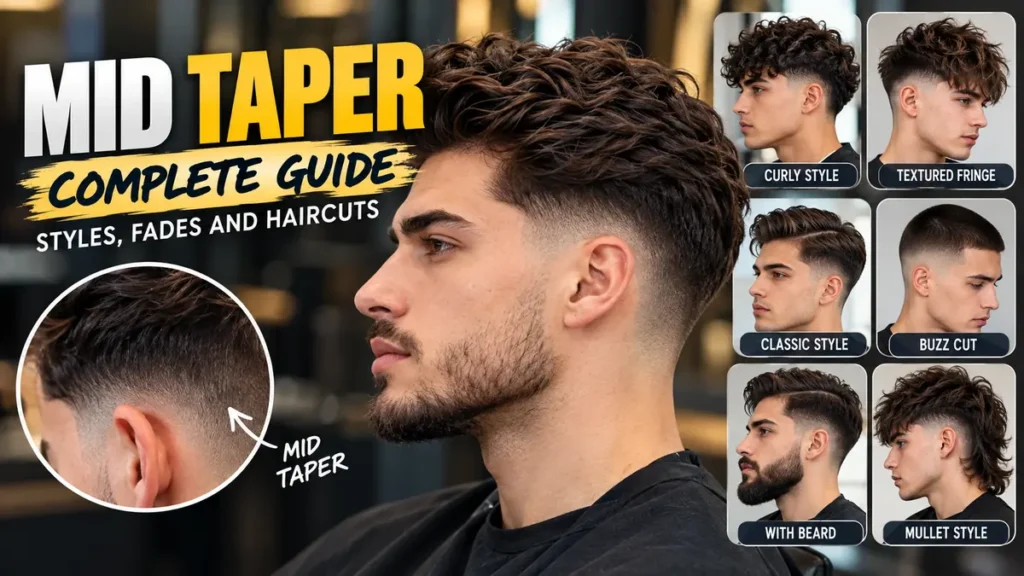
The mid taper is one of the most versatile men’s haircuts because it creates a clean, polished appearance without removing too much hair from the sides. It works with curly, straight, wavy, and coily hair, making it a practical choice for different styles and personal preferences.
A mid taper is a haircut in which the hair gradually becomes shorter around the sideburns and neckline, with the transition beginning at a medium height. Unlike a full mid fade, it usually preserves more length around the sides and back while creating a neat, blended finish.
The key to getting this haircut right is understanding where the taper begins, how closely the hair is cut, and which hairstyle complements the longer hair on top.
What Is a mid taper Haircut?
A mid taper is a men’s haircut that gradually reduces hair length from longer sections into shorter areas near the temples, sideburns, and nape of the neck.
The word mid describes the approximate height of the transition, while taper refers to the gradual reduction in hair length.
In a traditional taper haircut, the shortest sections are concentrated around the edges rather than extending across the entire side of the head.
A barber typically uses adjustable clippers, different clipper guards, and blending techniques to create a smooth transition between lengths.
Key characteristics
- A gradual transition from longer to shorter hair
- A medium-height taper around the sideburn area
- A neatly blended neckline
- More natural-looking coverage than a full skin fade
- Compatibility with short, medium, and longer hairstyles
- Flexible styling options for casual and professional settings
A mid taper can be subtle or highly defined. Some people prefer a soft, natural finish, while others choose a sharper transition that exposes more skin near the edges.
How high does a mid taper go?
The transition generally begins around the middle portion of the temple or sideburn region, although the exact position varies according to head shape, hairstyle, and barbering technique.
There is no universally fixed measurement that defines a medium taper.
A skilled barber considers the natural hairline, ear position, hair density, and overall haircut shape before deciding where to place the blend.
mid taper vs Low Taper vs High Taper
The difference between low, mid, and high tapers is primarily the placement and visibility of the transition.
| Feature | Low taper | Mid taper | High taper |
|---|---|---|---|
| Transition placement | Close to hairline | Around middle temple area | Higher toward upper temples |
| Visual contrast | Subtle | Moderate | More pronounced |
| Hair retained on sides | Most | Moderate to high | Often less near tapered areas |
| Overall appearance | Conservative | Balanced | Bold |
| Best suited for | Natural, understated cuts | Versatile everyday styles | Stronger contrast |
Low taper
A low taper begins close to the sideburns and neckline. Most of the hair above these areas remains relatively long.
This creates a soft, natural appearance and works especially well with classic hairstyles.
Mid taper
A medium taper creates a more visible transition without making the haircut look excessively short.
It offers a balance between the understated appearance of a low taper and the sharper contrast of a high taper.
High taper
A high taper places the transition farther up the temple area.
It can produce a stronger visual effect, especially when paired with voluminous or textured hair.
However, a high taper is not necessarily the same as a high fade, because the amount of hair removed from the sides can differ considerably.
mid taper vs Mid Fade: What’s the Difference?
The terms taper and fade are sometimes used interchangeably, but they traditionally describe different cutting patterns.
A taper generally focuses on shortening hair around the sideburns and neckline, while a fade blends a larger section of the sides and back into shorter hair.
| Feature | mid taper | Mid fade |
|---|---|---|
| Main cutting area | Sideburns and neckline | Broader sides and back |
| Hair coverage | Retains more hair | Usually removes more hair |
| Contrast | Soft to moderate | Moderate to strong |
| Skin exposure | Optional and localized | Common in skin-fade versions |
| Grow-out appearance | Often more natural | More noticeable contrast as it grows |
| Maintenance | Usually less demanding | Often needs frequent edge refreshing |
A mid skin fade may transition all the way down to bare skin, while a mid taper can maintain a little length at its shortest points.
Some modern barbers use the phrase mid taper fade to describe a haircut that combines localized tapering with a very close fade around the edges.
Because terminology varies between barbershops, showing a reference photo is often more reliable than relying on the haircut name alone.
10 Popular mid taper Haircut Styles
The basic taper can be combined with numerous hairstyles. The biggest differences come from the length, texture, direction, and volume of the hair on top.
1. Classic mid taper
The classic version maintains a natural appearance with neatly blended sideburns and a clean neckline.
The top can remain short or medium-length, depending on personal preference.
This haircut suits people who want a tidy appearance without dramatic contrast.
Best for: Straight or slightly wavy hair, everyday grooming, and professional settings.
2. mid taper Fade
The mid taper fade combines a medium-height taper with a closer transition around the hairline.
The shortest areas may be cut using a zero guard, a 0.5 guard, or a skin finish, depending on the desired result.
The main side panels generally retain more length than they would in a conventional full mid fade.
Best for: Anyone who prefers defined edges while preserving a fuller hairstyle.
3. mid taper With Textured Fringe
A textured fringe features layered hair styled forward toward the forehead.
The front is usually cut using point-cutting techniques to create movement and separation rather than a heavy, straight line.
A matte styling product can enhance the individual strands without making the hairstyle appear greasy.
Best for: Thick, straight, or wavy hair.
This combination has become a prominent variation in contemporary haircut guides because it pairs a clean perimeter with a relaxed top.
syntaxsalon.com
+1
4. Curly mid taper
The curly version preserves natural curls on top while shortening the hair around the temples and neckline.
The result emphasizes the contrast between the defined curls and the cleaner perimeter.
For tightly curled hair, the barber should consider shrinkage before removing length.
Best for: Loose curls, tight curls, and naturally voluminous hair.
5. mid taper With Straight Hair
Straight hair creates a smooth, structured appearance that makes the taper’s transition particularly visible.
The top can be styled into a side part, textured crop, short quiff, or natural forward sweep.
Because straight hair may reveal uneven blending more easily, precise clipper work matters.
Best for: Fine to medium-density straight hair.
6. mid taper With Wavy Hair
Natural waves add movement and dimension without requiring extensive styling.
A medium taper removes excess bulk around the edges while allowing the waves to retain their shape.
A lightweight styling cream or sea salt spray may help enhance texture.
Best for: Naturally wavy hair with medium length on top.
7. mid taper With a Blowout
A blowout taper features additional height and volume on top, often created using a blow dryer and styling product.
The tapered sideburns and neckline provide a clean contrast against the fuller upper section.
This hairstyle works particularly well when the hair has enough length to hold its shape.
Best for: Thick, wavy, and curly hair.
8. mid taper With a Buzz Cut
A buzz cut paired with a medium taper creates a simple, low-maintenance hairstyle.
The top remains uniformly short, while the sideburns and neckline are blended to provide a cleaner finish.
The taper adds definition without requiring the top to be styled every morning.
Best for: People who prefer short hair and minimal daily maintenance.
9. mid taper With a Beard
A beard blend connects the sideburn taper with facial hair.
Instead of an abrupt separation between the haircut and beard, the barber gradually adjusts the length to create a continuous transition.
This works with short stubble, medium beards, and fuller facial hair.
Best for: Men who want coordinated hair and beard grooming.
10. mid taper With a Mullet
A modern mullet retains extra length at the back while keeping the temple and sideburn areas neatly tapered.
The contrast between the shorter edges and longer rear section gives the haircut a distinctive silhouette.
The top may be textured, curly, or styled forward.
Best for: Medium to long hair and people who prefer a more expressive haircut.
Choosing a mid taper for Your Hair Type
Hair texture affects how the haircut looks, how the barber creates the blend, and how much styling is required afterward.
| Hair type | Recommended approach | Styling consideration |
|---|---|---|
| Straight | Smooth taper with a textured or parted top | Lightweight clay or paste |
| Wavy | Preserve natural movement | Texture spray or light cream |
| Curly | Keep curl definition and control side bulk | Curl cream or leave-in conditioner |
| Coily | Preserve density and natural shape | Moisturizing products and gentle handling |
| Thick | Remove excess bulk selectively | Controlled layering |
| Fine | Maintain enough side coverage | Avoid heavy, oily products |
For curly and coily hair
Curly hair often benefits from a medium taper because the edges can be cleaned up without sacrificing the natural shape of the crown.
A curly fringe, short Afro, twist hairstyle, or defined sponge-curl top can all be paired with this cutting technique.
For tightly coiled hair, the barber should avoid cutting too much into established twist, braid, or loc sections.
For thick hair
Thick hair can create unwanted width around the temples.
A carefully positioned taper reduces some of that bulk while preserving the overall structure.
However, removing too much weight above the ears can create an uneven silhouette.
For fine or thinning hair
A softer taper that leaves additional coverage may be more flattering than a high-contrast skin fade.
The barber can preserve the appearance of density by avoiding an excessively long top combined with very short sides.
For thinning hair, the most suitable shape depends on the distribution of hair density rather than a single haircut rule.
Taper Trends
+1
Which Face Shapes Suit a mid taper?
A medium taper can be adapted to almost any face shape. The main consideration is how the hair on top changes the apparent proportions of the face.
Round face
A slightly taller quiff or textured top can create the impression of additional facial length.
Keeping some structure at the temples helps avoid an overly rounded silhouette.
Oval face
Oval faces generally accommodate a wide range of haircut proportions.
A classic taper, textured fringe, side part, or curly top can all work well.
Square face
A medium taper can complement a defined jawline.
A textured crop or short quiff creates balance without requiring excessive height.
Long or rectangular face
A very tall hairstyle may make the face appear longer.
A moderate-length top, relaxed fringe, or natural side part can create a more balanced appearance.
Heart-shaped face
A hairstyle with some width around the sides can help balance a broader forehead and narrower jaw.
Avoiding an unnecessarily aggressive taper may preserve that visual balance.
Face shape is only a starting point. Hair density, growth patterns, forehead proportions, and personal preference are often more useful when deciding on the final haircut.
How to Ask Your Barber for a mid taper
Clear communication is essential because haircut terminology can vary between barbers.
The easiest approach is to show reference photographs from the front, side, and back.
Then describe the specific details you want.
Step 1: Specify the taper height
Ask for a medium taper around the temples, sideburns, and neckline.
Explain that you want to retain some hair through the main side panels rather than having a complete fade around the head.
Step 2: Choose the shortest length
Common options include:
- Skin: The shortest areas are shaved close to the scalp.
- Zero: Very short clipper length.
- 0.5 guard: A slightly softer finish.
- Number 1 guard: More visible hair remains at the shortest point.
Clipper lengths vary slightly by equipment, but common detachable guard measurements include approximately 1.5 mm for a 0.5 guard and 3 mm for a number 1 guard.
Step 3: Decide how much hair stays on top
Tell your barber whether you want a short crop, medium-length textured top, long fringe, or natural curls.
If you already like your top length, ask for a small trim rather than a major reduction.
Step 4: Discuss the neckline
The back can have a natural, rounded, or more defined finish.
A natural tapered neckline generally grows out more softly than a sharply squared neckline.
Step 5: Confirm the overall blend
Before the barber begins, clarify that you want a localized taper rather than a full mid fade.
A useful instruction is:
“I’d like a mid taper around the sideburns and neckline, with a smooth blend. Keep more length above and behind the ears, and don’t fade the entire side panel.”
This distinction is also emphasized in professional haircut comparison guides.
barber.style
+1
How to Style a mid taper at Home
The taper itself generally requires little daily styling. Most of the work involves arranging the longer hair on top.
Styling straight or textured hair
- Wash or lightly dampen your hair.
- Towel-dry until it is slightly damp.
- Apply a small amount of lightweight styling product.
- Use your fingers or a comb to create the desired direction.
- Blow-dry on a moderate setting if additional volume is needed.
- Finish with a small amount of matte clay or paste for hold.
Avoid applying excessive product because it can make the hair appear flat and heavy.
Styling curly hair
For curls, moisture and definition are usually more important than strong hold.
Apply leave-in conditioner or curl cream to damp hair, then gently scrunch the curls.
Allow the hair to air-dry or use a diffuser on a low heat setting.
Avoid repeatedly brushing dry curls if doing so causes frizz or disrupts their shape.
Styling a textured fringe
A textured fringe looks best when individual strands have natural separation.
Apply a small amount of matte product, then direct the hair forward with your fingers.
For additional texture, use a blow dryer while gently lifting and separating the front sections.
The goal is controlled movement rather than a perfectly uniform finish.
How Often Should You Maintain a mid taper?
Most medium tapers can be refreshed approximately every three to five weeks, depending on hair growth and the desired sharpness.
A skin-close taper may lose its crisp appearance sooner, while a softer taper can remain presentable for longer.
| Maintenance task | Typical frequency |
|---|---|
| Taper refresh | Every 3–5 weeks |
| Skin-close edge cleanup | Every 2–3 weeks, if desired |
| Top-length trim | Every 4–8 weeks |
| Hair washing | According to scalp and hair needs |
| Beard blending | As facial hair grows |
These are general grooming intervals, not strict requirements. Hair growth speed and personal style determine how often a haircut needs attention.
barber.style
+1
How does a mid taper grow out?
A medium taper usually grows out more gradually than a full skin fade because much of the hair around the sides remains longer.
As the shorter sections grow, the transition becomes less defined.
The hairstyle may still look natural, particularly if the initial taper was soft.
Can you maintain a mid taper yourself?
Basic neckline and sideburn cleanup may be possible with appropriate grooming equipment and a mirror.
However, recreating the original blend is more difficult.
Attempting to raise the taper line during a home touch-up can accidentally turn a subtle taper into a higher fade.
For that reason, it is usually better to leave detailed clipper blending to a trained barber.
Common mid taper Haircut Mistakes
Even a well-known haircut can look different from the reference photo when important details are overlooked.
Cutting the taper too high
An overly high transition can remove too much hair around the temples.
This changes the intended balance and may resemble a high taper or a fuller fade.
Removing too much bulk
Thick and curly hair needs thoughtful weight distribution.
Removing too much from the sides can leave the top looking disconnected from the rest of the haircut.
Ignoring the natural hairline
Cowlicks, uneven growth patterns, and natural neckline shapes affect how the haircut sits.
A barber should work with these features rather than forcing an identical shape on every head.
Choosing the wrong top length
A textured fringe requires enough length to fall forward, while a quiff needs sufficient hair to create lift.
Cutting the top too short can make the intended hairstyle difficult to reproduce.
Confusing a taper with a full fade
This is one of the most common communication problems.
A person asking for a medium taper may receive a full mid fade if the barber interprets the terms differently.
Providing a photograph and specifying where the shortest sections should appear helps prevent this.
Is a mid taper a Good Haircut for School, Work, and Everyday Life?
A medium taper is suitable for many everyday settings because it can be adapted to different levels of formality.
For school, a short textured top with a soft taper offers a neat appearance without extensive daily styling, subject to the school’s grooming rules.
For professional environments, a classic side part, short quiff, or neatly combed top can create a conservative finish.
For casual settings, curly fringes, messy textured tops, and blowout styles provide more movement and personality.
The haircut is also flexible across age groups. Teenagers, young adults, and older men can all wear variations that suit their preferences.
Advantages and disadvantages
| Advantages | Disadvantages |
|---|---|
| Works with many hair textures | Precise blending requires skill |
| Can look natural or defined | Sharp edges require regular refreshing |
| Retains more side coverage than a full fade | Terminology differs between barbers |
| Compatible with numerous top hairstyles | Some styles need daily product |
| Usually grows out relatively softly | Poor placement can affect proportions |
Final Thoughts on the mid taper
The mid taper is a flexible haircut that creates a clean transition around the sideburns and neckline while retaining more hair through the sides than a traditional full mid fade.
Its versatility comes from the many hairstyles that can be paired with it, including textured fringes, curly tops, buzz cuts, blowouts, side parts, and longer styles.
For the most reliable result, focus on four details: taper height, shortest clipper length, top length, and the amount of hair retained above the ears.
A clear reference photograph and specific instructions will help your barber create a mid taper that suits your natural hair texture, head shape, and preferred level of maintenance.