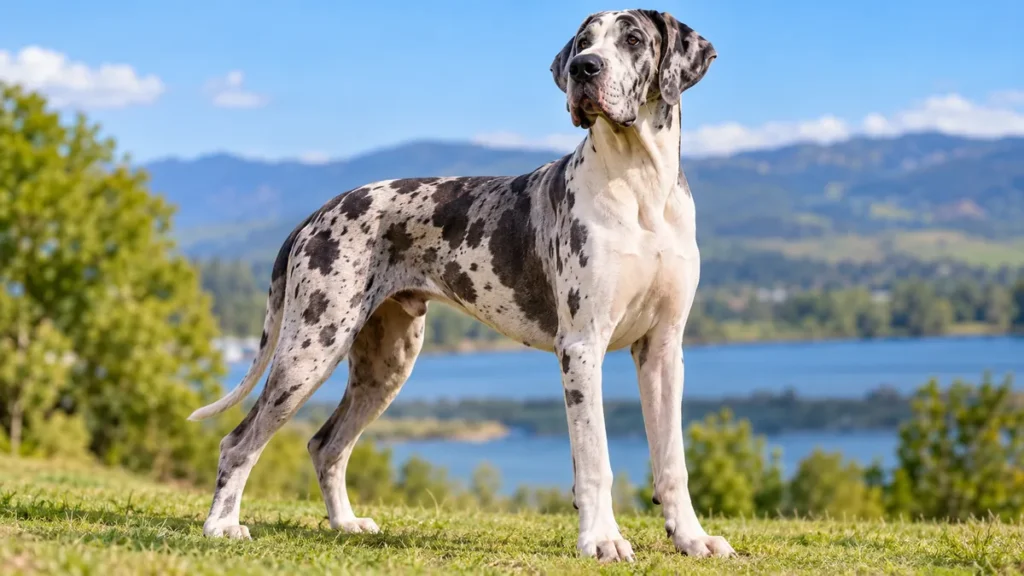
Few dogs make an entrance quite like a great dane. Their height can be startling, yet behind that imposing frame is a breed widely known for being affectionate, sociable, patient, and deeply attached to its family. The contrast explains why the Great Dane is so often called a “gentle giant.” American Kennel Club
A Great Dane is a giant Working breed developed in Germany from powerful hunting dogs used for wild boar. Modern Great Danes are primarily companions. Adults commonly stand about 28–32 inches at the shoulder and can weigh roughly 110–175 pounds. They generally need moderate daily exercise, early training, careful nutrition, and proactive health care. American Kennel Club
Great Dane at a Glance
| Trait | Typical Great Dane |
|---|---|
| Breed group | Working |
| Origin | Germany |
| Height | About 28–32 inches |
| Weight | Roughly 110–175 pounds |
| Coat | Short, smooth |
| Temperament | Friendly, affectionate, dependable |
| Exercise | Moderate |
| Grooming | Relatively low maintenance |
| Training | Early training essential |
| Lifespan | Commonly around 7–10 years |
| Major concerns | GDV/bloat, heart and orthopedic disease |
Male Great Danes are generally larger than females. Royal Canin lists males at approximately 30–32 inches and 140–175 pounds, while females are approximately 28–30 inches and 110–140 pounds. Individual dogs naturally vary. Royal Canin
Where Did the Great Dane Come From?
The name creates one of the breed’s most persistent misconceptions: the Great Dane did not originate in Denmark.
Its development is associated primarily with Germany. Large Mastiff-type dogs had existed in Europe for centuries, and dogs that contributed to the modern breed were used as powerful boarhounds. Hunting wild boar demanded a combination of strength, courage, speed, and endurance. American Kennel Club
The breed was historically known by names including the German Mastiff. In Germany, it became known as the Deutsche Dogge.
As the need for specialized boar-hunting dogs declined, breeders increasingly selected for steadier temperaments and the elegant appearance associated with today’s Great Dane. The intimidating hunter gradually became a companion and show dog.
The American Kennel Club recognized the breed in 1887. AKC Images
Why Is It Called a Great Dane?
There is no simple connection between the modern breed and Denmark. AKC historical material notes that the French term Grand Danois—essentially “big Danish”—became associated with these dogs even though the breed developed in Germany. Exactly why the Danish name persisted remains unclear. American Kennel Club
Great Dane Size: How Big Do They Get?
Size is the feature people notice first.
A mature Great Dane commonly reaches 28–32 inches at the shoulder, with males usually taller and heavier than females. Dogs at the upper end of the range can weigh 175 pounds. Royal Canin
Yet size alone doesn’t define correct breed structure. The Great Dane Club of America emphasizes balance: a Dane should combine substantial size and strength with proportion, elegance, a distinctive rectangular head, a long neck, and powerful but smooth movement. Great Dane Club of America
That distinction matters. A healthy Great Dane shouldn’t simply look enormous. The body needs to carry that size efficiently.
How Fast Does a Great Dane Puppy Grow?
Very fast.
Giant-breed puppies undergo dramatic physical development during their first year. That makes puppy nutrition and weight management especially important.
Trying to make a puppy grow as large or as quickly as possible is not a sensible goal. AKC notes that excessive growth can contribute to musculoskeletal problems in large and giant breeds. American Kennel Club
A growing Dane needs appropriate giant-breed puppy nutrition, controlled body condition, and age-appropriate exercise rather than excessive calories and strenuous workouts.
Great Dane Temperament and Personality
A dog’s enormous body can give the wrong first impression.
The Great Dane breed standard calls for a dog that is spirited, courageous, friendly, dependable, and neither timid nor aggressive. Modern Danes are commonly affectionate dogs that want considerable interaction with their people. American Kennel Club
Typical breed tendencies include:
- Strong attachment to family
- Friendly and social behavior
- Patience
- Alertness around the home
- Moderate playfulness
- Desire for human companionship
- Eagerness to please
- Some interest in following scents
These are breed tendencies rather than guarantees. Genetics, socialization, training, previous experiences, health, and the individual dog’s personality all affect behavior.
Are Great Danes Aggressive?
Aggression is not considered desirable or typical breed temperament. The Great Dane Club of America describes the correct Dane as friendly and dependable rather than aggressive. Great Dane Club of America
That does not mean training can be ignored.
A poorly socialized 150-pound dog presents a much bigger practical problem than an equally untrained 15-pound dog. Fear, frustration, resource guarding, pain, or inadequate socialization can affect any breed.
Owners should therefore treat early socialization and obedience as necessities rather than optional extras.
Are Great Danes Good Family Dogs?
For the right household, they can be excellent family companions.
Great Danes are generally affectionate, people-oriented dogs and are often patient with children. Properly socialized Danes commonly enjoy participating in normal family life rather than living separately from everyone. American Kennel Club
Their temperament, however, isn’t the only consideration.
A friendly adult Dane may weigh more than some adults and several times as much as a small child. An excited dog can accidentally knock a child over without displaying any aggression.
Interactions between dogs and young children should therefore be supervised.
Children should also learn not to climb on dogs, disturb them while eating or sleeping, pull their ears, or treat them like furniture.
Do Great Danes Get Along With Other Dogs?
Many do, particularly when properly socialized from puppyhood.
Early positive exposure to dogs of different sizes, people, environments, noises, surfaces, vehicles, and everyday situations helps a puppy develop confidence.
Socialization doesn’t mean forcing a puppy to interact with everything it sees. Quality matters more than quantity. Experiences should be controlled and positive.
Training a Great Dane
Training should begin while the puppy is still small enough to manage easily.
Waiting until a Dane weighs 100 pounds before teaching leash manners creates unnecessary difficulty.
Focus early training on practical everyday behaviors such as:
- Walking without pulling
- Coming when called
- Sit and stay
- Waiting at doors
- Settling calmly
- Leaving unwanted objects
- Greeting people without jumping
- Accepting handling of paws, ears, mouth, and body
Positive, consistent training generally works well because Great Danes tend to be people-oriented and eager to please. AKC strongly recommends early socialization and puppy training because of the breed’s eventual size and strength. American Kennel Club
One Training Mistake That Becomes Expensive Later
Don’t allow a puppy to do something you won’t tolerate from a 150-pound adult.
A tiny Dane puppy putting its paws on your shoulders may seem funny. The same behavior becomes dangerous when the dog reaches adult size.
House rules should therefore be established early and applied consistently.
How Much Exercise Does a Great Dane Need?
Despite its enormous size, the Great Dane isn’t necessarily a high-energy dog.
Healthy adults generally need regular daily activity rather than hours of relentless exercise. Walks, controlled play, training sessions, scent-based activities, and time in a secure area can provide physical and mental stimulation.
AKC describes moderate exercise needs and notes that adults can eventually become hiking or jogging companions. American Kennel Club
Exercise for Great Dane Puppies
Growing puppies require a different approach.
Their bones and joints are still developing, so repetitive high-impact activity should not be treated like adult exercise.
AKC recommends waiting until around two years of age before using a Great Dane as a regular jogging companion because strenuous exercise can stress developing joints. American Kennel Club
Normal puppy movement, exploration, play, training, and appropriate walks are different from forcing a young dog through sustained running or excessive jumping.
Your veterinarian can help tailor exercise to an individual puppy’s development and body condition.
Great Dane Food and Nutrition
Feeding a giant breed requires more thought than simply buying a larger bag of food.
Puppies need nutrition formulated to support controlled growth. Too many calories don’t create a healthier or better Great Dane; unnecessary weight increases stress on a developing skeletal system.
AKC specifically highlights appropriate nutrition during puppyhood because overly rapid growth may contribute to orthopedic disease. American Kennel Club
For adults, the goal remains straightforward: provide a nutritionally complete diet appropriate for the dog’s life stage while maintaining a healthy body condition.
How Much Should a Great Dane Eat?
There isn’t one correct quantity for every Dane.
Food requirements vary according to:
- Age
- Body weight
- Sex
- Activity level
- Metabolism
- Health
- Calorie density of the food
- Reproductive status
The feeding guide on a food package can provide a starting point, but body condition and veterinary advice should determine adjustments.
Avoid treating visible ribs or body weight in isolation as the only measurement of health. Giant breeds should remain lean without being undernourished.
Great Dane Health Problems
Health deserves serious consideration before anyone brings home a Great Dane.
The breed’s large body and genetic predispositions are associated with several significant medical conditions. The Great Dane Club of America identifies inherited and other health concerns and encourages appropriate health screening. Great Dane Club of America
Important concerns include gastric dilatation-volvulus, dilated cardiomyopathy, orthopedic disease, thyroid disorders, and certain cancers.
Bloat and Gastric Dilatation-Volvulus
One condition every Great Dane owner should understand is gastric dilatation-volvulus (GDV), commonly called bloat.
The stomach becomes distended and may rotate, interfering with circulation. GDV can become life-threatening rapidly and requires emergency veterinary treatment.
AKC identifies bloat as a particularly important problem in Great Danes. American Kennel Club
Possible warning signs can include:
- Repeated unsuccessful attempts to vomit
- A swollen or tight abdomen
- Excessive drooling
- Restlessness
- Obvious discomfort
- Weakness or collapse
A suspected case is an emergency rather than something to monitor overnight.
Owners should discuss individual risk and preventive strategies—including whether prophylactic gastropexy is appropriate—with their veterinarian.
Dilated Cardiomyopathy
Dilated cardiomyopathy (DCM) is another important breed concern.
DCM affects the heart muscle and can impair the heart’s ability to pump effectively. The Great Dane Club of America lists cardiomyopathy among the breed’s health concerns and notes suspected inherited involvement. Great Dane Club of America
Symptoms of heart disease can sometimes be subtle. Reduced stamina, coughing, weakness, rapid breathing, fainting, or exercise intolerance warrant veterinary attention.
Responsible breeding programs take cardiac health seriously.
Hip, Joint, and Bone Problems
A Great Dane’s size puts substantial mechanical demands on its musculoskeletal system.
Hip dysplasia, osteoarthritis, and other orthopedic problems can occur. Rapid growth during puppyhood makes appropriate nutrition, body condition, and exercise particularly relevant. American Kennel Club
Keeping an adult Dane lean can also reduce unnecessary stress on joints.
Owners should watch for stiffness, reluctance to rise, altered gait, reduced activity, difficulty using stairs, or persistent lameness.
Thyroid and Other Health Concerns
Autoimmune thyroiditis and hypothyroidism are also recognized concerns in the breed. AKC notes that thyroid function can be monitored through veterinary blood testing. American Kennel Club
No screening program guarantees that a dog will remain healthy, but knowing the health history of breeding dogs can reduce avoidable risk.
When considering a puppy, don’t rely solely on statements that the parents “look healthy.” Ask for documented breed-appropriate health testing.
Great Dane Lifespan
One of the hardest realities of this breed is its relatively short lifespan.
Sources vary slightly, but a commonly cited range is approximately 7–10 years. AKC gives an 8–10-year range in its general lifespan guidance, while other breed information sources commonly cite 7–10 years. American Kennel Club
Some individuals live longer, while serious disease can shorten life considerably.
This shorter longevity isn’t unique to Great Danes. Giant dog breeds generally have shorter average lifespans than smaller dogs. Research discussed by AKC has found a strong relationship between body size and longevity across dog breeds. American Kennel Club
Owners cannot control genetics, but maintaining healthy body condition, providing appropriate exercise and nutrition, scheduling regular veterinary examinations, and investigating symptoms early can support health throughout the dog’s life.
Great Dane Colors and Coat
Great Danes have short, smooth, glossy coats.
The breed is seen in several striking colors and patterns. The current Great Dane standard recognizes specific colors and patterns including:
- Black
- Blue
- Brindle
- Fawn
- Harlequin
- Mantle
- Merle
The Great Dane Club of America’s illustrated standard provides detailed requirements for these colors and markings. Great Dane Club of America
Color is visually interesting, but it should never take priority over health, temperament, structure, and responsible breeding practices when choosing a companion.
Grooming a Great Dane
Compared with many long-coated breeds, routine coat care is simple.
The short coat generally benefits from weekly brushing to remove loose hair and distribute natural oils. Shedding may increase seasonally, when more frequent brushing helps control loose hair. American Kennel Club
Basic grooming also includes:
- Nail trimming
- Dental care
- Ear checks
- Occasional bathing
- Skin inspection
- Checking paws and pads
The amusing complication is scale.
Bathing a 150-pound dog is physically different from bathing a small terrier, even if the coat itself is easy to maintain.
Owners should teach puppies to tolerate nail handling, brushing, mouth examination, and bathing before they become enormous.
Do Great Danes Drool?
Yes, many do.
The amount differs among individuals, but owners should expect at least some drool. Royal Canin specifically identifies slobber as a practical part of living with the breed. Royal Canin
Keeping washable towels around commonly occupied areas becomes a surprisingly useful habit.
Can a Great Dane Live in an Apartment?
Potentially—but square footage isn’t the whole question.
An adult Great Dane can be relatively calm indoors when its exercise, training, and social needs are satisfied. A huge backyard does not automatically create a well-exercised dog, just as apartment living doesn’t automatically mean inadequate exercise.
Practical space still matters.
A Dane needs enough room to turn, lie down, walk through the home, and rest comfortably. Owners also need to consider elevators, stairs, flooring, nearby walking areas, transportation, and whether building rules permit giant dogs.
The dog’s enormous tail deserves consideration too. Objects positioned at tail height may not stay where you put them.
Can Great Danes Be Left Alone?
Great Danes tend to be social and strongly attached to their people.
They can learn to spend reasonable periods alone, particularly when independence is introduced gradually from puppyhood. But they generally aren’t ideal for a lifestyle in which the dog receives little interaction day after day.
Teach calm separation progressively rather than suddenly leaving a young puppy alone for an entire working day.
Mental enrichment, predictable routines, appropriate exercise, and a comfortable resting space can make alone time easier.
Living With a Giant Dog: What People Underestimate
The biggest challenge isn’t usually the coat or exercise requirement. It’s the practical effect of size on almost everything.
A Great Dane needs larger beds, stronger equipment, more food, more space in a vehicle, and appropriately sized crates.
Veterinary expenses may also be higher because medication doses, procedures, equipment, and boarding requirements can scale with body size. AKC specifically cautions prospective owners that giant dogs can bring greater food, veterinary, equipment, and transportation expenses. American Kennel Club
Transportation deserves planning before an emergency occurs. Make sure your vehicle can accommodate the dog and consider how you would physically move an injured 140-pound Dane that couldn’t walk.
Those mundane details often determine whether giant-breed ownership fits someone’s lifestyle.
Choosing a Healthy Great Dane Puppy
A beautiful puppy photograph tells you almost nothing about responsible breeding.
Look beyond color and size.
A responsible breeder should be willing to discuss the health and temperament of the parents, explain breed-specific risks, provide relevant documentation, answer questions about the pedigree, and be equally interested in whether you can provide a suitable home.
Health screening matters because several important Great Dane disorders have hereditary components or breed predispositions. The Great Dane Club of America recommends knowing the health status of breeding animals and using available health screenings. Great Dane Club of America
Be cautious when the primary sales pitch revolves around unusual colors, extreme size, or producing the “biggest” possible puppies.
Bigger isn’t automatically healthier.
Great Dane Rescue and Adult Adoption
A puppy isn’t the only route to Great Dane ownership.
Adult Danes and Dane mixes sometimes become available through breed rescues and general shelters. An adult dog offers one practical advantage: its final physical size and much of its established behavior are easier to assess.
An unknown pedigree doesn’t mean an adopted dog cannot make an excellent companion. It simply means health history may be incomplete.
A thorough veterinary examination and gradual behavioral assessment can help establish an appropriate care plan.
Is a Great Dane a Good First Dog?
It can be, but the breed isn’t necessarily an easy introduction to dog ownership.
The temperament can be forgiving. The logistics are less forgiving.
A first-time owner needs to be comfortable committing to early obedience training, socialization, veterinary care, giant-breed nutrition, daily exercise, and the costs associated with an enormous animal.
Mistakes that seem minor with small dogs can become serious with a Dane. Leash pulling is a perfect example.
A motivated first-time owner who learns early and trains consistently may manage the breed successfully. Someone seeking a cheap, low-commitment or physically easy dog should look elsewhere.
Who Is the Great Dane Best Suited For?
The breed generally fits people who want a highly social, affectionate companion and are comfortable organizing their lives around a giant dog.
A suitable household should be prepared for:
- Early and consistent training
- Daily exercise and interaction
- Higher food and care costs
- Significant indoor physical space
- Large-dog transportation
- Drool and shedding
- Potentially expensive medical problems
- A relatively short average lifespan
In exchange, owners often get a remarkably affectionate companion whose imposing appearance contrasts with a calm, people-focused personality.
Final Thoughts on the Great Dane
The great dane combines characteristics that seem almost contradictory: enormous yet often gentle, powerful yet elegant, historically a boar hunter yet now primarily an affectionate companion.
Its short coat and moderate exercise requirements can make everyday care appear straightforward. The real commitment comes from managing giant size responsibly. Nutrition during growth, early socialization, obedience training, weight control, and awareness of problems such as GDV, cardiomyopathy, thyroid disease, and orthopedic disorders deserve serious attention. American Kennel Club
For someone prepared for those realities, the Great Dane offers far more than impressive height. Understanding the breed’s health, temperament, developmental needs, and practical demands before bringing one home is the best starting point for giving this giant companion a safe and well-managed life.