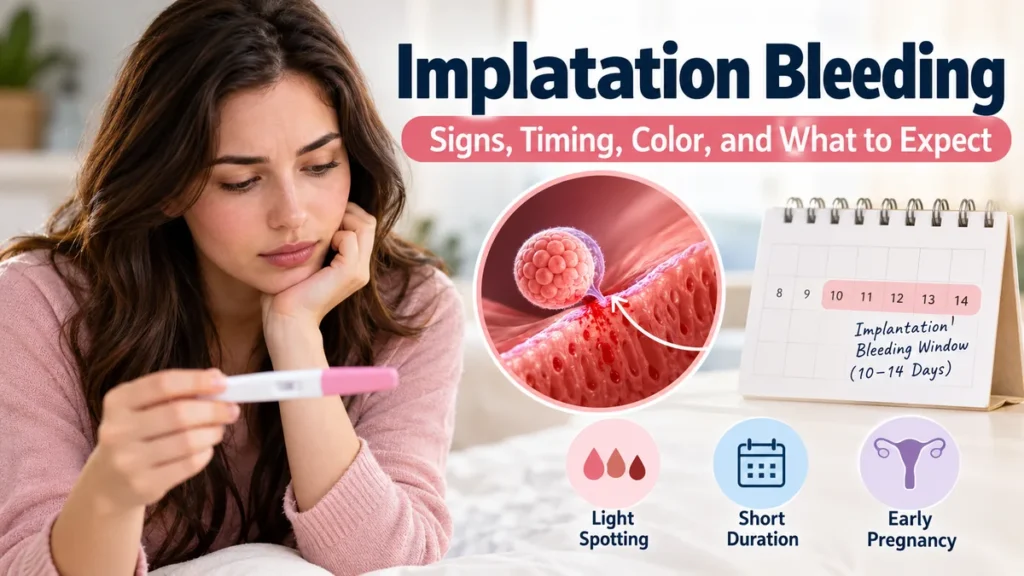
Seeing unexpected spotting when your period is due can be confusing, especially if pregnancy is possible. One explanation is implantation bleeding, a small amount of vaginal spotting associated with very early pregnancy.
Implantation bleeding is generally described as light spotting that may occur around 10 to 14 days after conception, close to when a menstrual period might normally begin. It tends to be lighter than menstrual bleeding, may look pink or brown, and usually resolves on its own. Not everyone experiences or notices it. Cleveland Clinic
What Is Implantation Bleeding?
Implantation is an early stage of pregnancy in which the developing embryo attaches to the lining of the uterus, called the endometrium.
After fertilization, the developing cluster of cells travels toward the uterus. It eventually develops into a blastocyst and attaches to the uterine lining. Implantation is followed by increasing production of human chorionic gonadotropin (hCG), the hormone detected by pregnancy tests. Healthline
Implantation bleeding is the term commonly used for light spotting around this time. It is thought to occur when implantation affects small blood vessels in the uterine lining. Cleveland Clinic describes it as typically occurring about 10 to 14 days after ovulation. Cleveland Clinic
The key word is light. Heavy bleeding is not typical of implantation bleeding and deserves medical attention, particularly when accompanied by pain or other concerning symptoms.
When Does Implantation Bleeding Happen?
The timing can make implantation bleeding particularly difficult to distinguish from menstruation.
Mayo Clinic reports that it typically occurs about 10 to 14 days after conception, around the time a menstrual period may be expected. Mayo Clinic
The sequence generally looks like this:
- Ovulation: An ovary releases an egg.
- Fertilization: Sperm fertilizes the egg, usually while it is in the fallopian tube.
- Early development: The fertilized egg divides as it travels toward the uterus.
- Implantation: The developing blastocyst attaches to the uterine lining.
- hCG production increases: Levels eventually become high enough for a pregnancy test to detect.
The precise timing varies because ovulation does not necessarily occur on the same cycle day every month.
For that reason, counting calendar days alone cannot confirm whether spotting is caused by implantation.
What Does Implantation Bleeding Look Like?
Implantation bleeding is usually described as spotting rather than a menstrual-like flow.
Common characteristics include:
- Pink, light brown, or brown spotting
- A small amount visible on toilet paper or underwear
- Bleeding that does not soak through pads
- No large blood clots
- Intermittent rather than progressively heavier bleeding
- A relatively short duration
Cleveland Clinic notes that implantation bleeding is commonly pink or brown and light enough to appear as a spot on underwear or toilet paper. Heavy, bright or dark red bleeding or bleeding containing clots is less characteristic. Cleveland Clinic
Color alone, however, cannot diagnose the cause of vaginal bleeding. Menstrual spotting and other forms of early-pregnancy bleeding can also appear pink or brown.
How Long Does Implantation Bleeding Last?
Implantation bleeding is generally brief.
Some people may notice a single episode when wiping, while others experience intermittent spotting for several hours or roughly one to two days. Cleveland Clinic states that it should generally stop on its own after about two days, although individual experiences vary. Cleveland Clinic
Bleeding that becomes progressively heavier, persists, contains clots, or is associated with significant pain should not simply be assumed to be implantation bleeding.
Implantation Bleeding vs. Period: How Can You Tell?
This is often the most difficult question because implantation-related spotting can occur close to the expected start of menstruation.
There is no visual feature that can confirm the cause with certainty, but several patterns may provide clues.
| Feature | Implantation bleeding | Menstrual period |
|---|---|---|
| Amount | Usually very light spotting | Usually a noticeable flow |
| Color | Often pink or brown | Often red to dark red |
| Duration | Usually hours to a couple of days | Commonly several days |
| Clots | Not typical | May occur |
| Cramping | None or mild | Can range from mild to strong |
| Pattern | Spotting or intermittent | Often develops into a fuller flow |
| Timing | Around early pregnancy/expected period | According to menstrual cycle |
Implantation bleeding tends to be shorter and lighter than menstruation. Still, these characteristics overlap considerably, so symptoms alone cannot reliably establish pregnancy. Mayo Clinic
A pregnancy test is more useful than trying to diagnose pregnancy from the appearance of spotting.
Can Implantation Bleeding Be Heavy?
Heavy bleeding is not considered typical implantation bleeding.
Implantation-related spotting should generally remain light. Bleeding that soaks through a pad, becomes similar to or heavier than a normal menstrual period, or contains significant clots may have another cause. Cleveland Clinic
Early-pregnancy bleeding can occur for several reasons, including changes involving the cervix, infection, miscarriage or ectopic pregnancy. This does not mean heavy bleeding automatically indicates pregnancy loss, but it does mean it should be evaluated rather than attributed to implantation without medical assessment. nhs.uk
Does Implantation Bleeding Include Clots?
Clots are not a typical characteristic of implantation bleeding.
Because the amount of blood associated with implantation spotting is generally small, there usually is not enough bleeding to produce the clotting sometimes seen during menstruation.
If you have confirmed or suspected pregnancy and experience significant bleeding or clots, contact a healthcare professional.
Does Implantation Bleeding Cause Cramps?
Some people report mild abdominal or pelvic cramping around early pregnancy.
When cramps occur alongside presumed implantation spotting, they are generally described as mild. Significant, worsening, one-sided or persistent pain should not be considered a normal implantation symptom without evaluation.
This distinction matters because abdominal or pelvic pain accompanied by vaginal bleeding can occur with conditions such as ectopic pregnancy or pregnancy loss.
Are There Other Symptoms of Implantation?
Spotting may occur around the same time as other early-pregnancy symptoms, including:
- Breast tenderness
- Fatigue
- Bloating
- Mild cramping
- Nausea
- Headaches
However, these symptoms are not specific to implantation. Many overlap with premenstrual syndrome (PMS) and normal hormonal changes during the menstrual cycle.
Some pregnant people have no noticeable symptoms at implantation. Likewise, experiencing several of these symptoms does not prove pregnancy. Healthline
Can You Have Implantation Bleeding Without Knowing You’re Pregnant?
Yes.
Implantation-related spotting can happen before someone knows they are pregnant. Because the timing may overlap with the expected menstrual period, light spotting can easily be mistaken for an unusually short or light period.
Mayo Clinic notes that this can occasionally cause confusion when estimating pregnancy dates. Ultrasound later in the first trimester can provide more accurate pregnancy dating when menstrual dates are uncertain. Mayo Clinic
When Should You Take a Pregnancy Test After Implantation Bleeding?
Taking a pregnancy test too early can produce a false-negative result.
Pregnancy tests detect hCG. Levels of this hormone increase after implantation, but initially there may not be enough hCG in urine for an at-home test to detect.
For a more reliable result, follow the timing instructions supplied with the pregnancy test. Testing around or after a missed period is generally more informative than testing immediately after suspected implantation spotting.
If the result is negative but your period still does not arrive, repeating the test after a short interval may be appropriate.
A healthcare professional can also perform pregnancy testing when the situation remains unclear.
Does Implantation Bleeding Guarantee Pregnancy?
No.
Spotting by itself cannot establish pregnancy, and not everyone who becomes pregnant experiences implantation bleeding.
The most practical way to determine whether pregnancy has occurred is an appropriately timed pregnancy test followed, when necessary, by medical evaluation.
This is particularly important because many different conditions can cause spotting around the expected date of menstruation.
Other Causes of Spotting in Early Pregnancy
Not every episode of early-pregnancy bleeding is implantation bleeding.
Possible causes include changes in the cervix, bleeding after sex, infection and other pregnancy-related conditions. NHS guidance also lists miscarriage, ectopic pregnancy and, less commonly, molar pregnancy among possible causes of bleeding during pregnancy. nhs.uk
Sometimes, no specific cause is identified.
This is why the amount of bleeding, associated symptoms, pregnancy-test results and clinical evaluation are more useful than color alone.
Cervical changes
Pregnancy causes changes in blood flow and blood vessels around the cervix. This can make the area more prone to light bleeding, including after sexual intercourse.
Infection
Some urinary or sexually transmitted infections can cause bleeding or unusual discharge and may require treatment. nhs.uk
Miscarriage
Bleeding can occur during pregnancy loss. The amount and accompanying symptoms vary, so bleeding alone cannot determine whether a miscarriage is occurring.
Ectopic pregnancy
An ectopic pregnancy occurs when a pregnancy implants outside the main cavity of the uterus, commonly in a fallopian tube.
Bleeding associated with significant abdominal or pelvic pain—particularly severe or one-sided pain—requires prompt medical evaluation because ectopic pregnancy can become a medical emergency.
When Should You Seek Medical Care?
Light spotting does not necessarily mean something is wrong, but unexplained bleeding during a known or suspected pregnancy is worth discussing with a healthcare professional.
Seek urgent medical care for symptoms such as:
- Heavy or rapidly increasing bleeding
- Severe abdominal or pelvic pain
- Significant one-sided pain
- Fainting or severe dizziness
- Weakness or feeling very unwell
- Significant clotting
- Shoulder pain associated with abdominal symptoms
- Fever or other signs of illness
Bleeding during pregnancy has numerous potential causes, ranging from relatively minor changes to conditions requiring urgent treatment. Healthline
How Is Early-Pregnancy Bleeding Evaluated?
A healthcare professional will usually begin by asking about the bleeding: when it started, how much blood there is, its appearance, and whether you have pain or other symptoms.
Depending on the stage of pregnancy and symptoms, evaluation may include:
- Pregnancy testing
- Blood tests, including quantitative hCG in some circumstances
- Urine testing
- Physical examination
- Ultrasound
The goal is not simply to decide whether spotting “looks like” implantation bleeding. It is to confirm pregnancy when appropriate and exclude other important causes of vaginal bleeding.
What Should You Do If You Think You Have Implantation Bleeding?
If the spotting is extremely light and pregnancy is possible, keep track of its amount, duration and any accompanying symptoms.
A panty liner can make it easier to monitor the bleeding. Avoid relying solely on blood color to identify its cause.
Take a pregnancy test at an appropriate time according to the test manufacturer’s instructions. If the test is negative but menstruation does not begin, consider repeating it later.
If bleeding becomes heavy, continues unexpectedly, or is accompanied by significant pain, dizziness, weakness or other concerning symptoms, seek medical advice promptly.
Implantation Bleeding: The Bottom Line
Implantation bleeding is generally described as brief, light spotting around the time an early pregnancy implants in the uterine lining. It commonly appears pink or brown and is typically much lighter than a menstrual period. Cleveland Clinic
The difficulty is that spotting alone cannot confirm implantation or pregnancy. Menstruation and several other conditions can produce similar bleeding.
An appropriately timed pregnancy test is more reliable than judging spotting by color or timing. And if bleeding is heavy, painful, persistent, or accompanied by dizziness, fainting or significant abdominal pain, medical evaluation is the safest next step.