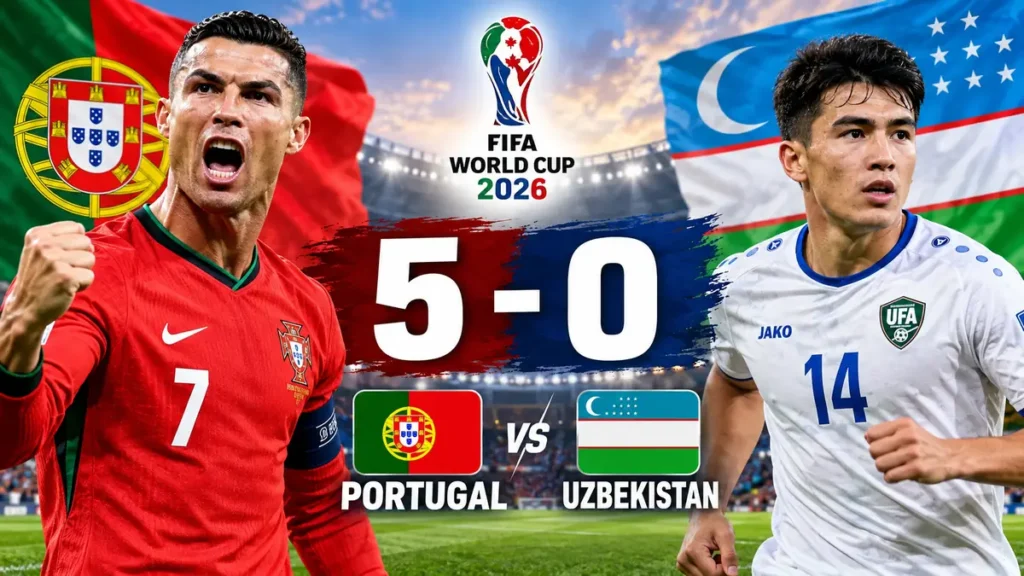
Portugal and Uzbekistan met in Group K of the 2026 FIFA World Cup on June 23, 2026, at NRG Stadium in Houston. What looked like a potentially tricky group-stage contest quickly became one of Portugal’s most convincing performances of the tournament.
Portugal defeated Uzbekistan 5-0, with Cristiano Ronaldo scoring twice, Nuno Mendes finding the net, an Uzbekistan own goal adding a fourth, and Rafael Leão completing the scoring late in the match. The result gave Portugal its first victory of the tournament after opening with a 1-1 draw against DR Congo.
The portugal vs uzbekistan match finished 5-0 to Portugal. Cristiano Ronaldo scored in the 6th and 39th minutes, Nuno Mendes struck in the 17th, an own goal made it 4-0 after the break, and Rafael Leão scored the fifth in the 87th minute. Portugal controlled possession and created significantly more shooting opportunities.
portugal vs uzbekistan Match at a Glance
| Match detail | Information |
|---|---|
| Competition | 2026 FIFA World Cup |
| Stage | Group K |
| Date | June 23, 2026 |
| Venue | NRG Stadium, Houston |
| Final score | Portugal 5-0 Uzbekistan |
| Half-time score | Portugal 3-0 Uzbekistan |
| Attendance | 68,777 |
| Portugal scorers | Cristiano Ronaldo 6′, 39′; Nuno Mendes 17′; Rafael Leão 87′ |
| Other goal | Uzbekistan own goal, 60′ |
The official match records show an attendance of 68,777, with Portugal already holding a commanding three-goal advantage by half-time.
The scoreline tells much of the story, but Portugal’s control of the game was just as significant. The European side dictated possession, moved the ball effectively through midfield and repeatedly forced Uzbekistan to defend close to its own goal.
Portugal vs Uzbekistan Score: How the Match Unfolded
Portugal did not need long to establish control.
Cristiano Ronaldo opened the scoring after only six minutes. An early goal was exactly what Portugal needed after its frustrating opening draw with DR Congo, and it immediately forced Uzbekistan to reconsider its approach.
Ronaldo Opens the Scoring
Portugal’s first goal developed through João Cancelo, who supplied Ronaldo for the finish.
Ronaldo’s movement remained one of the major problems for the Uzbek defence. Rather than constantly dropping deep to become involved in possession, he frequently occupied dangerous central positions and waited for Portugal’s creative players to find him.
The approach paid off almost immediately.
Portugal were 1-0 ahead in the sixth minute.
Nuno Mendes Makes It 2-0
The second goal arrived in the 17th minute through Nuno Mendes.
The Portuguese left-back produced another attacking contribution from a team whose threat was coming from several different areas of the pitch.
This was important tactically. Uzbekistan could not simply concentrate its defensive resources on Ronaldo. Portugal had players capable of attacking through the middle, overlapping from wide areas and arriving from deeper positions.
With Mendes adding the second goal, Portugal had established a two-goal cushion inside 20 minutes.
Ronaldo Scores Again Before Half-Time
Uzbekistan briefly appeared to have found a route back into the match when Azizjon Ganiev had the ball in the net around the half-hour mark, but the goal was disallowed following a VAR review.
Instead of becoming 2-1, the match soon moved further in Portugal’s direction.
Ronaldo scored again in the 39th minute, this time following an assist from Bruno Fernandes.
Portugal entered half-time leading 3-0.
At that point, Uzbekistan faced an enormous challenge. They needed to attack to have any chance of recovering the game, but committing additional players forward also risked creating more space for Portugal.
portugal vs uzbekistan Second-Half Goals
Portugal made changes after the break but continued controlling the match.
Francisco Conceição and Nélson Semedo were introduced at half-time for Pedro Neto and João Cancelo, while Uzbekistan also attempted to change the pattern of the game with substitutions.
The fourth goal arrived in the 60th minute through an own goal credited in match records to goalkeeper Abduvokhid Nematov.
By then, the contest was effectively settled.
Portugal continued using its squad rather than simply protecting the lead. Francisco Trincão, Bernardo Silva and Rafael Leão were among the players introduced during the second half.
Leão provided the final goal in the 87th minute, completing a 5-0 victory.
Portugal vs Uzbekistan Match Stats
The statistics demonstrate how effectively Portugal controlled the contest.
| Statistic | Portugal | Uzbekistan |
|---|---|---|
| Possession | 65.9% | 34.1% |
| Shots | 17 | 7 |
| Shots on target | 9 | 2 |
| Corners | 3 | 2 |
| Accurate passes | 561 | 262 |
| Passing accuracy | 89.9% | 80.1% |
| Duels won | 54 | 45 |
| Successful dribbles | 14 | 8 |
| Yellow cards | 1 | 1 |
| Red cards | 0 | 0 |
Portugal had almost two-thirds of possession and attempted 17 shots compared with Uzbekistan’s seven. Nine Portuguese efforts were on target, while Uzbekistan managed only two.
The passing figures are equally revealing.
Portugal completed 561 passes at an accuracy rate of 89.9%. Uzbekistan completed 262 at 80.1%. Portugal therefore had both more possession and greater efficiency when circulating the ball.
Quick Takeaway
Portugal’s 5-0 victory was not simply the product of unusually clinical finishing. The underlying statistics support the result: Portugal controlled possession, completed substantially more passes and generated more than twice as many shots.
Portugal Starting Lineup vs Uzbekistan
Portugal started with:
Goalkeeper: Diogo Costa
Defenders: João Cancelo, Rúben Dias, Renato Veiga, Nuno Mendes
Midfielders: João Neves, Vitinha, Bruno Fernandes
Forwards: Pedro Neto, João Félix, Cristiano Ronaldo
Roberto Martínez had a technically strong midfield capable of controlling possession while still providing the forward line with service.
Rúben Dias provided experience in central defence, while Cancelo and Mendes offered attacking options from full-back. Bruno Fernandes operated as one of Portugal’s primary creators, with Vitinha and João Neves contributing to control in midfield.
Uzbekistan Starting Lineup vs Portugal
Uzbekistan’s starting side included:
Goalkeeper: Abduvokhid Nematov
Defenders: Abdukodir Khusanov, Rustam Ashurmatov, Sherzod Nasrullaev, Abdulla Abdullaev, Behruzjon Karimov
Midfielders: Otabek Shukurov, Odiljon Khamrobekov, Azizjon Ganiev, Abbosbek Fayzullaev
Forward: Eldor Shomurodov
Uzbekistan’s structure reflected the difficulty of facing a Portuguese team with dangerous attacking players across the pitch.
Abdukodir Khusanov was an important presence in defence, while Abbosbek Fayzullaev and captain Eldor Shomurodov offered potential outlets when Uzbekistan recovered possession.
The difficulty was getting those attacking players involved often enough.
Portugal’s control of possession repeatedly forced Uzbekistan to spend long periods defending rather than developing sustained attacks.
Why Portugal Dominated Uzbekistan
The difference between the teams came from more than individual quality.
Portugal combined several tactical advantages.
1. Portugal Started Aggressively
Scoring after six minutes completely changed the match.
Uzbekistan’s safest route into the game was keeping the score level for as long as possible, remaining compact and forcing Portugal to become impatient.
Ronaldo’s early goal removed that possibility.
Once Uzbekistan needed to chase the match, Portugal gained more opportunities to exploit space.
2. Portugal Controlled the Ball
With 65.9% possession and almost 90% passing accuracy, Portugal rarely allowed Uzbekistan to establish a sustained rhythm.
Vitinha and João Neves helped Portugal circulate possession, while Bruno Fernandes offered more direct creativity.
That combination gave Portugal different ways of progressing the ball rather than relying on a single playmaker.
3. The Full-Backs Added Another Attacking Dimension
Nuno Mendes and João Cancelo gave Portugal width and attacking support.
Mendes scoring the second goal highlighted the problem Uzbekistan faced: Portugal’s attacking threat was not restricted to its forwards.
Defenders moving into advanced positions stretched Uzbekistan’s defensive shape and created additional passing options.
4. Ronaldo’s Movement Created Problems
Ronaldo’s two goals naturally attracted the headlines, but his positioning was equally significant.
At 41, he did not need to dominate every phase of Portugal’s buildup. His value came from occupying dangerous spaces, timing movements and converting opportunities when they arrived.
His brace also produced a historic milestone: he became the first player to score at six men’s World Cups.
5. Portugal Had Greater Squad Depth
Portugal’s substitutions illustrated another major difference.
Players such as Bernardo Silva, Rafael Leão, Francisco Conceição, Francisco Trincão and Nélson Semedo could enter without dramatically reducing the team’s quality.
Leão eventually scored Portugal’s fifth.
For an Uzbekistan side already forced to defend for long stretches, facing fresh high-level attackers late in the game made the challenge even harder.
Cristiano Ronaldo’s Performance Against Uzbekistan
Ronaldo was the central figure in the match.
His goals came in the sixth and 39th minutes and effectively put Portugal in complete control before half-time.
The performance also carried historical significance.
Ronaldo became the first men’s player to score at six World Cups, according to contemporary match reporting. His brace also strengthened his place among Portugal’s most significant World Cup performers.
Portugal coach Roberto Martínez praised not only Ronaldo’s goals but also his leadership and contribution to the team. Martínez described Portugal’s overall performance as more disciplined and tactically controlled than its opening 1-1 draw with DR Congo.
What Uzbekistan Did Well Despite the Score
A 5-0 result makes it easy to conclude that Uzbekistan offered nothing, but the statistics provide a little more context.
Uzbekistan produced seven shots and created seven chances according to the recorded match statistics. The team also attempted 15 dribbles, completing eight.
There were moments when Uzbekistan managed to progress beyond Portugal’s midfield.
The disallowed first-half goal was particularly important. Had it stood, the score would have become 2-1 and the tactical situation could have changed considerably.
Instead, the goal was ruled out and Ronaldo made it 3-0 shortly afterwards.
That sequence represented one of the game’s decisive moments.
Portugal vs Uzbekistan Head-to-Head Context
The 2026 World Cup meeting provided a significant competitive reference point between these national teams.
Their football histories are very different.
Portugal has decades of experience at major UEFA and FIFA competitions and has produced internationally prominent players across multiple generations. Uzbekistan, meanwhile, reached the 2026 World Cup as part of an important period in the development of its national team.
That difference in major-tournament experience was visible in Houston.
Portugal appeared comfortable controlling the tempo after taking the lead. Uzbekistan had promising spells but struggled to respond when the match moved rapidly against them.
The result should therefore be understood in its tournament context rather than simply as a comparison of the long-term potential of the two national programs.
What the Result Meant for Group K
Portugal had started the 2026 World Cup with a 1-1 draw against DR Congo, so the Uzbekistan match represented an important opportunity to secure a first victory.
The 5-0 win moved Portugal to four points after two games and significantly improved its goal difference.
Portugal subsequently drew 0-0 with Colombia in its final group match. The completed Group K standings showed Colombia first with seven points, Portugal second with five, DR Congo third with four and Uzbekistan fourth without a point.
Portugal therefore progressed from the group stage, while Uzbekistan’s campaign ended after three defeats.
What Happened to Portugal After the Uzbekistan Match?
Portugal’s World Cup continued beyond Group K.
After the goalless draw against Colombia, Portugal defeated Croatia 2-1 in the Round of 32 before facing Spain in the Round of 16. Spain won that match 1-0, ending Portugal’s tournament.
That makes the Uzbekistan result stand out as Portugal’s largest victory of its 2026 World Cup campaign.
It also represented a major response to the criticism that followed the opening draw with DR Congo.
What Happened to Uzbekistan After Facing Portugal?
Uzbekistan entered its final Group K fixture needing a dramatic turnaround after defeats against Colombia and Portugal.
The team then lost 3-1 to DR Congo, completing the group stage with three defeats. The final table recorded two goals scored, 11 conceded and a goal difference of minus nine.
The tournament was difficult in terms of results, but simply competing at this level represented valuable experience for Uzbekistan’s developing national side.
Facing players accustomed to Champions League and major international football also provided a clear measure of the standards required to compete consistently against elite national teams.
portugal vs uzbekistan: Final Assessment
The portugal vs uzbekistan World Cup meeting was ultimately decided by Portugal’s superior control, attacking variety and efficiency in decisive moments.
Cristiano Ronaldo’s sixth-minute opener forced Uzbekistan away from its preferred game plan almost immediately. Nuno Mendes doubled the advantage, Ronaldo’s second made it 3-0 before half-time, an own goal extended the lead, and Rafael Leão completed the 5-0 scoreline.
Portugal’s statistical superiority supported what was visible on the pitch: 65.9% possession, 17 shots, nine efforts on target and 561 completed passes compared with Uzbekistan’s 262.
For Portugal, the match delivered its first victory of the 2026 World Cup and a memorable Ronaldo milestone. For Uzbekistan, it demonstrated both the difficulty of facing an experienced elite side and the level required to compete successfully on football’s biggest international stage.