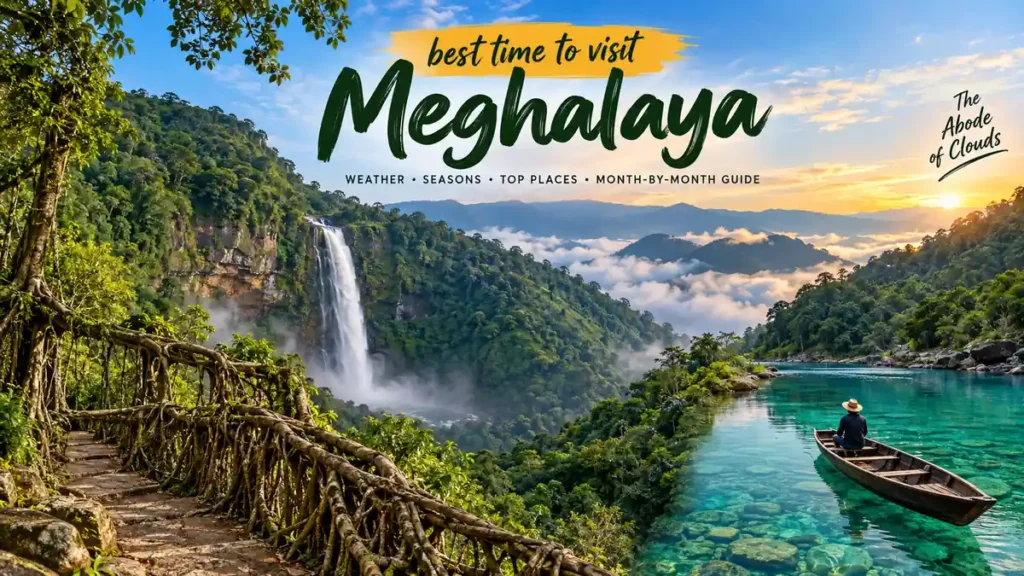
Meghalaya can look like two completely different destinations depending on when you arrive. One season brings transparent rivers, crisp skies, and comfortable trekking weather; another transforms the hills into a spectacular landscape of roaring waterfalls, mist, and intense greenery.
For most travelers, the best time to visit meghalaya is October to April, when rainfall is lower, roads and trekking trails are generally easier to navigate, and sightseeing conditions are comfortable. October and November offer an especially good balance of green landscapes and flowing waterfalls, while November to February is excellent for Dawki, trekking, and clear views.
That does not mean the monsoon should automatically be avoided. Meghalaya’s extraordinary rainfall is part of its identity, and travelers who specifically want powerful waterfalls and cloud-covered landscapes may actually prefer June to September.
The right month therefore depends on what you want to see.
| Travel priority | Best time |
|---|---|
| Best overall weather | October–April |
| Green scenery + strong waterfalls | October–November |
| Clear Umngot River at Dawki | November–March |
| Living root bridge trekking | October–April |
| Peak waterfall experience | June–September |
| Comfortable sightseeing | October–April |
| Cultural experiences | October–November |
| Cooler weather | November–February |
| Fewer crowds with pleasant conditions | February–April |
Why October to April Is the best time to visit meghalaya
Meghalaya literally means the “Abode of Clouds,” and its climate is fundamental to the travel experience. The state includes some of the wettest places on Earth, particularly Sohra—better known as Cherrapunji—and Mawsynram.
The heavy summer monsoon creates Meghalaya’s forests, waterfalls, caves, rivers, and famous living root bridges. But the same rainfall can make outdoor exploration more difficult.
Once the monsoon begins retreating, conditions become much more balanced.
Official Meghalaya Tourism guidance describes October and November as post-monsoon months when waterfalls and rivers remain impressive while clearer skies become more frequent. Winter, from roughly November to February, is the driest period and gives hikers, campers, and trekkers better access to remote areas.
This creates a broad October-to-April travel window.
October and November: the sweet spot
If you want one period that delivers a little of almost everything, choose October or November.
The landscape remains intensely green after months of rain. Waterfalls usually still carry significant water, but outdoor conditions become easier as rainfall decreases.
You can explore places such as:
- Shillong
- Sohra (Cherrapunji)
- Dawki
- Mawlynnong
- Nongriat
- Mawphlang
- Mawsynram
- Nohkalikai Falls
- Living root bridges
October is particularly attractive because it sits immediately after the main monsoon. Several current travel guides identify October as one of the strongest all-round months because waterfalls remain active while trails gradually become more manageable.
November generally brings clearer and drier conditions.
It is also harvest season in parts of Meghalaya, with traditional festivals and cultural events adding another dimension to a trip.
Quick Takeaway: Choose October if waterfalls and greenery matter most. Choose November if you prefer clearer skies, drier conditions, and better prospects for Dawki.
Meghalaya Weather by Season
Meghalaya’s terrain varies substantially in elevation, so there is no single temperature that accurately describes the entire state.
Shillong sits in the Khasi Hills at a considerably higher elevation than the lowlands near the Bangladesh border. Sohra, Mawsynram, Dawki, the Garo Hills, and Jaintia Hills can therefore feel different on the same day.
Still, the year can be divided into four useful travel periods.
| Season | Months | Typical experience | Best for |
|---|---|---|---|
| Spring/early summer | March–May | Mild to warm, increasing showers | Sightseeing, trekking |
| Monsoon | June–September | Very wet, cloudy, intensely green | Waterfalls, monsoon scenery |
| Post-monsoon | October–November | Greener landscapes, improving skies | Best overall balance |
| Winter | November–February | Cool, comparatively dry | Dawki, hiking, sightseeing |
October to November: Best Overall Balance
October is arguably the easiest month to recommend to someone visiting Meghalaya for the first time.
The monsoon has replenished rivers, forests, natural pools, and waterfalls. At the same time, prolonged heavy rainfall normally begins easing.
This matters at places such as Nohkalikai Falls, Nohsngithiang Falls (Seven Sisters Falls), Wei Sawdong, Kynrem Falls, and numerous smaller cascades around Sohra.
During the middle of the dry season, some waterfalls can lose much of their volume. October lets you see them closer to their dramatic monsoon character without necessarily accepting peak-monsoon travel conditions.
Why October works so well
The main advantages are:
- Waterfalls remain relatively strong.
- Hills are exceptionally green.
- Visibility begins improving.
- Trekking conditions become better.
- Temperatures are comfortable.
- Rivers gradually become clearer.
- Outdoor sightseeing becomes more predictable.
There can still be rain. Meghalaya does not suddenly become dry on October 1.
That is actually part of October’s appeal—you are traveling during a transition rather than at either climatic extreme.
November brings clearer conditions
By November, the dry season becomes more established.
This makes November particularly good for travelers interested in photography, viewpoints, outdoor exploration, boating, and long road trips.
It is also a good period for exploring Khasi culture and seasonal events.
November to February: Best Time for Dawki and Clear Weather
If photographs of transparent turquoise-green water are the reason Meghalaya caught your attention, prioritize winter.
The Umngot River at Dawki and nearby Shnongpdeng becomes famous for its clarity during the drier months. Under favorable conditions, boats can appear to float above the riverbed.
Current local guidance places the strongest window for clear water broadly between November and April, with November through February particularly popular.
During the monsoon, runoff carries sediment into the river. The surrounding landscape may look magnificent, but you should not expect the same transparent-water photographs.
Is December a good time to visit Meghalaya?
Yes. December is one of the better months for a first visit.
Expect cool weather, comparatively clear skies, good Dawki conditions, and comfortable daytime sightseeing.
December is particularly suitable for:
- Umngot River boating
- Shillong sightseeing
- Mawlynnong
- Root bridge walks
- Sohra viewpoints
- Photography
- Camping in suitable areas
- Road trips
The trade-off is demand.
Christmas and year-end holidays can make popular areas busier, particularly Shillong.
January and February
January is among the coldest and driest periods.
Official tourism information notes that some elevated areas, including parts of the West Khasi Hills and locations around Mylliem and Laitlyngkot, can experience frost and very low early-morning temperatures during winter.
That dry weather is valuable for hikers.
You sacrifice some waterfall volume, but gain better trail conditions, clearer skies, and lower humidity.
February begins the gradual transition toward spring. It remains an excellent month for outdoor activities without the year-end holiday crowds.
Quick Takeaway: For Dawki’s clearest water and comfortable trekking, prioritize November through February. For stronger waterfalls, move your trip earlier toward October.
March to May: Good for Pleasant Weather and Fewer Crowds
March and April are sometimes overlooked because October–February receives most of the attention.
They shouldn’t be.
Spring can provide an excellent compromise for travelers who want outdoor activities without winter’s coldest mornings.
Conditions become warmer, daylight is useful for long sightseeing days, and many trekking routes remain accessible.
March and April work particularly well for:
- Living root bridge hikes
- Shillong sightseeing
- Mawphlang Sacred Forest
- Cave exploration
- Road trips
- Family travel
- Photography
- Village visits
By May, pre-monsoon rainfall becomes increasingly important.
Conditions can shift quickly, particularly around Sohra and Mawsynram. If your itinerary includes multiple outdoor activities, leaving some flexibility is sensible.
June to September: Meghalaya in the Monsoon
Ask someone who dislikes rain about the best time to visit meghalaya, and they will probably tell you to avoid June through September.
Ask a waterfall photographer the same question, and you may receive exactly the opposite answer.
The monsoon is when Meghalaya reveals the landscape responsible for its reputation.
Sohra and Mawsynram experience extraordinary rainfall. Water pours from cliffs, temporary cascades appear across hillsides, forests become saturated with color, and clouds move through valleys at eye level.
For pure atmosphere, there is nothing quite like it.
Why visit during monsoon?
The main attraction is water.
Major waterfalls become far more powerful, including Nohkalikai and the Seven Sisters Falls. Countless seasonal falls that may barely exist during winter reappear.
The hills become intensely green.
Mist rolls through valleys and across roads, producing the classic “Abode of Clouds” experience.
If your idea of Meghalaya is rainforests, waterfalls, clouds, and dramatic weather, the monsoon delivers it better than winter.
The disadvantages are significant
Heavy rain changes how you need to travel.
Potential issues include:
- Slippery trekking paths
- Leeches on forest trails
- Reduced visibility
- Muddy sections
- Rapidly rising streams
- Road delays
- Occasional landslide disruption
- Poorer Dawki water clarity
- Outdoor plans changing at short notice
Local travel guidance specifically warns that monsoon conditions can make stone steps slick and streams more difficult around the living root bridges.
Do not build an extremely tight monsoon itinerary.
Allow extra travel time and check local road and weather conditions before long drives or treks.
Best Time to Visit Meghalaya for Waterfalls
For maximum waterfall volume, June through September wins.
This is when the state’s enormous rainfall feeds its rivers and cascades.
But “maximum volume” and “best sightseeing experience” are not necessarily the same thing.
Clouds can obscure viewpoints during intense rain. Access can also become more difficult.
For many travelers, October is the better compromise.
Waterfalls retain much of the water accumulated during the monsoon while visibility and road conditions generally begin improving.
Think of it this way:
| Priority | Best period |
|---|---|
| Maximum waterfall power | July–September |
| Waterfalls + easier sightseeing | October |
| Waterfalls + clearer skies | October–November |
| Dry-weather sightseeing | December–February |
Nohkalikai Falls near Sohra is especially impressive around and immediately after the rainy season.
The same principle applies to Seven Sisters Falls and many lesser-known waterfalls throughout the Khasi and Jaintia Hills.
Best Time for Living Root Bridges
Meghalaya’s living root bridges are among the state’s most remarkable cultural landscapes.
They are created by communities who guide the aerial roots of Ficus elastica, the Indian rubber fig, across streams until the roots develop into strong natural crossings.
The Khasi and Jaintia communities have maintained this practice across generations.
One of the most famous examples is the Double Decker Living Root Bridge at Nongriat, reached from the village of Tyrna through a demanding route involving thousands of steps.
For most travelers, October to April is the best trekking window.
Trails are generally drier and river levels more manageable than during peak monsoon. Current visitor guidance particularly recommends October through March for the Double Decker route.
Nongriat vs. Riwai
You don’t necessarily need to attempt the strenuous Nongriat trek to experience a living root bridge.
The Riwai Living Root Bridge near Mawlynnong is considerably easier to reach and works better for families, older visitors, and travelers with limited time.
Nongriat is the more demanding adventure.
The descent is only half the challenge. You must climb back up again, which catches some first-time visitors by surprise.
Good-grip footwear, water, an early start, and realistic expectations about fitness make a substantial difference.
Avoid attempting demanding forest treks during periods of exceptionally heavy rain.
Best Time to Visit Shillong
Shillong works as a year-round destination, but October through April provides the most comfortable conditions for conventional sightseeing.
The Meghalaya capital makes a useful base for visiting places such as:
- Umiam Lake
- Shillong Peak
- Elephant Falls
- Ward’s Lake
- Mawphlang
- Laitlum Canyon
- Sohra
- Dawki
Winter days can be pleasant, but evenings and early mornings may feel genuinely cold.
November is particularly interesting because seasonal flowering and cultural events can add color to the city.
If Shillong is your main destination rather than a base for waterfall exploration, winter’s lower rainfall is usually an advantage.
Best Time to Visit Cherrapunji or Sohra
Sohra presents a more complicated decision.
Visit in peak monsoon and you experience one of the world’s legendary rainfall landscapes.
Visit in winter and you get easier sightseeing.
For most first-time visitors, October to April is the more practical window. Local destination guidance similarly recommends the drier months for clearer visibility and easier exploration.
Sohra offers far more than waterfalls.
Important attractions include:
- Nohkalikai Falls
- Seven Sisters Falls
- Mawsmai Cave
- Arwah Cave
- Dainthlen Falls
- Living root bridges
- Limestone landscapes
- Forest trails
Mawsmai Cave is relatively accessible, while other caves and trails may demand more time and preparation.
October and November are particularly appealing because you can combine waterfalls with cave exploration, viewpoints, and trekking.
Best Time for Mawlynnong and Mawphlang
Mawlynnong is often combined with Dawki because the two can fit naturally into the same regional itinerary.
October through April provides comfortable conditions for walking through the village and visiting nearby Riwai.
Mawphlang offers a different experience.
The Mawphlang Sacred Forest introduces visitors to the ecological and cultural traditions of the Khasi Hills. Cooler, relatively dry conditions are helpful if you plan a longer guided forest walk.
Winter creates easier walking conditions, while the post-monsoon months retain a particularly lush appearance.
Meghalaya Month-by-Month Travel Guide
Choosing a season is useful, but choosing the actual month is better.
January
Cold, relatively dry, and good for trekking.
Dawki is usually a major highlight because the Umngot River benefits from dry-season conditions. Pack warm clothing for mornings and evenings, particularly in higher areas.
Best for: Dawki, hiking, photography and clear weather.
February
Still dry and comfortable but gradually warmer.
It is one of the better months for travelers who want winter conditions without the Christmas and New Year rush.
Best for: trekking, sightseeing and quieter travel.
March
Spring brings warmer days while many outdoor routes remain comfortable.
Waterfalls may carry less water than in October, but conditions suit active itineraries.
Best for: hiking, family trips and road trips.
April
April remains a good travel month, though rainfall begins increasing as the region moves toward the pre-monsoon period.
Best for: sightseeing, trekking and spring travel.
May
May is transitional.
Warmth and humidity increase and showers become more frequent. It can still be rewarding, but weather becomes less predictable.
Best for: flexible itineraries and greener scenery.
June
The main monsoon establishes itself.
Waterfalls grow dramatically, while trekking and long-distance sightseeing become more weather-dependent.
Best for: rain lovers and waterfall-focused trips.
July
July sits deep inside the wet season.
Expect extremely lush landscapes and powerful waterfalls around Sohra and Mawsynram, alongside frequent heavy rain.
Best for: dramatic monsoon scenery.
August
August continues the monsoon experience.
It is beautiful but demands flexibility. Waterproof footwear and clothing become essential rather than optional.
Best for: waterfalls, clouds and photography between showers.
September
Rain remains significant, although conditions gradually begin moving toward the post-monsoon transition.
Best for: greenery and late-monsoon landscapes.
October
For many travelers, this is the standout month.
The landscape remains lush, waterfalls are still impressive, and improving weather makes exploration easier.
Best for: first-time visitors and travelers wanting the broadest mix of experiences.
November
November becomes drier and clearer.
Dawki improves, hiking conditions are excellent, and cultural events can add interest.
Best for: photography, Dawki, trekking and culture.
December
Cool, dry weather makes December excellent for sightseeing.
The main downside is heavier holiday demand around Christmas and New Year.
Best for: family trips, Dawki and winter holidays.
When Is the Best Time for a First Meghalaya Trip?
For a first trip, aim for October, November, February, March, or early April.
These months make it easier to build an itinerary containing several different experiences rather than organizing your entire trip around the weather.
A classic first-time route might connect:
Shillong → Sohra → Nongriat → Mawlynnong → Dawki/Shnongpdeng → Shillong
October and November favor greenery and waterfalls.
February and March favor dry trails, clearer skies, and comfortable exploration.
If Dawki’s transparent river is your absolute priority, move toward the winter months.
If waterfalls are your priority, move toward October.
How Many Days Do You Need in Meghalaya?
A rushed three-day visit can cover a few highlights, but Meghalaya rewards slower travel.
Five to seven days is much more comfortable for a first visit because mountain roads make distances deceptive. A place that looks close on a map may require hours of driving.
A balanced trip can dedicate time to:
- Shillong and nearby attractions
- Sohra’s waterfalls and caves
- Nongriat or another living root bridge
- Mawlynnong and Riwai
- Dawki and the Umngot River
- Mawphlang or another Khasi Hills experience
Adding buffer time is particularly valuable during the monsoon.
What Should You Pack for Meghalaya?
Packing should follow the season rather than a generic Northeast India checklist.
October to February
Carry warm layers, particularly for Shillong and higher elevations.
Useful items include a light insulated jacket, comfortable walking shoes, sunscreen, reusable water bottle, and a compact rain layer.
March to May
Choose breathable clothes but keep rain protection handy.
A waterproof outer layer becomes increasingly useful as May approaches.
June to September
Proper waterproof equipment matters.
Bring a rain jacket or poncho, quick-drying clothes, waterproof protection for electronics, shoes with reliable grip, spare socks, insect repellent, and a dry bag.
An umbrella alone is often inadequate when wind accompanies heavy rain.
Is Meghalaya Worth Visiting During Monsoon?
Yes—but only if you actually want a monsoon trip.
Do not choose July because you saw a winter photograph of a transparent boat on the Umngot River. Likewise, don’t choose January expecting every seasonal waterfall to resemble its peak-monsoon appearance.
June through September is ideal for travelers who prioritize:
- Huge waterfalls
- Rain-soaked forests
- Misty landscapes
- Intense greenery
- Atmospheric photography
It is less suitable for travelers whose priorities are:
- Predictable itineraries
- Long treks
- Clear panoramic views
- Transparent Dawki water
- Dry-weather road trips
This distinction matters more than simply labeling one season “good” and another “bad.”
Which Is Better: Meghalaya in Winter or Monsoon?
Neither season wins every category.
| Factor | Winter | Monsoon |
|---|---|---|
| Weather comfort | Excellent | Challenging |
| Waterfalls | Moderate | Spectacular |
| Dawki clarity | Excellent | Poorer |
| Trekking | Excellent | Difficult |
| Green landscapes | Good | Exceptional |
| Road-trip reliability | Better | Lower |
| Photography | Clear landscapes | Dramatic clouds |
| Living root bridges | Easier access | Wet/slippery |
| Mist and atmosphere | Moderate | Exceptional |
Winter is better for a conventional sightseeing holiday.
Monsoon is better for experiencing Meghalaya’s extreme natural character.
Post-monsoon October and November sit between the two, which explains why they are such strong all-round choices.
Practical Tips for Choosing Your Travel Dates
Do not plan Meghalaya based only on temperature.
Rainfall, water levels, visibility, trail conditions, and river clarity often matter more.
Check current weather and road conditions shortly before traveling, especially if you are visiting Sohra, Mawsynram, Nongriat, or remote areas during wetter months.
Avoid packing too many distant attractions into a single day. Mountain roads and weather can turn an apparently short journey into a much longer one.
For trekking, footwear with proper grip is far more useful than casual sneakers. This becomes particularly important around Nongriat’s stone steps.
If you want the famous Dawki “floating boat” photographs, prioritize dry weather and remember that water clarity depends on recent rainfall—not simply the date on the calendar.
For waterfall photography, do the opposite: some recent rain is desirable.
So, What Is the best time to visit meghalaya?
For the majority of first-time travelers, the best time to visit meghalaya is October to April. This period offers the most dependable combination of comfortable weather, accessible trekking routes, clearer skies, and good sightseeing conditions.
Within that window, October and November offer perhaps the best overall balance. The hills remain green, waterfalls retain substantial post-monsoon flow, and the weather becomes progressively easier for road trips and trekking.
Choose November to February if Dawki’s transparent Umngot River, cool weather, and dry trails matter most.
Choose March and April for warmer weather and comfortable outdoor exploration.
And choose June to September deliberately—not because it is the conventional “best season,” but because you want to experience Meghalaya at its wildest: immense waterfalls, saturated forests, heavy clouds, and the extraordinary monsoon that created the Abode of Clouds in the first place.