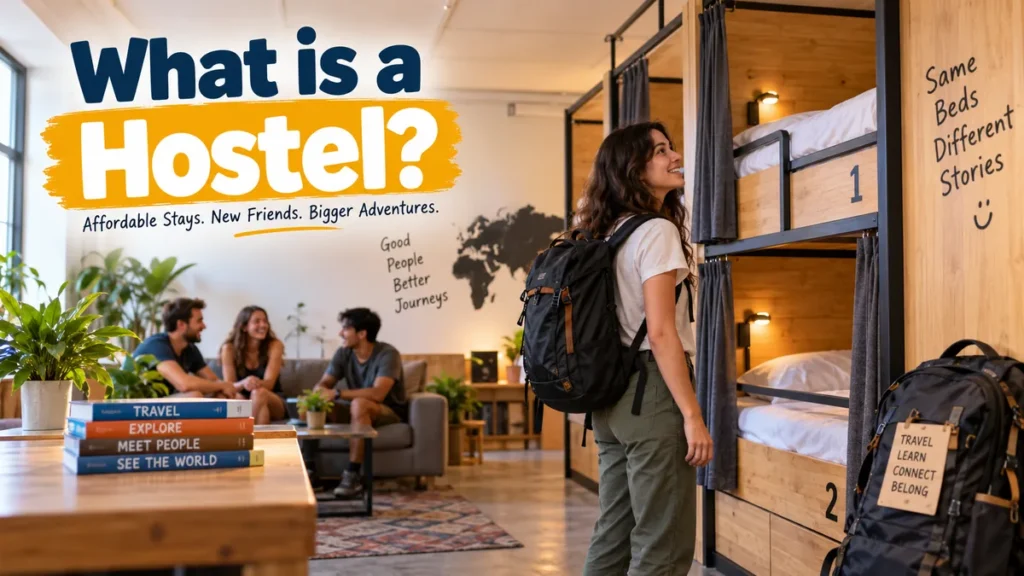
If you have never stayed in one, the word “hostel” can bring up images of crowded bunk beds and backpackers living out of oversized bags. That picture is only partly accurate.
Modern hostels range from simple dorm-style accommodation to stylish properties with private rooms, coworking spaces, cafés, rooftop terraces, organized activities, and pod-style beds.
A hostel is a budget-friendly type of accommodation where travelers commonly rent a bed in a shared dormitory rather than an entire room. Most hostels also provide communal spaces such as kitchens, lounges, and bathrooms, while many offer private rooms for guests who want more privacy without giving up the social hostel experience.
The combination of affordability and community is what really separates hostels from most traditional hotels.
What Is a Hostel and How Does It Work?
The basic hostel model is simple: instead of every guest paying for a private hotel room, several travelers can sleep in the same dormitory.
You normally reserve one individual bed. The other beds may be occupied by travelers you have never met.
A typical dorm might contain four, six, eight, ten, or more beds. Bunk beds are common, although newer properties increasingly use pod-style sleeping spaces with privacy curtains, individual reading lights, shelves, and charging sockets.
Many hostels also have private rooms. Depending on the property, these may accommodate one person, a couple, a family, or a small group.
This creates two main ways to stay:
- Dormitory bed: You pay for one sleeping space and share the room.
- Private room: You reserve the entire room while retaining access to the hostel’s communal facilities.
Bathrooms may be shared between guests, located inside individual dorms, or provided privately with ensuite rooms. There is no universal setup, so checking the room description matters.
The hostel concept has also expanded well beyond bare-bones backpacker lodging. Current properties can include family rooms, female-only dormitories, pods, boutique-style rooms, coworking areas, cafés, and other amenities.
Is a hostel basically a dorm?
A hostel dorm can resemble a university dormitory because several people sleep in one room and use shared facilities.
The difference is purpose and duration. A hostel primarily provides temporary accommodation to travelers, whereas a university dormitory is normally residential accommodation for students enrolled at an institution.
Hostel guests may stay for a single night, several days, or longer depending on the property’s rules.
What Does a Hostel Room Look Like?
There is no standard hostel room.
A traditional dormitory usually contains bunk beds arranged around a shared room. Beside or underneath the beds, you may find lockers where guests can secure backpacks, electronics, passports, and other belongings.
Modern dorm beds often include:
- A mattress and bed linen
- Reading light
- Electrical outlet or USB charging point
- Small shelf
- Personal locker
- Privacy curtain
- Under-bed storage
Not every hostel supplies every feature.
Bathrooms may also work differently from property to property. One hostel might have a bathroom inside each dorm, while another could have several shared bathrooms in the hallway.
The number of beds matters too. Smaller dorms generally provide a quieter, less crowded experience, while larger dormitories can reduce the cost per bed.
Mixed dorms and female-only dorms
A mixed dorm allows guests of different genders to stay in the same room.
Many properties also provide female-only dorms for women who prefer that arrangement. Female-only rooms are now a normal accommodation option at hostels around the world.
Room configurations should always be checked before confirming a stay rather than assuming every dorm works the same way.
Do hostels have private rooms?
Yes. This is one of the biggest misconceptions about hostel accommodation.
Many hostels offer private rooms alongside dormitories. A private room gives you exclusive use of the sleeping area while still allowing you to use communal lounges, kitchens, bars, terraces, or activities.
The bathroom might still be shared, although some private rooms have ensuite bathrooms.
A private hostel room can therefore suit travelers who enjoy the social atmosphere of a hostel but don’t want to sleep beside strangers.
What Facilities Do Hostels Usually Have?
Shared facilities are central to hostel life.
Rather than spending most of their time inside private rooms, guests are often encouraged to use communal areas. These spaces naturally make it easier to talk to other travelers.
Common hostel amenities include:
- Shared kitchen
- Lounge or common room
- Guest bathrooms
- Lockers
- Luggage storage
- Free Wi-Fi
- Laundry facilities
- Bar or café
- Outdoor terrace
- Coworking tables or work areas
- Reception desk
- Tours and organized activities
Some properties go much further with swimming pools, rooftop bars, gyms, restaurants, movie rooms, games areas, yoga sessions, or organized walking tours.
Others provide little more than a bed, bathroom, locker, and basic kitchen.
That’s why “hostel” describes an accommodation format rather than a particular standard of luxury.
Communal kitchens
A guest kitchen is particularly useful for budget travelers.
Instead of eating at restaurants for every meal, guests may be able to buy groceries and prepare their own food. Kitchens can include refrigerators, cooktops, microwaves, kettles, cookware, and shared dining areas.
Not every property has one, however.
Lockers and luggage storage
Dorm rooms commonly provide lockers or another form of secure personal storage. Some require travelers to bring their own padlock, while others use electronic locks or provide keys.
Luggage storage may also be available before check-in or after checkout.
Check exactly what is included before arriving.
Hostel vs Hotel: What Is the Difference?
The easiest way to understand what is a hostel is to compare it with a hotel.
The biggest differences are privacy, room structure, atmosphere, facilities, and price model.
| Feature | Hostel | Hotel |
|---|---|---|
| Sleeping arrangement | Shared dorm bed or private room | Usually private room |
| Bathrooms | Shared or private | Usually private |
| Kitchen | Often communal | Less commonly available to guests |
| Common areas | Major part of the experience | Usually less socially focused |
| Privacy | Lower in dorms | Higher |
| Social atmosphere | Usually stronger | Usually more private |
| Pricing | Often charged per bed | Usually charged per room |
| Lockers | Common in dorms | Usually unnecessary |
| Best suited to | Budget and social travelers | Privacy-focused travelers |
Privacy is arguably the most noticeable difference.
In a hotel, closing your room door normally separates you from other guests. In a dormitory hostel, your sleeping space itself is shared.
The trade-off is that hostels can make meeting people much easier.
That distinction is why solo travelers frequently choose hostels even when price isn’t their only concern. Shared kitchens, lounges, dining tables, activities, and dormitories create natural opportunities for conversation.
Hostel vs motel
A motel is different again.
Motels traditionally cater to road travelers and motorists, providing private rooms with convenient vehicle access or parking. They generally don’t revolve around dormitory accommodation or communal social spaces.
A hostel focuses more heavily on shared accommodation and interaction between guests.
Hostel vs guesthouse
A guesthouse usually offers private rooms in a smaller, more residential property.
Hostels are more likely to offer individual dorm beds, communal kitchens, lockers, and social areas designed for unrelated travelers to share.
The boundaries aren’t absolute, however. Modern accommodation types increasingly overlap.
Why Are Hostels Usually Cheaper?
The shared-room model is the main reason.
Imagine that a property has a room large enough for eight people. A traditional hotel might sell it as one private room. A hostel can place several beds inside and sell each bed separately.
Guests share more of the available space and facilities, reducing the amount of private space required per person.
Hostels may also operate with fewer hotel-style services.
For example, you shouldn’t automatically expect:
- Daily room servicing
- Room service
- Fresh towels every day
- Toiletries
- Porter service
- A private bathroom
- Hotel-style concierge service
Exactly what is included varies widely.
Some hostels provide breakfast, towels, bed linen, toiletries, and activities within the rate. Others charge separately for extras.
This is why comparing only the advertised bed price can be misleading.
How much does a hostel cost?
There isn’t a useful worldwide fixed price.
Hostel rates change according to:
- Country and city
- Neighborhood
- Travel season
- Weekday or weekend
- Dorm size
- Private versus shared room
- Property quality
- Facilities
- Events taking place locally
- Demand and availability
A large dormitory bed in an inexpensive destination can cost dramatically less than a private room in a popular capital during peak season.
Private hostel rooms can sometimes approach — or even exceed — the price of budget hotel rooms.
The smarter question isn’t simply “Are hostels cheaper?” but “What exactly am I getting for this price?”
Compare the sleeping arrangement, bathroom, location, cancellation conditions, linen, towels, breakfast, lockers, and other charges.
Who Usually Stays in Hostels?
Backpackers are strongly associated with hostels, but they are far from the only guests.
You may encounter:
- Solo travelers
- Students
- Backpackers
- Couples
- Groups of friends
- Gap-year travelers
- Digital nomads
- Remote workers
- Long-term travelers
- Families
- Older independent travelers
There is no single “hostel traveler.”
Recent industry coverage shows that hostels increasingly accommodate travelers beyond the stereotypical young backpacker, including couples, families, and remote workers.
Individual properties can still impose their own rules or age restrictions, so travelers should check the terms before booking.
Are hostels only for young people?
No.
Youth travel played an important role in the development of hostelling, and many properties still attract a younger crowd. But being a hostel does not automatically mean guests must be under a certain age.
Some individual hostels have minimum or maximum age policies, particularly for dormitories. Others welcome adults across a much wider age range.
Check the property’s policy rather than relying on the stereotype that hostels are exclusively for people in their teens or twenties.
What Are the Different Types of Hostels?
Modern hostels can feel completely different from one another.
Choosing the right type is often more important than simply finding the highest-rated property.
Backpacker hostels
These are built primarily around affordable accommodation for independent travelers.
Expect dormitories, communal kitchens, lockers, travel information, and plenty of opportunities to meet people.
Social hostels
Social hostels deliberately create interaction through common rooms, group dinners, walking tours, games, outings, and other activities.
They can work particularly well for solo travelers.
“Social” does not necessarily mean loud.
Party hostels
Party hostels put nightlife at the center of the experience.
They may operate bars, organize pub crawls, play music late, and attract guests specifically interested in meeting people and going out.
Great if that’s your goal. A poor choice if you need eight uninterrupted hours of sleep.
Boutique hostels and poshtels
The term poshtel is sometimes used for an upscale or boutique hostel.
These properties combine hostel-style communal accommodation with more polished interior design and upgraded amenities.
You might see privacy pods, quality bedding, stylish lounges, coworking spaces, ensuite bathrooms, or swimming pools.
Eco-hostels
Eco-focused properties try to reduce their environmental impact through measures such as recycling, reduced single-use plastics, energy conservation, water-saving systems, or locally sourced products.
Standards vary, so sustainability claims are worth checking rather than taking at face value.
Surf, ski and activity hostels
Some hostels revolve around a particular activity or destination.
Surf hostels might provide board storage and lessons. Mountain properties may cater to hikers or skiers. Others organize diving, cycling, yoga, or outdoor excursions.
Capsule and pod-style hostels
Pod hostels replace exposed bunk beds with partially enclosed sleeping spaces.
A pod can offer a privacy curtain or walls around much of the bed, giving the guest more separation without creating a fully private room.
It sits somewhere between an open dorm bed and a traditional private room.
Are Hostels Safe?
Hostels can provide secure accommodation, but sharing sleeping and communal spaces means personal security habits matter.
Common security features include:
- Lockers
- Key cards
- Controlled building access
- Reception staff
- Luggage storage
- Security cameras in appropriate communal areas
- Individual room keys or codes
Some larger hostels also operate staffed reception desks around the clock.
Still, security standards vary by property and destination.
How to keep your belongings secure
A simple rule works well: if it matters, lock it.
Don’t leave your passport, cash, laptop, wallet, camera, or other valuable items unattended on a dorm bed.
Use the locker provided and carry a padlock when the hostel requires one.
For particularly important items, a small personal bag that stays with you can be useful.
Before booking, check recent reviews for comments about security, lockers, door access, staffing, cleanliness, and the surrounding neighborhood.
Are hostels safe for solo travelers?
Solo travelers commonly use hostels, and the social environment is one of their main attractions.
The same normal travel precautions still apply.
Know how you’ll get back to the property at night, keep valuables secured, don’t give strangers unrestricted access to your room, and tell someone where you’re going when appropriate.
Female solo travelers who would prefer not to stay in a mixed dorm can look for female-only accommodation.
Quick takeaway: A shared room does not automatically make a property unsafe, but it does mean you need to take more responsibility for securing your belongings.
What Are the Advantages and Disadvantages of Staying in a Hostel?
Hostels aren’t automatically better or worse than hotels. They solve a different set of travel needs.
Advantages
Lower accommodation costs
Dormitory beds can reduce lodging expenses, especially for solo travelers who would otherwise have to pay for an entire hotel room.
Easy social interaction
Common rooms, kitchens, dormitories, and organized events make meeting fellow travelers much easier.
Useful for solo travel
You can travel alone without necessarily spending every evening alone.
Cooking facilities
Access to a communal kitchen can reduce food costs and help travelers with specific dietary needs.
Local travel knowledge
Hostel staff and other guests can be valuable sources of practical information about transportation, neighborhoods, day trips, and inexpensive places to eat.
Flexible room options
Properties offering both dorms and private rooms let travelers choose between affordability and privacy.
Disadvantages
Less privacy
Even with a privacy curtain, a dorm bed isn’t a private bedroom.
Noise
Snoring, alarms, late arrivals, early departures, conversations, doors, and people packing bags can disturb sleep.
Shared bathrooms
You may have to wait for a shower or carry your toiletries between your room and bathroom.
Different cleanliness standards
Cleanliness depends heavily on both property management and the behavior of fellow guests.
Security requires more attention
You need to lock valuables rather than casually leaving them around the room.
Social environments can be tiring
Someone who values solitude may find highly social or party-oriented properties exhausting.
What Is Hostel Etiquette?
Sharing a room with strangers works surprisingly well when everyone follows a few basic unwritten rules.
1. Keep noise down when people are sleeping
If you return late, avoid turning on the main light, making phone calls, or having long conversations beside sleeping guests.
2. Pack before an early departure
Packing an entire backpack at 5 a.m. while repeatedly opening plastic bags is a reliable way to annoy a dorm.
Prepare as much as possible the night before.
3. Use headphones
Music, videos, games, and phone calls shouldn’t become entertainment for the entire room.
4. Keep your belongings within your space
A dorm bed isn’t permission to spread shoes, clothing, chargers, and luggage across the room.
5. Clean the kitchen after yourself
Wash dishes, wipe surfaces, label food when required, and don’t assume unlabeled groceries belong to everyone.
6. Respect bathroom time
Shared bathrooms aren’t private hotel bathrooms. Avoid occupying them unnecessarily when other guests are waiting.
7. Don’t snooze your alarm repeatedly
Set the alarm you actually intend to wake up to.
8. Respect boundaries
Hostels make conversation easy, but social interaction isn’t compulsory. Someone wearing headphones, working, reading, or relaxing quietly may want space.
Good hostel etiquette comes down to one principle: remember that your temporary bedroom is somebody else’s temporary bedroom too.
What Should You Bring to a Hostel?
You don’t need specialist equipment, but a few items make shared accommodation considerably easier.
Consider packing:
- Padlock
- Earplugs
- Sleep mask
- Quick-dry towel
- Flip-flops or shower shoes
- Toiletry bag
- Reusable water bottle
- Charging cable
- Power adapter for international travel
- Small bag for valuables
Before packing a towel or bed linen, check what the property supplies. Bed linen is commonly provided, whereas towels may be included, rented, or unavailable depending on the hostel.
Should you bring a sleeping bag?
Usually not unless the property specifically recommends one.
Some hostels actually prohibit personal sleeping bags because of hygiene or pest-control policies and provide their own linen instead.
Read the accommodation rules beforehand.
How Do You Choose a Good Hostel?
The cheapest bed isn’t necessarily the best value.
A hostel that matches your travel style can improve the entire trip; one that doesn’t can leave you counting the hours until checkout.
Read recent reviews
Don’t focus only on the overall score.
Look for repeated comments about:
- Cleanliness
- Security
- Noise
- Staff
- Wi-Fi
- Bathrooms
- Beds
- Atmosphere
- Location
Recent reviews are especially valuable because management, facilities, and atmosphere can change.
Check the location carefully
A cheap hostel far outside the area you want to explore can cost more once daily transportation is included.
Look at public transport, walkability, the surrounding neighborhood, and how you’ll reach the property after dark.
Match the atmosphere to your trip
“Excellent atmosphere” means different things to different people.
One traveler wants a rooftop party until 2 a.m. Another wants a peaceful lounge and a quiet night’s sleep.
Read descriptions and reviews for clues such as party, social, quiet, coworking, family-friendly, backpacker, nightlife, or relaxed.
Check the dorm size
A four-bed dorm and a twenty-bed dorm offer very different experiences.
Larger rooms may cost less. Smaller dorms generally mean fewer people entering, leaving, packing, snoring, and setting alarms.
Examine the bathroom arrangement
Check whether the bathroom is:
- Ensuite
- Shared between a few rooms
- Shared across an entire floor
This can matter just as much as dorm size.
Check what’s included
Before comparing prices, find out whether you have to pay extra for:
- Towels
- Breakfast
- Lockers
- Padlocks
- Luggage storage
- Laundry
- City taxes
- Bed linen
A slightly more expensive hostel can be better value when useful extras are included.
What Is It Actually Like to Stay in a Hostel?
Your first stay will probably feel unusual for the first few minutes.
You check in, find your bed, put your belongings into a locker, and suddenly realize several strangers may be sleeping in the same room that night.
Then the hostel begins to make sense.
Someone asks where you’re from. Another guest recommends a cheap restaurant. People cook dinner in the kitchen. A group decides to join a walking tour the next morning.
Or none of that happens.
You might simply shower, put in your earplugs, sleep, and leave early the next day.
That’s an overlooked point about hostel life: you don’t have to be constantly social.
Communal accommodation gives you the opportunity to interact. It doesn’t create an obligation.
How Long Can You Stay in a Hostel?
There is no universal maximum stay that applies to every hostel.
Some properties primarily accommodate short-term travelers and impose maximum stays. Others permit longer visits or provide weekly and monthly arrangements.
Policies can also vary by season, room type, city regulations, or the traveler’s residency status.
If you’re planning to stay for several weeks, read the property’s terms rather than assuming you can continuously extend your reservation.
For a longer stay, also consider whether dorm life will remain comfortable. Sharing sleeping space for two nights is very different from doing it for a month.
Can You Work Remotely From a Hostel?
Yes, but choose carefully.
The rise of digital nomads and remote travel has encouraged some hostels to provide coworking tables, stronger Wi-Fi, quiet areas, and private rooms.
Before planning a working stay, check:
- Wi-Fi quality
- Dedicated workspaces
- Noise levels
- Availability of electrical outlets
- Private-room options
- Reviews from remote workers
A party hostel with excellent ratings can still be terrible for someone who needs to join a video meeting at 9 a.m.
Is a Hostel Right for You?
A hostel is worth considering when affordability, flexibility, and meeting other travelers matter more to you than having a completely private environment.
You may enjoy a hostel if you:
- Want to reduce accommodation costs
- Are traveling alone
- Like meeting people
- Don’t mind sharing facilities
- Want access to a kitchen
- Prefer an informal atmosphere
- Are comfortable securing your own belongings
A hotel, apartment, or private guesthouse may suit you better if uninterrupted sleep, personal space, private bathrooms, or hotel-style service are priorities.
And there is a middle ground: book a private room in a hostel. You get your own sleeping space while retaining access to the social areas.
what is a hostel? The Simple Answer
So, what is a hostel in practical terms?
It is shared, traveler-focused accommodation built around affordability and communal living. The traditional experience involves renting a bed in a dormitory, sharing facilities such as bathrooms and kitchens, storing belongings in a locker, and interacting with other guests in common areas.
But modern hostels are far more varied than the old backpacker stereotype. They can offer female-only dorms, private rooms, ensuite bathrooms, sleeping pods, coworking spaces, bars, cafés, pools, activities, and boutique-level design.
The trade-off is straightforward: you usually give up some privacy in exchange for lower costs and a more social travel experience.
For a first stay, focus less on finding the absolute cheapest bed and more on finding a hostel with strong recent reviews, secure lockers, the right location, a dorm size you’re comfortable with, and an atmosphere that matches the trip you actually want.