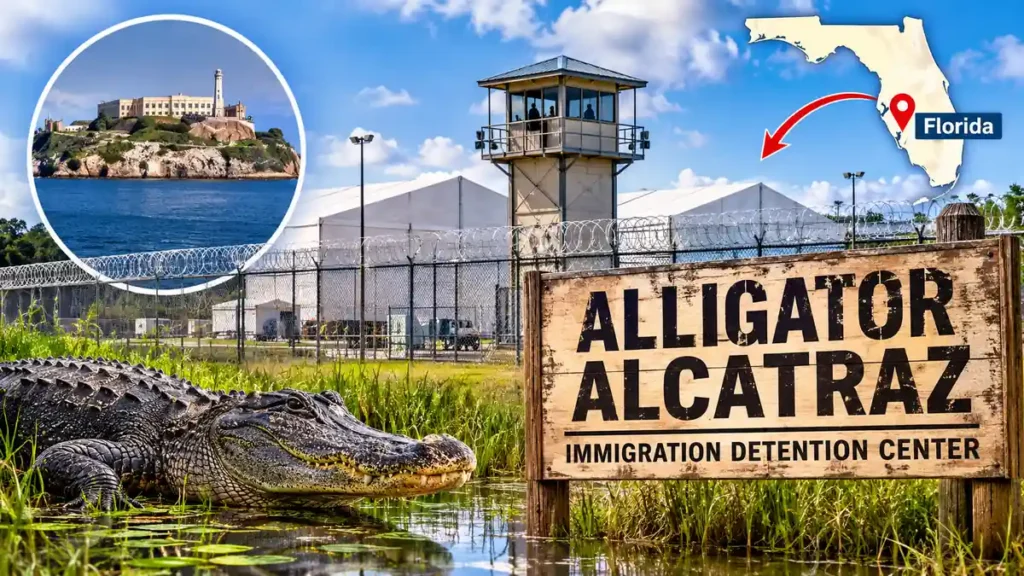
Deep in the Florida Everglades, a remote airstrip became the center of one of America’s most controversial immigration detention experiments. Nicknamed alligator alcatraz, the facility attracted national attention for its isolated location, rapid construction, detention conditions, environmental concerns, and legal challenges.
The story did not end when the facility closed in June 2026. Federal investigators subsequently documented serious deficiencies in living conditions, while litigation concerning its environmental impact continued.
Alligator Alcatraz was a temporary immigration detention facility established in July 2025 at the Dade-Collier Training and Transition Airport in South Florida’s Everglades region. Operated under Florida’s immigration enforcement initiative, it held immigration detainees until June 25, 2026. Its closure followed months of legal challenges, public criticism, and concerns about hurricane-season safety.
ABC News+2
What Was alligator alcatraz?
Alligator Alcatraz was a state-run immigration detention center developed as part of a broader effort to expand detention capacity during President Donald Trump’s second administration.
Unlike a conventional prison built with permanent concrete structures, the facility relied on temporary housing arrangements, including large tent-like buildings, trailers, fencing, and modular infrastructure.
It was designed to accommodate thousands of detainees in an isolated area of South Florida.
The facility’s purpose was to hold people in immigration custody while federal authorities processed immigration enforcement matters, including potential removal proceedings.
Although the site was commonly described as a prison, immigration detention is legally distinct from imprisonment following a criminal conviction. People may be detained for civil immigration violations without having been convicted of a crime.
Why Was It Called Alligator Alcatraz?
The nickname combined two recognizable references.
The first was the American alligator, a reptile associated with Florida’s freshwater wetlands. The surrounding Everglades landscape also supports snakes, including invasive Burmese pythons.
The second was Alcatraz, the former federal prison located on an island in San Francisco Bay.


6
The comparison emphasized geographical isolation and the perceived difficulty of escaping through surrounding wilderness.
However, the name was primarily political branding. It did not mean that the facility was part of the historic Alcatraz prison system or that alligators were an official security mechanism.
The wildlife-focused messaging also became controversial because critics argued that it trivialized the treatment of detained people.
Where Was Alligator Alcatraz Located?
The detention center operated at the Dade-Collier Training and Transition Airport, near Ochopee, in Collier County, Florida.
The airport sits along the Tamiami Trail corridor, west of the Miami metropolitan area, within the environmentally sensitive Everglades and Big Cypress region.
The surrounding landscape contains wetlands, wildlife habitat, and areas subject to seasonal flooding.
Its remote location was central to both the government’s operational approach and critics’ concerns about emergency access, environmental protection, and legal representation.
Why Was the Everglades Location Controversial?
The Everglades is not simply an isolated swamp. It is a complex ecological system supporting water flows, native plants, endangered wildlife, and communities whose livelihoods and cultural connections depend on the landscape.
Environmental organizations questioned whether converting the airport site into a large detention complex could damage the surrounding ecosystem.
Their concerns included increased vehicle traffic, artificial lighting, waste management, water use, and the possible effects of temporary construction on wetlands.
The facility was also situated in a region exposed to tropical storms and hurricanes.
These geographical conditions made evacuation planning, drainage, and infrastructure resilience especially important.
When Did Alligator Alcatraz Open and Close?
The facility opened in July 2025 and ceased detention operations on June 25, 2026.
Its operational life lasted less than one year, although the legal and political controversy surrounding it continued afterward.
Timeline of Major Events
| Date | Development |
|---|---|
| June 2025 | Florida moved forward with plans for a temporary immigration detention facility in the Everglades. |
| July 3, 2025 | The detention center opened. |
| July 2025 | Immigration advocates initiated legal challenges involving attorney access and due process. |
| August 2025 | A federal district judge ordered restrictions on further development and operations in an environmental lawsuit. |
| September 2025 | An appeals court paused the district court’s injunction. |
| January 2026 | Federal inspectors conducted an unannounced inspection of detention conditions. |
| April 2026 | An appellate ruling addressed the dispute over federal environmental review requirements. |
| June 25, 2026 | The facility stopped holding detainees. |
| September 14, 2026 | A federal watchdog report publicly detailed serious deficiencies in detention conditions. |
The timeline illustrates how quickly the project developed and how its legal disputes extended beyond its period of operation.
American Civil Liberties Union+2
Is alligator alcatraz Still Open in 2026?
No. As of October 2026, Alligator Alcatraz is no longer operating as an immigration detention center.
Florida Governor Ron DeSantis announced its closure in June 2026, and detainees were transferred to other facilities.
Subsequent reporting documented the removal of temporary structures and generators from the site.
The end of detention operations did not automatically resolve every lawsuit or question concerning the facility’s construction and management.
ABC News+1
Why Was Alligator Alcatraz Built?
The detention center emerged during a period of expanded federal immigration enforcement.
The Trump administration sought additional capacity to detain people while immigration authorities handled removal cases and other enforcement actions.
Florida officials promoted the Everglades project as a way to establish detention space quickly using an existing airport site.
How Did the Facility Operate?
The facility combined state administration with federal immigration enforcement responsibilities.
Florida officials managed day-to-day operations, while U.S. Immigration and Customs Enforcement (ICE) had responsibilities involving people held under federal immigration authority.
This arrangement raised questions about oversight.
The Department of Homeland Security (DHS) later argued that Florida was responsible for daily operations. However, the DHS Office of Inspector General identified federal involvement and emphasized that facilities holding ICE detainees must meet applicable detention standards.
The division of responsibilities became a central issue in evaluating accountability for detention conditions.
WJXT+1
How Many People Could It Hold?
The facility was designed for large-scale detention, with a planned capacity of at least 3,000 people.
Actual occupancy varied during its operation.
In litigation concerning access to legal counsel, the American Civil Liberties Union (ACLU) reported that approximately 700 people were being held at the facility around the time of its initial legal challenge.
Later federal inspection findings described conditions affecting a substantially larger detained population.
It is therefore important to distinguish planned capacity from actual occupancy on a particular date.
ACLU of Florida+1
What Were Conditions Like Inside Alligator Alcatraz?
Conditions inside the facility became one of the most extensively documented controversies.
Former detainees, attorneys, advocacy organizations, and journalists reported concerns about sanitation, heat, crowding, medical access, and opportunities to communicate with lawyers.
In September 2026, the DHS Office of Inspector General released findings from an unannounced January inspection.
The report provided independent federal documentation of several problems that advocates had previously described.
Overcrowded Housing Areas
Inspectors found detainees living in cramped, windowless housing units.
The report identified approximately 28 square feet of living space per detainee, compared with a cited federal standard of 75 square feet.
Housing areas contained rows of bunk beds separated by fencing.
The lack of natural light and limited personal space raised concerns about physical and psychological well-being.
Showers and Drinking Water
Federal inspectors also documented hygiene problems.
Detainees reported that they could shower only three times per week, and inspectors observed insects in shower facilities.
Some detainees said drinking water was dirty or inadequate. Inspectors also noted problems with cleaning and storing reusable drinking cups.
These findings were particularly concerning because Florida’s hot, humid environment increases the importance of sanitation and reliable access to drinking water.
Medical Care and Recreation
The watchdog report identified deficiencies involving medical care, recreation, and other aspects of daily living.
Some detainees had less recreational access than applicable standards required.
Inspectors also reported concerns about the availability of legal materials.
Such limitations can have practical consequences for detainees trying to understand their immigration proceedings or communicate with legal representatives.
What Were the Small Metal Enclosures?
One of the most significant findings concerned individual metal enclosures used within the detention facility.
The DHS inspector general found that 79 detainees had been confined in enclosures measuring approximately 18 square feet between July 2025 and January 2026.
Some remained there for nearly two hours.
Facility staff described these structures as areas intended to calm detainees. Investigators, however, questioned their use and found that the practice did not align with humane-treatment standards.
The report also raised concerns that the enclosures may have been used for disciplinary purposes.
DHS disputed broader allegations of inhumane detention conditions, while Florida officials maintained that the state followed applicable confinement standards.
The inspector general’s findings nevertheless established that significant operational deficiencies existed.
AP News+2
What Legal Challenges Did Alligator Alcatraz Face?
Alligator Alcatraz faced multiple legal challenges addressing different issues.
Some concerned the rights of detainees, while others questioned the government’s authority to operate the facility or its compliance with environmental laws.
These cases should not be treated as one lawsuit because they involved different legal arguments and procedural outcomes.
Access to Lawyers and Due Process
Immigration rights organizations challenged restrictions on communication between detainees and their attorneys.
The ACLU and other legal advocates argued that individuals held at the facility experienced serious barriers to obtaining legal assistance.
Reported problems included limited telephone access, inadequate opportunities for confidential attorney-client conversations, and difficulties accessing immigration proceedings.
Some detainees also faced uncertainty about custody decisions and bond hearings.
These issues matter because immigration detention does not eliminate a person’s procedural rights.
Even when the government has legal authority to detain someone, that authority remains subject to constitutional and statutory requirements.
The case known as H.C.R. v. Noem became a significant challenge involving legal access and due process.
ACLU of Florida+1
Questions About Florida’s Authority
Another lawsuit, M.A. v. Guthrie, challenged Florida’s asserted authority to operate the detention center under immigration enforcement agreements.
A central issue involved Section 287(g) of the Immigration and Nationality Act.
This provision permits certain immigration enforcement functions to be delegated to qualifying state and local officers under agreements with federal authorities.
The legal dispute questioned whether those agreements authorized the particular detention arrangement used in Florida.
The distinction was important because cooperation with federal immigration enforcement does not necessarily establish unlimited state authority over immigration detention operations.
ACLU of Florida
Environmental Litigation
Environmental organizations separately challenged the facility’s development.
Their arguments focused on environmental review requirements and potential impacts on protected lands and ecosystems.
In August 2025, a federal district judge issued an injunction affecting the facility’s operations and development.
An appellate court subsequently paused that order.
In April 2026, the Eleventh Circuit ruled against the argument that the state-run project required the federal environmental review sought in that litigation.
Other environmental questions continued to attract attention after the detention center closed.
The overall legal history therefore involved mixed judicial outcomes rather than a single ruling declaring every aspect of the project lawful or unlawful.
Unredacted+1
How Did Alligator Alcatraz Affect the Everglades?
The environmental debate extended beyond the footprint of the detention structures.
The Florida Everglades forms part of a wider network of wetlands and water-management systems that influence ecosystems across South Florida.
Big Cypress National Preserve, located in the surrounding region, provides habitat for numerous species and plays an important role in regional water movement.
Wildlife and Habitat Concerns
Environmental advocates worried that the facility could disturb sensitive wildlife habitat.
Potential impacts included artificial lighting, construction activity, increased traffic, and changes in waste-handling requirements.
Wildlife associated with the region includes American alligators, wading birds, and the endangered Florida panther.
However, the presence of wildlife near the facility does not itself establish that construction caused measurable harm to a particular species.
Determining ecological damage requires evidence such as habitat assessments, water-quality testing, and monitoring.
Water and Waste Management
Large temporary detention facilities require substantial sanitation infrastructure.
They must provide drinking water, wastewater management, food storage, and reliable electricity.
These needs become especially complicated in wetland environments where flooding and drainage conditions may affect operations.
Environmental groups argued that the project should have undergone more extensive review before development.
Officials defended the project and disputed the legal basis for the environmental challenges.
Why Did Environmental Litigation Continue After Closure?
Removing detainees does not necessarily eliminate environmental concerns.
Temporary construction can leave behind disturbed land, infrastructure, waste-management questions, or restoration obligations.
Environmental organizations therefore continued pursuing litigation after the facility stopped operating.
In August 2026, public reporting confirmed that temporary structures had been dismantled while legal questions concerning environmental impacts remained unresolved.
Earthjustice+1
How Much Did Alligator Alcatraz Cost?
The facility’s financing became another subject of scrutiny.
Costs associated with a detention project can include site preparation, temporary housing, security, transportation, food, medical services, utilities, staffing, and eventual removal of infrastructure.
It is important to separate authorized funding from money actually paid.
According to reporting on the DHS inspector general’s findings, the Federal Emergency Management Agency (FEMA) obligated approximately $608.4 million to the Florida Division of Emergency Management for the temporary facility in September 2025.
The same reporting stated that $58.3 million had been disbursed by May 15, 2026, for eligible operational costs.
These figures describe different financial stages and should not be treated as interchangeable measures of total expenditure.
WJXT
Why Was the Spending Controversial?
Critics questioned whether establishing a remote temporary facility represented an efficient use of public funds.
Operating in an isolated area created logistical requirements involving transportation, utilities, staffing, and emergency planning.
Supporters emphasized the need for additional detention capacity and the speed with which the site could be prepared.
A complete financial assessment would need to account for actual expenditures, contractual commitments, unused appropriations, and any restoration costs.
The publicly reported funding figures alone do not establish the final total cost per detainee.
Why Did Alligator Alcatraz Close?
Alligator Alcatraz stopped holding detainees on June 25, 2026.
The closure occurred against a background of lawsuits, public criticism, and concerns about conditions at the facility.
Hurricane-season risks were also a significant factor.
Federal officials indicated that detainees were transferred to other locations because of concerns associated with severe weather.
Did a Court Order Shut It Down?
It would be inaccurate to attribute the final closure solely to one court order.
Environmental litigation produced injunctions, appeals, and later rulings that complicated the project’s legal position.
However, the June 2026 shutdown was also associated with operational decisions and hurricane-related safety concerns.
The facility’s closure and the outcomes of its lawsuits were related developments, but they were not identical events.
What Happened to the Detainees?
People held at the facility were transferred to other detention locations.
The shutdown therefore did not mean that every detainee was released from immigration custody.
Their individual legal circumstances depended on immigration proceedings, custody determinations, and other applicable decisions.
Following the transfers, the site ceased functioning as the detention complex that had attracted national attention.
ABC News+2
What Did the September 2026 Federal Investigation Reveal?
The September 2026 watchdog report became an important development because it provided official findings about conditions inside the now-closed facility.
Earlier reports had relied heavily on testimony from detainees, attorneys, and advocacy organizations.
The DHS Office of Inspector General independently examined the facility and identified deficiencies in multiple operational areas.
| Area examined | Reported finding |
|---|---|
| Living space | Cramped, windowless housing areas with inadequate personal space |
| Individual enclosures | Approximately 18-square-foot metal structures used to hold detainees |
| Hygiene | Insect-infested showers and insufficient shower access |
| Drinking water | Complaints about water cleanliness and sanitation |
| Recreation | Insufficient opportunities for exercise and outdoor activity |
| Legal access | Inadequate access to legal information and materials |
| Food safety | Concerns involving food-storage temperatures |
| Oversight | Questions about which detention standards were being applied |
The report also documented that 79 detainees had been placed in the small metal enclosures during the period examined.
Inspectors found that these practices and other conditions presented risks inconsistent with relevant detention standards.
The inspection was limited in scope and did not independently establish every allegation made during the facility’s operation.
Nevertheless, its findings supported several previously reported concerns about detention conditions.
Federal and state officials disputed characterizations that the facility was broadly inhumane, illustrating the continuing disagreement over responsibility and compliance.
Axios Miami+2
How Was Alligator Alcatraz Different From a Traditional Detention Center?
The facility differed from many established detention centers in its location, construction, and operational arrangement.
| Feature | Alligator Alcatraz | Conventional permanent detention facility |
|---|---|---|
| Location | Remote Everglades airport | Varies, often near established infrastructure |
| Buildings | Primarily temporary structures | Usually permanent buildings |
| Development | Rapid deployment | Typically longer planning and construction |
| Administration | Florida-run arrangement involving federal immigration authorities | Federal, local, or contracted operation |
| Environmental setting | Sensitive wetland region | Depends on the facility |
| Weather exposure | Significant tropical storm and flooding concerns | Varies by location |
| Legal controversy | Multiple challenges involving detention authority, rights, and environmental review | Depends on individual facility |
These differences do not mean that every conventional detention center provides adequate conditions.
Permanent facilities can also face overcrowding, medical-care deficiencies, and legal challenges.
What made Alligator Alcatraz distinctive was the combination of temporary construction, state-level administration, environmental sensitivity, and the intense political attention surrounding its creation.
What Is the Lasting Significance of Alligator Alcatraz?
Alligator Alcatraz became a prominent example of the challenges involved in rapidly expanding immigration detention infrastructure.
Its history raises several broader questions.
One concerns government accountability. When state and federal agencies share responsibilities, clear oversight is essential to establish which authority must ensure compliance with detention standards.
Another concerns legal access. Remote facilities may create additional obstacles for attorneys, families, and people seeking information about detained relatives.
The environmental controversy highlights the difficulty of balancing rapid infrastructure development with protections for sensitive ecosystems.
Finally, the September 2026 inspection findings demonstrated why independent oversight remains important even after a controversial facility has closed.
A shutdown may end current operations, but it does not erase questions about past conditions, financial accountability, or the rights of people who were held there.
Conclusion
The story of alligator alcatraz began with the rapid construction of an immigration detention center in the Florida Everglades in July 2025 and continued through its closure in June 2026.
During its brief operation, the facility became a national controversy involving immigration enforcement, detention conditions, environmental protection, legal authority, and government spending.
The September 2026 federal watchdog report added substantial evidence about deficiencies in living conditions and detention practices.
As of October 2026, the facility remains closed, but its broader significance continues through legal proceedings, public oversight, and debates about how immigration detention centers should be established and managed.
Understanding Alligator Alcatraz requires looking beyond its memorable nickname to the documented experiences of detainees, the responsibilities of government agencies, and the legal and environmental questions that its operation left behind.