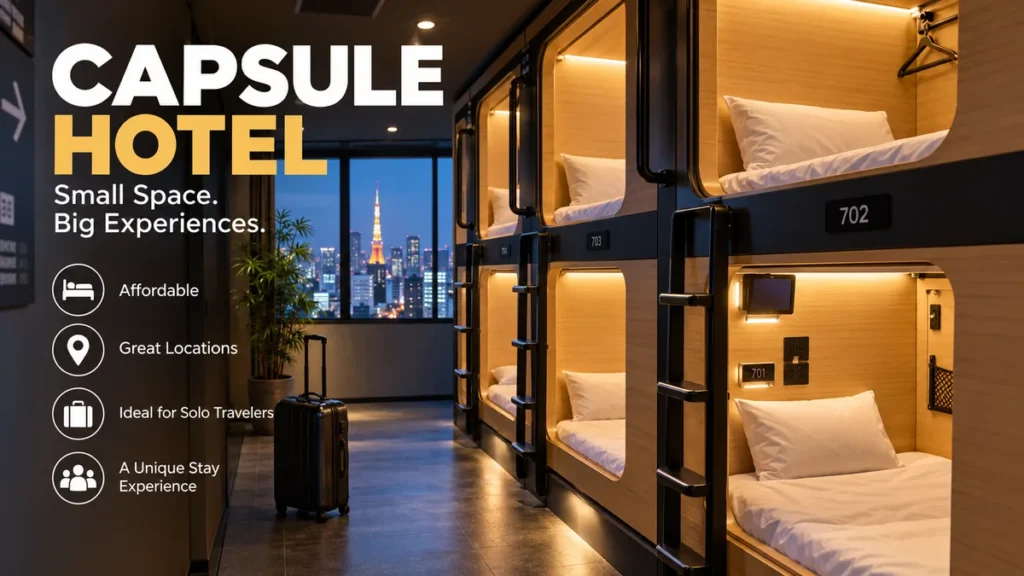
A capsule hotel can look like something from a science-fiction movie: rows of compact sleeping pods stacked neatly along a corridor. Yet the idea behind it is surprisingly practical. You get a private place to sleep without paying for the space and facilities of a conventional hotel room.
Born in Japan, capsule hotels were originally designed as convenient overnight accommodation for workers and travelers who needed little more than a comfortable bed. Today, modern versions range from basic budget pods to stylish cabins with Wi-Fi, charging ports, lounges, coworking spaces, saunas, and upgraded bedding.
A capsule hotel is a type of accommodation where guests sleep in individual, bed-sized pods rather than conventional private rooms. Capsules typically contain a mattress, light, electrical outlet, and privacy screen, while bathrooms, showers, lockers, and lounges are shared. The concept originated in Osaka, Japan, in 1979.
Understanding how these hotels actually operate makes it much easier to decide whether sleeping in a pod will feel efficient and comfortable—or simply too confined.
What Is a Capsule Hotel?
A capsule hotel, sometimes called a pod hotel, replaces a conventional guest room with a compact sleeping compartment designed primarily for one person.
Instead of entering a room containing a bed, desk, bathroom, wardrobe, and other furniture, you enter a small pod containing essentially everything necessary for sleeping.
Capsules are commonly arranged side by side and stacked two levels high.
A typical traditional capsule is roughly:
| Feature | Typical Arrangement |
|---|---|
| Width | Around 1–1.2 meters |
| Length | Around 2 meters |
| Height | Around 1 meter |
| Capacity | Usually one person |
| Bed | Single mattress or futon |
| Bathroom | Shared |
| Luggage storage | Locker or separate storage area |
| Privacy | Curtain, blind, shutter, or door depending on property |
| Wi-Fi | Common in modern properties |
| Power | Usually available inside the pod |
Japan-guide describes a traditional unit as approximately 1.2 meters wide, two meters long, and one meter high, built around a single-size futon mattress.
That means you normally have enough room to lie comfortably and sit up to some degree, but not enough space to walk around.
This distinction matters. A capsule isn’t simply a very small hotel room.
It is a private sleeping space within a hotel containing shared facilities.
Why Are Capsule Hotels So Small?
The format makes efficient use of expensive urban space.
Instead of dedicating substantial floor area to every traveler, the property concentrates sleeping areas into compact pods while moving bathrooms, lounges, luggage storage, dining areas, and other facilities into shared spaces.
For travelers who spend most of their day exploring a city and only return to sleep, paying for a large private room may seem unnecessary.
This combination of privacy, efficiency, and relatively low cost explains much of the concept’s appeal.
Where Did the Capsule Hotel Concept Come From?
The modern capsule hotel is a Japanese invention.
The world’s first widely recognized capsule hotel, Capsule Inn Osaka, opened in Osaka’s Umeda district in 1979. It was designed by Japanese architect Kisho Kurokawa.
Kurokawa was associated with Japan’s Metabolist architectural movement, which explored modular structures capable of adapting to changing urban life.
His interest in capsule architecture actually predates the hotel.
The famous Nakagin Capsule Tower, completed in Tokyo in 1972, used prefabricated modular units attached to structural cores. Although it was a residential and mixed-use architectural experiment rather than a capsule hotel, it demonstrated many of the compact-living ideas later associated with capsule accommodation. The tower was eventually dismantled in 2022.
Why Were Capsule Hotels Created?
Early capsule hotels served a very practical group: urban workers.
Japan’s large cities developed extensive commuter rail systems, and workers who stayed in the city after the final train sometimes needed inexpensive accommodation for one night.
Rather than paying for a conventional hotel, a worker could rent a sleeping capsule.
Official Japanese tourism information notes that capsule hotels were traditionally associated particularly with businessmen and “salarymen” who missed their last train home.
The audience is much broader now.
International tourists, backpackers, solo travelers, business travelers, event attendees, and people needing convenient accommodation near railway stations or airports may all use them.
Capsule-style accommodation has also spread beyond Japan to other parts of Asia, Europe, North America, and elsewhere.
Quick Takeaway: Capsule hotels were created around efficiency rather than luxury. Modern properties may feel sophisticated, but the central idea remains the same: give each guest a private sleeping space while sharing facilities that don’t need to be inside every room.
What Is Inside a Capsule Hotel Pod?
Open a traditional capsule and the first thing you’ll see is the bed. Nearly everything else is arranged around it.
Common features include:
- Mattress or futon
- Pillow and bedding
- Reading or ceiling light
- Electrical outlet
- USB charging port at newer properties
- Small shelf
- Alarm clock or control panel
- Wi-Fi access
- Ventilation or air-conditioning outlet
- Privacy curtain, shutter, blind, or door
- Television at some properties
Older Japanese capsules are often associated with built-in televisions and radios, while newer hotels increasingly emphasize charging facilities, lighting controls, better mattresses, and minimalist interiors.
The exact setup varies substantially between properties.
Some capsules are extremely basic. Others resemble miniature cabins and may provide taller ceilings, wider beds, desks, premium bedding, or enough room to stand beside the bed.
Can You Stand Inside a Capsule?
Usually not in a traditional capsule.
The classic pod is intended for sleeping rather than walking around. With a height around one meter, it generally provides enough space to crawl inside, lie down, turn over, and sit partially upright.
However, the boundaries between a capsule, pod, and compact cabin have become less rigid.
Premium concepts may provide considerably more vertical and floor space. Some modern accommodations market larger “cabins” that preserve the shared-hotel concept while providing more room than a traditional fiberglass capsule.
Does a Capsule Have a Bathroom?
Generally, no.
Bathrooms are normally shared.
Guests leave their sleeping area to use communal toilets, sinks, and showers. Traditional Japanese capsule hotels may also provide a sento-style communal bath, sauna, or other bathing facilities.
This is one of the biggest differences between a capsule hotel and a standard hotel.
If having a private bathroom is essential to you, always check the property’s facilities rather than assuming your pod includes one.
How Does a Capsule Hotel Work?
Checking into a capsule hotel isn’t difficult, although the process can initially feel unfamiliar.
A traditional Japanese property may operate approximately like this:
- Check in at reception or a self-service kiosk.
You receive your capsule assignment and information about the hotel’s facilities. - Store your shoes if required.
Some Japanese properties provide dedicated shoe lockers near the entrance. - Put luggage in the assigned storage area.
Your sleeping capsule usually isn’t designed for a suitcase. - Use the shared changing or bathing facilities.
Towels, soap, shampoo, toothbrushes, slippers, or nightwear may be supplied depending on the hotel. - Use lounges and dining spaces for activities not allowed in sleeping areas.
Food and drinks may be restricted inside capsules. - Enter your assigned pod when you’re ready to sleep.
- Keep noise to a minimum.
Sleeping areas are communal environments even though individual pods provide visual privacy. - Check out according to the property’s rules.
Traditional properties sometimes require guests staying multiple nights to leave the sleeping area or remove their belongings during daytime cleaning periods, although policies vary.
Modern hotels can work differently. Some have automated check-in, electronic lockers, keycards, smartphone access, 24-hour lounges, and more flexible multi-night arrangements.
Read the property’s rules before assuming the traditional system applies.
Where Do You Put Your Luggage?
One of the most common first-time mistakes is imagining that your suitcase will sit beside your bed.
There may be nowhere to put it.
Capsule hotels typically provide an assigned locker for clothing and personal belongings. Large suitcases may instead need to go into a dedicated luggage room, oversized locker, or reception storage area.
A practical approach is to separate what you need overnight before entering the sleeping area.
Keep essentials together:
- Phone
- Charger
- Earplugs
- Sleep mask
- Medication
- Toiletries
- Clean clothes
- Passport and valuables where appropriate
- Small personal items
This saves you from repeatedly opening lockers or reorganizing a suitcase late at night when other guests are sleeping.
Capsule Hotel Bathrooms, Showers, and Shared Facilities
Shared facilities are fundamental to the capsule model.
Instead of building dozens of tiny private bathrooms, the hotel centralizes them.
Depending on the property, you might find:
Toilets and Sinks
These are generally located away from the sleeping pods and shared by multiple guests.
Well-designed properties may provide several toilet and sink areas on each floor.
Showers
Private shower cubicles are common at contemporary properties.
Shampoo, body wash, and other basic toiletries are frequently supplied, although inclusions differ from one hotel to another.
Communal Baths
Traditional Japanese establishments may have larger bathing areas where guests wash themselves before entering a shared bath.
Foreign visitors unfamiliar with Japanese bathing etiquette should check the property’s instructions before entering.
Lockers
Most hotels provide lockers because the sleeping pod itself isn’t intended to function as a secure luggage room.
Lounges
A lounge gives guests somewhere to work, eat, talk, or simply spend time outside the sleeping area.
More elaborate properties can also contain:
- Restaurants
- Cafés
- Vending machines
- Coin laundry
- Coworking areas
- Manga libraries
- Entertainment rooms
- Saunas
- Public baths
Japan-guide notes that restaurants, vending machines, laundry facilities, lounges, game rooms, and manga libraries can all be found at some properties.
Quick Takeaway: The pod is only one part of the experience. When comparing capsule hotels, look closely at the quality of the showers, lockers, lounge, ventilation, luggage storage, and other shared facilities.
How Much Does a Capsule Hotel Cost?
Price depends heavily on city, location, property quality, day of the week, season, and demand.
Official Tokyo tourism guidance gives a general range of roughly ¥2,000–¥5,000 per night, while Japan-guide places typical rates around ¥3,000–¥5,000. Premium or themed properties can cost more.
Treat those numbers as broad reference points rather than guaranteed prices.
A pod near a major railway station during a quiet period can have a very different rate from a premium capsule during a festival, holiday, or peak tourism period.
Why Are Capsule Hotels Often Cheaper?
The economics are fairly straightforward.
A standard hotel dedicates substantial floor space to each room. Every room may need its own bathroom, furniture, storage, and circulation space.
Capsule properties place more sleeping units within the same building area and centralize many facilities.
Guests sacrifice space and some privacy in exchange for potentially lower accommodation costs.
That trade-off works particularly well for travelers who mainly need somewhere clean and convenient to sleep.
Capsule Hotel vs Hostel: What’s the Difference?
Capsule hotels and hostels are both associated with budget travel, but sleeping arrangements can be quite different.
| Feature | Capsule Hotel | Hostel Dorm |
|---|---|---|
| Sleeping space | Enclosed or semi-enclosed pod | Usually open bunk bed |
| Visual privacy | Generally higher | Usually lower |
| Bathrooms | Usually shared | Usually shared |
| Social atmosphere | Often quieter | Often more social |
| Luggage | Locker/storage area | Locker or dorm storage |
| Room space | Very limited inside pod | Shared dormitory space |
| Typical guest | Solo traveler | Solo travelers and groups |
| Main emphasis | Privacy + efficient sleeping | Budget + communal experience |
A hostel dorm normally places multiple beds inside one shared room.
A capsule hotel gives each guest a more clearly defined personal sleeping enclosure.
That doesn’t necessarily mean complete privacy. You’ll still hear people moving around the corridor, opening lockers, setting alarms, coughing, snoring, or getting ready in the morning.
But visually, a capsule can feel substantially more private than an exposed bunk.
Capsule Hotel vs Regular Hotel
The difference becomes even clearer with conventional accommodation.
A regular hotel room generally gives you a private room and often a private bathroom. You can walk around, unpack luggage, work at a desk, speak normally, and spend substantial time in the room.
A capsule is primarily a sleeping compartment.
Choose a conventional hotel when private space matters more than compactness or cost. Choose a pod when you’re comfortable sharing facilities and mainly need a convenient place to sleep.
Are Capsule Hotels Safe?
Well-managed capsule hotels can provide secure accommodation, but their security setup is different from a conventional private room.
The crucial point is that your capsule should not be treated as your safe.
Traditional Japanese capsules may close with a curtain, shutter, or non-locking door rather than functioning like a lockable conventional hotel room. Official Tokyo guidance specifically advises that belongings are generally kept in the locker provided by the hotel.
For better security:
- Put valuables in the designated secure locker.
- Use reception storage when necessary.
- Don’t leave a passport, wallet, cash, or expensive electronics unattended in an open pod.
- Check whether lockers can accommodate your luggage.
- Learn how floor and elevator access works.
- Confirm whether sleeping areas are gender-separated if that matters to you.
- Follow the property’s security procedures.
Some modern hotels use keycards or electronic systems to restrict access to sleeping floors and locker areas.
Safety therefore depends less on the word “capsule” and more on the particular hotel’s management, access controls, storage arrangements, location, and guest policies.
Are Capsule Hotels Only for Men?
Historically, many Japanese capsule hotels primarily served male business travelers.
That is no longer universally true.
Today you’ll find properties that accept men and women, dedicated female-only accommodation, and hotels with separate male and female sleeping floors or areas.
Arrangements vary significantly.
A property might be:
- Men-only
- Women-only
- Mixed
- Mixed with gender-separated floors
- Mixed with separate sleeping sections
- A combination of private cabins and standard pods
Never assume from the hotel’s appearance alone.
Check the room or pod category carefully, particularly when traveling as a couple. Two people may not necessarily be able to sleep next to each other, even when the property accepts guests of all genders.
Can Two People Sleep in One Capsule?
A standard capsule is usually intended for one guest.
Even if two people could physically squeeze into a pod, hotel rules generally assign individual capsules to individual guests.
Couples should expect to reserve two sleeping spaces unless the property specifically offers double pods or larger cabins.
This is another reason capsule hotels work particularly well for solo travel.
Friends and couples can still stay at the same property, but the experience isn’t equivalent to sharing a private double hotel room.
How Private Is a Capsule Hotel?
The answer depends on what you mean by privacy.
Visual Privacy
Usually good.
Closing the curtain, blind, or approved door separates you visually from people walking through the sleeping area.
Acoustic Privacy
Usually limited.
The walls between capsules do not necessarily provide the sound isolation of conventional hotel rooms.
You may hear:
- Snoring
- Alarms
- Footsteps
- Zippers
- Locker doors
- People entering or leaving
- Early-morning packing
- Ventilation systems
If you’re a light sleeper, earplugs can be one of the most useful things you pack.
Bathroom Privacy
Bathrooms are communal, but individual shower cubicles may provide privacy.
Properties with Japanese communal baths may involve shared bathing, so travelers uncomfortable with that arrangement should look for hotels offering individual showers.
What Are Capsule Hotels Like for Claustrophobic Travelers?
This deserves more attention than it often receives.
A traditional capsule is genuinely small.
Although one side opens onto a corridor and ventilation is provided, being surrounded closely by walls and ceiling can feel uncomfortable for someone who dislikes confined spaces.
Pictures can also be misleading. A wide-angle photograph may make a pod look considerably larger than it feels once you’re inside.
Before booking, check:
- Capsule dimensions
- Ceiling height
- Entrance size
- Ventilation
- Whether the front uses a curtain or more substantial enclosure
- Reviews mentioning heat or airflow
- Availability of larger cabins
People with significant claustrophobia may be more comfortable in a hostel private room, ordinary hotel, or larger cabin-style property.
Saving money isn’t worthwhile if the sleeping environment prevents you from sleeping.
Can You Stay in a Capsule Hotel for Several Nights?
Yes, many properties allow multi-night reservations, but the experience is best understood as short-stay accommodation.
Some traditional hotels may require guests to check out temporarily or remove belongings during daytime cleaning, even when returning for another night. Japan-guide notes that this practice exists at some capsule hotels.
Other modern properties operate much more like conventional hotels and permit straightforward consecutive-night stays.
For one or two nights, limited personal space may barely matter.
After several days, however, repeatedly dressing from a locker, reorganizing luggage, using communal bathrooms, and lacking a private room can become tiring.
Longer stays are usually more comfortable when the property has a spacious lounge, reliable luggage storage, laundry facilities, and generous shower areas.
Capsule Hotel Etiquette: Rules First-Time Guests Should Know
The sleeping floor may contain dozens of people trying to rest within a relatively small area.
Small disturbances can therefore become big annoyances.
Keep Noise Down
Avoid phone calls, loud conversations, videos without headphones, and noisy packing inside the sleeping area.
Use lounges for conversations.
Don’t Treat the Pod Like a Dining Room
Many properties prohibit eating inside capsules.
Food smells and crumbs are particularly disruptive in compact sleeping areas. Official Japanese tourism guidance recommends respecting individual property rules and notes that food may be prohibited inside pods.
Use Headphones
If your capsule includes a television or you’re watching something on your phone, headphones are essential.
Set a Sensible Alarm
An alarm that rings repeatedly can wake an entire row of guests.
Keep the volume reasonable and turn it off promptly.
Pack Quietly
Prepare tomorrow’s clothing before going to bed.
Searching through plastic bags and repeatedly opening luggage at 5 a.m. is an easy way to disturb everyone nearby.
Respect Photography Rules
Capsule interiors are unusual, so visitors naturally want photos.
But sleeping and bathing areas are private environments. Never photograph other guests without permission, and follow hotel restrictions.
Learn Bathing Etiquette
If the hotel has a Japanese communal bath, wash thoroughly before entering the shared bath itself.
The bathing area isn’t a swimming pool; its purpose and etiquette are different.
Quick Takeaway: The most useful capsule hotel rule is simple: behave as though someone is sleeping a few feet away—because someone probably is.
What Are the Advantages of a Capsule Hotel?
The concept survives because it solves several real travel problems efficiently.
Lower Accommodation Costs
Capsules can cost less than conventional rooms, particularly in expensive urban areas.
Convenient Locations
Properties are commonly found near major railway stations and city centers, especially in Japan.
That can make them useful after late arrivals, before early departures, or during short city visits.
More Privacy Than Many Hostel Dorms
You don’t necessarily have your own room, but the enclosed sleeping area gives you a personal boundary.
For some solo travelers, that’s an appealing compromise between a hostel bunk and a private hotel room.
Useful Amenities
A relatively inexpensive property can still provide Wi-Fi, toiletries, showers, pajamas, lockers, lounges, laundry facilities, or baths.
Efficient for Short Trips
If you’ll spend 14 hours exploring and eight hours sleeping, a large room may provide little practical value.
A Distinctive Japanese Experience
Although pod hotels now exist internationally, capsule accommodation remains strongly associated with Japanese urban culture and design.
For many visitors, spending a night in one is part accommodation and part travel experience.
What Are the Disadvantages?
The trade-offs are equally real.
Very Little Personal Space
Your capsule is essentially your bed.
Anyone who likes unpacking, exercising, working, or relaxing privately in their room may find this frustrating.
Shared Bathrooms
Even excellent communal facilities aren’t the same as having your own bathroom.
Noise
Visual privacy does not equal soundproofing.
A single loud sleeper can affect several nearby pods.
Luggage Can Be Inconvenient
Large suitcases may need separate storage.
Constantly retrieving belongings becomes annoying if you’re poorly organized.
Limited Suitability for Couples and Families
The format is primarily optimized for individual sleepers.
Families with young children and couples wanting shared private space will usually find conventional accommodation easier.
Potential Claustrophobia
A one-meter-high sleeping enclosure isn’t comfortable for everyone.
Rules Can Be More Restrictive
Food, phone calls, luggage, bathing, daytime access, and check-in procedures may be regulated more closely than in a private hotel room.
Who Should Stay in a Capsule Hotel?
A capsule hotel tends to work particularly well for:
Solo travelers who value a private sleeping enclosure but don’t need an entire room.
Budget-conscious visitors who prefer spending money on experiences rather than accommodation.
Short-stay travelers who only need a bed for one or two nights.
Business travelers who want practical accommodation near transport hubs.
Late-night travelers who need somewhere convenient after missing transport.
Early-departure travelers staying near stations or airports.
Curious visitors to Japan who want to experience a distinctive form of Japanese accommodation.
It may be less suitable for:
- People with strong claustrophobia
- Very light sleepers
- Families with children
- Travelers carrying extensive luggage
- Couples wanting to share a bed
- Anyone requiring a private bathroom
- Travelers who spend significant time relaxing inside their room
- People who need a quiet private workspace
Neither choice is inherently better. The right accommodation depends on what you actually need from the room.
How to Choose a Good Capsule Hotel
Not all pods are equal.
The bed itself receives most of the attention in photographs, but practical details elsewhere in the property often determine whether you have a good night.
1. Check the Capsule Dimensions
Don’t rely solely on photos.
Compare width, length, and height if measurements are available. Taller or wider pods can make a substantial difference.
2. Look at the Privacy Setup
Is there a curtain, blind, shutter, or cabin-style entrance?
Understand exactly how your sleeping space closes and what security system protects the sleeping floor.
3. Check Luggage Storage
This is particularly important if you’re traveling with a full-size suitcase.
Find out:
- Locker dimensions
- Whether oversized bags are accepted
- Whether luggage storage is free
- Whether you can access stored luggage overnight
4. Read Comments About Noise
Look beyond the overall review score.
Guest comments about snoring, alarms, doors, ventilation, and corridor noise tell you more about sleeping conditions.
5. Check the Bathroom Arrangement
Find out whether the property provides individual showers, communal baths, or both.
6. Confirm Gender Policies
Make sure you’ve selected the correct floor or pod category.
This matters particularly for couples trying to stay at the same property.
7. Check Daytime Access
For a multi-night stay, find out whether you can remain in your capsule during the day.
8. Examine the Location
Being close to a station can be more valuable than saving a small amount at a property far from public transportation.
9. Look for Ventilation Reviews
A beautiful pod becomes uncomfortable quickly if it feels hot or stuffy.
10. Compare the Whole Property, Not Just the Pod
A basic capsule with an excellent lounge, clean showers, secure lockers, and good ventilation can provide a better experience than a stylish pod surrounded by poor communal facilities.
What Should You Bring to a Capsule Hotel?
One attraction of Japanese capsule hotels is that many provide more toiletries than travelers expect.
Depending on the property, towels, shampoo, body wash, toothbrushes, slippers, and even pajamas or yukata may be available.
Still, a few personal items can improve the experience considerably.
Consider bringing:
- Earplugs
- Sleep mask
- Charging cable
- Compact power adapter for international travel
- Small overnight bag
- Personal toiletries
- Medication
- Comfortable sleepwear if none is supplied
The two most useful items for many first-timers are simple: earplugs and a small overnight bag.
They solve two of the format’s most common inconveniences—noise and luggage organization.
Are Capsule Hotels Clean?
The capsule format itself doesn’t determine cleanliness.
Cleanliness depends on hotel management, cleaning schedules, building condition, guest behavior, and maintenance.
The design does, however, make regular turnover particularly important because many guests use the same shared showers, toilets, sinks, and lounges.
When assessing a property, pay attention to recent reviews discussing:
- Bedding
- Bathrooms
- Shower areas
- Odors
- Ventilation
- Lockers
- Towels
- Common spaces
Recent cleanliness comments are usually more useful than assumptions based on whether a property is categorized as a capsule hotel, hostel, or regular hotel.
Do Capsule Hotels Have Wi-Fi and Electricity?
Modern properties commonly provide both.
Wi-Fi is widely offered, and capsules frequently contain electrical outlets for charging devices. Traditional capsules may also contain televisions, while newer designs increasingly provide USB ports, adjustable lighting, or bedside controls.
Don’t assume every pod has identical technology, though.
If you need to charge several devices, work remotely, or use a specific electrical setup, verify the facilities before arriving.
A lounge or coworking area is generally much better for laptop work than trying to work inside a bed-sized capsule.
Are Capsule Hotels Just a Japanese Thing?
Not anymore.
The format originated in Japan, but variations have spread internationally. Official Tokyo tourism information notes capsule hotels in destinations including the United States, Singapore, and Vietnam, while the broader concept has appeared in numerous countries.
International versions aren’t always faithful copies of the classic Japanese capsule.
Some resemble:
- Enclosed hostel bunks
- Airport sleeping pods
- Micro-hotels
- Compact cabins
- Futuristic modular rooms
- Premium sleeping pods
This makes terminology confusing.
A property calling itself a “pod hotel” might provide something very different from a traditional Japanese capsule.
Judge the actual dimensions and facilities rather than the label.
How Modern Capsule Hotels Are Changing the Concept
The original model focused heavily on inexpensive overnight accommodation.
Contemporary operators have expanded that idea.
Some modern capsule hotels use sleek minimalist interiors and sophisticated lighting. Others add coworking facilities, larger beds, high-quality mattresses, premium toiletries, saunas, cafés, or spacious lounges.
Japan’s tourism authorities describe the market as ranging from futuristic pods to more elegant, upmarket sleeping cabins.
Properties such as The Millennials Kyoto illustrate how far the idea can stretch: JNTO highlights its larger sleeping spaces along with lounge and coworking facilities.
That evolution has blurred the boundary between capsule hotels, hostels, micro-hotels, and cabin hotels.
The defining principle remains compact private sleeping accommodation combined with shared facilities, but there is now a much wider spectrum of comfort.
Common First-Time Capsule Hotel Mistakes
A capsule stay becomes much easier when you know what not to do.
Expecting a Tiny Conventional Room
This creates disappointment immediately.
You’re renting a sleeping space, not a miniature suite.
Bringing Your Entire Suitcase to the Pod
Prepare a small overnight bag and leave larger luggage where the hotel instructs.
Assuming the Pod Is Soundproof
It probably isn’t.
Pack earplugs if you’re sensitive to noise.
Ignoring the Property’s Bathing Rules
Communal Japanese baths have established etiquette. Read the instructions before entering.
Booking Without Checking Gender Restrictions
This can cause problems for couples and groups.
Check the exact pod category rather than simply confirming that the hotel accepts both men and women.
Staying Too Long for Your Travel Style
One night can feel novel and efficient.
A week without private floor space may feel completely different.
Leaving Valuables in the Capsule
Use the hotel’s secure storage system.
Choosing on Appearance Alone
Futuristic lighting makes good photographs, but mattress quality, ventilation, cleanliness, locker space, and noise matter much more at 2 a.m.
Is a Capsule Hotel Worth It?
For the right traveler, absolutely.
The strongest case for a capsule hotel isn’t that sleeping inside a pod is inherently better than sleeping in a conventional room. It’s that the format gives solo travelers a practical middle ground between an exposed hostel bunk and a more expensive private hotel room.
You get your own defined sleeping space while sharing the facilities that require more room.
The compromise is clear: less personal space, shared bathrooms, limited sound insulation, and more rules.
In return, you may get a convenient location, useful amenities, lower rates, and—particularly in Japan—a lodging experience with genuine cultural and architectural history.
For your first stay, focus less on finding the most futuristic-looking capsule and more on the fundamentals: pod dimensions, ventilation, cleanliness, noise, secure luggage storage, bathroom setup, and location.
If those details fit your needs, sleeping in a capsule can be remarkably straightforward. You check in, store your belongings, shower, climb into your private pod, close the screen, and sleep.
That’s ultimately the cleverness of the concept: almost everything you don’t need overnight has been removed, while the one thing you do need—a comfortable place to rest—remains.